Showing posts with label Books. Show all posts

Thursday, October 22, 2015

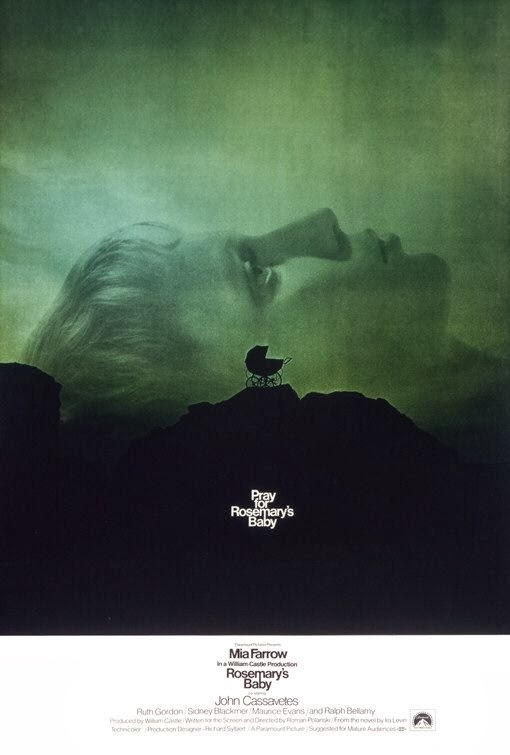
Shocktober Revisited: Rosemary's Baby


 editor's note: this review originally appeared in the Horror Fest VIII coverage.

Rosemary’s Baby may be based on the novel by Ira Levin (Son of Rosemary) and be produced by William Castle (The Tingler) directed by Roman Polanski (I can only imagine what’s going to happen now that I’ve mentioned his name again on this blog), but it’s really the story of a book. And not just any book, because while Rosemary Woodhouse (Mia Farrow) has a lot of books, including the conspicuously placed copy of Yes, I Can: The Story of Sammy Davis Jr.*, the most important one appears about an hour into the film.
 
 Of course, I speak of All of Them Witches.

 Oh sure, the title is an anagram (although not the one Rosemary figures out – for the record, you can make “Hell a Cometh Swift from the title), but for whatever reason, it became the running joke of the rest of the movie. There was a lengthy discussion about follow-up books like Some More of Them Witches, The Rest of Them Witches, That Should Cover Every Last One of Them Witches This Time, and the legally obligated retraction book Not All of Them Was Witches After All, and many a chuckle was had.
  
I realize that it’s probably disrespectful to Rosemary’s Baby to talk about it this way when I’ve never properly written about the film here before, but sometimes when you’ve seen a movie enough times and you’re with a crowd of people who have as well, instead of focusing on the actual story you begin to fixate on silly details or make jokes. While I often try to give a film its proper perspective on the Blogorium, much of what constitutes a Horror Fest recap is trying to convey the atmosphere surrounding the screening as well.
 For the record, I was not the first person to make a tasteless John Lennon joke about the Dakota Building. I made the second, and it was in reference to an audience member being unhappy that nothing bad happens to Guy Woodhouse (John Cassavetes) at the end of the film. I responded that she needn’t worry, because “there’s a guy outside waiting for phonies.”
 There were many jokes and references to Cassavetes films (as actor and as director), to Planet of the Apes, Harold and Maude, Midnight Run, The Wolf Man, and to Frank Sinatra, Robert Evans, William Castle, and any number of other ridiculous observations, like what was playing at Radio City Music Hall with Fred MacMurray (our theory – Walt Disney’s The Shaggy Dog: The Musical, or Son of Flubber: The Musical).
 
 (This is a total side note, but since I mentioned John Carpenter’s references in Prince of Darkness, it’s worth pointing out that at the beginning of In the Mouth of Madness,  John Glover’s character’s name is Dr. Saperstein, a slight variation on the name of Ralph Bellamy’s character in Rosemary’s Baby.)
 
 All joking aside (and it’s really the big point at the fest where the audience participation took over, which the Cap’n fully endorses as long as you can still enjoy the movie), Rosemary’s Baby is a great horror movie. It’s so well constructed and so limited to one character’s perspective that even though you know what’s happening to Rosemary and you desperately want her to get away from the Castevets and the conspiracy in The Bramford, you understand why she’s confused and can’t leave. The world is set against poor Rosemary from the outset, in arguably more insidious ways than even Suzy Bannion faces in Suspiria (it turns out witches, Satan, and issues with pregnancy emerged as the consistent themes this Horror Fest).
 
 Her husband is distant and verbally abusive, especially after he gets close with Roman and Minnie Castevet (Ruth Gordon and Sidney Blackmer), her doctor recommends doing nothing when she feels pain during pregnancy, and then her old doctor (Charles Grodin), hands her over to the enemy when she comes to him for help. Her only real ally in the film, Hutch (Maurice Evans), is the victim of witchcraft – as is Guy’s original agent – and the first friend she makes in The Bramford plunges to her death not long after they meet. All the while, Polanski keeps us tightly locked in on Rosemary (although not quite as uncomfortably framed as Catherine Deneuve in Repulsion) as we slowly move towards June of 1966, when her baby is due. I shouldn’t need to spell that out for you, and it’s not as blatantly stated in the film, but if you do the math from when conception happened to when the baby should be due, it only makes sense.
 
 The use of dream sequences and somewhat ambiguous dream logic (another recurring motif this fest) helps disorient the audience early in the film, so that even forty five years later, it’s not abundantly clear what Rosemary is imagining and what we’re actually seeing when plans are set in motion. The ending still gets me, despite the presence of one of the worst Asian stereotypes since Mickey Rooney’s unfortunate appearance in Breakfast at Tiffany’s. “What have you done to his eyes, you maniacs!” and, eventually, “You’re rocking him too hard.” It’s unsettling, but inevitable.
 
 If we jest during Rosemary’s Baby, it’s only because we like it so. Also, All of Them Witches would want it that way. Hail Satan!

 
* Now, it’s entirely up to you whether Yes, I Can is there because of the Rat Pack connection or just as another subtle hint about the Satanism to come.  In the interest of full disclosure, we leaned towards the former.

Tuesday, October 29, 2013

Shocktober Book Review Revisited: Shock Value

Since we're officially into Shocktober now, the grand month of Horror Fest(s), I thought I'd kick things off with one of Cap'n Howdy's rare book reviews. Today I'm looking at Shock Value: How a Few Eccentric Outsiders Gave Us Nightmares, Conquered Hollywood, and and Invented Modern Horror by Jason Zinoman. It explores the period between Rosemary's Baby and Halloween, when outsiders made a huge impact on the way audiences experienced horror films, revitalizing the genre and ushering in a new era we're still feeling the effects of today.

 When Shock Value appeared on my radar, the only concern I had was that this might be old hat for the Cap'n. I'm a big fan of that particular era of horror, and have been soaking up books, interviews, and DVD extras about The Texas Chainsaw Massacre, The Last House on the Left, Halloween, Alien, and Night of the Living Dead for years. I'm always interested in more analysis, but I had trepidations that Shock Value might bear no new fruit for a horror fanatic. Fortunately, I was well off base.

 Almost immediately Zinoman surprised me with a story in the Rosemary's Baby chapter, about a Vincent Price appearance on the Mike Douglas show where the horror icon was unable to defend the genre that made him famous (or, perhaps, was not interested in defending horror) from attacks by Dr. Fredric Wertham, the same man who killed EC Comics in the 1950s. I must admit that I had never heard of the debate, or of its impact in the transition from Old Horror to New Horror. Zinoman's coverage of the development of Rosemary's Baby also provides a nice counterpoint to the what Robert Evans presents in The Kid Stays in the Picture, his memoirs of developing pictures for Paramount.

 Shock Value is filled with surprising moments, including the aborted collaboration between John Carpenter and Tobe Hooper that eventually morphed into Halloween. I was particularly fond of the reactions the major figures in New Horror had to each others' work: for years, I suppose I considered Brian De Palma and Alfred Hitchcock to be mutually exclusive - that one simply mimicked the other, so it was (rightly or wrongly on my part) revelatory to hear that the Master had seen De Palma films before he passed (and didn't like them, to wit). Dan O'Bannon's fall out with John Carpenter after Dark Star produces a great deal of animosity on the former's part, especially to the success of Halloween. Sean Cunningham's reaction to Carpenter's slasher film is classic, and the way that Rosemary's Baby formed what The Exorcist became to William Peter Blatty and William Friedkin (along with the extended explanation of how the "Version You've Never Seen" came to be) were all stories I thought I knew well, but Zinoman finds a way to bring a fresh perspective.

 Speaking of Halloween, I'm a little curious about the construction of Zinoman's analysis of the film. Generally speaking, what successfully separated New Horror from Old Horror is the ambiguity of motive from the villains, a reflection of the uncertainty of America during and immediately after the Vietnam War. It's not that element that bothers me, but the way Zinoman frames Halloween - a success in spite of its "sloppy" mistakes. One or two of his assertions sent me back to the film, particularly the breakdown of Carpenter's opening sequence. For some reason, Zinoman chooses to fixate on the perspective shot of Michael Meyer's knife when he's stabbing his sister (a choice that identifies the audience and director's interest rather than the character). However, Zinoman treats this paragraph as though it's the first time we've seen the knife in the film. That wasn't how I remembered it, so I checked, and sure enough...


 The audience is already aware that the (to that point unseen killer) is carrying a knife, and we know what to expect when Michael arrives and his sister recognizes him. The shock of the murder is on her part, not the audiences. Zinoman's point is well made, but it's a sloppy mistake in a critique of "sloppy" moments in Halloween.

 My only other issue with Shock Value is that Zinoman echoes the central thesis of Peter Biskind's Easy Riders, Raging Bulls at the end of the book. He arrives at the conclusion that the seminal voices of New Horror peaked in their early years, and have struggled to match, let alone surpass, their original masterpieces. Like Biskind, Zinoman highlights the struggles of many of the creative forces to move forward with any success (highlighting the failure of Romero's projects between Night of the Living Dead and Dawn of the Dead, or O'Bannon's reputation as an intrusive curmudgeon kept him unable to parlay his involvement with Alien to anything until Return of the Living Dead. The controversy surrounding Tobe Hooper and Poltergeist isn't glossed over, either). Wes Craven is given the Scorsese-like pass of the "exception to the rule" because of the Scream series re-invigoration of horror in the late nineties (although A Nightmare on Elm Street is given a lukewarm reaction for its innovative first film and watered down sequels)..

 I take umbrage with this in part because I disagree with the premise of Easy Riders, Raging Bulls, and Zinoman mostly chooses to ignore the fact that John Carpenter had varying degrees of success in and out of horror through Vampires, not limited to The Fog, Christine, or In the Mouth of Madness. He scarcely "topped out" after Halloween and The Thing with an immediate (or even steady) decline attributed to Hooper and Cunningham and Romero. It makes me wonder whether the curious exclusion of Sam Raimi (save for a brief mention of The Evil Dead director during the "end of Horror's New Wave" portion of the epilogue), and the cursory inclusion of David Lynch and David Cronenberg during O'Bannon's "body horror" chapter.

 Overall, Shock Value has more than enough going for it that I'm willing to overlook minor quibbles like the Halloween analysis or the ambivalent closing. I was initially concerned that the book might be a retread of stories I'd heard in other documentaries (or from the directors / writers / producers themselves in other books), but you'll be pleasantly surprised by the more obscure anecdotes and the depth of insight into some of the heavily covered entries. Horror aficionados shouldn't hesitate to pick up Shock Value, even if you're positive you know what you'll find inside.

Saturday, October 19, 2013

Horror Fest VIII (Day Two): Rosemary's Baby

Rosemary’s Baby may be based on the novel by Ira Levin (Son of Rosemary) and be produced by William Castle (The Tingler) directed by Roman Polanski (I can only imagine what’s going to happen now that I’ve mentioned his name again on this blog), but it’s really the story of a book. And not just any book, because while Rosemary Woodhouse (Mia Farrow) has a lot of books, including the conspicuously placed copy of Yes, I Can: The Story of Sammy Davis Jr.*, the most important one appears about an hour into the film.
Of course, I speak of All of Them Witches.
 Oh sure, the title is an anagram (although not the one Rosemary figures out – for the record, you can make “Hell a Cometh Swift from the title), but for whatever reason, it became the running joke of the rest of the movie. There was a lengthy discussion about follow-up books like Some More of Them Witches, The Rest of Them Witches, That Should Cover Every Last One of Them Witches This Time, and the legally obligated retraction book Not All of Them Was Witches After All, and many a chuckle was had.
  
I realize that it’s probably disrespectful to Rosemary’s Baby to talk about it this way when I’ve never properly written about the film here before, but sometimes when you’ve seen a movie enough times and you’re with a crowd of people who have as well, instead of focusing on the actual story you begin to fixate on silly details or make jokes. While I often try to give a film its proper perspective on the Blogorium, much of what constitutes a Horror Fest recap is trying to convey the atmosphere surrounding the screening as well.
 For the record, I was not the first person to make a tasteless John Lennon joke about the Dakota Building. I made the second, and it was in reference to an audience member being unhappy that nothing bad happens to Guy Woodhouse (John Cassavetes) at the end of the film. I responded that she needn’t worry, because “there’s a guy outside waiting for phonies.”
 There were many jokes and references to Cassavetes films (as actor and as director), to Planet of the Apes, Harold and Maude, Midnight Run, The Wolf Man, and to Frank Sinatra, Robert Evans, William Castle, and any number of other ridiculous observations, like what was playing at Radio City Music Hall with Fred MacMurray (our theory – Walt Disney’s The Shaggy Dog: The Musical, or Son of Flubber: The Musical).
 (This is a total side note, but since I mentioned John Carpenter’s references in Prince of Darkness, it’s worth pointing out that at the beginning of In the Mouth of Madness,  John Glover’s character’s name is Dr. Saperstein, a slight variation on the name of Ralph Bellamy’s character in Rosemary’s Baby.)
 All joking aside (and it’s really the big point at the fest where the audience participation took over, which the Cap’n fully endorses as long as you can still enjoy the movie), Rosemary’s Baby is a great horror movie. It’s so well constructed and so limited to one character’s perspective that even though you know what’s happening to Rosemary and you desperately want her to get away from the Castevets and the conspiracy in The Bramford, you understand why she’s confused and can’t leave. The world is set against poor Rosemary from the outset, in arguably more insidious ways than even Suzy Bannion faces in Suspiria (it turns out witches, Satan, and issues with pregnancy emerged as the consistent themes this Horror Fest).
 Her husband is distant and verbally abusive, especially after he gets close with Roman and Minnie Castevet (Ruth Gordon and Sidney Blackmer), her doctor recommends doing nothing when she feels pain during pregnancy, and then her old doctor (Charles Grodin), hands her over to the enemy when she comes to him for help. Her only real ally in the film, Hutch (Maurice Evans), is the victim of witchcraft – as is Guy’s original agent – and the first friend she makes in The Bramford plunges to her death not long after they meet. All the while, Polanski keeps us tightly locked in on Rosemary (although not quite as uncomfortably framed as Catherine Deneuve in Repulsion) as we slowly move towards June of 1966, when her baby is due. I shouldn’t need to spell that out for you, and it’s not as blatantly stated in the film, but if you do the math from when conception happened to when the baby should be due, it only makes sense.
 The use of dream sequences and somewhat ambiguous dream logic (another recurring motif this fest) helps disorient the audience early in the film, so that even forty five years later, it’s not abundantly clear what Rosemary is imagining and what we’re actually seeing when plans are set in motion. The ending still gets me, despite the presence of one of the worst Asian stereotypes since Mickey Rooney’s unfortunate appearance in Breakfast at Tiffany’s. “What have you done to his eyes, you maniacs!” and, eventually, “You’re rocking him too hard.” It’s unsettling, but inevitable.
 If we jest during Rosemary’s Baby, it’s only because we like it so. Also, All of Them Witches would want it that way. Hail Satan!
Up Next: Curse of Chucky and Trick ‘r Treat!
* Now, it’s entirely up to you whether Yes, I Can is there because of the Rat Pack connection or just as another subtle hint about the Satanism to come.  In the interest of full disclosure, we leaned towards the former.

Tuesday, November 29, 2011

Retro Review: Fear and Loathing in Las Vegas

 Quick story: in the world of quasi-counterculture of high school circa 1998, there were very few things as exciting as the impending release of Terry Gilliam's adaptation of Hunter S. Thompson's Fear and Loathing in Las Vegas. I know this because I and friends of mine were quasi-countercultural in high school, insomuch as one could be where we went to high school. For a few of us, following the every movement of the film was like a trail of breadcrumbs to something that of course would be amazing. Even more amazing, we hoped, than the release of Thompson's oft-delayed Polo is My Life (which never came out, by the way).

 As recently as five years ago it was fashionable for assholes to assume that people only knew who Terry Gilliam was because of Fear and Loathing - I guess because the assholes making that assumption weren't old enough to see it themselves. If this qualifies as justification, I think it's fair to point out that before I had a working understanding of what the words "Monty" "Python" "Flying" and "Circus" meant in conjunction, I had already seen Time Bandits. In fact, I'm positive that I had seen Time Bandits on home video long before Monty Python registered in my brain. I was traumatized at a young age by the parents who failed to recognize "Evil" and were destroyed, orphaning Kevin until Sean Connery arrived as a fireman (and not Agamemnon) to rescue him.

 To be fair, it was probably years later before I saw Brazil, which is what most defensive geeks cite when someone throws the "you only like him because of Fear and Loathing" slur, but I did see The Fisher King and Twelve Monkeys in theatres (with a bonus Independence Day trailer in front of Monkeys, which I remember for no apparent reason). Anyway, so the collision of director we liked and author we loved (with Johnny Depp as Raoul Duke, no less) we a "must see" affair. We put on hawaiian shirts, poker visors, and headed to the Grande in Raleigh.

 It didn't matter that critics savaged the film, or that people got up and left during the movie while we howled with laughter. We loved it, and though the film died the quick death at the box office, it became its own bona fide cult phenomenon on video. Hell, it even has its own Criterion Spine Number (175). Eat that, fashionable assholes.

 But that is not the quick story. Oh no. That's the background to what happened after we saw the movie, where our own bourgeoisie version of "Gonzo" kicked in. See, a nearby high school was building a new annex and we'd been sneaking by there on weekends and evenings to poke around the in construction and rarely secured proto-building. We figured that night would be a good opportunity to do the same, and the driver in question parked his Dart across four parking spaces as we tromped around the pretty-much completed and now totally locked new area. The important part here is how he parked the car, because otherwise there's a reasonably good chance the local police wouldn't start investigating potential tresspassing.

 But he did, and they did, and we three geniuses came marching around the building like people with something to hide (rather than walk all the way around the campus and pretend we'd simply been out for a stroll nearby), so they took our ID's and ran them while we sweated it out. Of course, being suburbia, they just told us to go home and we did and that was that. There's no good ending to the adventure, because we lived in and near a city where police are bored, kids are even more listless, and misdemeanors aren't worth anybody's time.

 Still, at the time it felt like a fitting cap to seeing the film, and it wasn't like we didn't visit other high school campuses and tool around (forgive me, but I have a fascination with structures designed to be populated but are instead deserted, hence my dalliance with abandoned mall exploration years later). We watched Fear and Loathing again and again on video, and eventually Thompson published The Rum Diary, Kindgom of Fear much (MUCH) later, followed by Hey Rube. I still haven't seen the critically lukewarm-ed The Rum Diary adaptation (also starring Depp) but I did watch all of Gilliam's subsequent films, including the terrible Brothers Grimm, the Cormac McCarthy-level bleak Tideland, and the fascinating but inevitably compromised The Imaginarium of Doctor Parnassus. I haven't tooled around and empty campus in a long time, though. It seems a little perv-y now.

Thursday, November 3, 2011

In Progress (a euphemism for Slacking)

 Hey gang! How about I tell you about things I'm currently in progress as a way to divert attention from the fact that I don't have anything done yet*? Sound good**?

 The Cap'n has begun reading Nerd Do Well by Simon Pegg, which is to this point very entertaining. When I finish the sort-of memoirs interspersed with passages from a fictionalized (?) version of Pegg's life away from the silver screen, I'll give you cats and kittens a review. Since I only have time to read it at night (before bed), this might take a little while, but it worked for Shock Value, so I think it'll be sooner rather than later.

 Last night I was doing some laundry and was finally able to put on More Brains: A Return to the Living Dead, which is a "warts and all" documentary about the making of Dan O'Bannon's Return of the Living Dead. I only watched forty or so minutes, but the film doesn't sugarcoat anything so far. It's both informative and funny, which doesn't always work but in this instance is exactly the tone to strike when covering Return of the Living Dead. I'm hoping to finish that up sometime this weekend for a proper review, but so far it's pretty engrossing. Stupid needing to sleep.

 Let's see, what other plates am I trying to keep spinning? Well, spine numbers are 50% off again at Barnes and Noble, so I'm really going to have to mull over those copies of The Battle of Algiers, The Complete Jean Vigo, 3 Women, Orpheus, Cul-De-Sac, High and Low, If..., Fear and Loathing in Las Vegas, and, um, Salo. Because I'm in such a hurry to watch Salo on Blu Ray. And you're so ready for that review, I know.

 Professor Murder will also be in town this weekend. That's almost always a call for some strange movie in theatres, so against the prevailing wisdom of reviews, I might end up seeing The Thing. Or something much worse. He did miss out on Horror Fest, and we have to rectify this, you see.

 As a small addendum to that, would people please stop referring to John Carpenter's The Thing as "the original"? You do know that John Carpenter's The Thing is a remake of The Thing from Another World, right? Oh no? You do now.


* In my defense, my work schedule makes it very difficult to do much of anything when it comes to watching movies, and it's only been getting busier because of two words: Annual Enrollment. Last weekend was by far the most movie watching I've done since the beginning of September.
** There are actually no other options, so I hope so.

Monday, October 3, 2011

Blogorium Book Review: Shock Value

  Since we're officially into Shocktober now, the grand month of Horror Fest(s), I thought I'd kick things off with one of Cap'n Howdy's rare book reviews. Today I'm looking at Shock Value: How a Few Eccentric Outsiders Gave Us Nightmares, Conquered Hollywood, and and Invented Modern Horror by Jason Zinoman. It explores the period between Rosemary's Baby and Halloween, when outsiders made a huge impact on the way audiences experienced horror films, revitalizing the genre and ushering in a new era we're still feeling the effects of today.

 When Shock Value appeared on my radar, the only concern I had was that this might be old hat for the Cap'n. I'm a big fan of that particular era of horror, and have been soaking up books, interviews, and DVD extras about The Texas Chainsaw Massacre, The Last House on the Left, Halloween, Alien, and Night of the Living Dead for years. I'm always interested in more analysis, but I had trepidations that Shock Value might bear no new fruit for a horror fanatic. Fortunately, I was well off base.

 Almost immediately Zinoman surprised me with a story in the Rosemary's Baby chapter, about a Vincent Price appearance on the Mike Douglas show where the horror icon was unable to defend the genre that made him famous (or, perhaps, was not interested in defending horror) from attacks by Dr. Fredric Wertham, the same man who killed EC Comics in the 1950s. I must admit that I had never heard of the debate, or of its impact in the transition from Old Horror to New Horror. Zinoman's coverage of the development of Rosemary's Baby also provides a nice counterpoint to the what Robert Evans presents in The Kid Stays in the Picture, his memoirs of developing pictures for Paramount.

 Shock Value is filled with surprising moments, including the aborted collaboration between John Carpenter and Tobe Hooper that eventually morphed into Halloween. I was particularly fond of the reactions the major figures in New Horror had to each others' work: for years, I suppose I considered Brian De Palma and Alfred Hitchcock to be mutually exclusive - that one simply mimicked the other, so it was (rightly or wrongly on my part) revelatory to hear that the Master had seen De Palma films before he passed (and didn't like them, to wit). Dan O'Bannon's fall out with John Carpenter after Dark Star produces a great deal of animosity on the former's part, especially to the success of Halloween. Sean Cunningham's reaction to Carpenter's slasher film is classic, and the way that Rosemary's Baby formed what The Exorcist became to William Peter Blatty and William Friedkin (along with the extended explanation of how the "Version You've Never Seen" came to be) were all stories I thought I knew well, but Zinoman finds a way to bring a fresh perspective.

 Speaking of Halloween, I'm a little curious about the construction of Zinoman's analysis of the film. Generally speaking, what successfully separated New Horror from Old Horror is the ambiguity of motive from the villains, a reflection of the uncertainty of America during and immediately after the Vietnam War. It's not that element that bothers me, but the way Zinoman frames Halloween - a success in spite of its "sloppy" mistakes. One or two of his assertions sent me back to the film, particularly the breakdown of Carpenter's opening sequence. For some reason, Zinoman chooses to fixate on the perspective shot of Michael Meyer's knife when he's stabbing his sister (a choice that identifies the audience and director's interest rather than the character). However, Zinoman treats this paragraph as though it's the first time we've seen the knife in the film. That wasn't how I remembered it, so I checked, and sure enough...


 The audience is already aware that the (to that point unseen killer) is carrying a knife, and we know what to expect when Michael arrives and his sister recognizes him. The shock of the murder is on her part, not the audiences. Zinoman's point is well made, but it's a sloppy mistake in a critique of "sloppy" moments in Halloween.

 My only other issue with Shock Value is that Zinoman echoes the central thesis of Peter Biskind's Easy Riders, Raging Bulls at the end of the book. He arrives at the conclusion that the seminal voices of New Horror peaked in their early years, and have struggled to match, let alone surpass, their original masterpieces. Like Biskind, Zinoman highlights the struggles of many of the creative forces to move forward with any success (highlighting the failure of Romero's projects between Night of the Living Dead and Dawn of the Dead, or O'Bannon's reputation as an intrusive curmudgeon kept him unable to parlay his involvement with Alien to anything until Return of the Living Dead. The controversy surrounding Tobe Hooper and Poltergeist isn't glossed over, either). Wes Craven is given the Scorsese-like pass of the "exception to the rule" because of the Scream series re-invigoration of horror in the late nineties (although A Nightmare on Elm Street is given a lukewarm reaction for its innovative first film and watered down sequels)..

 I take umbrage with this in part because I disagree with the premise of Easy Riders, Raging Bulls, and Zinoman mostly chooses to ignore the fact that John Carpenter had varying degrees of success in and out of horror through Vampires, not limited to The Fog, Christine, or In the Mouth of Madness. He scarcely "topped out" after Halloween and The Thing with an immediate (or even steady) decline attributed to Hooper and Cunningham and Romero. It makes me wonder whether the curious exclusion of Sam Raimi (save for a brief mention of The Evil Dead director during the "end of Horror's New Wave" portion of the epilogue), and the cursory inclusion of David Lynch and David Cronenberg during O'Bannon's "body horror" chapter.

 Overall, Shock Value has more than enough going for it that I'm willing to overlook minor quibbles like the Halloween analysis or the ambivalent closing. I was initially concerned that the book might be a retread of stories I'd heard in other documentaries (or from the directors / writers / producers themselves in other books), but you'll be pleasantly surprised by the more obscure anecdotes and the depth of insight into some of the heavily covered entries. Horror aficionados shouldn't hesitate to pick up Shock Value, even if you're positive you know what you'll find inside.

Saturday, September 3, 2011

News and Notes: Technical Edition (with Books)


 - Let's start with why it doesn't matter that Starz decided not to continue its contract with Netflix. This news is being treated the same way that Netflix's split with Showtime (and the never-to-be HBO deal), but I for one am happy to hear this.

 Consistently, I've found that Starz content on Netflix tends to be the most egregious examples of "pulling a fast one" on streaming viewers. In an era where "full screen" means something very different than it did five years ago, Starz streaming movies and TV shows on Netflix were constantly shown as "letterboxed" 4x3 images. If you aren't quite sure what I mean, try watching a show like MTV's Jersey Shore on a widescreen TV. See how the black bars are still on the top and bottom of the screen, even though it doesn't fill out the left and right of your TV? This is a fake "widescreen" that only really worked on old television sets.

 MTV released their Jersey Shore DVDs in the same fashion, and Starz did it with everything I watched from them on Netflix. It's a lazy alternative to providing 16x9 enhanced content and it actually diminishes the size of the picture on your screen. While it might have been nice to watch newer Disney films on Netflix, it certainly wasn't worth the drop in picture size. Not in this day and age. Netflix is hurting, and more companies jumping ship isn't necessarily good news for them, but I avoided the "Starz" section of Instant Viewing like the plague after being burned repeatedly. Good riddance to bad rubbish, if you ask me.

 - Speaking of "Full Screen," it makes me chuckle when I see stores (like one I will soon no longer be with) that still sell new DVDs with that moniker. Widescreen has slowly become the norm, and the pan-and-scan 4x3 discs are less and less desirable for customers. Many studios don't release new movies in "Full Screen" anymore, because it doesn't mean the same thing it used to. Not so long ago I would have to pay careful attention to the DVD cover of a movie I wanted to pick up in order not to buy one with a butchered "full" transfer.

 Every now and then, I put this video up, just to give folks a primer of what I mean by "pan-and-scan," because it doesn't just mean removing the black bars from the top and bottom of widescreen films:


  I often wonder what families who made the transition from standard TVs to widescreen TVs do with their collections of "Full Screen" DVDs when watching them. What probably happens is that they set their TV to automatically zoom in on the image so it fills the whole frame, creating an image twice as messy as the one shown above. Imagine taking a "Full Screen" image and then stretching it out even further to the left and right, because that's what probably happens. Yikes. I've seen it done before with VHS (hell, I did it once with the Star Wars Holiday Special) and if you really don't mind things looking messy, I guess it's watchable. But again, we were watching the Star Wars Holiday Special here, and mostly in fast-forward.

- Some time in the near future the Cap'n might have a book review up again. It's been a while, I know, but I've started reading Shock Value: How a Few Eccentric Outsiders Gave Us Nightmares, Conquered Hollywood, and Invented Modern Horror by Jason Zinoman. From the introduction, it certainly seems to be interested in Wes Craven, Sean Cunningham, George Romero, John Carpenter, Dan O'Bannon, and Brian de Palma and uses the William Castle produced, Roman Polanski directed Rosemary's Baby as the point at which Old Horror passed the torch to Modern Horror.

 I was a little nervous starting out because I have followed much of the history of Night of the Living Dead, The Last House on the Left, Halloween, and Alien, but the chapter on Rosemary's Baby already included an anecdote about Vincent Price I don't think I've seen anywhere to this point as well as a more balanced approach to Castle's involvement into bringing the picture to Paramount than is evident from Robert Evans' The Kid Stays in the Picture. The next chapter is about Hitchcock, particularly Psycho's oft cited influence on Modern Horror, and seems to be adding some nuance to the claims that it spawned the slasher films of the next two decades. Anyway, I'm clearly only starting the book, so I'll give it a proper review when I finish. I will say that it really makes me want to start working on a book idea I've had for years...

Monday, July 11, 2011

News and Notes (and a Little Spillover from Saturday's Rambling Rant)

 - Well, if somebody was going to remake Oldboy - and that's an inevitability given the quality of the film and the hesitancy of Americans to watch films with subtitles - I, for one, am glad to hear that Spike Lee is the man behind the camera. Not to speak ill of Steven Spielberg, but the only movie he's been involved with in the last twenty years even close to the grittiness of Oldboy was Munich, and I have no idea how he would have handled the, ahem, twists and turns of the film.

 Spike Lee, on the other hand, is going to bring something to an American version of Oldboy that is going to be fresh and unexpected. That's one of the things I love about Spike Lee films, which are criminally under-represented here in the Blogorium. I'll have to fix that. In the hands of anyone else, a movie like Inside Man could be just another generic heist / cops and robbers film, but Lee infuses it with personality, keeps the stakes up, makes the film interesting. And that's arguably as "mainstream" or "slick" as a Spike Lee Joint ever got. I'm actually very excited to see what he does with the material, and in the meanwhile Park Chan-Wook's first English language film is also on its way. Next year could be very intriguing indeed.

- Speaking of remakes, I really don't understand this next one. The King of Kong: A Fistful of Quarters is a genuinely compelling documentary about a subject you'd never think would be worth spending 90 minutes with - the high score of Donkey Kong. Watch it on Netflix right now - it's available for instant viewing. I'll wait right here.

 See? I was surprised too, and I went into it with more than a passing interest in arcade games. The director of the film, Seth Gordon, who is out promoting his new film Horrible Bosses, mentioned to Playlist that New Line is planning on remaking The King of Kong, but as a mockumentary, ala The Office or Christopher Guest's films.

 This doesn't make sense at all; if you're going into The King of Kong looking to laugh at the awkwardness of two guys jockeying for the position of "all time high score in Donkey Kong," it's not like you won't find that in the movie itself. There's no need to remake the film in order to further mock Donkey Kong enthusiasts, and it overlooks what The King of Kong does so well in the first place: it takes Billy Mitchell (the champion) and Steve Wiebe (the challenger) and over the course of the film creates a "David vs. Goliath" struggle over something as trivial as an arcade game. And you're swept up in it, because it's important to them and Gordon conveys that clearly.

 If you make it a mockumentary, then Billy Mitchell might as well be played like Ben Stiller in Dodgeball. And that's probably how they're going to approach it. But why? Is New Line convinced that if they put out a movie that people can easily find, but sell the same premise as a "look at these losers" comedy instead of a documentary, that this is somehow preferable? That it's somehow going to bring out people who didn't see The King of Kong in the first place?

- This is probably the most trivial thing I've never understood about geekdom, but I left it off of Saturday's piece because it isn't just geeks that do this. When the time comes for the newest sequel or entry into a franchise (Harry Potter, Twilight, Pirates of the Caribbean, the Bourne films), people come flooding into used stores looking for the other films. Now, I understand this - it makes sense to want to re-watch the last chapter before jumping in. If that were strictly the case, I could totally overlook how silly it is to wait until the week before the movie comes out to come rushing in (when we are invariably sold out because people who have the foresight to plan ahead have beaten them to the punch). But that's actually less of the case than one would think.

 I worked at a used book store from 2006-2009, and when, let's say, Harry Potter and the Half Blood Prince came out, people came rushing in not only for copies of Harry Potter and the Order of the Phoenix, but for ALL five movies that preceded Half Blood Prince. Because they wanted to start the series (for themselves or with their kids) three days before the next film opened. The books, I totally understood, because you have plenty of time to sit down with them, so when The Deathly Hallows arrived (the only book our store ever ordered new), it made sense we'd run out of previous chapters. Trying to cram the first five Potter movies into three days in order to not feel "left out" of the pop culture phenomenon of this weekend is asinine. Getting angry because you lack the sense to consider finding these movies when they were readily available and not waiting until everyone else on Earth is also looking for them is not my fault. People would freak out at us because we were sold out, as was every big box retail store, all because they waited and waited and waited and now it's too late.

 The same thing happened with The Bourne Ultimatum, Pirates of the Caribbean: At World's End, Spider-Man 3, Ocean's Thirteen, Indiana Jones and the Kingdom of the Crystal Skull, The Dark Knight, X-Men Origins: Wolverine, Star Trek, The Mummy: Tomb of the Dragon Emperor, and perhaps the greatest exercise in futility with a week to go - The X-Files: I Want to Believe. No, really; someone tried to find every season of The X-Files in order to "catch up" in time for the movie.

 I haven't ever understood this mentality and I can't imagine I ever will. It's true that the Cap'n has been known to wait to close to the last minute to finish projects, but when it comes to getting "caught up," especially in pop culture, if I don't have the time to do it or haven't planned ahead to do so, I'm not going to try to cram it in at the last second to be a part of the herd in theatres. I can wait, which is admittedly a rarity in this instance, but it beats the aggravation of knowing I waited too long.


 - I'm not sure when the world became so sick of pre-movie trailers on DVD and Blu-Ray. That includes me, by the way; when I see anything other than the menu for the movie I want to watch come up, the Cap'n instinctively hits the "skip" button, and grouses when the disc is encoded to prevent skipping. I can't remember the last time I watched the previews before a DVD or BD. I attribute this to two main causes: 1) most of the time people watching a disc at home are watching a movie they've seen before, or are at least keen on getting to before the distractions kick in, and 2) many of the trailers are for movies we've already seen advertised dozens of time, or are for movies that have been out almost as long as the disc we're watching.

 Universal tried to do something novel and prompts online streaming of new trailers before your film (and the dozens of legal mumbo jumbo) begins, but I usually skip that too. I want to watch the movie, and even the novelty of Anchor Bay's trailer programming - which focuses on catalog titles that someone might enjoy if they like this movie - is seen as an impediment.

 I bring this up because it's something very different (at least for me) when it comes to VHS. While fast-forwarding through the trailers is something I'll sometimes consider doing, the trailers in front of movies I've looked at recently on video have been more like an archeological expedition, full of fun discoveries, than a nuisance. A tape I was looking at for a film called Drive-In Massacre begins with a trailer for Another State of Mind, a punk documentary along the lines of The Decline of Western Civilization. I didn't know Another State of Mind existed, so it was a pleasant discovery and now I have another movie to look into. That a punk doc appeared before a schlock-o-rama horror movie is one of the charms of VHS that didn't seem to carry over into the digital realm. However, it's not the "retro" quality that drives this cognitive dissonance; after all, I own several DVDs that are nothing BUT trailers. I just can't quite decide why so many of us are impatient with the oldest form of exposing ourselves to other movies.

Saturday, March 12, 2011

Five Movies: Five Books About Movies Worth Your Time

Yesterday, I briefly mentioned that literature about film was a useful way of feeding the Cinephilic meme, so it only seemed fair that the Cap'n give you some suggestions. More often than not, the casual-to-curious film fan will wander into their local bookseller (or retail chain), head for the "Media" section, and find themselves inundated with oversized "making of" books, unauthorized celebrity bios, and more "1001 ____ Movies You Must See Before You Die" than you can shake a stick at. The end result tends to be that they leave with nothing, feeling perplexed about where all these "great books" their friends talk about are.

One of the problems - perhaps the largest problem - is that the critical analysis or scholarly approach to film texts are limited to small, university presses, and most major chains don't feel the need to carry them. It is, after all, not their target demographic - typically the casual shopper looking for a paperback to enjoy on a sunny afternoon - so you won't find analytical texts just anywhere (periodically they pop up in used book stores, especially ones in the vicinity of a college campus).

Then again, the neophyte or leaning cinephile will want to wait for most of those texts, so while I'll mention a few after the list proper, this edition of Five Movies will focus on good "entry points" with a dash of heavier reading to keep you busy. Whenever possible, I'll link the titles to Amazon, so you have a reasonably priced starting point.

1. VideoHound's Cult Flicks & Trash Pics (edited by Carol Schwartz with Jim Olenski) - Let's start with a video guide; when I was younger, I used The Video Movie Guide by Mick Martin and Marsha Porter, but as the list of films grows, the reviews become shorter and shorter, and omissions ramped up. VideoHound publishes guides by topic, genre, and year, so you get more concentrated subsections of films, with better information about the film and its relative merits. I chose Cult Flicks & Trash Pics because if you want a handy guide to the "underground" films that exist in the realm of meme-dom, this is a great point of entry. It also makes a good companion to J. Hoberman and Johnathan Rosenbaum's Midnight Movies.

2. Hooked by Pauline Kael - From movie guides, let's move on to collections of reviews by critics; while I do own a few books by Roger Ebert, Pauline Kael was far and away my favorite "newspaper critic" - her reviews are insightful, witty, and so effortlessly well written that it drives me crazy I can't come anywhere close. Kael died ten years ago, and her collections are woefully out of print (I found Hooked at a used book store), but our number 2 pick is a little bit easier to find than 5001 Nights at the Movies, which is also excellent. Hooked deals with reviews from 1984-1989, covering a number of titles you may be familiar with (and many you won't be), and even when I don't agree with Kael (like her pans of After Hours and Raising Arizona), I appreciate the level of writing she brings even to pithy dismissals. This book would make a fine counterpoint to Harlan Ellison's Watching, which covers much of the same time period in cinema.

3. The Kid Stays in the Picture by Robert Evans - You may have seen the documentary based on our third choice, also narrated by Evans, but it doesn't even scratch the surface of this entertaining, frank, and frequently revelatory autobiography from the former head of Paramount Pictures. Evans makes it clear from the get-go that this is his version of the story, but his path from salesman to B-movie actor to mogul is never dull, even if the facts tend to lean only in one direction. As "tell all"'s or Hollywood biographies go, skip what you normally see on the shelf and gravitate towards The Kid Stays in the Picture; you'll learn a lot more and have more fun doing it.


4. The Director's Series by various authors, editors, et al - This series, which sometimes goes by the name Directors on Directors, is a collection of interviews with various filmmakers about their process, history, craft, and themes in their body of work. There's one for just about any director you could be interested in: David Lynch, Martin Scorsese, Alfred Hitchcock, Federico Fellini, Werner Herzog, David Cronenberg, Douglas Sirk, Lars von Trier, John Cassavetes, Louis Malle, Ken Loach, Woody Allen, Kryzysztof Kielslowski, Pedro Almodoovar, Tim Burton, Paul Schrader, Barry Levinson, John Sayles, Robert Altman, and Terry Gilliam. Personal favorites? I'd start with Lynch on Lynch or Gilliam on Gilliam, which have a more conversational tone with the directors in question. Burton on Burton is a treasure trove of information, but its structure is more of introductory text preceding a quote from Tim Burton moving chronologically through his films. It's interesting, but less intimate, so I'd start with Gilliam or Lynch and more forward from there.


5. The Making of Star Wars: The Definitive Story Behind the Original Film by J.W. Rinzler - As chronicles of making a film go, you'd be hard pressed to find a more in-depth exploration than The Making of Star Wars. I assure you that even the most die-hard Star Wars fan is going to find plenty of revelations in the book, about the writing process, the conceptualizing of Lucas' vision, the perils of making the film, its disastrous first edit, and the effort that went into making the first film a cultural landmark. Rinzler does similar work with the Indiana Jones series and The Empire Strikes back (and, one must assume, eventually Return of the Jedi), with plenty of access to everyone involved in the making of A New Hope, and the book feels like it steps beyond the typical "Lucas whitewash" that other "histories" of the films have.

This is just to get you started, of course; if you want some really good "theory" I suggest More Than Night: Film Noir in its Contexts by James Naremore, Horror, The Film Reader, edited by Mark Jancovich, Theories of Authorship, edited by John Caughie, or Terminal Identity: The Virtual Subject in Post-Modern Science Fiction by Scott Bukatman. If you like more niche or subgenre guides, hunt down Stuart Galbraith IV's Japanese Science Fiction, Fantasy, and Horror Films.

If you want to have some fun with reviews or career pieces, check out Vern's Five on the Outside, Seagalogy: A Study of the Ass-Kicking Films of Steven Seagal, or "Yipee Ki-Yay, Moviegoer!": Writings on Bruce Willis, Badass Cinema, and Other Important Topics. You can also look at the series of director interviews with the likes of Steven Soderbergh, David Lynch and The Coen Brothers. Want to know how to make a movie? Try Robert Rodriguez's Rebel Without a Crew or Lloyd Kaufman's Make Your Own Damn Movie!. Want a cultural history of a genre? Check out David J. Skal's The Monster Show, Kendal Phillips' Projected Fears: Horror Films and American Culture, or Joe Bob Briggs' one-two punch of Profoundly Disturbing and Profoundly Erotic.

I'm always looking for more good reads, so if you have one, pass it on.

Friday, March 11, 2011

Cinephilia: Meme Without a Cause

Before the internet made (no pun intended) virtually everything accessible, I used to wonder how it was that knowledge of the obscure, the forgotten, or the "cult" films came from. The information seemed to travel like a meme; no one could pinpoint exactly where they heard it from, or declare with any certainty that this knowledge originated from any source more reliable than a "friend of a friend told me." It just appeared - one day you didn't know about these movies, and the next you did.

Voracious readers experience a similar phenomenon, one that provides a gateway into the experience I'm talking about: at a certain point in time, almost invariably high school, some students clue in to "alternative" literature, seemingly without a point of reference. The only point of entry that makes sense is the one student that always seems to carry around The Portable Beat Reader, but how one makes the leap from Jack Kerouac to Aldous Huxley or Philip K. Dick, H.P. Lovecraft, William Gibson, or Hunter S. Thompson, I can't say. If my library had a copy of Fear and Loathing in Las Vegas, I didn't know it. I don't even remember how I knew the book existed: I just did. Ironically, years before I had been reading issues of Rolling Stone that Thompson wrote essays for (the one that springs to mind is "Polo is My Life," which became the book he never released between Better Than Sex and Kingdom of Fear), but I didn't read those articles. In retrospect, I wish I had, but the literary "virus" infects without warning.

The same is applicable to film, even if there are a few more tangible sources to point towards. Most film "geeks" spend (spent? considering current trends) hours poring through the titles at video stores, attracted to lurid cover art or titles that confound the mind. The video store clerk, not always the stereotypical "comic book guy" from The Simpsons, was handy in offering suggestions. True story: while applying for a job at a local video store (a job I did not end up getting because I was too young), the manager interviewing me suggested that I watch Swimming with Sharks because I really enjoyed Kevin Spacey in The Ref. Had she not suggested I rent Swimming with Sharks, I may have missed out on the film entirely for years.

Looking back on the job I did get, a seasonal shift working for Suncoast Video (now FYE), the root cause for the cinephile "meme" still remains elusive: aside from a friend asking me to find Sid and Nancy*, much of my time working there wasn't spent combing through titles I didn't recognize or hadn't heard of. To be fair, it was the holiday season and I was only sixteen, but both prime opportunities to identify an originating "there" for the cinematic virus both come up blank.

The truth is that I don't know who told me that The Evil Dead was a film to see. Maybe it was The Video Movie Guide by Mick Martin and Marsha Porter - that was, I recall, the first time I ever heard that Evil Dead 2: Dead by Dawn was practically a "remake of the first film" - then again, maybe it was a review of Army of Darkness in the local newspaper. I didn't see Army of Darkness at the time, but I knew it existed, and with a bit of diligent investigation, it's possible I traced the sequel back to Sam Raimi's debut. The problem is that you always seem to be telling other people about these films, but can never suss out how you knew about them. Nobody told me about The Rocky Horror Picture Show; it just always seemed to be there, a midnight listing for The Rialto every week. One week, we decided to go, not really knowing much more about the film or the rules than when we didn't want to go.

Once the meme reaches you, infects you, the information and the desire to learn more increases exponentially. One film leads to another, that leads to another, that leads to a dead end, a rumor, a film no one can find: the Cannibal Holocaust's, the "director's cut" of Dawn of the Dead, a "workprint" cut of Alien 3, the "five hour" Dune. At the time, with limited resources, these seem like impossibilities. They have to be "out there" because you read some arcane reference to the fact, or saw a discrepancy in the running time** somewhere.

Now, things are a little different: the internet leveled out much of the conjecture, many of the second or third-hand sources, and the growing availability of DVDs have, in many ways, altered the landscape permanently. Access is different, although surprisingly as vague as the meme was before an era of instant availability. While it's much, much easier to find out about apocryphal "geek" trivia, like what's missing in different versions of a film (see Movie-Censorship dot com), the paper trail is nevertheless no more definite. The availability of information is more prevalent; it's source remains nearly as ethereal.

Apropos to this discussion is the fact that I don't consider the internet to have "ruined" geek culture: Patton Oswalt made several salient (if tongue in cheek) points in a Wired article titled "Wake Up, Geek Culture: Time to Die" and maybe the "cult" aspect of fandom is vanishing thanks to over-saturation. We live in an age when the random, the lost-in-the-shuffle, the marginal can not only be found on the Internet Movie Database, but the poster is only a Google Image Search away (often linked to a page where it's for sale), has at least one link on Amazon***, and if an industrious pirate has enough perseverance, the film itself is floating somewhere in the digital cloud.

The digital cloud, so to speak, has become another fold in which the film meme hides itself. What's different is that the limited resources of fifteen or twenty years ago have, for the most part, disappeared. People visit this blog as a result of image searches for films like Monsturd, a movie I can't imagine is really that widely discussed. Still, someone heard the title from a friend of a friend (or from Netflix), and plugged the title in. They ended up here, and I take great pride in being a source that passes on the film meme, or Cinephilia as I like to classify it. Maybe I can tell you where I heard about these films from, but I'll be more than happy to pass them on if they're worth your while.


* True story - Sid and Nancy was, at that point, not available on VHS. I jokingly suggested she buy a sixty dollar Laserdisc copy of the film. The laserdisc's publisher? Criterion.
** This continues to be a point of curiosity among friends: when Artisan released The Ninth Gate, the Spanish running time was fifteen minutes longer than the American version, which I have never found any accounting for, or if a longer cut even exists.
*** Take, for example, Five Minutes to Live, also known as The Door-to-Door Maniac: a Johnny Cash and Ronnie Howard vehicle from the 1960s that most Cash fans don't even know exists. Seven Amazon listings for the DVD as of five minutes ago.

Friday, March 4, 2011

The Cap'n: Debunker of Rumours.

Every few months, I hear one of the two statements about my movie viewing habits:

1. You didn't see that? I thought you saw everything!

2. Well, of course _____ sounds bad. Everything you show at (fill in the blank) Fest is bad.


or some variation thereof. When hit with both in the course of two days, it seemed like I needed to once again step up and dispel some assumptions about what I watch, what I show others, and other erroneous assertions made about the Cap'n.

The first assumption is fair, and goes along with the theory proposed last week about what non-cinephiles think that "film geeks" do with their time: watch everything. The truth of the matter is that I have neither the time, the money, nor the inkling to watch every single movie that comes out. I can't even see all of the critically well regarded films, though I do keep track of them, bookmark reviews so I don't forget they exist, and hope that I remember when the DVD or Blu Ray comes out so I can add it to an already lengthy Netflix queue.

As it is, I see as much as I can, where I can and when I can, but I'm just like you "normals": I have other concerns that occupy my time, I have the same mundane day-to-day tasks to deal with. I fit in movies late at night, or in small doses so that I have something to write about (which also takes time). While I'd love to be able to wander from theatre to theatre and soak in everything, then head to the video store (supposing they exist anymore) and rent every old title in stock to accompany the new releases I picked up, I can't do that. Yet. When I can, I'll let you know.

I also read, which may or may not come as a surprise (I don't really know what you assume the Cap'n does with his spare time), not always about film, but in reasonable doses. I find that if I ever want to pursue an education and career writing about film, I should soak up as much information as humanly possible about the aspects of cinema I find interesting, so the texts range from academic theory, compendiums of interviews with directors, writers, actors, and editors about process, work by other critics I admire, the occasional bio or autobiography, and one or two movie guides to use in order to find something I haven't heard of - and that tends to be plenty.

To address the second comment (which the first dovetails nicely into), I openly admit that the "about" blurb on the right side of the page says "trash savant," which implies that the Cap'n is knowledgeable about a certain type of film, one that others might hold their nose while walking past were the metaphor extended to food rather than cinema. I understand that, and it is true that that is a facet of what I watch, show, and discuss. It's also true that the Cap'n has a term coined in his honor: the "Trappening," a deliberate misleading of friends to come over and watch a movie only to show them something horrible (named for my devilish enjoyment of M. Night Shyamalan's The Happening and the dirty trick I played on everyone during Horror Fest III).

Somehow these facts, coupled with Bad Movie Night - an appropriation of what my brother and his friends do for each of their birthdays - has given people the strange notion that this is ALL the Cap'n is interested in. Yes, I take a certain amount of pride in finding the obscure and rightfully forgotten films for festivals; more often than not, those are the films that unite the audience and energize them between films with slower pacing or that are less easy to react to. The atmosphere created by a "party" movie can lift the group up and continue momentum over the night, as many fest attendees will attest to.

Let's address the main point for a moment, and where assumption one dovetails into assumption two: the idea that I will, or would want to, watch "everything." The second postulate goes further to assert that I will watch anything as long as it is "bad," which is demonstrably untrue. In fact, I turned the point around to the person who made it when he bemoaned how terrible Transformers 2 was. Here is a reasonable facsimile of the discussion:

Me: Now wait a minute... I never saw Transformers because it looked awful. You not only saw Transformers and hated it, but still went back and saw Transformers 2, which you knew you wouldn't like.

He: Yeah.

Me: And I'm the one who watches "bad" movies?

He: Fair point.

In the interest of full disclosure, the conversation then turned to the fact that I had seen Michael Bay's The Island, which I didn't like, in part because it sounded exactly like Parts: The Clonus Horror, a film I only knew existed because of Mystery Science Theater 3000. If you want to negate my point, there's your opportunity. I also mentioned an interest in seeing the 1989 film Red Scorpion, starring Dolph Lundgren, which was met with some derision.

Red Scorpion may well be a terrible movie; in fact, I've seen no kind words written about it, but my reasons for seeing it have nothing to do with the "quality" of the film. My interest in seeing Red Scorpion, like my interest in The Island, has to do with its place among other films. That the existence of Red Scorpion is one of the most surprising things in a film as revelatory as Casino Jack and the United States of Money spoke to me. I had no idea that lobbyist Jack Abramoff dabbled as a Hollywood producer, and this apocryphal piece of film history makes seeing Red Scorpion worth the diversion into "bad" movie territory.

Every now and then, I'll get a wild hair and watch something like Street Fighter: The Legend of Chun-Li or s. Darko or, yes, Death Bed: The Bed That Eats, and despite the fact that the first two reviews appeared with the caveat SO YOU WON'T HAVE TO, people seem to think that I only seek these movies out. Yes, they're easy to describe and the reviews are often memorable because I go out of my way to describe the lunacy and ineptitude on display, but it isn't the only thing I write about.

The fact that I enjoy the loopy, nonsensical narrative of Death Bed and its novel, totally unexpected way of having the bed "eat", or the fact that Hillbillys in a Haunted House delivers nothing the title promises (but is still charming in a stupid, earnest manner), does not mean that I'm only going to program those films at festivals. What I run into by the time you get to 8 official "fests" is the risk of repeating yourself too much and running out of films that are going to surprise people. So I take risks - some pay off, like the deliriously offensive Blood Car and ThanksKilling, and some don't, like the turgid Matango or the lifeless Navy vs. the Night Monsters.

Do I sometimes relish in how much you hate these films? Yes, at times; I never said the Cap'n was sadistic, but many of you keep coming back knowing that there's a 50/50 chance things could not work. They can't all be as woefully pathetic and hysterical as The Giant Claw, after all. I appreciate your willingness to venture into uncharted territory with me, but by this point I had hoped more people would realize that's not all that makes up the Cap'n.

If not, then maybe "Good Movie Night" would be fun, if a bit redundant conceptually. Beats me; I just thought you were already watching those without my involvement. Am I assuming too much?

Saturday, February 12, 2011

Today's Post has the Bad Taste Sheep Explosion in It.

Sorry for the lack of Blogorium content yesterday - the Cap'n does, at times, have other obligations which prevents me from watching films or continuing to discuss the latest and greatest of the day. That being said, there are actually a few things worth reporting, dear readers:

- Quite unlike normal for the Cap'n, there was a sustained debated on another social networking site about the relative merits of The Matrix vs. Dark City, the issue of artistic repetition that doesn't involve direct remake / re-imagining / re-adaptation - i.e. films like The Illusionist and The Prestige or Deep Impact and Armageddon, films with similar premises of plot devices - and whether or not The Matrix is pretentious, over-convoluted, or just silly. If I procure permission from the other discussees, this discussion might make its way to the Blogorium next week.

- The reason the discussion happened at all was a result of the Cap'n finding a number of books at a local used business, one of which is called Terminal Identity: The Virtual Subject in Post-Modern Science Fiction. Published in 1993, it focuses heavily on Baudrillard, Philip K. Dick, William Burroughs, David Cronenberg, William Gibson, Tron, The Terminator, and The Man Who Fell to Earth. I'd really love an updated edition that included Cronenberg's eXistenZ, as well as Strange Days and Dark City. Just no The Matrix. I've heard enough about how "revolutionary" that film was in my life already.

- I also picked up Scorsese on Scorsese, David Cronenberg: A Delicate Balance, and Kieślowski on Kieślowski, as well as some Bergman titles, Criterion and otherwise, all with trade credit. Spending money isn't something I can (no pun intended) afford to be doing, so finding other ways - that don't involve stealing - to continue research has been an ongoing project.

- Finally, I have actually been working on a small side project, one that would allow for Rogue Commentary Tracks from the Cap'n and friends to become a more tangible reality. The following clip should be helpful. Consider it a not-quite video daily double clip.

Because I don't want to leave you with sweet nothings, here's one of the most random acts of pointless violence in the already random and incredibly violent Bad Taste, the other Peter Jackson movie nobody seems to have seen:

Monday, June 7, 2010

The Week in Preview

Folks, there's just so many things to cover that the Cap'n isn't really sure where to start. Over the week ahead I should have reviews up for the following:

- The Informant

- The Wolfman (2010)

- Get Him to the Greek

- Breathless (part of French Film Friday)

- Micmacs (also a part of French Film Friday and the new Jean-Pierre Jeunet film)

- Iron Man 2 (which I've now seen twice)

- MGM: When the Lion Roars

- Murder By Decree (Sherlock Holmes takes on Jack the Ripper)

Plus if I can ever settle down and write it up, a review of Fiasco: A History of Hollywood's Most Iconic Flops, a brief digression on Amazon's pre-order listings for Criterion titles that nobody is vouching for, and a lead in to next week's All Hamlet edition of the Blogorium (featuring a review a day for the Olivier, Gibson, Branagh, Hawke, and Tennant versions of the play). Plus I still never got around to my Hot Tub Time Machine review from nearly two months ago...

The problem is that I can't decide what to kick things off with. What do you want to read about first?

Friday, March 19, 2010

Blogorium Book Review: The Greatest Sci-Fi Movies Never Made

The Greatest Sci-Fi Movies NEVER Made

by David Hughes

2001, A Capella Books

Reviewed by the Cap'n

---

David Hughes chronicles a number of high profile Science Fiction (and to be honest, Comic Book and television) properties that failed to materialize despite considerable efforts on the part of artists, writers, designers, directors, and producers. Oh, and H.R. Giger, who appears in almost every chapter as a key figure in pre-production for The Greatest Sci-Fi Movies NEVER Made. What works is that Hughes does a very good job of putting together the stories from as many sources as possible, but the book suffers from a handful of problems, the largest of which is that the bold claim in the title is frequently undermined by the reality that many of these films WERE made.

I'm going to try very hard not to beat up on straw men here, because it's really not fair to hold a book from 2001 accountable for suggesting a number of movies would not be made that were subsequently produced and released. And believe me, I'm really having a hard time not calling out Ain't It Zoul's Harry Knowles for saying "It's a melancholy examination of that which will never come to pass..." (242) in the Afterword, because he of all people should know that in Hollywood all films are in a constant state of flux until the last penny is squeezed out of "Unrated Director's Cut" DVDs and Blu-Rays. But instead of criticizing the book for periodically unfortunate timing, I'll stick with some amusing ironies:

Had Hughes waited, let's say four years, several of the films listed under a "NEVER" moniker would at least be in active production, and quite a few of them would be already be out. For example, there are breakdowns of Spider-Man, Terminator 3, Aliens vs Predator, Superman Returns (nee Lives), I Am Legend, Watchmen, The Fantastic Four, The Silver Surfer, The Hitch-hiker's Guide to the Galaxy, Thunderbirds, and the unlikelihood that James Cameron would ever make Avatar.

What you're noticing (and what struck me) is that all of these came out not long after the book was published. While not Science Fiction, it's entirely possible that had Freddy vs. Jason found its way into the book, that also would have been a "never" going to happen movie, and yet it sits on many a shelf. But getting back to the proximity of release, I was continually reminded in the middle chapters of just how close Hughes coverage of the films was from the final version; usually no more than a script draft or directorial swap. The suggestion that a Will Smith version of I Am Legend is brought up in its chapter, although the focus is on the Ridley Scott take that didn't come to pass.

To be fair, Hughes has updated the book for a 2008 version, which I have not seen, but the point remains that "Never" unfortunately became "yeah, I saw that" for a lot of you.

What I will grant you is that none of the films were made as described in Hughes book; The I Am Legend film with Ridley Scott and Arnold Schwarzenegger did never did materialize, and probably won't since the Will Smith one did. Whether that's good or bad is a matter of debate. Like Science Fiction in general, what's outdated about the book becomes a game of speculative "what if"s.

However, not all of the book covers films that did eventually happen. The early chapters, devoted to Alfred Bester's The Stars My Destination, Arthur C. Clarke's Childhood's End, The Tourist, and two stillborn David Lynch projects (Ronnie Rocket and One Saliva Bubble) do thoroughly cover films that have not and may not ever appear. Other chapters deal with unrealized visions of Star Trek and Alien sequels, plus various takes on Dune.

I was also quite fond of the chapter on how Steven Spielberg's Night Skies idea split off and became E.T. and Poltergeist, or the strange saga of how Supernova came to be, but was the most interested in a blow-by-blow account of how The Island of Dr. Moreau became the disaster it is*. For that, I certainly felt like the book was worth reading. (I had no idea that Richard Stanley, director of Hardware and Dust Devil, was initially directing the film and subsequently fired and replaced by John Frankenheimer)

Not all of the stories are new to the book; in fact, I'd venture to guess that since Hughes lifts most of the quotes from other magazines, books, or newspapers that there's only a bit of original research, but his ability to collect it all in one volume is quite valuable. I was troubled by minor but consistent typos throughout the text, particularly when it's a case of misspelling someone's name when the correct spelling is less than half the page up.

My only other quibble was that the chapter on The Hitch-hiker's Guide to the Galaxy tries very hard to replicate Douglas Adams' style, and it doesn't really work. I had hoped it would only last a paragraph of two, but it appears sporadically throughout the chapter and is more annoying than clever. I get why Hughes tried to do it (I myself have attempted to co-opt Adams' style once or twice), but even in 2001 it had been done to death.

Overall, I'd have to say I give The Greatest Sci-Fi Films NEVER Made a "check it out" recommendation. If you happen to find it used somewhere (or the 2008 edition, which no doubt addresses many of the drawbacks), I will admit that at no point was I particularly bored. The caveat is that I spread out reading the chapters over visits to the bathroom, and I find it works quite well broken up into smaller portions. I'm not sure that sitting down and reading the book beginning to end would be the same experience.

"Never" might have been too strong of a word, but as a collection of collapsed productions and good ideas that never took off, it's definitely worth looking into.


* The film is famous for being one of the few movies a regular Blogorium reader ever walked out of.