In the interest of having my review be like the movie, I'll try to keep this short and to the point. Steven Soderbergh's Haywire is a no-frills, bare minimum exposition, ass kicking action film starring Gina Carano. If you don't know who she is (as I did not), I suggest you click on the link embedded in her name. Every review mentions that she was (is?) an MMA fighter with Strikeforce (including this review) and is, accordingly, the "gimmick" employed by Soderbergh in his latest film.
Very briefly, Soderbergh likes to have one conceit in each of his films that is (presumably) of interest to him and maybe to us, but mostly to film students like me. In The Good German it was using equipment available during the period the film was set. In Traffic it was the color filters. In The Informant it was casting comedians in the boring roles. He is also fond of non-linear storytelling, deliberately misleading edits, and music that is "funky" (Ocean's Eleven, Out of Sight), all of which also play into Haywire. And he's working with Lem Dobbs, who wrote The Limey.
This time around he's casting an actual cage fighter in a movie about a badass ex-Marine who does contract work for the Government. Admittedly this is not really a new thing, either for action films, or for Soderbergh, who did something similar in The Girlfriend Experience when he cast porn star Sasha Grey as a call girl. It's not really novel or anything to see MMA fighters in movies, what with Randy Couture, "Rampage" Jackson, Oleg Taktarov, Andrei Orlovski, and Keith "The Dean of Mean" Jardine figuring prominently into films in the last few years. Even Zoƫ Bell, who did stunts for Tarantino, had a prominent role in Death Proof and headlined Angel of Death. So maybe this isn't Soderbergh's most novel "gimmick" to date.
On the up side, it really doesn't matter because Steven Soderbergh also knows how to frame action and actually does so in Haywire. There's no "shaky-cam" or disorienting fight choreography. He sets up master shots, cuts around the action creatively but always in a way that the hits still feel visceral and the efficiency of the fighting is conveyed. Take the opening scene, where Mallory Kane (Carano) is in a diner and she meets up with Aaron (Channing Tatum), an associate from a job in Barcelona. Aaron doesn't know that Kane's boss / ex Kenneth (Ewan MacGregor) tried to have Mallory killed in Dublin, and when she instead killed Paul (Michael Fassbinder), he set her up. Aaron just knows that Kenneth wants Mallory to "come in" and that Kane doesn't want to. It's an inconvenience to Aaron, so he tries to subdue her. It doesn't work out so well.
Mallory, after giving a Channing Tatum-sized beatdown in a diner, commandeers the car owned by Scott (Michael Angarano), and provides him with the details of how Kenneth tried to have her killed, what the Barcelona job was, and how she got out of Dublin. In most movies this is just a conceit to catch the audience up, so the other character never asks why they need to know all this and just agrees to help (see: Commando). In Haywire, Dobbs and Soderbergh make sure that all of the story structure serves a purpose, as Mallory knows she's going to need to pass this information to Coblenz (Michael Douglas), the only person she works for that isn't trying to kill or frame her.
Along the way, we find out how Coblenz and Rodrigo (Antonio Banderas) brought Kane in to the Barcelona job against Kenneth's better judgment, how he talked her into going to Dublin to meet MI6 agent Paul, and about the spying on Studer (Mathieu Kassovitz), which is actually just a ruse. None of this, it turns out, is insignificant to when things pick up in real time, nor is the seemingly unimportant plot point about Kane's father John (Bill Paxton), who is alternately concerned for and impressed with his daughter. She really does handle her own throughout the film, even when the hits register (there's a lot of bruises and cuts in Haywire), or when she falls while climbing a building and has a visible limp when she finally escapes Irish special forces.
I don't really understand why Haywire is so disliked by audiences. Critics seem to really enjoy it, but if you look at the TomatoMeter, 80% of critics like the film only 42% of audiences did. I know that most of my friends don't like Steven Soderbergh (the ones that like some of his movies are often bothered by the detached nature of direction, writing, and editing from the subjects) and I guess Haywire is maybe not as "crowd pleasing" as, say, The Mechanic, but it's far and by a better movie. Like, no question is Haywire a better movie than The Mechanic. Or The Expendables, or most theatrical "action" movies. It's a little bit like a Jason Bourne movie but with competent camerawork and better fights.
Gina Carano carries the Haywire with ease, and that's saying something with the cast assembled. I was a little nerd-happy to see Antonio Banderas, Michael Douglas, and Ewan MacGregor in the same scene, and then Michael Fassbinder and Kassovitz show up. Channing Tatum, who I didn't really think about ever before 21 Jump Street, is also good as the guy who isn't that attentive but figures out Kenneth's story doesn't add up. In the hands of literally any other director, Haywire would probably be a "direct to video" joint starring Carano and Billy Zane or something like that. Luckily, Soderbergh was having trouble getting his version of Moneyball off the ground and saw one of her fights on TV. Carano has both the charisma and the badassitude to run the show as Mallory Kane, and if Soderbergh wasn't leaving films to become a painter, I think he'd have a new franchise ready to go. Adventure novelists need to sweep in and start writing "Mallory Kane" paperbacks, pronto. I worked in a used book store. They'd fit right in.
It all works out, I guess, because it was recently announced that Carano is in talks to join the cast of Fast Six, another action series with recently impressive entries that can showcase what people are missing by hating on Haywire. Seriously, I don't get it. I get why you maybe didn't like Drive, but even if Haywire isn't wall-to-wall ass kicking and maybe it doesn't have a "final boss" fight, I don't buy the same "it's boring" argument. Not that Drive is boring, but Haywire is even less "boring" by the standards of people who I guess would rather be watching Transformers or something. It's more accessible by Soderbergh standards than even the Ocean's films. Oh well. Your loss I guess. After I see Safe with Jason Statham then maybe the Cap'n will come back and figure out what I'm missing. In the meantime, maybe I'll watch Haywire again.
Showing posts with label Ewan MacGregor. Show all posts
Monday, April 23, 2012
Tuesday, September 6, 2011
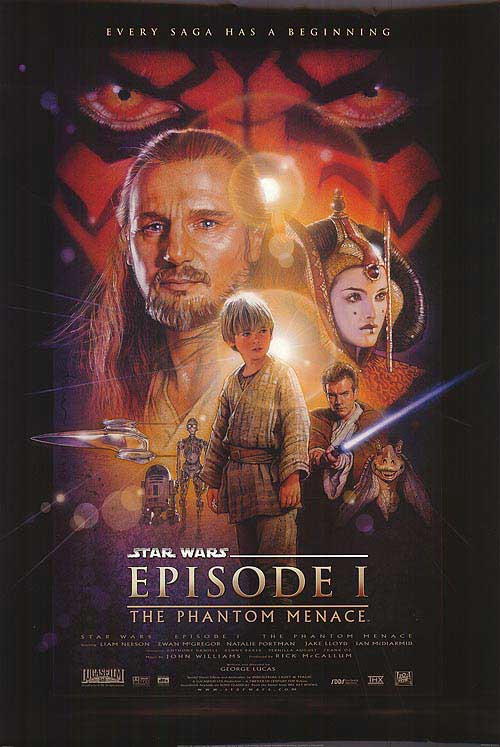
Retro Review: Star Wars Episode One - The Phantom Menace
While talking about Star Wars last week, it occurred to me that like many movies I hold near and dear I've never given them a proper write-up. This still won't really be a proper write-up for The Phantom Menace, but I do want to continue the thread I began in the triple feature review of Rush Hour 2, The Siege, and Star Trek: Insurrection. In that I laid out the pattern of an obsessive Star Wars fan (one who'd gone batty at seeing the Special Editions but was old enough to have seen at least one film the first time around) and this is the payoff. This was what it all boiled down to: no more teasers, trailers, leaked audio from ADR sessions or pictures or crazy rumors / script reviews*; it was time for the real thing, at midnight.
May 18th, 1999 came too soon - I didn't have tickets for the midnight showing because I'd just returned from school an hour-and-a-half away and hadn't been able to procure any. Even working for a local theatre proved futile in getting to see The Phantom Menace on opening day. I was convinced it would be sold out by the day before (and I say the 18th because most of this takes place before midnight, May 19th, 1999) and was scrambling to find anybody who had an extra ticked. A friend of my brother's had one at the appropriately named Imperial Cinemas (now it's the Galaxy), and I got there around... 9:30?
Young, delusional, and buying into the hype, I was convinced that the massive line would already be happening in short order, so two-and-a-half hours early seemed like a good idea**. I was probably the seventh or eighth person in line, which gives you some idea of the level of fandom for The Phantom Menace and the futility of my fears. By the time 11:45 rolled around (when they opened the doors), there was a line wrapped around the front and side of the building, although it was nothing compared to the one I was in for Revenge of the Sith, where we were in a parking lot for the grocery store next to the theatre two hours before the film started.
We all piled in, got our popcorn and drinks, had a seat (third row) and waited for new Star Wars. Holy shit, can you believe it? NEW Star Wars! The sensory overload, the crowd's adrenaline, and the glow of lightsabers sustained two hours of wooden, stilted line delivery, personality-less characters, dumb jokes, and soulless fight scenes. We were too overwhelmed by the event to care that the movie didn't live up to its tremendous hype, let alone to the minimum expectations of a competently made film. For days, I would continue to delude myself into thinking that The Phantom Menace was a film that needed to be, one that I was better for having seen.
The fundamental flaw of Episode One isn't any of the litany of illogical plot developments or the "kiddie" tone (for that, I direct you to the notorious Mr. Plinkett reviews of the prequels, which are hilarious, brutal, and often illuminating). The problem is one inherent in any prequel: you already know where the story is going. New characters introduced are going to be killed off or shoved to the margins in order for the characters the audience already knows ARE in the original films to step forward. So unless you really want to know HOW Obi-Wan Kenobi came to train Anakin Skywalker or WHY Yoda decided to go into exile on Dagobah, there's not a lot for you in these films. But we were willfully ignorant of this, and I did ruin at least one person's experience by casually mentioning that Qui-Gon Jinn was going to die before the movie ended.
I watched The Phantom Menace in its entirety four times that summer: the midnight screening, twice with friends, and once with my Dad, who was unimpressed. I kept trying to convince myself that it wasn't the disappointment that everyone said it was (and that I knew deep down was true) by sneaking off during breaks at the movie theatre I worked at to watch the Obi-Wan / Darth Maul lightsaber fight. I'd time breaks so I could walk in just in time to see it. All this time, this interest, invested for naught? It couldn't be. Twenty year old Cap'n Howdy couldn't believe that. It can't be true; it's impossible.
But search my feelings I did, and I knew it was true. You could hear it drop like the proverbial turd when The Phantom Menace dropped on VHS. Already Lucas had made changes - extending the Pod Race and including a longer sequence where our heroes fly through Coruscant. Why? Because he felt they "improved" the experience. The really just made the film longer, and without the big screen and crowd enthusiasm, The Phantom Menace was as bad as I knew it was. I just couldn't pretend otherwise.
I tend to think of that experience as the point at which I became more cynical about the hype surrounding films - I'd been burned, and so had many other geeks my age. Sure, we went to see Attack of the Clones and Revenge of the Sith (sometimes at midnight), but more out of a grudging sense of completion, a "let's get this over with." The excitement turned to caution, then dread, then relief. The scratch had been itched, and I was no longer outraged by Lucas' incessant tinkering with his films on DVD (and now Blu-Ray); this was the man who brought us the Prequels, his undiluted vision of the Star Wars universe, and they were not good. They were barely watchable, and I don't own them any more. It grouses me a bit knowing that if I want to see the bounty of extra material Lucasfilm has been ferreting away for decades that I'll have to own them again. I tried watching the end of Revenge of the Sith on TV yesterday and howled with laughter at how bad the writing was.
At this point, I don't really feel like it's worth piling on to George Lucas for his rotten prequels, but they are the reason that I have to temper expectations for movies I really like. Yesterday's Attack the Block review is a great example - I really enjoyed the movie, but don't want the film to get bogged down by people who think it's going to fix their car or something. Somehow we got on this kick that any movie that's better than "pretty good" has to be elevated to transcendent levels, and a lot of that has to do with the built-in cynicism that came for geeks in a post-The Phantom Menace world. Half of the geeks automatically assume something is going to suck because "they" will "mess it up," so the other half pushes too hard to counter that attitude and movies suddenly have to be the second coming to be worth seeing. I remember going to see just about everything pre-Godzilla and The Phantom Menace with a blissful ignorance of whether it would be good or not - The Big Hit? Lost in Space? Suicide Kings? The Faculty? We were there. Hate it, love it, going was fun. I think that The Phantom Menace took some of that away, or at least changed the way I looked forward to movies.
* Like this one, for example. I can't find the one on Ain't It Cool that goes over-the-top about a SPOILER that can't be revealed - and I've been wracking my brain trying to figure out what people coming into this movie could have been "spoiled" by. On the other hand, I don't think Jeffrey Wells feels too bad about his column now, or even six months after the release of The Phantom Menace.
** True story: on a whim, two friends drove by Mission Valley and Park Place 16 to look at the lines for The Phantom Menace only to find empty parking lots.
Labels:
CGI,
Ewan MacGregor,
George Lucas,
Liam Neeson,
Natalie Portman,
Prequels,
Retro Review,
Star Wars,
True Story
Tuesday, June 21, 2011
Retro What the Hell Week: Moulin Rouge
Welcome to day two of What the Hell week, where the Cap'n is exploring movies he had otherwise planned to skip out on, but is instead saying "why not?" and giving them a shot. For more details, please take a look at yesterday's review of Saw 3D.
---
Today's trip to "What the Hell" land is a little bit different, in that Retro Reviews necessitate the Cap'n having already seen the film in question. Lucky for all of us, I've seen a number of films that would, at first, seem uncharacteristic of a "Cap'n Howdy kind of movie": America's Sweethearts, Bridget Jones's Diary, What Dreams May Come, Bring It On, Pay It Forward, The Nutty Professor 2: The Klumps, and practically any Disney movie you can think of*.
One component of my movie-viewing experience that I often under represent on the Blogorium is musicals. That's right, musicals: call it carryover from all the Disney films or a byproduct of being on and off stage during middle and high school, but I know my way around quite a few musicals and I enjoy even more than that. The Sound of Music? There's a copy of it behind me. Oklahoma? Oh, I know how many people hate the movie, but not me. The Music Man? Yep, fan. How to Succeed in Business Without Really Trying? I used to have the DVD. Meet Me in St. Louis? West Side Story? South Pacific? For Me and My Gal? Singin' in the Rain? Oliver? Brigadoon? Annie? Chicago? Yes indeed. Don't even get me started on The Rocky Horror Picture Show. I even watched Paint Your Wagon**...
From time to time I've reviewed one or two more recent musicals, like Repo! The Genetic Opera or Hedwig and the Angry Inch (appreciated, if disliked the former and am constantly impressed by the latter), but for the life of me I still can't really explain why I went to see Moulin Rouge in the theatre. I'm hoping a colleague of mine who reads this might help jog my memory in the comments, because I am not a Baz Luhrmann fan, and on the surface there is very little about the film that be very appealing, even in 2001.
I've been trying to rationalize it to myself beyond the fact that we saw just about everything that came out, from Ghosts of Mars to Planet of the Apes to Jay and Silent Bob Strike Back to Final Fantasy: The Spirits Within. I was a big fan of Ewan MacGregor's going back to Trainspotting, and I had enjoyed Nicole Kidman in Kubrick's Eyes Wide Shut (and would later that summer in The Others), but my brief love affair with Luhrmann's Romeo + Juliet crashed and burned after trying to watch the spastic, ADD-edited cut and paste approach to Shakespeare on VHS. It's more apocryphal than anything, but the CD that Luhrmann released with "Everbody's Free (To Wear Sunscreen)" that was falsely attributed to Kurt Vonnegut really irritated me.
Maybe I bought into the idea that Moulin Rouge's use of existing pop songs as a musical foundation was okay because, well, Singin' in the Rain did it too. In fact, many of the studio musicals released in the 30s and 40s relied on songs people already knew, so I can see a younger version of the Cap'n drinking that Kool Aid, being lured in by the presence of David Bowie, Beck, Ozzy Osbourne, and Kylie Minogue in addition to lyrical mashups of songs from the 70s and 80s performed by actors I didn't really knew sang.
But I also knew what Baz Luhrmann's style was: over-the-top, loud, rapid, and obnoxious. Nothing in the advertising for Moulin Rouge suggested anything different that an abrasive musical version of Romeo + Juliet. And guess what? It wasn't!
To this day I still meet people who love Moulin Rouge, and I kind of understand why, because I almost caved in while watching the film. The first hour or so is such a sensory overload for your eyes and ears that eventually you just collapse and let the movie continue throttling along, bombarding you at every opportunity with noise and distracting editing. Had it not been for one song, I might have convinced myself that instead of being exhausted by Moulin Rouge, I actually liked it. But then "Like a Virgin" happened.
It aims for high camp. but is so obvious in its execution that it pulled me out of the daze of Luhrmann's audiovisual assault and turned me against the film once and for all, never to return. The way that he appropriates the idea of a "drag show" performance of Madonna minus the drag, almost to say "Oh look at how clever I am! They're still dressed up and butchy but they're singing 'Like a Virgin!' What Juxtaposition!" just killed it for me, and the laziness behind appropriating existing songs was apparent.
My central problem with Moulin Rouge is not so much Luhrmann's style - something I already knew annoyed me - but that the fact that the musical doesn't do anything new with the songs. They use them in exactly the fashion you'd expect them to be used in and nothing more. There's a faux-camp quality to most of the songs, from "The Sound of Music" to "Lady Marmalade" that accentuates the hyper-aggressive editing, but in the end the film is all noise and no substance. There's nothing memorable to me about the film in a positive way. I remember plenty of moments I disliked, if not outright hated, but there's nothing Moulin Rouge does that dozens of other musicals don't do better. So what's the point?
Which brings me back around to the question: why did I see Moulin Rouge? It's out of character for me, even in a time in my life when I happily went to see Hannibal and The Grinch Who Stole Christmas. In the rare instance I tried to revisit the film, to understand why I or anyone else found something appealing, I end up turning Moulin Rouge off after ten minutes. Without fail. I never watched Luhrmann's Australia and have no interest in his The Great Gatsby in 3D. Maybe I had a "What the Hell" moment in the summer of 2001; the moment was fleeting, and I cannot say it was beneficial.
*Except Condorman. I have never seen Condorman, even though I kind of want to.
** That is, by the way, not an endorsement of Paint Your Wagon. If you don't believe me, see how far you can get into the three hour mess that is the film.
Labels:
Baz Luhrmann,
Disney,
Ewan MacGregor,
Musicals,
Retro Review,
What the Hell Week
Friday, December 3, 2010
Blogorium Review: I Love You, Phillip Morris
As I Love You, Phillip Morris is finally opening in theatres (albeit limited release), I was planning on re-posting my original review today... then I realized I never wrote one. I could have sworn that in addition to reviewing Leaves of Grass several months early, I had also covered this based-on-a-true-story Jim Carrey / Ewan MacGregor film, but for the life of me I can't find it. So no apologies for repeating myself; instead you get a fresh review, just in time to see the movie (in select markets).
Jim Carrey is Steven Russell, a seemingly run-of-the-mill, Bible quoting, Jesus loving American working for the Virginia Beach police force. What his wife Debbie (Leslie Mann) doesn't know is that Russell is a just barely closeted homosexual, and after a traffic accident nearly kills him, he abandons her and movies to Miami, determined to live his life out and proud. The problem for Russell is that he can't afford the lifestyle, so he resorts to conning his way into large cash settlements with bogus injuries, stolen credit cards, and assumed identities. This does, as one would imagine it would, eventually land Steven in jail.
While in prison in Houston, Russell meets and falls in love with Phillip Morris (Ewan MacGregor), and the two use the prison system to circumvent rules and eventually room together, all of which is fine until Morris is transferred, leaving Russell alone. Steven Russell puts his con artist skills into use and in order to reunite with Morris, he goes to great lengths (including posing as a doctor to escape, pretending to be a judge ordering his own release, and ultimately Morris' attorney) and the couple is ultimately free to live together in the outside world.
Providing the "perfect" life for the both of them becomes Russell's mission, and I don't need to tell you it's a true story to figure out where things go. What I am opting not to tell you is a fairly major plot point in I Love You, Phillip Morris because it would alter the way you watch the film from its outset. Normally, with true stories, I tend to defer to the facts and assume that if you wanted to look up Steven Jay Russell, you would, but it's actually better not to for I Love You, Phillip Morris. In this case, what you don't know going in will help with a clever plot conceit built around Carrey's narration at the beginning of the film.
What I will say is that it's nice to see Jim Carrey and Ewan MacGregor in a film that plays to their strengths again. Carrey is vulnerable, goofy, and just a tad devious as Steven Russell, and Ewan MacGregor gives Phillip Morris a pure, grounded, kindness that could be lost if the film drifted too far into strictly comedic territory. Writer(s)/ Director(s) Glen Ficarra and John Requa find a tone in I Love You, Phillip Morris that's somewhere between Frank Capra's filmography and Steven Soderbergh's The Informant!, and while the offbeat love story takes a moment to adjust to, I enjoyed the film a great deal the first time I saw it.
So there you have it; my very late yet seemingly quite timely review of I Love You, Phillip Morris, a film that hasn't had much press to my knowledge. Like Leaves of Grass, I'm not sure that it's going to appeal to everybody (and it's certainly going to ruffle some feathers with homophobic audiences expecting a "typical Jim Carrey" movie) but I Love You, Phillip Morris is worth checking out if you live in any of the cities that qualify as "limited release," and absolutely worth renting if you can't see it in theatres.
Jim Carrey is Steven Russell, a seemingly run-of-the-mill, Bible quoting, Jesus loving American working for the Virginia Beach police force. What his wife Debbie (Leslie Mann) doesn't know is that Russell is a just barely closeted homosexual, and after a traffic accident nearly kills him, he abandons her and movies to Miami, determined to live his life out and proud. The problem for Russell is that he can't afford the lifestyle, so he resorts to conning his way into large cash settlements with bogus injuries, stolen credit cards, and assumed identities. This does, as one would imagine it would, eventually land Steven in jail.While in prison in Houston, Russell meets and falls in love with Phillip Morris (Ewan MacGregor), and the two use the prison system to circumvent rules and eventually room together, all of which is fine until Morris is transferred, leaving Russell alone. Steven Russell puts his con artist skills into use and in order to reunite with Morris, he goes to great lengths (including posing as a doctor to escape, pretending to be a judge ordering his own release, and ultimately Morris' attorney) and the couple is ultimately free to live together in the outside world.
Providing the "perfect" life for the both of them becomes Russell's mission, and I don't need to tell you it's a true story to figure out where things go. What I am opting not to tell you is a fairly major plot point in I Love You, Phillip Morris because it would alter the way you watch the film from its outset. Normally, with true stories, I tend to defer to the facts and assume that if you wanted to look up Steven Jay Russell, you would, but it's actually better not to for I Love You, Phillip Morris. In this case, what you don't know going in will help with a clever plot conceit built around Carrey's narration at the beginning of the film.
What I will say is that it's nice to see Jim Carrey and Ewan MacGregor in a film that plays to their strengths again. Carrey is vulnerable, goofy, and just a tad devious as Steven Russell, and Ewan MacGregor gives Phillip Morris a pure, grounded, kindness that could be lost if the film drifted too far into strictly comedic territory. Writer(s)/ Director(s) Glen Ficarra and John Requa find a tone in I Love You, Phillip Morris that's somewhere between Frank Capra's filmography and Steven Soderbergh's The Informant!, and while the offbeat love story takes a moment to adjust to, I enjoyed the film a great deal the first time I saw it.
So there you have it; my very late yet seemingly quite timely review of I Love You, Phillip Morris, a film that hasn't had much press to my knowledge. Like Leaves of Grass, I'm not sure that it's going to appeal to everybody (and it's certainly going to ruffle some feathers with homophobic audiences expecting a "typical Jim Carrey" movie) but I Love You, Phillip Morris is worth checking out if you live in any of the cities that qualify as "limited release," and absolutely worth renting if you can't see it in theatres.
Labels:
Don't Ask How I Saw It,
Ewan MacGregor,
Jim Carrey,
Reviews,
True Story
Subscribe to:
Posts (Atom)