Showing posts with label Star Wars. Show all posts
Showing posts with label Star Wars. Show all posts
Sunday, May 4, 2014
May the... oh, you get it already.
There was a long piece here about why I wasn't obsessing about Star Wars anymore, but when I went back to look at it, the whole thing seemed silly. I was taking a lot of time to tell you that I wasn't going to worry about Episode VII and would just let it happen, but four or five times as long as the first half of this sentence. But now you know, and accordingly that answers potential questions about Star Wars on the Blogorium between now and December of next year, when I'll presumably review a new Star Wars movie.
Wow, I just said the words "Star" and "Wars" three times in one paragraph. Maybe it is better I do some "conscious uncoupling" from all of the casting rumors and script details. In truth, I haven't been reading anything about it. I did watch The Shining last night. Not sure if you'll get a write up for that one, though. Or Band of Outsiders - there's plenty I'd like to say about both, but it could take a little while to get them in a coherent place.
Anyway, stay tuned for tomorrow, when I'll be taking a look back to twenty years ago - it's a Retro Review of Reality Bites.


Friday, July 12, 2013
Summer Fest 5 (Day One): Starcrash
Starcrash (which I keep thinking I need to separate into two words) is one of those knock-offs of Star Wars that you'd like to pretend Roger Corman would be doing even if George Lucas hadn't struck box office gold two years earlier. In fact, I went so far as to "pretend" that Starcrash clearly wasn't a rip-off of "a galaxy far, far away" until I looked at the tagline for the film, one that describes it thusly:
"Star Wars meets Barbarella in the ultimate inter-galactic adventure!"
So never mind, let's stop pretending that Starcrash (and for that matter, Battle Beyond the Stars) is anything but a crass attempt by a legendary B-movie producer to cash in on a more popular film. It's not as though Corman was the only guy trying to make a buck off of a "space adventure" film in the late 1970s / early 1980s, he just does it so transparently that you can't even pretend Starcrash is its own movie devoid of the obvious comparisons.
In fairness, I should point out that Roger Corman didn't direct Starcrash - that distinction belongs to Luigi Cozzi (Contamination, The Killer Must Kill Again), under the pseudonym "Lewis Coates." I suppose it's meant to hide the fact that this is an Italian co-production, although there's a degree of suspicious dubbing mixed throughout the film (that, or Shout Factory's Blu-Ray goes out of sync repeatedly during scenes with very specific actors).

The "Barbarella" component of the film comes, I suppose, from Caroline Munro, who plays Stella Star, one half of a.... uh... smuggling (?) duo of space ne'er do wells. Alongside Acton (Marjoe Gortner), her robot (?) friend, Stella cruises around the galaxy until she's captured by bounty hunter Thor (Robert Tessier) and robot policeman
It's not really important why, but Stella manages to kill all of the prisoners AND guards in her prison while escaping, and then inadvertently destroys the prison itself only to be picked up by L and Thor. They've come to release her so that she and Acton can help the Emperor (Christopher Plummer) to defeat the evil Count Zarth Arn (Maniac's Joe Spinell). If they have time, they should also rescue the Emperor's son. First, they'll need to travel to the "haunted worlds" in order to find his secret weapon, which is really an excuse to visit different planets with different "menaces."
For example, there's the planet of the Amazon Warriors, the Ice Planet, the Planet of the Cavemen, and finally some other planet where the secret weapon is. Or maybe that's the cavemen one... look, the movie doesn't make a sustained impression, I'm afraid. Mostly they serve the purpose of having cheesy fight scenes, to demonstrate some adequate stop motion animation, or to freeze L and Stella Star for the express purpose of thawing her out very slowly. It's nice to know that the defrosting machine conveniently placed in the middle of the ship can also restore her hair to optimal volume despite being covered in something that loosely fits the definition of "ice."
In one of Starcrash's many "oh, now you're telling us this?" moments, we learn that Acton knew which planet the weapon was on THE ENTIRE TIME but neglected to tell Stella Star this. I think he just got a kick out of hearing L complain about how nervous everything makes him. He's really a pretty poorly programmed Robot Space Cop, but at least they got that "good ol' country" accent right.
Given provocation, I could go on for days about the things in Starcrash that made us scratch our heads while watching this movie, but instead I'd like to focus on the extended cameo of Christopher Plummer. You've probably heard the phrase "phoning it in" when referring to an actor who is clearly doing a movie because he owes somebody a favor or was caught doing something he shouldn't, but Plummer really takes it to a new level.
Apparently inspired by the stories of Marlon Brando filming The Godfather*, Plummer seems to have asked for his lines to be written on cue cards, often placed above eye level or well above the camera. He's constantly looking around at nothing, delivering a line, pausing, and then looking around again. As Starcrash progresses, it seems like having more than one line per cue card was too much for Baron Von Trapp, so he delivers one line, then looks around aimlessly until he finds the next cue card, and then reads that one. Sometimes he looks directly into the camera.
My favorite moment is when Plummer, as a hologram recruiting Stella Star and Acton, finishes a monologue, begins to walk away, and then does a one-quarter turn back to our heroes to finish a thought. As a hologram.
He also happens to have the kind of useful weapon that could, oh,, you know, prevent THE ENTIRE FINAL BATTLE OF THE MOVIE - the ability TO STOP TIME. But he only uses it to help our heroes (and himself) escape the Count's weapon when he shows up to what is clearly a trap. He tells them "you don't become Emperor without having a few tricks up your sleeve" or something to that effect, and then freezes time on the entire planet so that they can return to his ship before it explodes.
His son isn't much brighter, but he is David Hasselfhoff, in a third act reveal (although, if you're paying attention, you know it's the Emperor's son because he's the only hero we've been introduced to since Stella Star and company left the Emperor's ship). When Stella is captured by the cavemen (who, no joke, say "ooga booga"), the Hoff appears with a golden helmet that shoots lasers to scare them off. When he and Stella escape after they return (and in greater numbers), he promptly THROWS THE HELMET AWAY and picks up a club to fight them with. Fortunately, Acton has a
Pretending that Starcrash is some hidden gem from the post-Star Wars era is not something you're likely to see me do (ever), but I'll admit it has its dumb charms. The film is too long and unnecessarily episodic for such a flimsy narrative, and the acting is not great, but it's watchable. You'll have a hard time not filling in the Star Wars lines that Starcrash sets up but tries very hard not to get caught copying, and with properly lowered expectations, I'd daresay you might enjoy the experience. I'm sure Roger Corman enjoyed the money I gave him to buy Starcrash on Blu-Ray, something which raised more than a few eyebrows at Summer Fest**.
Up next, Miami Connection, a movie with a story more compelling than anything on-screen, but my goodness what ends up on-screen is something special indeed...
* Pure, but not unfounded conjecture, based on the available evidence onscreen.
** By that I mean the "why is Starcrash on Blu-Ray" eyebrow raising.
Friday, May 17, 2013
"T" is for Turkish Star Wars
Normally, I try to do some research about the movie I'm watching. It helps to have some context going in or when trying to relay what's happening in the film, particularly if the film doesn't make much sense. For The ABCs of Movie Masochism, I've looked at it on a case by case basis, and often it helps to give you some idea why I chose the movies I did.
But not when it comes to the 1982 "movie" Turkish Star Wars.
The only information I sought out for this film was its actual title (Dünyayı Kurtaran Adam or The Man Who Saved the World), because I knew going in that I wouldn't be watching it with subtitles. I was just going to let the film wash over me, untranslated, and see if I could figure out the story beyond its copious (and unauthorized) use of footage from Star Wars - hence its more popular online title. I had done this before with Jean-Pierre Jeunet's Micmacs, and was mostly able to keep up, and that movie I actually cared about.
After a long prologue that I couldn't really make sense of, other than the fact that it consisted almost exclusively of space footage from Star Wars - sometimes the same footage, but upside down and backward - the main plot finally kicks in. The "story," as best I can tell, involves two pilots attacking the Death Star who crash land on a strange desert planet. They wander around and then one of them whistles, which draws the attention of skeletons on horseback. Fortunately, they make short work of them (if excessive, considering that they didn't need to kill ALL of them just to steal some horses) and continue on their path, until robots take their horses and force them into gladiatorial combat with the planets' indigenous population.


The evil Emperor / sorcerer / villain who was (is?) on the Death Star is now also on the planet and our heroes are trying to stop him from finding... something. But first they meet an old man and a girl who has a young son. When the other people are killed by mummies and pink werewolves (or I guess just aliens, it doesn't really matter) they barely escape. There's a montage of the heroes training by karate-chopping rocks and kicking boulders until they explode, and the main hero (the one with the silver-y Eric Estrada hairdo) begins to feel a romantic attachment to the woman and her son. I guess, because the extent of their "romance" consists of the camera cutting back and forth between them, until he smirks and then she smiles. It's love, you see.
Because I don't speak Turkish let's just assume that they went to the cantina from Star Wars to start a fight and get caught by the Emperor's robots, because otherwise I'm not sure how they knew he would magically appear to taunt them and make the world turn red. The guys are split up and the main hero talks tough with the Emperor (who wants a magical brain) while the other guy is seduced by a sorceress. Like every scene in Turkish Star Wars, it ends with them fighting monsters, but this time they lose and the main hero once again finds himself in the gladiatorial battle, but with a werewolf who has tinsel on its fingertips.
Anyway, he uses his powers of off-camera trampoline jumping to defeat the wolf and once again escapes to the tomb of Jesus (and maybe Shiva, if the mural on the wall was what I thought it was) to retrieve what I'm just going to assume is the brain of Jesus and his lightning bolt sword. After he defeats two golden ninjas, he takes the sword and the brain and there's some more stolen footage from what looks like a religious epic I couldn't place (but is letterboxed where the rest of Turkish Star Wars isn't) and betrayed by his "friend" - actually a monster in disguise.
He goes to save his friend who again betrays him and takes Jesus' brain and sword to the old man, but that's the Emperor in disguise who uses the force to throw him around. Our hero saves him and the Emperor disappears, leaving the brain and sword behind, so they go find the real old man, who is dying. Then there's an explosion and the sidekick dies and the hero melts the brain and sword and uses them to create golden gauntlets. He's the man with the golden fists, ready to do battle with all of the forces of evil, conveniently waiting outside in a ravine.
With his gauntlets, golden boots, and trampoline skills, he chops monsters in half, rips their heads off, and generally makes short work of everybody, including the Emperor, who he CHOPS IN HALF. Yes, he chops him in half, and to demonstrate this, the camera shows half of his face and the rest of the screen is blocked by a piece of paper (or something to that effect). Our hero then leaves in the Millenium Falcon while the theme from Raiders of the Lost Ark plays.
In fact, I really hope you like John Williams' music from Raiders of the Lost Ark, because you're going to hear it a lot during Turkish Star Wars. Whether it's the main theme, the love theme, or the music from the truck chase, the cues are re-purposed ad nausem, with only snippets of other movie scores appearing in between (I caught some from Ben-Hur, Planet of the Apes and Battlestar Galactica). Strangely, there's no music from Star Wars - I guess they felt it was pushing it enough to lift entire sequences from the film, sometimes for no apparent reason.
While I am not terribly familiar with Turkish cinema, I have heard of its reputation for sometimes shamelessly ripping off other movies / characters without permission (for example, I have seen 3 Dev Adam, which pits Captain America and Santos the masked wrestler against Spider-Man), but Turkish Star Wars takes it to new levels. The beginning and ending of the film consist almost entirely of footage from Star Wars, often without changing it in any fashion. It's really hard to tell if the Death Star is attacking the planet they land on or if they just crashed on the Death Star because the footage is used without context in the film.
My friends refused to watch this with me if I wouldn't watch it with subtitles, but I sincerely doubt that would have helped beyond the long, rambling prologue and maybe the speech the old man gives in a temple. It's not that Turkish Star Wars is hard to follow, per se, but so much of it is stolen from more iconic films (specifically the one in the title) that it doesn't even matter why things are happening. Nearly every sequence ends with the heroes fighting monsters, so it's not important how they got there or why. There's barely a plot and calling the characters "wafer thin" would be a gross understatement.
In the end, Turkish Star Wars is a curiosity, one that is probably more entertaining when watched in snippets online, completely devoid of context. Trying to make sense out of the last ten minutes without watching the first 80 is vastly more entertaining than sitting through the whole film, subtitles or not, and I certainly wasn't dying to find out what was actually happening when it was over.
Tuesday, February 7, 2012
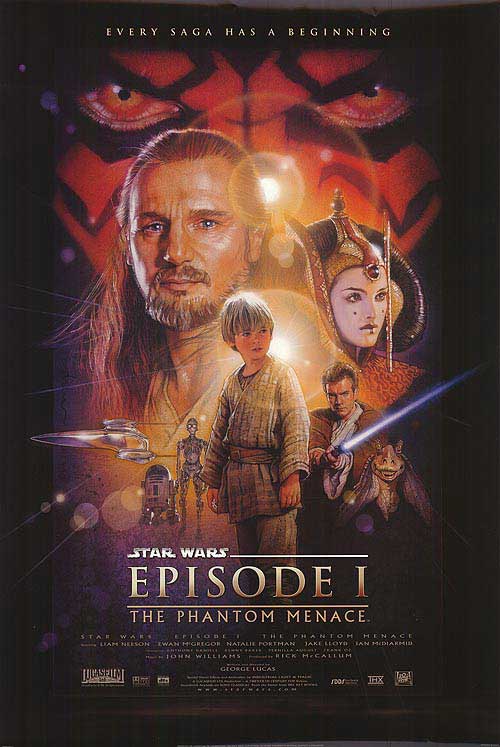
Retro Review Repost (By Popular Demand): Star Wars Episode One - The Phantom Menace
While everybody is not talking about Red Tails or the impending re-release of one of the most hated sequels of all time (along with Batman and Robin, Blues Brothers 2000, and Indiana Jones and the Kingdom of the Crystal Skull), it occurred to me that like many movies I hold near and dear I've never given them the fourth - or first, if you're REALLY a stickler - Star Wars film a proper write-up. This still won't really be a proper write-up for The Phantom Menace, but I do want to continue the thread I began in the triple feature review of Rush Hour 2, The Siege, and Star Trek: Insurrection. In that I laid out the pattern of an obsessive Star Wars fan (one who'd gone batty at seeing the Special Editions but was old enough to have seen at least one film the first time around) and this is the payoff. This was what it all boiled down to: no more teasers, trailers, leaked audio from ADR sessions or pictures or crazy rumors / script reviews*; it was time for the real thing, at midnight.
 May 18th, 1999 came too soon - I didn't have tickets for the midnight showing because I'd just returned from school an hour-and-a-half away and hadn't been able to procure any. Even working for a local theatre proved futile in getting to see The Phantom Menace on opening day. I was convinced it would be sold out by the day before (and I say the 18th because most of this takes place before midnight, May 19th, 1999) and was scrambling to find anybody who had an extra ticked. A friend of my brother's had one at the appropriately named Imperial Cinemas (now it's the Galaxy), and I got there around... 9:30?
Young, delusional, and buying into the hype, I was convinced that the massive line would already be happening in short order, so two-and-a-half hours early seemed like a good idea**. I was probably the seventh or eighth person in line, which gives you some idea of the level of fandom for The Phantom Menace and the futility of my fears. By the time 11:45 rolled around (when they opened the doors), there was a line wrapped around the front and side of the building, although it was nothing compared to the one I was in for Revenge of the Sith, where we were in a parking lot for the grocery store next to the theatre two hours before the film started.
We all piled in, got our popcorn and drinks, had a seat (third row) and waited for new Star Wars. Holy shit, can you believe it? NEW Star Wars! The sensory overload, the crowd's adrenaline, and the glow of lightsabers sustained two hours of wooden, stilted line delivery, personality-less characters, dumb jokes, and soulless fight scenes. We were too overwhelmed by the event to care that the movie didn't live up to its tremendous hype, let alone to the minimum expectations of a competently made film. For days, I would continue to delude myself into thinking that The Phantom Menace was a film that needed to be, one that I was better for having seen.
The fundamental flaw of Episode One isn't any of the litany of illogical plot developments or the "kiddie" tone (for that, I direct you to the notorious Mr. Plinkett reviews of the prequels, which are hilarious, brutal, and often illuminating). The problem is one inherent in any prequel: you already know where the story is going. New characters introduced are going to be killed off or shoved to the margins in order for the characters the audience already knows ARE in the original films to step forward. So unless you really want to know HOW Obi-Wan Kenobi came to train Anakin Skywalker or WHY Yoda decided to go into exile on Dagobah, there's not a lot for you in these films. But we were willfully ignorant of this, and I did ruin at least one person's experience by casually mentioning that Qui-Gon Jinn was going to die before the movie ended.
I watched The Phantom Menace in its entirety four times that summer: the midnight screening, twice with friends, and once with my Dad, who was unimpressed. I kept trying to convince myself that it wasn't the disappointment that everyone said it was (and that I knew deep down was true) by sneaking off during breaks at the movie theatre I worked at to watch the Obi-Wan / Darth Maul lightsaber fight. I'd time breaks so I could walk in just in time to see it. All this time, this interest, invested for naught? It couldn't be. Twenty year old Cap'n Howdy couldn't believe that. It can't be true; it's impossible.
But search my feelings I did, and I knew it was true. You could hear it drop like the proverbial turd when The Phantom Menace dropped on VHS. Already Lucas had made changes - extending the Pod Race and including a longer sequence where our heroes fly through Coruscant. Why? Because he felt they "improved" the experience. The really just made the film longer, and without the big screen and crowd enthusiasm, The Phantom Menace was as bad as I knew it was. I just couldn't pretend otherwise.
I tend to think of that experience as the point at which I became more cynical about the hype surrounding films - I'd been burned, and so had many other geeks my age. Sure, we went to see Attack of the Clones and Revenge of the Sith (sometimes at midnight), but more out of a grudging sense of completion, a "let's get this over with." The excitement turned to caution, then dread, then relief. The scratch had been itched, and I was no longer outraged by Lucas' incessant tinkering with his films on DVD (and now Blu-Ray); this was the man who brought us the Prequels, his undiluted vision of the Star Wars universe, and they were not good. They were barely watchable, and I don't own them any more. It grouses me a bit knowing that if I want to see the bounty of extra material Lucasfilm has been ferreting away for decades that I'll have to own them again. I tried watching the end of Revenge of the Sith on TV yesterday and howled with laughter at how bad the writing was.
At this point, I don't really feel like it's worth piling on to George Lucas for his rotten prequels, but they are the reason that I have to temper expectations for movies I really like. Last year's Attack the Block review is a great example - I really enjoyed the movie, but don't want the film to get bogged down by people who think it's going to fix their car or something. Somehow we got on this kick that any movie that's better than "pretty good" has to be elevated to transcendent levels, and a lot of that has to do with the built-in cynicism that came for geeks in a post-The Phantom Menace world. Half of the geeks automatically assume something is going to suck because "they" will "mess it up," so the other half pushes too hard to counter that attitude and movies suddenly have to be the second coming to be worth seeing. I remember going to see just about everything pre-Godzilla and The Phantom Menace with a blissful ignorance of whether it would be good or not - The Big Hit? Lost in Space? Suicide Kings? The Faculty? We were there. Hate it, love it, going was fun. I think that The Phantom Menace took some of that away, or at least changed the way I looked forward to movies.
And now it's been converted to 3-D gimmickry, because instead of being the "future" of movie-going as James "Yes, I'm converting Titanic to 3-D!" Cameron keeps claiming it is, we're going to continue to see movies that weren't conceived, composed, or shot for the third dimension getting an extra price-hike. Why? Because running it into the ground in the 1950s and 1980s wasn't enough; it's time for one more go-round of "everything old is new again" as long as there's a penny to be made in the meantime. And because we haven't seen the sequel-remake-3D-IMAX-"experience" yet. Once that happens, and heads explode, we can wait for The Phantom Menace to be beamed into our dreams. Jar Jar while you sleep! Until then, take your kids to see the movie that ruined Star Wars for your budding geek twenties.
* Like this one, for example. I can't find the one on Ain't It Cool that goes over-the-top about a SPOILER that can't be revealed - and I've been wracking my brain trying to figure out what people coming into this movie could have been "spoiled" by. On the other hand, I don't think Jeffrey Wells feels too bad about his column now, or even six months after the release of The Phantom Menace.
** True story: on a whim, two friends drove by Mission Valley and Park Place 16 to look at the lines for The Phantom Menace only to find empty parking lots.
Young, delusional, and buying into the hype, I was convinced that the massive line would already be happening in short order, so two-and-a-half hours early seemed like a good idea**. I was probably the seventh or eighth person in line, which gives you some idea of the level of fandom for The Phantom Menace and the futility of my fears. By the time 11:45 rolled around (when they opened the doors), there was a line wrapped around the front and side of the building, although it was nothing compared to the one I was in for Revenge of the Sith, where we were in a parking lot for the grocery store next to the theatre two hours before the film started.
We all piled in, got our popcorn and drinks, had a seat (third row) and waited for new Star Wars. Holy shit, can you believe it? NEW Star Wars! The sensory overload, the crowd's adrenaline, and the glow of lightsabers sustained two hours of wooden, stilted line delivery, personality-less characters, dumb jokes, and soulless fight scenes. We were too overwhelmed by the event to care that the movie didn't live up to its tremendous hype, let alone to the minimum expectations of a competently made film. For days, I would continue to delude myself into thinking that The Phantom Menace was a film that needed to be, one that I was better for having seen.
The fundamental flaw of Episode One isn't any of the litany of illogical plot developments or the "kiddie" tone (for that, I direct you to the notorious Mr. Plinkett reviews of the prequels, which are hilarious, brutal, and often illuminating). The problem is one inherent in any prequel: you already know where the story is going. New characters introduced are going to be killed off or shoved to the margins in order for the characters the audience already knows ARE in the original films to step forward. So unless you really want to know HOW Obi-Wan Kenobi came to train Anakin Skywalker or WHY Yoda decided to go into exile on Dagobah, there's not a lot for you in these films. But we were willfully ignorant of this, and I did ruin at least one person's experience by casually mentioning that Qui-Gon Jinn was going to die before the movie ended.
I watched The Phantom Menace in its entirety four times that summer: the midnight screening, twice with friends, and once with my Dad, who was unimpressed. I kept trying to convince myself that it wasn't the disappointment that everyone said it was (and that I knew deep down was true) by sneaking off during breaks at the movie theatre I worked at to watch the Obi-Wan / Darth Maul lightsaber fight. I'd time breaks so I could walk in just in time to see it. All this time, this interest, invested for naught? It couldn't be. Twenty year old Cap'n Howdy couldn't believe that. It can't be true; it's impossible.
But search my feelings I did, and I knew it was true. You could hear it drop like the proverbial turd when The Phantom Menace dropped on VHS. Already Lucas had made changes - extending the Pod Race and including a longer sequence where our heroes fly through Coruscant. Why? Because he felt they "improved" the experience. The really just made the film longer, and without the big screen and crowd enthusiasm, The Phantom Menace was as bad as I knew it was. I just couldn't pretend otherwise.
I tend to think of that experience as the point at which I became more cynical about the hype surrounding films - I'd been burned, and so had many other geeks my age. Sure, we went to see Attack of the Clones and Revenge of the Sith (sometimes at midnight), but more out of a grudging sense of completion, a "let's get this over with." The excitement turned to caution, then dread, then relief. The scratch had been itched, and I was no longer outraged by Lucas' incessant tinkering with his films on DVD (and now Blu-Ray); this was the man who brought us the Prequels, his undiluted vision of the Star Wars universe, and they were not good. They were barely watchable, and I don't own them any more. It grouses me a bit knowing that if I want to see the bounty of extra material Lucasfilm has been ferreting away for decades that I'll have to own them again. I tried watching the end of Revenge of the Sith on TV yesterday and howled with laughter at how bad the writing was.
At this point, I don't really feel like it's worth piling on to George Lucas for his rotten prequels, but they are the reason that I have to temper expectations for movies I really like. Last year's Attack the Block review is a great example - I really enjoyed the movie, but don't want the film to get bogged down by people who think it's going to fix their car or something. Somehow we got on this kick that any movie that's better than "pretty good" has to be elevated to transcendent levels, and a lot of that has to do with the built-in cynicism that came for geeks in a post-The Phantom Menace world. Half of the geeks automatically assume something is going to suck because "they" will "mess it up," so the other half pushes too hard to counter that attitude and movies suddenly have to be the second coming to be worth seeing. I remember going to see just about everything pre-Godzilla and The Phantom Menace with a blissful ignorance of whether it would be good or not - The Big Hit? Lost in Space? Suicide Kings? The Faculty? We were there. Hate it, love it, going was fun. I think that The Phantom Menace took some of that away, or at least changed the way I looked forward to movies.
And now it's been converted to 3-D gimmickry, because instead of being the "future" of movie-going as James "Yes, I'm converting Titanic to 3-D!" Cameron keeps claiming it is, we're going to continue to see movies that weren't conceived, composed, or shot for the third dimension getting an extra price-hike. Why? Because running it into the ground in the 1950s and 1980s wasn't enough; it's time for one more go-round of "everything old is new again" as long as there's a penny to be made in the meantime. And because we haven't seen the sequel-remake-3D-IMAX-"experience" yet. Once that happens, and heads explode, we can wait for The Phantom Menace to be beamed into our dreams. Jar Jar while you sleep! Until then, take your kids to see the movie that ruined Star Wars for your budding geek twenties.
* Like this one, for example. I can't find the one on Ain't It Cool that goes over-the-top about a SPOILER that can't be revealed - and I've been wracking my brain trying to figure out what people coming into this movie could have been "spoiled" by. On the other hand, I don't think Jeffrey Wells feels too bad about his column now, or even six months after the release of The Phantom Menace.
** True story: on a whim, two friends drove by Mission Valley and Park Place 16 to look at the lines for The Phantom Menace only to find empty parking lots.
Friday, February 3, 2012
Four Reasons I am not Seeing The Phantom Menace in 3-D
To put this to rest once and for all, because people really seem to think that I am or would be considering going to see Star Wars Episode One: The Phantom Menace in 3-D... soon. That should be number one, in fact:
 1. I Don't Even Care Enough to Know When It Opens - According to the button on my desk, it's February 10th. Next weekend. I did not know that, despite what feels like a constant barrage of advertisements trying to trick anyone into seeing The Phantom Menace again.
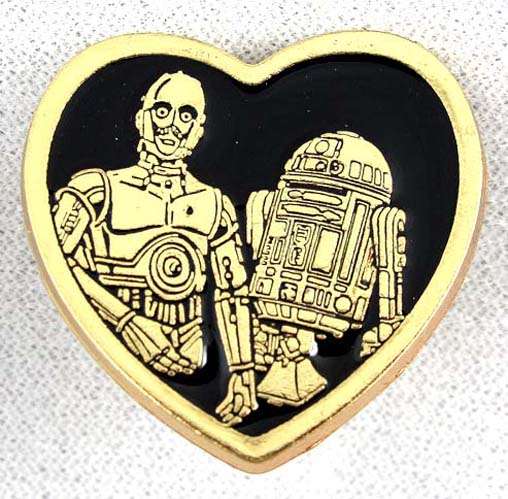
2. Wait, Why is There a Button on Your Desk? - Hey, I decide what merits a "reason" here, not you. The button, which is heart shaped an professes the love that one droid has for another (in this particular case, C-3P0 for R2-D2), is on my desk because when we went to see The Muppets, one of my friends found the fact that Lucasfilm was tacitly admitting what we've all known for years. In fact, they put it on a button and then put the $3 it cost towards charity. This is the pin. But since any opportunity to sell Star Wars merchandise, even for a good cause like children, is also an opportunity to plug something nobody cares about, there's a paper insert mentioning The Phantom Menace in 3-D. It happens to open next weekend.
3. So You Just Mentioned AGAIN for No Good Reason When It Opens - Hey, who runs this Blogorium? Me or you? Look, four times is enough for Star Wars Episode One: The Phantom Menace; that's the number of times I PAID to see it in theatres in the summer of 1999. That does not count the numerous instances of watching parts of it while on break, watching parts of it on VHS, DVD, Blu-Ray, on television, or the time spent to find, download, and watch The Phantom Edit, which it turns out really wasn't that much better. A polished turd is still a turd.
4. It Sure Sounds Like You've Seen The Phantom Menace a lot Already - Yes, it does. I have, and every single time it's a gigantic waste of my time. But I kept going back, thinking "hey, maybe this time it won't slap me around and then bore the living shit out of me before I turn it off in disgust," because I've watched the Mr. Plinkett dissections so many times that you can't even use The Phantom Menace to prove the points he makes. That's how stilted and lifeless that movie is. It's more entertaining watching someone else point out the idiot lapses in logic in The Phantom Menace than seeing them happen firsthand.
I don't watch The Clone Wars, I don't care about Red Tails, and The People vs. George Lucas felt like a lot of spent energy over something nobody seems to care about any more. Everybody knows The Phantom Menace sucks, even little kids. Your kids don't want to see The Phantom Menace any more than you want to take them to it because it's "Star Wars" and in another three years you can see A New Hope, the movie you'd actually like to see converted to 3-D for no good reason. In the meantime, you have to sit through the shitty prequels again and marvel at how flat, boring CGI backgrounds look even more phony in the third dimension. You can pretend that a Pod Racer flying at you makes up for the... well, anything. It doesn't, and you know it doesn't.
Oh well, I guess it beats going to see Titanic in 3-D, which is also happening soon, I think. I never saw that one in the first place, so at least people might believe me when I say I'm not going to see that one. Now if you'll excuse me I'm going to put on my "robot love" button and NOT watch the Star Wars Episode One: The Phantom Menace that's in the Blu-Ray boxed set behind me. Because that is something that is not going to happen. Right now.

2. Wait, Why is There a Button on Your Desk? - Hey, I decide what merits a "reason" here, not you. The button, which is heart shaped an professes the love that one droid has for another (in this particular case, C-3P0 for R2-D2), is on my desk because when we went to see The Muppets, one of my friends found the fact that Lucasfilm was tacitly admitting what we've all known for years. In fact, they put it on a button and then put the $3 it cost towards charity. This is the pin. But since any opportunity to sell Star Wars merchandise, even for a good cause like children, is also an opportunity to plug something nobody cares about, there's a paper insert mentioning The Phantom Menace in 3-D. It happens to open next weekend.
3. So You Just Mentioned AGAIN for No Good Reason When It Opens - Hey, who runs this Blogorium? Me or you? Look, four times is enough for Star Wars Episode One: The Phantom Menace; that's the number of times I PAID to see it in theatres in the summer of 1999. That does not count the numerous instances of watching parts of it while on break, watching parts of it on VHS, DVD, Blu-Ray, on television, or the time spent to find, download, and watch The Phantom Edit, which it turns out really wasn't that much better. A polished turd is still a turd.
4. It Sure Sounds Like You've Seen The Phantom Menace a lot Already - Yes, it does. I have, and every single time it's a gigantic waste of my time. But I kept going back, thinking "hey, maybe this time it won't slap me around and then bore the living shit out of me before I turn it off in disgust," because I've watched the Mr. Plinkett dissections so many times that you can't even use The Phantom Menace to prove the points he makes. That's how stilted and lifeless that movie is. It's more entertaining watching someone else point out the idiot lapses in logic in The Phantom Menace than seeing them happen firsthand.
I don't watch The Clone Wars, I don't care about Red Tails, and The People vs. George Lucas felt like a lot of spent energy over something nobody seems to care about any more. Everybody knows The Phantom Menace sucks, even little kids. Your kids don't want to see The Phantom Menace any more than you want to take them to it because it's "Star Wars" and in another three years you can see A New Hope, the movie you'd actually like to see converted to 3-D for no good reason. In the meantime, you have to sit through the shitty prequels again and marvel at how flat, boring CGI backgrounds look even more phony in the third dimension. You can pretend that a Pod Racer flying at you makes up for the... well, anything. It doesn't, and you know it doesn't.
Oh well, I guess it beats going to see Titanic in 3-D, which is also happening soon, I think. I never saw that one in the first place, so at least people might believe me when I say I'm not going to see that one. Now if you'll excuse me I'm going to put on my "robot love" button and NOT watch the Star Wars Episode One: The Phantom Menace that's in the Blu-Ray boxed set behind me. Because that is something that is not going to happen. Right now.
Tuesday, September 13, 2011
Retro Review: The Star Wars Trilogy (Special Edition)
I hadn't really planned on revisiting Star Wars again after last week's epic The Phantom Menace / Prequel Trilogy retrospective, but a valid question came up as a result of the review and the general discussion of Lucas' digital tinkering with nearly every iteration of his films since 1997: what did you think about the first major changes when the films were released for A New Hope's 20th Anniversary?
Let's keep this shorter than last week: the funny thing is that I really didn't mind it in 1997. Chalk part of that up to age (18) and to enthusiasm to see Star Wars on the big screen. I responded strongly to the trailer:
 I was part of that "entire generation" that grew up watching A New Hope, The Empire Strikes Back, and Return of the Jedi on VHS. I still have all of those tapes (one of which has From Star Wars to Jedi: The Making of a Saga as a bonus), and watching pan-and-scanned Star Wars was how I knew them. Yes, I saw Return of the Jedi in the theatre, but I was four. I have memories associated with the film, but it's not like I can reflect on it with crystal clarity. I certainly couldn't provide a nuanced discussion of what seeing the film on the wide screen was for a child - I didn't know the difference for a long time.
The first time I saw the trailer was in front of Mars Attacks (a movie I really should do next week for the Retro Review) and alongside a fellow Star Wars geek, I was frothing at the mouth at the chance. The fact that there were "a few new surprises" were icing on the cake as far as I was concerned - I still had the original trilogy on VHS so it wasn't like they were going away forever, y'know? It was just another way to watch the films.
But yeah, even a couple of years later the Mos Eisley extension seemed crowded and unnecessary. The Jabba sequence in A New Hope was redundant information after the Greedo scene. Oh, and the whole "Greedo Shoots First" thing. That was a big point of contention, even in 1997. That I do remember, because it fundamentally changes the kind of character Han Solo is before we really get to know him. He's a smuggler, untrustworthy, and not afraid of shooting his way out of a bad spot. Greedo doesn't need to shoot first to justify Solo's cold blooded murder. That's just how Han Solo rolls.
What else? Oh, the giant sand vagina dentata now had a little phallic monster that popped out? Why? Because they could. Digital Dewbacks, Vader's shuttle, more Wampa, and that silly song and dance replacement in Jabba's Palace that tries to mask criminals reveling in someone being eaten alive. And no more Ewok song. Yeah, can't say I really missed "Yub Nub" that much. Luke screaming when he chooses falling over joining Vader was stupid, but it wasn't really enough to turn me against Star Wars. Again, that was largely The Phantom Menace. It's weird that the revisionism and digital trickery didn't feel indicative of what was to come, but those were more innocent times...
There's an interesting side note to Return of the Jedi that may point to an early example of George Lucas tinkering: from the theatrical version to the VHS release, Lucas cut a brief sequence in the Rancor pit where Luke jumps up and hangs from the bottom of the "trap" Jabba and company watch the mayhem through. His hands are smashed by Jabba's minions and Luke falls, hitting the Rancor on the way down. The linked photo above has been floating around the internet for years and many believe it was in the theatrical release but had been cut by the time of home video release. It's not a memory I can say is genuine or manufactured, but it seems like that moment is familiar from 28 years ago.
So there you go - I'm not giving the Special Editions a pass, per se, but a younger Cap'n was less heavy with the scrutiny back then. Remember, that's when I used to like Baz Luhrmann's Romeo + Juliet. Take that for what it's worth...
Let's keep this shorter than last week: the funny thing is that I really didn't mind it in 1997. Chalk part of that up to age (18) and to enthusiasm to see Star Wars on the big screen. I responded strongly to the trailer:

The first time I saw the trailer was in front of Mars Attacks (a movie I really should do next week for the Retro Review) and alongside a fellow Star Wars geek, I was frothing at the mouth at the chance. The fact that there were "a few new surprises" were icing on the cake as far as I was concerned - I still had the original trilogy on VHS so it wasn't like they were going away forever, y'know? It was just another way to watch the films.
But yeah, even a couple of years later the Mos Eisley extension seemed crowded and unnecessary. The Jabba sequence in A New Hope was redundant information after the Greedo scene. Oh, and the whole "Greedo Shoots First" thing. That was a big point of contention, even in 1997. That I do remember, because it fundamentally changes the kind of character Han Solo is before we really get to know him. He's a smuggler, untrustworthy, and not afraid of shooting his way out of a bad spot. Greedo doesn't need to shoot first to justify Solo's cold blooded murder. That's just how Han Solo rolls.
What else? Oh, the giant sand vagina dentata now had a little phallic monster that popped out? Why? Because they could. Digital Dewbacks, Vader's shuttle, more Wampa, and that silly song and dance replacement in Jabba's Palace that tries to mask criminals reveling in someone being eaten alive. And no more Ewok song. Yeah, can't say I really missed "Yub Nub" that much. Luke screaming when he chooses falling over joining Vader was stupid, but it wasn't really enough to turn me against Star Wars. Again, that was largely The Phantom Menace. It's weird that the revisionism and digital trickery didn't feel indicative of what was to come, but those were more innocent times...
There's an interesting side note to Return of the Jedi that may point to an early example of George Lucas tinkering: from the theatrical version to the VHS release, Lucas cut a brief sequence in the Rancor pit where Luke jumps up and hangs from the bottom of the "trap" Jabba and company watch the mayhem through. His hands are smashed by Jabba's minions and Luke falls, hitting the Rancor on the way down. The linked photo above has been floating around the internet for years and many believe it was in the theatrical release but had been cut by the time of home video release. It's not a memory I can say is genuine or manufactured, but it seems like that moment is familiar from 28 years ago.

So there you go - I'm not giving the Special Editions a pass, per se, but a younger Cap'n was less heavy with the scrutiny back then. Remember, that's when I used to like Baz Luhrmann's Romeo + Juliet. Take that for what it's worth...
Tuesday, September 6, 2011
Retro Review: Star Wars Episode One - The Phantom Menace
While talking about Star Wars last week, it occurred to me that like many movies I hold near and dear I've never given them a proper write-up. This still won't really be a proper write-up for The Phantom Menace, but I do want to continue the thread I began in the triple feature review of Rush Hour 2, The Siege, and Star Trek: Insurrection. In that I laid out the pattern of an obsessive Star Wars fan (one who'd gone batty at seeing the Special Editions but was old enough to have seen at least one film the first time around) and this is the payoff. This was what it all boiled down to: no more teasers, trailers, leaked audio from ADR sessions or pictures or crazy rumors / script reviews*; it was time for the real thing, at midnight.
May 18th, 1999 came too soon - I didn't have tickets for the midnight showing because I'd just returned from school an hour-and-a-half away and hadn't been able to procure any. Even working for a local theatre proved futile in getting to see The Phantom Menace on opening day. I was convinced it would be sold out by the day before (and I say the 18th because most of this takes place before midnight, May 19th, 1999) and was scrambling to find anybody who had an extra ticked. A friend of my brother's had one at the appropriately named Imperial Cinemas (now it's the Galaxy), and I got there around... 9:30?
Young, delusional, and buying into the hype, I was convinced that the massive line would already be happening in short order, so two-and-a-half hours early seemed like a good idea**. I was probably the seventh or eighth person in line, which gives you some idea of the level of fandom for The Phantom Menace and the futility of my fears. By the time 11:45 rolled around (when they opened the doors), there was a line wrapped around the front and side of the building, although it was nothing compared to the one I was in for Revenge of the Sith, where we were in a parking lot for the grocery store next to the theatre two hours before the film started.
We all piled in, got our popcorn and drinks, had a seat (third row) and waited for new Star Wars. Holy shit, can you believe it? NEW Star Wars! The sensory overload, the crowd's adrenaline, and the glow of lightsabers sustained two hours of wooden, stilted line delivery, personality-less characters, dumb jokes, and soulless fight scenes. We were too overwhelmed by the event to care that the movie didn't live up to its tremendous hype, let alone to the minimum expectations of a competently made film. For days, I would continue to delude myself into thinking that The Phantom Menace was a film that needed to be, one that I was better for having seen.
The fundamental flaw of Episode One isn't any of the litany of illogical plot developments or the "kiddie" tone (for that, I direct you to the notorious Mr. Plinkett reviews of the prequels, which are hilarious, brutal, and often illuminating). The problem is one inherent in any prequel: you already know where the story is going. New characters introduced are going to be killed off or shoved to the margins in order for the characters the audience already knows ARE in the original films to step forward. So unless you really want to know HOW Obi-Wan Kenobi came to train Anakin Skywalker or WHY Yoda decided to go into exile on Dagobah, there's not a lot for you in these films. But we were willfully ignorant of this, and I did ruin at least one person's experience by casually mentioning that Qui-Gon Jinn was going to die before the movie ended.
I watched The Phantom Menace in its entirety four times that summer: the midnight screening, twice with friends, and once with my Dad, who was unimpressed. I kept trying to convince myself that it wasn't the disappointment that everyone said it was (and that I knew deep down was true) by sneaking off during breaks at the movie theatre I worked at to watch the Obi-Wan / Darth Maul lightsaber fight. I'd time breaks so I could walk in just in time to see it. All this time, this interest, invested for naught? It couldn't be. Twenty year old Cap'n Howdy couldn't believe that. It can't be true; it's impossible.
But search my feelings I did, and I knew it was true. You could hear it drop like the proverbial turd when The Phantom Menace dropped on VHS. Already Lucas had made changes - extending the Pod Race and including a longer sequence where our heroes fly through Coruscant. Why? Because he felt they "improved" the experience. The really just made the film longer, and without the big screen and crowd enthusiasm, The Phantom Menace was as bad as I knew it was. I just couldn't pretend otherwise.
I tend to think of that experience as the point at which I became more cynical about the hype surrounding films - I'd been burned, and so had many other geeks my age. Sure, we went to see Attack of the Clones and Revenge of the Sith (sometimes at midnight), but more out of a grudging sense of completion, a "let's get this over with." The excitement turned to caution, then dread, then relief. The scratch had been itched, and I was no longer outraged by Lucas' incessant tinkering with his films on DVD (and now Blu-Ray); this was the man who brought us the Prequels, his undiluted vision of the Star Wars universe, and they were not good. They were barely watchable, and I don't own them any more. It grouses me a bit knowing that if I want to see the bounty of extra material Lucasfilm has been ferreting away for decades that I'll have to own them again. I tried watching the end of Revenge of the Sith on TV yesterday and howled with laughter at how bad the writing was.
At this point, I don't really feel like it's worth piling on to George Lucas for his rotten prequels, but they are the reason that I have to temper expectations for movies I really like. Yesterday's Attack the Block review is a great example - I really enjoyed the movie, but don't want the film to get bogged down by people who think it's going to fix their car or something. Somehow we got on this kick that any movie that's better than "pretty good" has to be elevated to transcendent levels, and a lot of that has to do with the built-in cynicism that came for geeks in a post-The Phantom Menace world. Half of the geeks automatically assume something is going to suck because "they" will "mess it up," so the other half pushes too hard to counter that attitude and movies suddenly have to be the second coming to be worth seeing. I remember going to see just about everything pre-Godzilla and The Phantom Menace with a blissful ignorance of whether it would be good or not - The Big Hit? Lost in Space? Suicide Kings? The Faculty? We were there. Hate it, love it, going was fun. I think that The Phantom Menace took some of that away, or at least changed the way I looked forward to movies.
* Like this one, for example. I can't find the one on Ain't It Cool that goes over-the-top about a SPOILER that can't be revealed - and I've been wracking my brain trying to figure out what people coming into this movie could have been "spoiled" by. On the other hand, I don't think Jeffrey Wells feels too bad about his column now, or even six months after the release of The Phantom Menace.
** True story: on a whim, two friends drove by Mission Valley and Park Place 16 to look at the lines for The Phantom Menace only to find empty parking lots.
Young, delusional, and buying into the hype, I was convinced that the massive line would already be happening in short order, so two-and-a-half hours early seemed like a good idea**. I was probably the seventh or eighth person in line, which gives you some idea of the level of fandom for The Phantom Menace and the futility of my fears. By the time 11:45 rolled around (when they opened the doors), there was a line wrapped around the front and side of the building, although it was nothing compared to the one I was in for Revenge of the Sith, where we were in a parking lot for the grocery store next to the theatre two hours before the film started.
We all piled in, got our popcorn and drinks, had a seat (third row) and waited for new Star Wars. Holy shit, can you believe it? NEW Star Wars! The sensory overload, the crowd's adrenaline, and the glow of lightsabers sustained two hours of wooden, stilted line delivery, personality-less characters, dumb jokes, and soulless fight scenes. We were too overwhelmed by the event to care that the movie didn't live up to its tremendous hype, let alone to the minimum expectations of a competently made film. For days, I would continue to delude myself into thinking that The Phantom Menace was a film that needed to be, one that I was better for having seen.
The fundamental flaw of Episode One isn't any of the litany of illogical plot developments or the "kiddie" tone (for that, I direct you to the notorious Mr. Plinkett reviews of the prequels, which are hilarious, brutal, and often illuminating). The problem is one inherent in any prequel: you already know where the story is going. New characters introduced are going to be killed off or shoved to the margins in order for the characters the audience already knows ARE in the original films to step forward. So unless you really want to know HOW Obi-Wan Kenobi came to train Anakin Skywalker or WHY Yoda decided to go into exile on Dagobah, there's not a lot for you in these films. But we were willfully ignorant of this, and I did ruin at least one person's experience by casually mentioning that Qui-Gon Jinn was going to die before the movie ended.
I watched The Phantom Menace in its entirety four times that summer: the midnight screening, twice with friends, and once with my Dad, who was unimpressed. I kept trying to convince myself that it wasn't the disappointment that everyone said it was (and that I knew deep down was true) by sneaking off during breaks at the movie theatre I worked at to watch the Obi-Wan / Darth Maul lightsaber fight. I'd time breaks so I could walk in just in time to see it. All this time, this interest, invested for naught? It couldn't be. Twenty year old Cap'n Howdy couldn't believe that. It can't be true; it's impossible.
But search my feelings I did, and I knew it was true. You could hear it drop like the proverbial turd when The Phantom Menace dropped on VHS. Already Lucas had made changes - extending the Pod Race and including a longer sequence where our heroes fly through Coruscant. Why? Because he felt they "improved" the experience. The really just made the film longer, and without the big screen and crowd enthusiasm, The Phantom Menace was as bad as I knew it was. I just couldn't pretend otherwise.
I tend to think of that experience as the point at which I became more cynical about the hype surrounding films - I'd been burned, and so had many other geeks my age. Sure, we went to see Attack of the Clones and Revenge of the Sith (sometimes at midnight), but more out of a grudging sense of completion, a "let's get this over with." The excitement turned to caution, then dread, then relief. The scratch had been itched, and I was no longer outraged by Lucas' incessant tinkering with his films on DVD (and now Blu-Ray); this was the man who brought us the Prequels, his undiluted vision of the Star Wars universe, and they were not good. They were barely watchable, and I don't own them any more. It grouses me a bit knowing that if I want to see the bounty of extra material Lucasfilm has been ferreting away for decades that I'll have to own them again. I tried watching the end of Revenge of the Sith on TV yesterday and howled with laughter at how bad the writing was.
At this point, I don't really feel like it's worth piling on to George Lucas for his rotten prequels, but they are the reason that I have to temper expectations for movies I really like. Yesterday's Attack the Block review is a great example - I really enjoyed the movie, but don't want the film to get bogged down by people who think it's going to fix their car or something. Somehow we got on this kick that any movie that's better than "pretty good" has to be elevated to transcendent levels, and a lot of that has to do with the built-in cynicism that came for geeks in a post-The Phantom Menace world. Half of the geeks automatically assume something is going to suck because "they" will "mess it up," so the other half pushes too hard to counter that attitude and movies suddenly have to be the second coming to be worth seeing. I remember going to see just about everything pre-Godzilla and The Phantom Menace with a blissful ignorance of whether it would be good or not - The Big Hit? Lost in Space? Suicide Kings? The Faculty? We were there. Hate it, love it, going was fun. I think that The Phantom Menace took some of that away, or at least changed the way I looked forward to movies.
* Like this one, for example. I can't find the one on Ain't It Cool that goes over-the-top about a SPOILER that can't be revealed - and I've been wracking my brain trying to figure out what people coming into this movie could have been "spoiled" by. On the other hand, I don't think Jeffrey Wells feels too bad about his column now, or even six months after the release of The Phantom Menace.
** True story: on a whim, two friends drove by Mission Valley and Park Place 16 to look at the lines for The Phantom Menace only to find empty parking lots.
Thursday, September 1, 2011
A Theory About Star Wars
...or really a theory about George Lucas, I suppose. Star Wars is, as usual, the method by which Lucas has chosen to again antagonize geeks everywhere. By now, most of you have heard about the change to Return of the Jedi where Darth Vader screams "Noooooo!" before throwing the Emperor deep into the Death Star, as well as a few other "adjustments" to the Original Trilogy* (and the Prequel Trilogy, but really, who cares about that?). Attentive internet geeks have been pitting George Lucas from 1988 against the George Lucas of today, once again desperately trying to appeal to the director / producer. That, or to once again make the argument that the guy is a money-grubbing hack. Or that other thing - the totally overboard reference to what Lucas is allegedly doing to your "childhood" that I cannot abide by repeating.
At this point, it gets really old hearing about how angry people are at George Lucas and about documentaries like The People vs. George Lucas, etc. Every time the inevitable re-release of the film comes out, people swear they're being cheated and that "this is the last time you'll get MY money, George!" and then news comes out about changes and then the hyperbole kicks into high gear. Star Wars came out on DVD - but it was the Special Editions. Then Lucas released the Original Versions on DVD, but not anamorphically enhanced and with 2.0 stereo mixes (direct ports from the Laserdiscs) and that was ripping people off so of course they aren't going to buy it. Now the Blu-Rays are coming out and another series of alterations are in place and fans are shocked to discover that a man who has digitally altered every single film he's directed for DVD and Blu-Ray release once again took the opportunity for more tinkering.
Here's the catch - I think he knows that you're going to complain. He also knows (as I do) that the calls for boycotts are no reflection of actual sales. They haven't been in the past - and I've worked in places that sold those movies and toys and I know for a fact that people continue to buy the versions of Star Wars they claim to loathe - and I strongly believe that other than grousing the internet community, Lucas knows exactly what he's doing. He doesn't even mind ruffling those feathers, because it helps his cause.
Lucas has, once again, shrewdly concocted a way to keep everyone talking about Star Wars as the Blu-Ray release approaches. It's not enough to sell ad space and to make deals with Best Buy about exclusive this or yadda yadda that; despite what's said about the man, George Lucas knows how to get his audience passionate about Star Wars when it's time to have their wallets out. Whether the passion is positive or negative, I suspect he doesn't care, because here's what's going to happen: outraged fans are going to scream all the way up and down the internet about the classics being "butchered" again, swear that THIS TIME they won't be buying them, and then quietly ordering that nine disc boxed set off of Amazon so that the next time they see their friends, they can authoritatively rant with indignation.
The changes we DO know about aren't the only changes, which may or may not be true - we know that puppet Yoda from The Phantom Menace is now digital, and that Obi-Wan's "dragon" noise is, *ahem* more suggestive, and that Ewoks blink now - but the earliest promise from Lucasfilm was of more "surprises" in the films. In order to be a properly incensed geek, that means purchasing the set (on the down-low, of course) in order to catalog the changes before someone else gets to it and then poring over every minute detail on chat boards.The people who yell the loudest online are almost always the first people to say to you "can you believe that Lucas did THIS and THIS???" at the first opportunity, usually before the average fan even noticed.
So is this outrage surprising? No, not really. Is it fun to sit back and listen to? Yeah, it kind of is. If people really stuck to their guns and didn't buy this Blu-Ray set after rating it with one star on Amazon sight unseen, I'd be more impressed with the sturm and drang, but I don't see that happening. I've yet to decide if I'm going to pick it up or wait another year (*ahem*, thirty-fifth anniversary of A New Hope) for some other, cheaper, repackaging once this version is pulled from shelves (20th Century Fox, like Disney, will do that to drive up demand). I'd like to see those extra three discs of footage, and wouldn't mind watching the films in high definition, but it really depends on if I have a hundred dollars to spare in two weeks. I waited on The Lord of the Rings and that worked out well enough. Lucas has my passing attention, and he may well have my money, but I can't give him the outrage; just a passing glance and "Huh, this again?"
* Actually, it's not even the Original Trilogy at this point. For a detailed examination of how the original films became the Special Editions and then the DVD editions, go here.
Tuesday, May 31, 2011
Retro Review: The Siege, Star Trek: Insurrection, and Rush Hour
This is a little bit different take on the Retro Review, less about the specific films listed in the title and more about the reason WHY I sat through two movies I'll never watch again and a movie I haven't seen in nearly a twelve years and vaguely remember. The connective tissue between these three disparate, otherwise wholly unrelated films, has everything to do with George Lucas and May of 1999*.
Although Star Wars doesn't receive the level of attention at the Blogorium that it might have ten years ago, I was once a fanatic of George Lucas' sci-fi / fantasy series. These days, in the wake of Episode III: Revenge of the Sith, The Clone Wars movie and subsequent series (which I have not and do not plan on seeing), and the impending Blu-Ray release / 3-D re-release of the "saga," I just don't feel the need to write about Star Wars that much anymore. I'm not one of those hyperbolic "Lucas raped my childhood" idiots**, and I do sometimes smile or chuckle at a well placed SW reference, but most of the time I just don't think about the movies. Any of them, even if I'm more inclined to watch A New Hope and The Empire Strikes Back than the other four.
That was not always the case; from the announcement of the Star Wars prequels (some time after the 1997 Special Editions) until the release of Star Wars Episode One: The Phantom Menace, I was a rabid fanatic. You can ask anyone I knew in college freshman year, when I undoubtedly drove them nuts with taped trailers from Entertainment Tonight or the latest rumors from TheForce.net.More to the point, I was insufferable when it came to seeing the teaser trailer, and I had a habit of dragging very reasonable friends to movies we wouldn't see otherwise because the teaser was "rumored" to be attached. I was home from school on three occasions, and I think you can figure out what the first two movies were.

I'm sure you've all seen Rush Hour at this point; you've probably seen Rush Hour 2 and not Rush Hour 3 (at least, that's my level of interaction with the series). I heard that The Phantom Menace's teaser ran before the film, and that Rush Hour might be funny. I suppose we enjoyed it, although I'd be pressed to tell you much about Rush Hour. Thinking back, it seems like I remember as much about Rush Hour as I do Shanghai Noon (anybody see that movie?). It's an amiable comedy, notable (at the time) for featuring Tom Wilkinson, who I had seen in The Full Monty the year before. I can't honestly remember if the trailer was attached or not, but it seems like it wasn't.

Skip two months later to Thanksgiving break of 1998, when a similar situation unfolded for The Siege.
Driving to the theatre, I swore up and down we wouldn't be as "let down" this time, and by "we," I meant "me" because compared to The Siege, Rush Hour was a walk in the park. Other than hating the movie, here are the things I remember about The Siege: Bruce Willis, Denzel Washington, Annette Bening, and Tony Shalhoub were in the film. It had something to do with a terrorist attack or the threat of terrorism or something, and Willis declared marshal law in New York. That's it. I never saw The Siege again, don't recall enjoying it, and have no plans to revisit the film. Considering that we (I) only went to see The Siege to watch that trailer, and the trailer wasn't there, I was doubly disappointed.
 How I eventually saw the teaser trailer or what it was playing in front of is lost to the ages, so I'm just going to assume I saw it online over and over in some horrible quality QuickTime on a loop, obsessing over the minutiae until the next trailer came along. Maybe it's even on a cd-r or a floppy disc somewhere, lost in the shuffle of the following decade.
Star Trek: Insurrection is more of an appendix to the story, a movie I saw with my Dad for Christmas or possibly even early in 1999 for his birthday. The film itself is a elongated, mostly pointless episode of Star Trek: The Next Generation that I'd largely forgotten until watching Mr. Plinkett's review of the film***. It's only really worth noting because I do know that the Episode 1 trailer played before Insurrection, and was arguably the highlight of the afternoon.
This is not a Retro Review for The Phantom Menace (although I might do one of those down the line), so there's no need to get into whether the film lived up to the teaser or not. I just thought you might chuckled at the lengths to which a young and silly Star Wars fan would go to see a trailer. Not the movie, a trailer. Laugh it up, fuzzballs.
* You could also consider The Mummy to fit into this rubric, although its release was much closer to Episode 1. For whatever reason, I gave The Mummy's crappy visual effects a pass because, as I reasoned, "ILM put most of their effort towards Star Wars."
** If you don't understand why using a rape metaphor to describe your reaction to three shitty movies, you are an idiot. Period.
*** Appropriately, the reason I knew Mr. Plinkett existed was because of his now famous Episode 1 review.
Although Star Wars doesn't receive the level of attention at the Blogorium that it might have ten years ago, I was once a fanatic of George Lucas' sci-fi / fantasy series. These days, in the wake of Episode III: Revenge of the Sith, The Clone Wars movie and subsequent series (which I have not and do not plan on seeing), and the impending Blu-Ray release / 3-D re-release of the "saga," I just don't feel the need to write about Star Wars that much anymore. I'm not one of those hyperbolic "Lucas raped my childhood" idiots**, and I do sometimes smile or chuckle at a well placed SW reference, but most of the time I just don't think about the movies. Any of them, even if I'm more inclined to watch A New Hope and The Empire Strikes Back than the other four.
That was not always the case; from the announcement of the Star Wars prequels (some time after the 1997 Special Editions) until the release of Star Wars Episode One: The Phantom Menace, I was a rabid fanatic. You can ask anyone I knew in college freshman year, when I undoubtedly drove them nuts with taped trailers from Entertainment Tonight or the latest rumors from TheForce.net.More to the point, I was insufferable when it came to seeing the teaser trailer, and I had a habit of dragging very reasonable friends to movies we wouldn't see otherwise because the teaser was "rumored" to be attached. I was home from school on three occasions, and I think you can figure out what the first two movies were.

I'm sure you've all seen Rush Hour at this point; you've probably seen Rush Hour 2 and not Rush Hour 3 (at least, that's my level of interaction with the series). I heard that The Phantom Menace's teaser ran before the film, and that Rush Hour might be funny. I suppose we enjoyed it, although I'd be pressed to tell you much about Rush Hour. Thinking back, it seems like I remember as much about Rush Hour as I do Shanghai Noon (anybody see that movie?). It's an amiable comedy, notable (at the time) for featuring Tom Wilkinson, who I had seen in The Full Monty the year before. I can't honestly remember if the trailer was attached or not, but it seems like it wasn't.

Skip two months later to Thanksgiving break of 1998, when a similar situation unfolded for The Siege.
Driving to the theatre, I swore up and down we wouldn't be as "let down" this time, and by "we," I meant "me" because compared to The Siege, Rush Hour was a walk in the park. Other than hating the movie, here are the things I remember about The Siege: Bruce Willis, Denzel Washington, Annette Bening, and Tony Shalhoub were in the film. It had something to do with a terrorist attack or the threat of terrorism or something, and Willis declared marshal law in New York. That's it. I never saw The Siege again, don't recall enjoying it, and have no plans to revisit the film. Considering that we (I) only went to see The Siege to watch that trailer, and the trailer wasn't there, I was doubly disappointed.
 How I eventually saw the teaser trailer or what it was playing in front of is lost to the ages, so I'm just going to assume I saw it online over and over in some horrible quality QuickTime on a loop, obsessing over the minutiae until the next trailer came along. Maybe it's even on a cd-r or a floppy disc somewhere, lost in the shuffle of the following decade.
Star Trek: Insurrection is more of an appendix to the story, a movie I saw with my Dad for Christmas or possibly even early in 1999 for his birthday. The film itself is a elongated, mostly pointless episode of Star Trek: The Next Generation that I'd largely forgotten until watching Mr. Plinkett's review of the film***. It's only really worth noting because I do know that the Episode 1 trailer played before Insurrection, and was arguably the highlight of the afternoon.
This is not a Retro Review for The Phantom Menace (although I might do one of those down the line), so there's no need to get into whether the film lived up to the teaser or not. I just thought you might chuckled at the lengths to which a young and silly Star Wars fan would go to see a trailer. Not the movie, a trailer. Laugh it up, fuzzballs.
* You could also consider The Mummy to fit into this rubric, although its release was much closer to Episode 1. For whatever reason, I gave The Mummy's crappy visual effects a pass because, as I reasoned, "ILM put most of their effort towards Star Wars."
** If you don't understand why using a rape metaphor to describe your reaction to three shitty movies, you are an idiot. Period.
*** Appropriately, the reason I knew Mr. Plinkett existed was because of his now famous Episode 1 review.
Monday, March 14, 2011
Recommendations of a Supplement Junkie
Earlier this year, I came clean about the horrible, terrible affliction the Cap'n lives with every day: an addiction to supplements on DVDs and Blu-Rays. In order to help myself (and others), I thought it would be in our best interests if I shared some of my favorite "making of" documentaries found on various discs.
As I said previously, of late there have been some really clever, well designed, and revelatory documentaries (or "extended featurettes"), so I'll be focusing on those as opposed to feature-length "making-of" docs like Burden of Dreams of Hearts of Darkness. Mind you, those are fantastic in their own right, but they tend to have their own releases (or, in the case of Hearts of Darkness, are included as its own disc on Apocalypse Now's Blu-Ray set), whereas the longer pieces listed below are sometimes buried behind EXCLUSIVE INTERACTIVITY POCKET BLU BLAH BLAH BLAH. Don't let the noise and the trivial extras scare you away, because many of these longer pieces are every bit as good as the stand-alone docs.
The Hamster Factor and Other Tales of 12 Monkeys - directed by Keith Fulton and Louis Pepe (Lost in La Mancha), The Hamster Factor is a nearly 90 minute look behind the scenes of Terry Gilliam's 12 Monkeys, focused primarily on the director's working process. Gilliam, who has a partially deserved / partially exaggerated reputation as a "difficult" perfectionist, may do himself no favors by giving the documentary its title: the "hamster" in question is holding up an otherwise perfectly executed and technically elaborate shot because the rodent refuses to do what Gilliam wants in frame, slowing production to a halt. That's one of the many confounding, fascinating elements about making an already confounding, fascinating film.
Beware the Moon - While it balances "making of" stories with a "locations then and now" host structure, Beware the Moon is as thorough document of the making of An American Werewolf in London as you're likely to find. Not only has writer / director / host Paul Davis managed to track down most of the original locations, but he also assembles as many surviving members of the cast and crew to discuss Werewolf's origins, its filming, the special effects, and its peculiar balance of horror and humor. Among the heretofore unrealized tidbits was the fact that John Landis had the idea to make An American Werewolf in London while working as a production assistant on Kelly's Heroes; Rick Baker had already committed to The Howling when Landis finally pulled him back into Werewolf, after finding out the makeup effects artist would be using his designs for Joe Dante's wolf film; and the queasy feeling Griffin Dunne felt after seeing his "corpse" makeup design for the first time.
One By One We Will Take You: The Untold Saga of The Evil Dead, Life After Death: The Ladies of the Evil Dead, and Discovering The Evil Dead - Taken together, this nearly 86 minute story of Sam Raimi's debut film covers nearly every angle of its inception: from the attempt to raise money by knocking down investors' doors, to the extended filming in Tennessee, to the film's release, subsequent success, and controversy after being labeled a "video nasty" in England. While Raimi, Rob Tapert, Bruce Campbell, and much of the cast and crew appear in the first two docs, the third featurette is equally as interesting because it focuses on the film's appearance in Great Britain, and the subsequent trial that Raimi faced after the film was deemed "obscene."
The Making of the Alien Legacy (The Beast Within, Superior Firepower, Wreckage and Rage, and One Step Beyond) - If you haven't seen this epic set of documentaries (which total nearly 12 hours in length) and consider yourself a fan of the Alien series, I highly recommend checking the fifth disc of the Alien Anthology Blu-Ray. I highlight the Antholgy version over the Alien Quadrilogy version if for no other reason than Wreckage and Rage: The Making of Alien 3 is included in its full, uncut format, restoring footage devoted to the battles between director David Fincher and studio executives at 20th Century Fox. Exhaustive might be the best way to put the docs in perspective: nearly everything you can think of about the making of Alien, Aliens, Alien 3, and Alien: Resurrection is covered in detail, warts and all.
These comprehensive stories are not without controversy, divided opinions, embittered participants (Michael Biehn's explanation of why and how he discovered Hicks wouldn't be in Alien 3 is a great example), and various takes on why certain things didn't work, especially in the third and fourth films. That doesn't mean everything on Alien is roses, however: there's a protracted segment about the approach to the script with writer Dan O'Bannon on one side and producer / co-writer Ronald Shusett on the other. In totality, while it will take you a few viewings to get through, you'll learn so much more about the series than you ever thought possible. (This does not, by the way, include the BD's "enhancement pods," which extend all four documentaries by nearly an hour apiece!)
While I'd love to continue, this is going a bit long; also check out Empire of Dreams: The Making of the Star Wars Saga, Indiana Jones: Making the Trilogy, The Battle of Brazil: A Video History, Inferno: The Making of the Expendables, Fear of the Flesh: The Making of the Fly, Dangerous Days: The Making of Blade Runner, 30 Days in Hell: The Making of the Devil's Rejects, and Orson Welles: One Man Band.
Tomorrow: a Retro Review of Jim Jarmusch's Dead Man.
Next Tuesday: a Retro Review of Neil Young's Human Highway.
As I said previously, of late there have been some really clever, well designed, and revelatory documentaries (or "extended featurettes"), so I'll be focusing on those as opposed to feature-length "making-of" docs like Burden of Dreams of Hearts of Darkness. Mind you, those are fantastic in their own right, but they tend to have their own releases (or, in the case of Hearts of Darkness, are included as its own disc on Apocalypse Now's Blu-Ray set), whereas the longer pieces listed below are sometimes buried behind EXCLUSIVE INTERACTIVITY POCKET BLU BLAH BLAH BLAH. Don't let the noise and the trivial extras scare you away, because many of these longer pieces are every bit as good as the stand-alone docs.
The Hamster Factor and Other Tales of 12 Monkeys - directed by Keith Fulton and Louis Pepe (Lost in La Mancha), The Hamster Factor is a nearly 90 minute look behind the scenes of Terry Gilliam's 12 Monkeys, focused primarily on the director's working process. Gilliam, who has a partially deserved / partially exaggerated reputation as a "difficult" perfectionist, may do himself no favors by giving the documentary its title: the "hamster" in question is holding up an otherwise perfectly executed and technically elaborate shot because the rodent refuses to do what Gilliam wants in frame, slowing production to a halt. That's one of the many confounding, fascinating elements about making an already confounding, fascinating film.
Beware the Moon - While it balances "making of" stories with a "locations then and now" host structure, Beware the Moon is as thorough document of the making of An American Werewolf in London as you're likely to find. Not only has writer / director / host Paul Davis managed to track down most of the original locations, but he also assembles as many surviving members of the cast and crew to discuss Werewolf's origins, its filming, the special effects, and its peculiar balance of horror and humor. Among the heretofore unrealized tidbits was the fact that John Landis had the idea to make An American Werewolf in London while working as a production assistant on Kelly's Heroes; Rick Baker had already committed to The Howling when Landis finally pulled him back into Werewolf, after finding out the makeup effects artist would be using his designs for Joe Dante's wolf film; and the queasy feeling Griffin Dunne felt after seeing his "corpse" makeup design for the first time.
One By One We Will Take You: The Untold Saga of The Evil Dead, Life After Death: The Ladies of the Evil Dead, and Discovering The Evil Dead - Taken together, this nearly 86 minute story of Sam Raimi's debut film covers nearly every angle of its inception: from the attempt to raise money by knocking down investors' doors, to the extended filming in Tennessee, to the film's release, subsequent success, and controversy after being labeled a "video nasty" in England. While Raimi, Rob Tapert, Bruce Campbell, and much of the cast and crew appear in the first two docs, the third featurette is equally as interesting because it focuses on the film's appearance in Great Britain, and the subsequent trial that Raimi faced after the film was deemed "obscene."
The Making of the Alien Legacy (The Beast Within, Superior Firepower, Wreckage and Rage, and One Step Beyond) - If you haven't seen this epic set of documentaries (which total nearly 12 hours in length) and consider yourself a fan of the Alien series, I highly recommend checking the fifth disc of the Alien Anthology Blu-Ray. I highlight the Antholgy version over the Alien Quadrilogy version if for no other reason than Wreckage and Rage: The Making of Alien 3 is included in its full, uncut format, restoring footage devoted to the battles between director David Fincher and studio executives at 20th Century Fox. Exhaustive might be the best way to put the docs in perspective: nearly everything you can think of about the making of Alien, Aliens, Alien 3, and Alien: Resurrection is covered in detail, warts and all.
These comprehensive stories are not without controversy, divided opinions, embittered participants (Michael Biehn's explanation of why and how he discovered Hicks wouldn't be in Alien 3 is a great example), and various takes on why certain things didn't work, especially in the third and fourth films. That doesn't mean everything on Alien is roses, however: there's a protracted segment about the approach to the script with writer Dan O'Bannon on one side and producer / co-writer Ronald Shusett on the other. In totality, while it will take you a few viewings to get through, you'll learn so much more about the series than you ever thought possible. (This does not, by the way, include the BD's "enhancement pods," which extend all four documentaries by nearly an hour apiece!)
While I'd love to continue, this is going a bit long; also check out Empire of Dreams: The Making of the Star Wars Saga, Indiana Jones: Making the Trilogy, The Battle of Brazil: A Video History, Inferno: The Making of the Expendables, Fear of the Flesh: The Making of the Fly, Dangerous Days: The Making of Blade Runner, 30 Days in Hell: The Making of the Devil's Rejects, and Orson Welles: One Man Band.
Tomorrow: a Retro Review of Jim Jarmusch's Dead Man.
Next Tuesday: a Retro Review of Neil Young's Human Highway.
Monday, November 29, 2010
Unrelated (as much as possible)
I've been racking my brains trying to find something to write about other than the bizarre trifecta of celebrity deaths - Ingrid Pitt, Leslie Nielsen, and Irvin Kershner - because I just don't have enough anecdotes beyond repeating "The Empire Strikes Back was the first movie I saw" or "The Naked Gun was a movie we watched during the first sleep over birthday party I remember" or "Ah, Ingrid Pitt. Where Eagles Dare and The Wicker Man, and oh yeah, Doctor Who*." That's really what I've got.
Other being enthused at the combination of James Franco and Anne Hathaway (who are consistently excellent hosts on Saturday Night Live) hosting the Academy Awards, I don't have much to add to that. Awards Season has been more of a Neil thing over the last few years, and I often find myself missing out on theshameless Oscar bait high profile end of year films. Yes, it's true: I'm more focused on Tron Legacy and True Grit than... well, that should give you some idea of how out of it I am. I'll be lucky to catch Get Low before the Oscar ceremonies, and I really want to see Get Low.
While toying around with ways to approach the forthcoming "Retro Reviews" column - which replaces "From the Vaults" in January - I found myself torn between reviewing films from my perspective now, or when I first saw them. During high school and early years in college, I saw perhaps more films than any other period save for 2007-2010. Many of the films I watched then I've never seen since (Lost in Space, Godzilla, The In Crowd), but some, like The Fifth Element, were revisited, and when I think about what I thought of Luc Besson's film the first time I saw it compared to the second, a review from that first experience might be as entertaining as a critical synopsis from today.
If I can make time in the next few weeks, I really hope to have reviews up for Harry Brown, I'm Still Here, the complete Metropolis, The Magician, Head, and possibly a revisiting of The Expendables outside of the sphere of that other movie opening the same day. And yes, I might look into Scott Pilgrim vs. the World. That being said, I'm torn between Metropolis, I'm Still Here, and Harry Brown, which are sitting on the table with Ratatouille, Grindhouse, 12 Monkeys, Fight Club, The Wizard of Oz, and Best Worst Movie.
That being said, I have a sudden, pressing urge to watch The Wicker Man, Forbidden Planet, and The Empire Strikes Back...
* The Warriors of the Deep, if you were wondering.
Other being enthused at the combination of James Franco and Anne Hathaway (who are consistently excellent hosts on Saturday Night Live) hosting the Academy Awards, I don't have much to add to that. Awards Season has been more of a Neil thing over the last few years, and I often find myself missing out on the
While toying around with ways to approach the forthcoming "Retro Reviews" column - which replaces "From the Vaults" in January - I found myself torn between reviewing films from my perspective now, or when I first saw them. During high school and early years in college, I saw perhaps more films than any other period save for 2007-2010. Many of the films I watched then I've never seen since (Lost in Space, Godzilla, The In Crowd), but some, like The Fifth Element, were revisited, and when I think about what I thought of Luc Besson's film the first time I saw it compared to the second, a review from that first experience might be as entertaining as a critical synopsis from today.
If I can make time in the next few weeks, I really hope to have reviews up for Harry Brown, I'm Still Here, the complete Metropolis, The Magician, Head, and possibly a revisiting of The Expendables outside of the sphere of that other movie opening the same day. And yes, I might look into Scott Pilgrim vs. the World. That being said, I'm torn between Metropolis, I'm Still Here, and Harry Brown, which are sitting on the table with Ratatouille, Grindhouse, 12 Monkeys, Fight Club, The Wizard of Oz, and Best Worst Movie.
That being said, I have a sudden, pressing urge to watch The Wicker Man, Forbidden Planet, and The Empire Strikes Back...
* The Warriors of the Deep, if you were wondering.
Tuesday, September 7, 2010
From the Vaults: Four Reasons - Return of the Jedi
Today we're going to look at the four reasons why Return of the Jedi doesn't work. In fact, I'm going to make a bold proclamation that's going to make Star Wars fans very angry: Jedi is as weak as any of the prequels and commits a much larger crime than any of the George-directed punching bags you love to go after. But we'll get to that soon enough. As we did last time, a bit of background:
Return of the Jedi is a distant third in the original trilogy, and it provides only a handful of iconic images (the funeral pyre, the Emperor) to counter the substantive shifts away from entertainment and towards pandering and simply-making-the-plot-up-as-he-goes. For children, I'm sure it's great; I mean it was a sentimental favorite of mine for years, but you know what? Kids love the prequels, and we all know how you feel about those.
2010 Thoughts: In light of two interviews with Star Wars producer Gary Kurtz, apparently the Cap'n isn't the only person who was underwhelmed with Return of the Jedi. In the six or so years since I wrote this piece, it's become fashionable to not like Return of the Jedi, something that wasn't at all the case when this came out, as I recall. How time changes things...
Preamble
Return of the Jedi is the first movie I can remember seeing on the big screen. It's true that my parents took me to many other films between birth and age four, but it's Jedi that stands out in my memory.
I remember that mom won tickets over the radio in some promotion, so we got to go to a sneak preview or the equivalent of a
To a four year old, Jabba's Palace can be a little creepy.
For a long time, I valued that experience above seeing A New Hope and The Empire Strikes Back on home video, and years after the fact I had high hopes for the 97 special edition of Jedi. Even more than Empire and Hope, that was my movie. My first Star Wars.
Going back to Jedi (and subsequently Indiana Jones and the Last Crusade), I found that unlike A New Hope and Empire, the film didn't hold up as well, sometimes not at all. A New Hope was scrappy and raw, and the cornball dialogue was overshadowed by a razzle dazzle exuberance. The Empire Strikes Back was the polar opposite: a dark, interwoven film that put character development over space trotting adventure. It dared to slow down for long periods of time and let the characters breathe, wherever they were.
I have lots of quibbles about Return of the Jedi, but there are four reasons I can no longer give Episode VI a pass, nostalgia be damned. They are:
1. Muppet-pa-Looza - Listen, I love The Muppet Show. I dig Sesame Street, and yes, Yoda is great. The downside is that the success of Yoda in The Empire Strikes back gave George Lucas all kinds of ideas for Return of the Jedi. Almost all of them involved "more puppets".
Ewoks are stupid, yes, but they pale in comparison to Salacious B. Crumb and Jabba's Band. Either version of Jabba's Band come up lacking, whether you prefer creepy 80s music to kill someone by or a big band number with digital muppets. Crumb doesn't actually do anything but punctuate scenes in Jabba's Palace by cackling loudly when something bad happens.
The two most interesting puppets in the entire film are the Rancor and Jabba the Hutt, and Jabba can't actually do anything but sit there and look menacing. The Rancor is undeniably a nice combination of puppetry and composite effects, but it's a drop in a water of unnecessary rubber characters.
Even Yoda's appearance feels perfunctory. The entire sequence on Dagobah suffers from brushing past interesting details and heavy exposition for things we didn't need to know, which brings me to point number 2...
2. He's making this shit up as he goes along - When Luke goes to see Yoda, it's under the pretense he has more training to do. Many folks complained when Attack of the Clones and Revenge of the Sith jumped right over the Clone Wars, but how the hell do explain Luke learning what he knows at the beginning of Return of the Jedi?
Don't point me to Shadows of the Empire or any other semi-canonical Star Wars ephemera. This is before we knew what Holocrons were or that anyone other than Sith could choke people or open doors with a wave of the hand. All Luke learned from Obi Wan was how to use a lightsaber and use the Jedi Mind Trick. From Empire, we can surmise Luke knows how move things with the force to a degree, but he's hopelessly outmatched by Vader's force throw.
So without another Jedi to train him and without returning to Dagobah between Empire and Jedi (as the third film indicates), where did he learn the ways of the Jedi? Why can't we see some of that? Instead, we get the shift from Apprentice to Master off camera, so much so that we wonder what Yoda has left to teach him.
But it doesn't even matter: the dying Yoda says "complete your training is. beat up your father you will." and he vanishes. That's how you follow up a cliffhanger line like "No, there is another."? Seriously? But since George painted himself into this corner, he has to come up with a quick explanation, and an unnecessary Yoda scene is coupled with an embarassing cameo for Sir Alec Guinness.
The "log chat" may be as bad as it gets in Star Wars. Need I remind you that after Obi Wan Kenobi died, he appeared first as a voice helping Luke to destroy the Death Star, then as a spectral vision sending him to Dagobah. So seeing him wander into frame through the swamp to sit down with Luke is a little sad.
It gets worse from there: Guinness is saddled with explaining why Lucas wrote that Anakin Skywalker was murdered by Darth Vader through some silly logic twists many of you pretend is clever. Then he has to pick up the slack for Frank Oz by selling the audience that Leia, the Princess Luke was hitting on in A New Hope, is his sister. It's a repetition of the "twist" from The Empire Strikes Back about who Luke's father is, but this time it seems kind of useless. Since nothing comes of Leia being Luke's sister in Jedi, it's all the more unnecessary. The whole Dagobah sequence is a waste, but since we're talking about recycling plot elements, how can I neglect...
3. The Death Star, all over again - Bringing back the Death Star is a hint of desperation on Lucas's part. The Star Destroyers were more than credible enough of a threat in Empire, and once you've seen a fully operation moon battlestation, a half finished one isn't quite as impressive. The design looks great, to be sure, but logic dictates it should be even easier to get to the reactor if half of the Death Star is incomplete. Sure enough, it is.
I can't say I have a better suggestion for where to place the final conflict between Vader, Luke, and The Emperor, and having another "star crusher" sort of ship would be just as lazy, but the second Death Star is a little ho-hum if you ask me. George had one thing in mind during Jedi: the story of Father and Son, and everything else got the short shrift, which brings me to the unforgivable sin of Return of the Jedi...
4. Who wants to see Han Solo anyway? - The Carbonite I don't mind. It bridges Empire to Jedi and provides the credible "first act" that brings everyone back together. The way the team reassembles in Jabba's Palace is both an impressive plan and leads to a pretty solid action sequence on the Sail Barge. After he's unfrozen, Han Solo cracks wise with Jabba, Chewbacca, Lando, and Luke, but it all goes downhill from there.
Harrison Ford famously wanted Han Solo to die in Return of the Jedi, a wish that George Lucas did not grant, and what happens to Solo instead is a travesty. It's not even that he becomes a sidekick; Han Solo is a totally useless character in Return of the Jedi. Nothing he does impacts the story, save for opening the bunker on Endor the first time. Funny thing is, they get kicked right out of the bunker, and Leia does all of the work from there.
For the bulk of Return of the Jedi, Han Solo can't even be comic relief because the droids are busy hamming it up. Instead, Ford puts own his "aw shucks" face and gets flummoxed about the blossoming relationship between Luke and Leia (get it? he doesn't know is sibling love! poor Han!)
It's not just Solo who gets reduced from dynamic, nuanced character in Empire to glorified sidekick status in Jedi; Lando Calrissian loses all of the dangerous charm and becomes a pilot complete with his own alien sidekick. Why? Because someone has to fly the Millenium Falcon while Han is standing around with teddy bears. Oh, and almost getting cooked. Almost forgot that.
This is something Lucas does again with characters in Indiana Jones and the Last Crusade, another movie about fathers and sons that reduces characters with depth to one note stereotypes to stand around until someone has to break the tension. I almost wish Lucas had let Han Solo die, because the charming rogue from A New Hope and The Empire Strikes back is certainly dead for most of Return of the Jedi.
Postscript
That's my case for Return of the Jedi not holding a candle to Episodes IV and V. I didn't even get into things like the short shrifting of Boba Fett, which follows the pattern established by Han and Lando, or the "Tarzan" moment. I even went easy on the Ewoks, and I hate those little bastards.Return of the Jedi is a distant third in the original trilogy, and it provides only a handful of iconic images (the funeral pyre, the Emperor) to counter the substantive shifts away from entertainment and towards pandering and simply-making-the-plot-up-as-he-goes. For children, I'm sure it's great; I mean it was a sentimental favorite of mine for years, but you know what? Kids love the prequels, and we all know how you feel about those.
2010 Thoughts: In light of two interviews with Star Wars producer Gary Kurtz, apparently the Cap'n isn't the only person who was underwhelmed with Return of the Jedi. In the six or so years since I wrote this piece, it's become fashionable to not like Return of the Jedi, something that wasn't at all the case when this came out, as I recall. How time changes things...
Tuesday, August 10, 2010
From the Vaults: Star Wars at Thirty
Since The Empire Strikes Back turns thirty this year, let's hop into they Way Back Machine for 2007's celebration of A New Hope:
For some people, 1977 is a long, long time ago, and for all intents and purposes, to them, May 25th might as well be a galaxy far, far away from the world they're used to. After all, there were no cellular phones, very few personal computers, and only the earliest inklings of the internet. What there was, however, was a film that would change the face of cinema; a film that took the name blockbuster away from Jaws and blew it out of this world. OnMay 25th, 1977 , Star Wars was unleashed on the world, and thirty years later, we're still living in its wake.
Thoughts from 2010: There are so many mitigating factors I could add to improve this essay: the licensing of Planet of the Apes Merchandise (paving the way for that Kenner license), the real impact of Jaws on summer entertainment, the many hands and voices other than George Lucas that deserve just as much credit for A New Hope, the list goes on and on. I don't have enough time to get into it, but understand that I realize this essay has a lot of holes in it that could be fixed, so don't rip me too badly in the comments.
For some people, 1977 is a long, long time ago, and for all intents and purposes, to them, May 25th might as well be a galaxy far, far away from the world they're used to. After all, there were no cellular phones, very few personal computers, and only the earliest inklings of the internet. What there was, however, was a film that would change the face of cinema; a film that took the name blockbuster away from Jaws and blew it out of this world. On
Star Wars did not arrive without precedent, of course; by the mid-1970's people were beginning to grapple with what Stanley Kubrick accomplished in 2001: A Space Odyssey, and science fiction was slowly taking hold of the Cineplex again. But it nearly didn't happen for Star Wars; when George Lucas, fresh off the unexpected success of American Graffiti, pitched his space epic, no studio was interested in it. A tentative 20th Century Fox agreed to distribute it, but their flirtation with science fiction, The Planet of the Apes, had ended with both diminished reviews and box office in 1973's
But first the movie had to be completed, and Lucas, his cast, and his crew faced a myriad of nearly disastrous events. Persistent windstorms interrupted shooting in
A
And of course, who can forget the creatures? What's a dashing rogue without his trusty sidekick? How about a seven foot sidekick covered with hair that communicates by growling? Chewbacca the Wookie should, by all rights, be the laughing stock of a film that talks seriously about light sabers, Death Stars, and diminutive creatures named Jawas that steal robots and sell them. Are you kidding me?
But Star Wars makes it work. Somehow, the combined efforts of the cast, Lucas, and the fledgling team of effects artists that would become Industrial Light and Magic, the film doesn't feel like cardboard sets and wobbly laser guns. Quite the opposite; Star Wars feels like dropping in on a world that's lived in, a world that's dirty and full of people trying to make their way. It doesn't hurt that Lucas borrowed liberally from the archetypes of just about every mythology out there, but what Star Wars does that science fiction and fantasy struggle with to this day is giving the audience an entry point without overwhelming them. Much of the film is spent in closed quarters with groups of four or five people, and the first half hour after the epic beginning (who can forget the first time they saw the Star Destroyer flying overhead. It kept going, and going, and going…) we spend exclusively with R2D2 and C3PO, who don't behave at all like Robby the Robot or any droid we're accustomed to; they bicker like we do, get lost, and find themselves in the hands of Luke Skywalker quite by accident.
And then there's the special effects work; as shows like Doctor Who and the Twilight Zone know, good writing and acting can be totally undone by a bad looking effect, so it's important that Lucas and ILM learned from Kubrick's example and keep things from looking fake. Some of the tricks they pulled to create the X-Wing attack on the Death Star were at the time unprecedented, at least to the degree of camera mobility and model work. And the aliens were lit in such a way that the seams weren't visible and no one looked like a rubber mask, even in the cantina sequence where masks were partially unfinished.
Star Wars worked because of that rare combination of intangibles, and because Lucas was a canny businessman. Cross promotion and marketing for films was nothing new in 1977, but the extent to which he took it was. Toys, games, books, records, drink glasses, merchandise tie-ins with major department stores and clothing lines. The deal with
Over the next thirty years, there would be five more Star Wars films, countless books, and no less than six small screen excursions into the galaxy far, far away. There is scarcely a person on Earth who doesn't know what a Jedi is, and hundreds of fan films, scripts, and blogs are produced every year. People may bicker about the relative merits of the two trilogies, the direction of their commercialization, or the future of Star Wars, but the truth is that without George Lucas, studios would be much less likely to invest money in films like Alien, The Lord of the Rings, The Terminator, Harry Potter, The Matrix, and any host of other science fiction and fantasy films being made today. Without the birth of ILM, Pixar wouldn't exist (it was sold to Disney in the early 90's), and it is unlikely that, without the success of Star Wars, Close Encounters of the Third Kind, and The Empire Strikes Back, Lucas and Spielberg would have carte blanche to make Raiders of the Lost Ark, taking the blockbuster to entirely new levels.
Directors like James Cameron and Peter Jackson have spoken of watching Star Wars and realizing the potential to make the kinds of films they always wanted to was possible. It seems like hyperbole, in particular because of the hotly contested reaction to Lucas's return to Star Wars, first with the special editions and then with the prequels, but Star Wars did make a considerable impact on the way movies are made and the way audiences watch them, for better or for worse.
Thirty years later, people like Kevin Smith still write about "the Trilogy" in their films, and no less than two movies are awaiting release that deal directly with the experience of seeing Star Wars, not to mention the temptation to compare the Pirates of the
Still don't believe me? Watch The Simpsons, or Saturday Night Live. Even shows like Friends mentioned Star Wars. Star Wars pops up on news networks, ESPN, on the radio, and in print just about every day. It's everywhere, and there's no sign it won't be around in another thirty years.
Happy Birthday, Star Wars. You don't look a day over 29.
Thoughts from 2010: There are so many mitigating factors I could add to improve this essay: the licensing of Planet of the Apes Merchandise (paving the way for that Kenner license), the real impact of Jaws on summer entertainment, the many hands and voices other than George Lucas that deserve just as much credit for A New Hope, the list goes on and on. I don't have enough time to get into it, but understand that I realize this essay has a lot of holes in it that could be fixed, so don't rip me too badly in the comments.
Friday, July 30, 2010
From the Vaults: Memoirs of a Geeky Cap'n
Greetings. The Cap'n is going to be a little busy today working on applications for money paying jobs (no disrespect to the Blogorium, but as it pays nothing, I cannot survive on blogging alone), so enjoy a flashback from the vaults.
My parents can’t quite seem to remember what the first movie they ever took me to was, but they narrowed it down to two possibilities: The Muppet Movie or The Empire Strikes Back.
Either one of them goes a long way in explaining why I’m the type of geek I am. The Empire Strikes Back, if that’s the case, is coupled with the first movie I remember going to see, a midnight showing of Return of the Jedi (mom won tickets through some radio promotion), which was the first time I ever saw a true fanboy (in this case, a woman dressed like Princess Leia).
The potential subliminal impact of seeing The Muppet Movie, however, takes us in an entirely different direction. I would’ve only been a few months old when they went to see it (as opposed to a little over a year for Empire), so most of it would’ve been noise and "Frog!", but I can’t help but think that some of Jim Henson’s bizarre and sometimes subversive humor embedded itself into my infant brain. It would certainly explain why I’ve always gravitated towards Muppets, either watching reruns of The Muppet Show, Sesame Street, or later a longstanding fascination with Labyrinth and The Dark Crystal.
Dad was a sci-fi geek, so in the mix with all the Disney movies mom would take us to see (I still remember seeing The Black Cauldron in theatres and wondering why it didn’t come out on video until I was in high school), dad liked to use the growing VHS market to introduce us to things like Tron, The Hitchhiker’s Guide to the Galaxy, and at a certain point, Blade Runner.
I’m pretty sure we were too young to understand Blade Runner when we saw it for the first time, but the fact that he’d mix it in with more "all ages" fare like Forbidden Planet made a real impression on me. Sure, we wore out our Star Wars tapes and Raiders of the Lost Ark, but Blade Runner was so dense, so sophisticated for a young kid that I never really shook it, and it continues to interest me with every successive viewing.
We would also see really random things, like Downtown and Disorganized Crime. I don’t know if you’ve ever heard of either of them, but they’re sort of typical eighties comedies: Downtown is a sort of reverse Beverly Hills Cop starring (conveniently) Judge Reinhold, and Disorganized Crime, if I remember it well enough, is a little bit like The Ref or Trapped in Paradise but with the sensibility of Bad Santa and set in the midwest. I haven’t watched either in years but I remember thinking they were funny when I was 12.
Because of the local video stores (and this was back before Blockbuster and Hollywood Video ran everyone out of town), Carbonated Video and The Video Bar, there was always an opportunity to check something different out, like Murder by Death and Real Genius, both of which became fixtures in the house. There were also kids movies, but my brother and I had surprisingly leniency until the age of 14 or 15 to watch pretty much anything that looked interesting (which is how I saw Time Bandits), and because of the invention of Mick Martin and Marsha Porter’s Video Movie Guide, I had no shortage of possibilities.
They still make those guides, but I can’t help but think with the sheer increase in number of movies to review that they can’t possibily be as entertaining as the old guides were. Reading about Shock Treatment long before I ever knew what The Rocky Horror Picture Show was or understanding that Evil Dead 2 was "more of a remake than a sequel" armed me with information that wouldn’t pay off for years, but within all that was the making of someone seriously curious about movies.
And that hasn’t changed much since.
My parents can’t quite seem to remember what the first movie they ever took me to was, but they narrowed it down to two possibilities: The Muppet Movie or The Empire Strikes Back.
Either one of them goes a long way in explaining why I’m the type of geek I am. The Empire Strikes Back, if that’s the case, is coupled with the first movie I remember going to see, a midnight showing of Return of the Jedi (mom won tickets through some radio promotion), which was the first time I ever saw a true fanboy (in this case, a woman dressed like Princess Leia).
The potential subliminal impact of seeing The Muppet Movie, however, takes us in an entirely different direction. I would’ve only been a few months old when they went to see it (as opposed to a little over a year for Empire), so most of it would’ve been noise and "Frog!", but I can’t help but think that some of Jim Henson’s bizarre and sometimes subversive humor embedded itself into my infant brain. It would certainly explain why I’ve always gravitated towards Muppets, either watching reruns of The Muppet Show, Sesame Street, or later a longstanding fascination with Labyrinth and The Dark Crystal.
Dad was a sci-fi geek, so in the mix with all the Disney movies mom would take us to see (I still remember seeing The Black Cauldron in theatres and wondering why it didn’t come out on video until I was in high school), dad liked to use the growing VHS market to introduce us to things like Tron, The Hitchhiker’s Guide to the Galaxy, and at a certain point, Blade Runner.
I’m pretty sure we were too young to understand Blade Runner when we saw it for the first time, but the fact that he’d mix it in with more "all ages" fare like Forbidden Planet made a real impression on me. Sure, we wore out our Star Wars tapes and Raiders of the Lost Ark, but Blade Runner was so dense, so sophisticated for a young kid that I never really shook it, and it continues to interest me with every successive viewing.
We would also see really random things, like Downtown and Disorganized Crime. I don’t know if you’ve ever heard of either of them, but they’re sort of typical eighties comedies: Downtown is a sort of reverse Beverly Hills Cop starring (conveniently) Judge Reinhold, and Disorganized Crime, if I remember it well enough, is a little bit like The Ref or Trapped in Paradise but with the sensibility of Bad Santa and set in the midwest. I haven’t watched either in years but I remember thinking they were funny when I was 12.
Because of the local video stores (and this was back before Blockbuster and Hollywood Video ran everyone out of town), Carbonated Video and The Video Bar, there was always an opportunity to check something different out, like Murder by Death and Real Genius, both of which became fixtures in the house. There were also kids movies, but my brother and I had surprisingly leniency until the age of 14 or 15 to watch pretty much anything that looked interesting (which is how I saw Time Bandits), and because of the invention of Mick Martin and Marsha Porter’s Video Movie Guide, I had no shortage of possibilities.
They still make those guides, but I can’t help but think with the sheer increase in number of movies to review that they can’t possibily be as entertaining as the old guides were. Reading about Shock Treatment long before I ever knew what The Rocky Horror Picture Show was or understanding that Evil Dead 2 was "more of a remake than a sequel" armed me with information that wouldn’t pay off for years, but within all that was the making of someone seriously curious about movies.
And that hasn’t changed much since.
Subscribe to:
Posts (Atom)