Showing posts with label Lucio Fulci. Show all posts

Sunday, October 26, 2014

Shocktober Revisited: Dawn of the Dead (Extended Cut)

 This review originally appeared in 2011 as part of a series on George Romero's "Dead" films.

Welcome back to Retro Reviews: after the Night of the Living Dead anniversary hack job, the Cap'n needed a palate cleanser, preferably with zombies. I watched Shaun of the Dead (with the Edgar Wright / Simon Pegg commentary on, because I'm the kind of person who listens to commentaries, thank you very much), but I realized what I really wanted to watch was Dawn of the Dead. The last three times I saw the film, however, I had seen the theatrical cut, so it seemed high time to shake things up. It was time for the longer, zombie-er-er "extended" cut!

While I will cover aspects of the film, this review will also cover the history of the "extended" cut. Accordingly, I won't recap Dawn of the Dead for readers unfamiliar with the film, and will more than likely include spoilers.

Unlike the mangled, pointless Night of the Living Dead 30th Anniversary edition, Dawn of the Dead's history of alternate versions goes back almost to the film's release. There are a number of different cuts (many of which were bootlegs in the era of VHS) in different countries, but Anchor Bay settled on three versions for its Ultimate Edition: the theatrical cut (127 minutes), the "extended" version (139 minutes), and the "European" cut (121 minutes).

The Ultimate Edition is, in many ways, a combining of earlier (albeit bare bones) releases of the films: in the early days of DVD, Anchor Bay released the "extended" version as the "Director's Cut," a disc so early in the medium's existence that Dual Layer technology had not yet been implemented, meaning that you had to flip the disc halfway through the film*. Romero was quick to point out that he preferred the shorter, theatrical version, so when releasing the Ultimate Edition, it was given the "extended" moniker and suggested as producer Richard Rubenstein's preferred cut. The European Cut, also known as Zombi, was re-edited by Dario Argento for foreign audiences; this version is shorter, removes much of the humor, and adds a few smaller character moments.

And that is, in a nutshell, your brief recap of the different versions of Dawn of the Dead. For the purposes of today's Retro Review, the Cap'n is setting the wayback machine to the version I've had the most contact with, the "Director's" or "extended" cut. Over the years I've had multiple copies of the longer version on VHS and DVD, and while the Blu Ray release is the theatrical cut, the version I've seen as often (if not more often) is the longer cut.

Young cinephiles are always excited to find something they didn't know existed, especially "alternate" cuts of films they love. I had seen Dawn of the Dead, maybe made a copy on VHS, and knew the film well by the time I first saw the two tape "Original Director's Cut" at, of all places, a used Record Store. Assuming that the Dawn of the Dead I knew was merely a charade, some censored version, I paid eight dollars (or whatever the price was) to see the "true" Dawn of the Dead, and to show it to all the other zombie fanatics I knew, as I would with so many other films over the years. Despite the fact that this was something mass produced - not to mention something someone already bought and sold - we thought we had the inside track on movie secrets!

I confess that I owned the "flipper" disc of the "Director's Cut" as well as the later Theatrical cut (which wasn't a flipper), and more than likely owned the re-release that preceded the four disc Ultimate Edition (which I still have). The holy grail until the Ultimate Edition was Zombi, the Argento cut, but aside from stripping away much of the social commentary and the underlying humor that sold it, Argento's version (disc three) isn't much more than a footnote best remembered for allowing Lucio Fulci to make Zombi 2 (or, as it's known in the U.S., Zombie). Let's take a look at what makes the "extended" cut so, well, extended.

The chief difference between the "extended" cut (disc two) and the theatrical version (disc one) of the set is that there's more of just about everything: more mall, more interview footage with the scientists, more ransacking, more mall shopping montage, and more chaos at the beginning, both in the WGON news station and in the housing project. With twelve extra minutes, there's actually less zombie carnage and more time spent developing the relationships between Roger, Stephen, Francine, and Peter. The additions are spread out over the film, usually in little chunks rather than a noticeably different sequence. Over the years the 127 and 139 minute versions bled together so much that I don't notice when minor additions are missing or present.

In fact, the only scene I can directly point to is early in the film: an extended encounter between the protagonists and police officers escaping by boat. In the theatrical version, most of the conversation is limited to the conversation about escaping to an island ("any island") and the cop asking for cigarettes. In the "extended" cut, there's a longer standoff between the two groups, and a cameo that I found interesting with respect to Romero's last three "dead" films.

Visitors to the Blogorium (and no doubt many other pages) have periodically dropped in my Survival of the Dead review because Alan Van Sprang appears in Land, Diary, and Survival of the Dead, playing what may or may not be the same character (Brubaker, Colonel, and Sarge, respectively). Since Land takes place after Diary and Survival, it is entirely possible that Van Sprang is playing the same soldier, but it turns out Romero also cast an actor in Dawn of the Dead for a minor part only to use him in a lead role in his next "dead" film. Joe Pilato, who plays Captain Rhodes in Day of the Dead, is one of the escaping officers in Dawn of the Dead. The "extended" cut expands his cameo by giving him the most interaction with Stephen and Francine, and he's listed in the credits. It's almost certain that Pilato is not playing the same role; the Van Sprang connection remains to be seen.

Other than that minor trivia tidbit, the "extended" cut of Dawn of the Dead does feel a little padded at times. Oh sure, it's nice to spend more time in the mall, to see more of Roger before he "turns," and feel the sense of time as the Monroeville Mall shifts from dream to nightmare, but in other ways the additions hurt the film. The film's opening at WGON is interminably long, and while it conveys a sense of chaos as the world tries to explain what's happening, the urgency of Francine needing to escape diminishes with every cut back to George Romero's cameo, or to the longer argument on-camera about the nature of the dead. The cumulative effect actually lessens the immediacy of "getting away," in part because the audience is now mired in the minute details of keeping the station operational.

It also takes twice as long to introduce Ken Foree's Peter and Scott Reiniger's Roger during the apartment complex raid. The sequence is adversely affected as a result: while the raid itself doesn't appear to be any longer than in the theatrical version, it certainly feels longer because the WGON sequence dragged the pace of Dawn of the Dead to a crawl, and by the time the foursome leaves in the helicopter it feels like the film may never find momentum. Romero's theatrical cut allows the film to have a sense of urgency, of desperation, before the film slows down in the middle, then to pick up again during the biker raid near the end.

With respect to pacing issues, I will say that there's no great harm done to Dawn of the Dead as a whole in the "extended" cut. It's hardly a mangled version of the film and, at times, benefits from a more languid pace. At two hours and twenty minutes, you're going to get more Dawn than you ever knew you needed, but for fans who wore out their shorter versions, it's a nice break from the norm.

Join the Cap'n next week when I continue "March of the Dead" by reviewing, um... Day of the Dead? Maybe? Return of the Living Dead part 2? We'll see when we get there.


* Early DVD adopters might also remember this from Goodfellas and Sleepers discs as well.

Thursday, October 23, 2014

Shocktober Revisited: The House By the Cemetery

This review originally appeared in 2010.

The House by the Cemetery is an exercise in futility: the film, made by Lucio Fulci (The Psychic, The New York Ripper) should be a gorehound's delight, with it's quasi-Lovecraftian connection (it forms the "Death" Trilogy with The Beyond and City of the Living Dead / Gates of Hell), brutal kills, and atmospheric setting (just north of Boston, Mass). Instead, the film is a disaster; an unnecessarily convoluted narrative that contradicts itself whenever possible, leaving plot points that go nowhere, characters that serve no purpose, and an ending that raises more "what?"s than anything else.

I don't know how much of this to blame on the fact that the DVD is dubbed and offered no alternate language / subtitle options (IMDB indicates it was filmed in Italian) but I doubt that many of the erratic plot jumps could be saved simply by Fulci's native tongue. From the opening sequence, which spatially misrepresents the Freudstein house, to the final scene and its fabricated Henry James quote, not a whole lot of The House by the Cemetery makes a lot of sense.

Following the strange death of his mentor, Dr. Peterson, Norman Boyle (Paolo Marco) moves his wife Lucy (Katherine MacColl) and son Bob (Giovanni Frezza) from New York to the small town of New Whitby, where Peterson murdered his mistress and hung himself. Staying in the "Freudstein" house - redubbed Oak Mansion by the real estate agent (Dagmar Lassander) - with Ann (Ania Perioni), Bob's babysitter, the Boyle's are beset with strange occurrences, mysterious indoor tombs, and a locked cellar that hides a terrible secret. Will Norman discover the secret of Dr. Freudstein before it's too late? Why did Peterson kill himself? Is Lucy really going insane, or is someone else in the house? And who is Bob's new friend Mae (Silvia Collatina), a girl only he can see who warns him of grave dangers?

Honestly, don't expect any of those questions to be answered. Well, not exactly. By the time anyone figures out what's going on at any point in the film, it's too late for them. Across the board, the plot of The House by the Cemetery makes no effort to address any of the many questions it raises, instead compounding on "twist" after another to the point that none of them mean anything at all. Every single character in the film exists to react to something that happens, and no one (including Dr. Freudstein) actually does anything to set events in place.

The criminal mistake that Fulci makes in The House by the Cemetery is to assume that just because the film is "inspired" by H.P. Lovecraft that he (and co-screenwriters Giorgio Mariuzzo and Dardano Sacchetti) frequently set up plot points that disappear mid-movie, or abruptly change characters in order to suit a "kill" scene. Norman is the subject of an entire subplot that goes nowhere: while following up on Dr. Peterson's research, more than one character mentions that Boyle has been to New Whitby before, has a daughter (not a son), and seem very surprised when he refutes their claims. Even Lucy asks him why it is he has a picture of the Freudstein house (which he makes dubious excuses about).

Ann, the babysitter, also seems to be involved in some conspiratorial pact with Norman, considering the frequency of close-up of Normans eyes, Ann's eyes, and sometimes Lucy, who has no idea what's going on. Ann, after all, goes out of her way to remove the board covering the cellar door, cleans up the blood after Freudstein kills the real estate agent, and seems to have a particular interest in Bob. That is, until she goes down into the cellar and is killed by Freudstein (decapitated, as per a vision Mae has with mannequins). Ann seems so surprised that Freudstein is down in the cellar that it totally undermines the suspicious behavior earlier.

Of course, almost everything is undone. To spoil a great deal for you (if such a thing is possible in a film that goes out of its way not to make sense), Norman doesn't have any connection to the Freudstein house that's ever mentioned, the couple in the beginning aren't Peterson and his mistress, and Mary Freudstein might be Dr. Freudstein and the monster we assumed was Dr. Freudstein is her son Jacob (at least, that is, if the ghost Mary and ghost Mae that take Bob away have anything to do with the quote Fulci made up and attributed to Henry James have anything to do with the story). We also never learn why the Boyles didn't leave the house after the "bat" incident (more on that below), even though they clearly stated they weren't staying.

The cheap and easy solution the trio of screenwriters thought they could get away with was a Lovecraft-esque series of revelations by Peterson that hinted at an increasing madness, leading him to suicide. Unfortunately, within the frame of a slasher narrative - with giallo-inspired murder set-pieces - creeping madness and dread become irrelevant. The two subgenres unfortunately fail to intersect: one demands a protagonist that encounters evil and goes insane, the other requires all characters but one to be killed and for the hero to kill the monster. The House by the Cemetery manages to do neither, instead settling more a muddled "ghost story" ending that just barely closes things out.

Does The House by the Cemetery have anything going for it? Well, as this is a Lucio Fulci film, the blood flows freely and the gore is at least worth some of your time*. While there's nothing as inventive or disturbing as Zombi 2, The New York Ripper, or Cat in the Brain, the Freudstein makeup is pretty cool, if entirely spoiled by the DVD cover. The kills alternate between simple giallo-esque stabbings (the real estate agent, the girl at the beginning) to full on exposed brains and heads decapitated slowly with a kitchen knife.

In particular, there's a sequence where the Boyle family goes into the basement for the first time and are attacked by a bat that starts unintentionally funny and grows increasingly violent, especially when Norman stabs the bat and it begins bleeding profusely, but doesn't die. Also of note: Mae's hallucination (vision?) of a mannequin that looks like Ann losing its head - complete with very real looking tendons and blood - adds a nightmarish quality early in the film. Alas, it promises more than The House by the Cemetery can deliver, so enjoy it while you can. The movie itself isn't really worth the time it takes to watch, especially when Fulci has so many better films to offer.


* How much of your time? Certainly not the 87 minutes it takes to watch the film, but I'm sure there's some "gore" compilation from the film on YouTube that'll save you wondering what you missed.

Monday, October 17, 2011

News and Notes: Horror Edition

 Welcome to another edition of News and Notes, where the Cap'n catches up on a few things I've been noticing and felt were worth sharing.
---

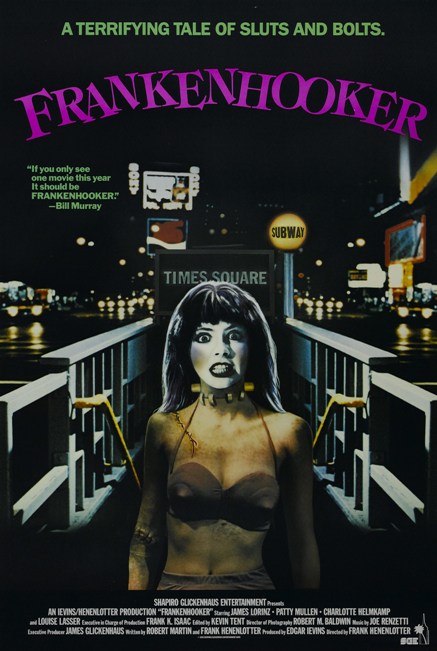
 Far be it from the Cap'n to neglect the fact that October means more horror releases, especially on Blu-Ray, and this year there are some doozies. For example, right now you can buy Basket Case, Frankenhooker, The Frighteners, The Others, The Bad Seed, The Last House on the Left, Torso, Dead Alive, Guillermo Del Toro's director's cut of Mimic, Herschel Gordon Lewis' Blood Trilogy (Blood Feast, Two Thousand Maniacs, and Color Me Blood Red), The Hills Have Eyes, Hellbound: Hellraiser II, Maniac Cop, Troll Hunter, The Phantom Carriage, Dark Night of the Scarecrow, and The Ward.

 That's right now. If that's not enough to fill up your queue, Attack the Block is coming next week, along with The House by the Cemetery and The Island of Lost Souls. If you're like me and feeling a bit industrious, you can shimmy on over to Amazon.co.uk and order the Nightmare on Elm Street Collection on Blu-Ray instead of waiting on a U.S. release next year. New Line figured it would be enough to leave Freddy fans with the existing first film on BD and a double feature of the best (Dream Warriors) and worst (Freddy's Revenge) Nightmare entries, the United Kingdom gets the whole shebang plus some new extras (including episodes of Freddy's Nightmares) in a Region Free package.

 Yes, that's Region Free as in "it will play on your PS3 / Blu-Ray player / etc." And so I'm not sounding like a commercial, in the interest of full disclosure I already ordered one which means I paid what was roughly $55 bucks with currency conversion. It won't even arrive for another week and a half at the soonest, but it's worth the hassle for me. If it's available and the same thing I'm going to see twelve months from now, I'll drop a little more for the privilege of having all the Nightmare flicks in one box again.

 I also put a little bit down for Arrow Film's Blu-Ray release of Day of the Dead, the much maligned third entry into Romero's "Dead" series. It's also region free, looks better than the Anchor Bay BD, and has something that no release of Day of the Dead has since VHS - the original audio track. For whatever reason, all of the Anchor Bay DVDs of Day of the Dead had slightly modified tracks that arbitrarily replaced profanity. Arrow Films found the original track and included it on the disc, along with new and old extras, a special effects commentary track (with the "N" and "B" of KNB plus two other crew members) in a really nice box that kicks the old BD all over the road. That I was able to find on the Amazon Marketplace for less than what a comparable set might sell for over here.

I'd considered Arrow's Dawn of the Dead, but the darned thing isn't Region Free, which makes it about as useful as the All the Boys Love Mandy Lane Blu-Ray I bought without reading carefully. Ah well, all the more incentive to seek out a Region Free Blu-Ray player down the line...

 Oh, and just so we don't leave out Amazon.ca, they have [Rec], [Rec]2, and Martyrs on Blu-Ray, which has my attention (although not my wallet.... yet). So there are plenty of options out there for a high definition Horror fanatic with an urge to splurge. Which would be me, but currently isn't: of the massive list above, I only have The Phantom Carriage and Troll Hunter. That Frighteners discs is really calling me though - both cuts and everything from that flipper disc special edition!

---

 In order to make this a proper "News and Notes" and not just a "hey gang, this is what's coming on Blu-Ray" I must stress my disappointment in the walloping that the prequel to The Thing is taking. I had a more than passing interest in seeing the film, but the negative buzz is such that I just can't bring myself to waste $10 for something that disappointing. Damn. Well, there's always Don't Be Afraid of the Dark, and Piranha 3DD when that comes out.

Tuesday, March 8, 2011

Retro Review: Dawn of the Dead (Extended Edition)

Welcome back to Retro Reviews: after that Night of the Living Dead anniversary hack job last week, the Cap'n needed a palate cleanser, preferably with zombies. I watched Shaun of the Dead (with the Edgar Wright / Simon Pegg commentary on, because I'm the kind of person who listens to commentaries, thank you very much), but I realized what I really wanted to watch was Dawn of the Dead. The last three times I saw the film, however, I had seen the theatrical cut, so it seemed high time to shake things up. It was time for the longer, zombie-er-er "extended" cut!

While I will cover aspects of the film, this review will also cover the history of the "extended" cut. Accordingly, I won't recap Dawn of the Dead for readers unfamiliar with the film, and will more than likely include spoilers.

Unlike the mangled, pointless Night of the Living Dead 30th Anniversary edition, Dawn of the Dead's history of alternate versions goes back almost to the film's release. There are a number of different cuts (many of which were bootlegs in the era of VHS) in different countries, but Anchor Bay settled on three versions for its Ultimate Edition: the theatrical cut (127 minutes), the "extended" version (139 minutes), and the "European" cut (121 minutes).

The Ultimate Edition is, in many ways, a combining of earlier (albeit bare bones) releases of the films: in the early days of DVD, Anchor Bay released the "extended" version as the "Director's Cut," a disc so early in the medium's existence that Dual Layer technology had not yet been implemented, meaning that you had to flip the disc halfway through the film*. Romero was quick to point out that he preferred the shorter, theatrical version, so when releasing the Ultimate Edition, it was given the "extended" moniker and suggested as producer Richard Rubenstein's preferred cut. The European Cut, also known as Zombi, was re-edited by Dario Argento for foreign audiences; this version is shorter, removes much of the humor, and adds a few smaller character moments.

And that is, in a nutshell, your brief recap of the different versions of Dawn of the Dead. For the purposes of today's Retro Review, the Cap'n is setting the wayback machine to the version I've had the most contact with, the "Director's" or "extended" cut. Over the years I've had multiple copies of the longer version on VHS and DVD, and while the Blu Ray release is the theatrical cut, the version I've seen as often (if not more often) is the longer cut.

Young cinephiles are always excited to find something they didn't know existed, especially "alternate" cuts of films they love. I had seen Dawn of the Dead, maybe made a copy on VHS, and knew the film well by the time I first saw the two tape "Original Director's Cut" at, of all places, a used Record Store. Assuming that the Dawn of the Dead I knew was merely a charade, some censored version, I paid eight dollars (or whatever the price was) to see the "true" Dawn of the Dead, and to show it to all the other zombie fanatics I knew, as I would with so many other films over the years. Despite the fact that this was something mass produced - not to mention something someone already bought and sold - we thought we had the inside track on movie secrets!

I confess that I owned the "flipper" disc of the "Director's Cut" as well as the later Theatrical cut (which wasn't a flipper), and more than likely owned the re-release that preceded the four disc Ultimate Edition (which I still have). The holy grail until the Ultimate Edition was Zombi, the Argento cut, but aside from stripping away much of the social commentary and the underlying humor that sold it, Argento's version (disc three) isn't much more than a footnote best remembered for allowing Lucio Fulci to make Zombi 2 (or, as it's known in the U.S., Zombie). Let's take a look at what makes the "extended" cut so, well, extended.

The chief difference between the "extended" cut (disc two) and the theatrical version (disc one) of the set is that there's more of just about everything: more mall, more interview footage with the scientists, more ransacking, more mall shopping montage, and more chaos at the beginning, both in the WGON news station and in the housing project. With twelve extra minutes, there's actually less zombie carnage and more time spent developing the relationships between Roger, Stephen, Francine, and Peter. The additions are spread out over the film, usually in little chunks rather than a noticeably different sequence. Over the years the 127 and 139 minute versions bled together so much that I don't notice when minor additions are missing or present.

In fact, the only scene I can directly point to is early in the film: an extended encounter between the protagonists and police officers escaping by boat. In the theatrical version, most of the conversation is limited to the conversation about escaping to an island ("any island") and the cop asking for cigarettes. In the "extended" cut, there's a longer standoff between the two groups, and a cameo that I found interesting with respect to Romero's last three "dead" films.

Visitors to the Blogorium (and no doubt many other pages) have periodically dropped in my Survival of the Dead review because Alan Van Sprang appears in Land, Diary, and Survival of the Dead, playing what may or may not be the same character (Brubaker, Colonel, and Sarge, respectively). Since Land takes place after Diary and Survival, it is entirely possible that Van Sprang is playing the same soldier, but it turns out Romero also cast an actor in Dawn of the Dead for a minor part only to use him in a lead role in his next "dead" film. Joe Pilato, who plays Captain Rhodes in Day of the Dead, is one of the escaping officers in Dawn of the Dead. The "extended" cut expands his cameo by giving him the most interaction with Stephen and Francine, and he's listed in the credits. It's almost certain that Pilato is not playing the same role; the Van Sprang connection remains to be seen.

Other than that minor trivia tidbit, the "extended" cut of Dawn of the Dead does feel a little padded at times. Oh sure, it's nice to spend more time in the mall, to see more of Roger before he "turns," and feel the sense of time as the Monroeville Mall shifts from dream to nightmare, but in other ways the additions hurt the film. The film's opening at WGON is interminably long, and while it conveys a sense of chaos as the world tries to explain what's happening, the urgency of Francine needing to escape diminishes with every cut back to George Romero's cameo, or to the longer argument on-camera about the nature of the dead. The cumulative effect actually lessens the immediacy of "getting away," in part because the audience is now mired in the minute details of keeping the station operational.

It also takes twice as long to introduce Ken Foree's Peter and Scott Reiniger's Roger during the apartment complex raid. The sequence is adversely affected as a result: while the raid itself doesn't appear to be any longer than in the theatrical version, it certainly feels longer because the WGON sequence dragged the pace of Dawn of the Dead to a crawl, and by the time the foursome leaves in the helicopter it feels like the film may never find momentum. Romero's theatrical cut allows the film to have a sense of urgency, of desperation, before the film slows down in the middle, then to pick up again during the biker raid near the end.

With respect to pacing issues, I will say that there's no great harm done to Dawn of the Dead as a whole in the "extended" cut. It's hardly a mangled version of the film and, at times, benefits from a more languid pace. At two hours and twenty minutes, you're going to get more Dawn than you ever knew you needed, but for fans who wore out their shorter versions, it's a nice break from the norm.

Join the Cap'n next week when I continue "March of the Dead" by reviewing, um... Day of the Dead? Maybe? Return of the Living Dead part 2? We'll see when we get there.


* Early DVD adopters might also remember this from Goodfellas and Sleepers discs as well.

Monday, October 18, 2010

Blogorium Review: House by the Cemetery

The House by the Cemetery is an exercise in futility: the film, made by Lucio Fulci (The Psychic, The New York Ripper) should be a gorehound's delight, with it's quasi-Lovecraftian connection (it forms the "Death" Trilogy with The Beyond and City of the Living Dead / Gates of Hell), brutal kills, and atmospheric setting (just north of Boston, Mass). Instead, the film is a disaster; an unnecessarily convoluted narrative that contradicts itself whenever possible, leaving plot points that go nowhere, characters that serve no purpose, and an ending that raises more "what?"s than anything else.

I don't know how much of this to blame on the fact that the DVD is dubbed and offered no alternate language / subtitle options (IMDB indicates it was filmed in Italian) but I doubt that many of the erratic plot jumps could be saved simply by Fulci's native tongue. From the opening sequence, which spatially misrepresents the Freudstein house, to the final scene and its fabricated Henry James quote, not a whole lot of The House by the Cemetery makes a lot of sense.

Following the strange death of his mentor, Dr. Peterson, Norman Boyle (Paolo Marco) moves his wife Lucy (Katherine MacColl) and son Bob (Giovanni Frezza) from New York to the small town of New Whitby, where Peterson murdered his mistress and hung himself. Staying in the "Freudstein" house - redubbed Oak Mansion by the real estate agent (Dagmar Lassander) - with Ann (Ania Perioni), Bob's babysitter, the Boyle's are beset with strange occurrences, mysterious indoor tombs, and a locked cellar that hides a terrible secret. Will Norman discover the secret of Dr. Freudstein before it's too late? Why did Peterson kill himself? Is Lucy really going insane, or is someone else in the house? And who is Bob's new friend Mae (Silvia Collatina), a girl only he can see who warns him of grave dangers?

Honestly, don't expect any of those questions to be answered. Well, not exactly. By the time anyone figures out what's going on at any point in the film, it's too late for them. Across the board, the plot of The House by the Cemetery makes no effort to address any of the many questions it raises, instead compounding on "twist" after another to the point that none of them mean anything at all. Every single character in the film exists to react to something that happens, and no one (including Dr. Freudstein) actually does anything to set events in place.

The criminal mistake that Fulci makes in The House by the Cemetery is to assume that just because the film is "inspired" by H.P. Lovecraft that he (and co-screenwriters Giorgio Mariuzzo and Dardano Sacchetti) frequently set up plot points that disappear mid-movie, or abruptly change characters in order to suit a "kill" scene. Norman is the subject of an entire subplot that goes nowhere: while following up on Dr. Peterson's research, more than one character mentions that Boyle has been to New Whitby before, has a daughter (not a son), and seem very surprised when he refutes their claims. Even Lucy asks him why it is he has a picture of the Freudstein house (which he makes dubious excuses about).

Ann, the babysitter, also seems to be involved in some conspiratorial pact with Norman, considering the frequency of close-up of Normans eyes, Ann's eyes, and sometimes Lucy, who has no idea what's going on. Ann, after all, goes out of her way to remove the board covering the cellar door, cleans up the blood after Freudstein kills the real estate agent, and seems to have a particular interest in Bob. That is, until she goes down into the cellar and is killed by Freudstein (decapitated, as per a vision Mae has with mannequins). Ann seems so surprised that Freudstein is down in the cellar that it totally undermines the suspicious behavior earlier.

Of course, almost everything is undone. To spoil a great deal for you (if such a thing is possible in a film that goes out of its way not to make sense), Norman doesn't have any connection to the Freudstein house that's ever mentioned, the couple in the beginning aren't Peterson and his mistress, and Mary Freudstein might be Dr. Freudstein and the monster we assumed was Dr. Freudstein is her son Jacob (at least, that is, if the ghost Mary and ghost Mae that take Bob away have anything to do with the quote Fulci made up and attributed to Henry James have anything to do with the story). We also never learn why the Boyles didn't leave the house after the "bat" incident (more on that below), even though they clearly stated they weren't staying.

The cheap and easy solution the trio of screenwriters thought they could get away with was a Lovecraft-esque series of revelations by Peterson that hinted at an increasing madness, leading him to suicide. Unfortunately, within the frame of a slasher narrative - with giallo-inspired murder set-pieces - creeping madness and dread become irrelevant. The two subgenres unfortunately fail to intersect: one demands a protagonist that encounters evil and goes insane, the other requires all characters but one to be killed and for the hero to kill the monster. The House by the Cemetery manages to do neither, instead settling more a muddled "ghost story" ending that just barely closes things out.

Does The House by the Cemetery have anything going for it? Well, as this is a Lucio Fulci film, the blood flows freely and the gore is at least worth some of your time*. While there's nothing as inventive or disturbing as Zombi 2, The New York Ripper, or Cat in the Brain, the Freudstein makeup is pretty cool, if entirely spoiled by the DVD cover. The kills alternate between simple giallo-esque stabbings (the real estate agent, the girl at the beginning) to full on exposed brains and heads decapitated slowly with a kitchen knife.

In particular, there's a sequence where the Boyle family goes into the basement for the first time and are attacked by a bat that starts unintentionally funny and grows increasingly violent, especially when Norman stabs the bat and it begins bleeding profusely, but doesn't die. Also of note: Mae's hallucination (vision?) of a mannequin that looks like Ann losing its head - complete with very real looking tendons and blood - adds a nightmarish quality early in the film. Alas, it promises more than The House by the Cemetery can deliver, so enjoy it while you can. The movie itself isn't really worth the time it takes to watch, especially when Fulci has so many better films to offer.


* How much of your time? Certainly not the 87 minutes it takes to watch the film, but I'm sure there's some "gore" compilation from the film on YouTube that'll save you wondering what you missed.

Friday, October 1, 2010

Shocktober: Official Horror Fest Announcement

Greetings, readers. As many of you know, October is my favorite month for movies, and the Cap'n tries to stack the deck with horror movies that I haven't seen or that I think you should hear about. There's also something else that happens every October, and that's:

HORROR FEST

Now, a number of regular readers have been asking me for details about Horror Fest V (originally sub-titled "A New Beginning," per the Friday the 13th series). Originally, I had planned to hold it in Santa Fe, where I'm currently located, but there's been a slight change of plans. This Halloween weekend, Horror Fest V will take place in....

GREENSBORO

where the Cap'n will be returning in the next week or so. I won't bore you with the details, because Horror Fest is front and center here in the Blogorium, and boy howdy do I have a killer lineup this year. Also, I have a new sub-title:


This year's Horror Fest Includes:

Weasels Rip My Flesh

Curse of the Undead

Point of Terror

Kingdom of the Spiders

Frankenhooker

Pieces

The House of the Devil

Street Trash

City of the Living Dead

The New York Ripper

The House on Sorority Row

It's Alive

The Evil Dead

Happy Birthday to Me

Let the Right One In

Night of the Living Dead

Tales from the Crypt

The Living Dead at the Manchester Morgue

The Exorcist

and our only returning film...

Trick 'r Treat

Festivities will begin Thursday, October 28th, at 7 p.m. and will continue until Sunday, October 31st. Due to budgetary limitations, this year's Horror Fest will be a BYOB affair*, and snacks may be limited.

The location is contingent on where the Cap'n ends up moving in Greensboro, so stay tuned for details. I hope to see as many of you as possible for Horror Fest's return to G-Vegas!

* The upside is that there will be NO Wild Irish Rose, Tequiza, or Bud Light with Clamato on the premises.