For at least the last decade, there seems to be a concerted push to anoint one horror movie as the next "classic": the genre reinventing, flying-under-the-radar take that will usher us out of this endless trend of remakes and PG-13 zombie/vampire/werewolf teen-friendly tripe. Sometimes, the hype is justified (The House of the Devil, The Cabin in the Woods), sometimes not (Hatchet, Behind the Mask*), but I think it's safe to say that we're not going to get rid of the PG-13 horror trend any time soon. In fact, there was a trailer for the Ghost House Pictures remake of Poltergeist in front of the movie we'll be discussing today. It Follows has been riding on a groundswell of praise from horror fans, and Radius / TWC is finally listening to audiences and putting the film in theatres, as opposed to dumping it on VOD. By the time the Cap'n heard about it, It Follows was already being labeled "this year's The Babadook," and I was a little worried about going in with heightened expectations, so I just stopped reading about the film. Does it live up to the hype?
(if you really don't want to know anything else, skip to the last paragraph, but the short answer is "yes.")
Jay Height (Maika Monroe) is a college student living at home with her mother and younger sister, Kelly (Lili Sepe). She's been on a few dates with Hugh (Jake Weary), and is thinking about taking things to the next level, but Hugh's behavior is a little strange. He seems to see people that Jay can't, and is always in a hurry to leave wherever they're settling in. But she decides to sleep with him, and as she's relaxing in the back seat of his car, Hugh knocks her out with a rag and chemicals. She wakes up tied to a wheelchair in the abandoned remains of a hotel, with Hugh pacing the building, looking frantically for... something. There's something following him; it's slow, but it's not dumb, and it's going to kill him, so he passed it on to Jay. If she wants to live, she has to pass it on to someone else, or it comes after him. It can look like anyone, but if it's feeling cruel, it will look like those you love most. She's tied down to prove that he's not making this up, and before long, someone - or something - slowly walks up to where she is...
We already know what the "It" is capable of from the opening sequence, which also establishes writer / director David Robert Mitchell's visual style: long, unbroken takes, using the most of the wide screen composition. If it helps, think of Halloween, and understand that I know how lofty of a comparison it is to make. Mitchell walks us through the moment of panic for "It"'s last victim - Hugh's first attempt to pass it on? - as she tries to escape from her house, to drive to the beach. And then a smash cut to the next morning. The stakes are established. Once Hugh explains the rules, we know what Jay is up against. We'll learn a little more about the "It," but not directly from the characters. It Follows is a film heavy on inference, on visual clues rather than exposition dump scenes. What you take away from the film depends heavily on how carefully you're paying attention.
Mitchell packs plenty in the frame to pay attention to, as Jay and her friends Yara (Olivia Luccardi), Paul (Keir Gilchrist), Kelly, and neighbor Greg (Daniel Zovatto) try to find Hugh, who rented his place in Detroit under a fake name and presumably skipped town. When the threat could be anything, it's a demented version of "Where's Waldo" in the frame - who's really a person? Who is it? Early on, Mitchell makes it abundantly clear, but towards the middle of the film, he starts playing with the audience. Much later in the film, "It" takes the form of someone we've only seen in photographs, and he relies on the viewer to have been observant. You don't need to know who it is - or was - but it's a bonus that weighs in It Follows' favor.
There are many things about It Follows I'd like to talk about, but would risk SPOILING plot points. Boiled down to its core, the film is a very straightforward variation on the horror trope of "Sex = Death," one that's been analyzed ad nauseum in college courses the world over. It Follows will likely join those thesis proposals, in part because Mitchell takes a very ambiguous approach to how and what we find out about the threat. They "why" is abandoned, strictly speaking, which distinguishes the film from many of its modern brethren. A reductive reading would call it "The Ring as an STD," but remove all of The Ring's second half - there is not history here. Jay only traces it as far back as Hugh (real name, Jeff, at home with his mother) - he got it from "some girl at a bar." We have some idea of what happened to Annie (Bailey Spry), the girl from the beginning, after Jay's attempt to pass it on goes horribly wrong, but it's only in flashes. What it wants is up to us to decide, and why the rules are the way they are is similarly up to interpretation.
Instead of devoting most of the film to monster lore creation, Mitchell spends almost all of It Follows dealing with Jay's fragile emotional state, as she struggles with how to deal with her state. It's a curious wrinkle that all of the sex in It Follows is consensual, and yet Jay is clearly left violated in every situation (one in particular is left to the imagination, only holding on her face before and after she swims out to a boat). Does she want to pass this curse on to someone else? Does she want to die? There seems to be no way to stop "It," and only the "infected" can see it. "It" can see them once they've passed it on, but it isn't interested. Not yet, anyway. You can drive and get ahead for a while, but it will always be right behind you, walking slowly, emotionless.
The inevitability of the threat could be a detriment to It Follows: in a more conventional approach, like the Final Destination series, it simply becomes an excuse to put Grand Guignol kills on display, character development be damned. But the death toll is relatively limited in It Follows, and they both count, emotionally. One sets the tone for the film, another gives us a vague insight to the first death, although what you take away is largely a matter of interpretation. I give the lion's share of the credit to the cast, although Mitchell certainly gives them plenty of time to breathe and to exist on screen. As a matter of fact, it's refreshing to see a group of young actors who don't look like the Hollywood Casting Template for Horror Films (see anything released by Platinum Dunes), and instead a cast that look like normal teenagers, that act like normal teenagers.
I say this knowing full and well that I just saw Maika Monroe in The Guest, playing a character just a little bit older than Jay is. I saw her in The Bling Ring, too, but didn't remember he when I saw The Guest. Monroe, like the rest of the kids (adults don't factor into It Follows in many ways, aside from two, meaningful moments involving the "It") is totally believable as Jay, a young woman thrust into a situation she doesn't understand and forced to cope with it. She doesn't magically become Nancy Drew or Buffy when "It" appears. She gets frightened, panics, makes bad decisions, and when she tries to help it doesn't always work. Likewise, Sepe, Luccardi, Gilchrist, and Zovatto aren't just assigned "types." They're Jay's friends, and despite the fact that Mitchell sets Greg and Paul against each other, the end of the film still isn't as apparent as I thought it would be.
Arguably the film's weakest moment comes from Paul's plan to stop "it" by electrocution in a public swimming pool they all went to when they were younger. The plan doesn't really make sense - the pool is too big, for one - but they aren't aware of what Jay and the audience know. We know that when she tried to shoot "it" (and as she just learned how to fire a gun a few hours before, she's a terrible shot), that didn't work. Mitchell foreshadows their plan with a shot that seems to be out of place in the film - the smaller pool out back that Jay enjoys swimming in, inexplicably ripped open - but it makes sense only in retrospect. That might have worked, but in their desperation, Paul's plan backfires and it ends up hurting more than just Jay. The only thing that works in the scene is the final shot, where Jay looks into the swimming pool and sees something the others can't, an image left open to your own interpretation.
The pool sequence is a minor stumble, but one I feel like I should point out. Mitchell and It Follows bounce back with a less conventional, more ambiguous ending that left some of the audience disappointed. Then again, I made the deliberate choice to see It Follows with a more conventional audience just to see how'd they would react. I could have seen the film at a smaller, art house theater with a more enthusiastic crowd, but it seemed like this would be an interest test case to see how the multiplex crowd reacted to less mainstream horror. They liked it while the film was going on, but seemed dissatisfied that it didn't end on some grand show down, the kind I imagine the remake of Poltergeist will (their enthusiastic reaction to the trailer was also telling).
But here's the truth about the internet hype machine surrounding independent horror: it only works for people who are seeking out the kind of movies that are like It Follows. The buzz is not going to change the minds of people who get impatient with something different from the formula, or something as stripped down as It Follows. And that's great. It really is, because I wouldn't have known about It Follows otherwise, and I will see it again. I want to see it again, because there's so much that Mitchell packs into the frame that I know I missed some of it. I want to pay closer attention to the forms "it" takes, because they're careful hints about the creature's history. Or maybe not - it's clear halfway through the film that "it" can and will take the form of a previous victim. I want to see if I somehow missed something that led to the pool in the backyard being torn open. The sign of a great horror movie (or any movie, for that matter) is that you're thinking about it after the fact. That you want to watch it again, to dig through and pick up pieces you missed. It's what distinguishes It Follows from the more basic "Sex = Death" movies that are enjoyable, but disposable.
I also have to point out how amusing it is to have Yara reading Dostoyevsky's The Idiot on a clamshell phone, which is a minor subplot in the film. Nice touch.
So if you're reading this review and wondering "should I see this or is it all sizzle and no steak?" the answers are an emphatic yes and an emphatic no, in that order. If you think you'd like It Follows, then yes, see it. If you liked The Babadook - which It Follows has a tonal connection to, particularly in how it ends - or You're Next or The Cabin in the Woods or The House of the Devil, basically anything that flew mostly under the radar as horror goes, go see it. I think you're really going to like it. Sometimes the hype is justified. That doesn't mean that It Follows is "game changing" or "genre redefining," two terms overused to help sell movies of this ilk. Much like Starry Eyes, another independent horror film that's flying under most people's radars, It Follows takes a concept you're familiar with and tells it in a unique way. I don't want to undersell this film, nor do I want to oversell it, because your mileage may vary. Don't seek out spoilers. Try to see it with limited knowledge. Which, uh, means not having read this review, I guess. Oops.
* I realize this is going to be a difference of opinion, but I found nothing in either movie worth watching: Behind the Mask either doesn't understand or chooses to misrepresent slasher movie "tropes" in order to advance its narrative, and the first Hatchet film has extreme gore and nothing else going for it. I have not seen Hatchet II or III, but have yet to see a review that made me want to.
Showing posts with label Theatrical Releases. Show all posts
Saturday, October 3, 2015
Wednesday, April 1, 2015
Blogorium Review: It Follows
For at least the last decade, there seems to be a concerted push to anoint one horror movie as the next "classic": the genre reinventing, flying-under-the-radar take that will usher us out of this endless trend of remakes and PG-13 zombie/vampire/werewolf teen-friendly tripe. Sometimes, the hype is justified (The House of the Devil, The Cabin in the Woods), sometimes not (Hatchet, Behind the Mask*), but I think it's safe to say that we're not going to get rid of the PG-13 horror trend any time soon. In fact, there was a trailer for the Ghost House Pictures remake of Poltergeist in front of the movie we'll be discussing today. It Follows has been riding on a groundswell of praise from horror fans, and Radius / TWC is finally listening to audiences and putting the film in theatres, as opposed to dumping it on VOD. By the time the Cap'n heard about it, It Follows was already being labeled "this year's The Babadook," and I was a little worried about going in with heightened expectations, so I just stopped reading about the film. Does it live up to the hype?
(if you really don't want to know anything else, skip to the last paragraph, but the short answer is "yes.")
Jay Height (Maika Monroe) is a college student living at home with her mother and younger sister, Kelly (Lili Sepe). She's been on a few dates with Hugh (Jake Weary), and is thinking about taking things to the next level, but Hugh's behavior is a little strange. He seems to see people that Jay can't, and is always in a hurry to leave wherever they're settling in. But she decides to sleep with him, and as she's relaxing in the back seat of his car, Hugh knocks her out with a rag and chemicals. She wakes up tied to a wheelchair in the abandoned remains of a hotel, with Hugh pacing the building, looking frantically for... something. There's something following him; it's slow, but it's not dumb, and it's going to kill him, so he passed it on to Jay. If she wants to live, she has to pass it on to someone else, or it comes after him. It can look like anyone, but if it's feeling cruel, it will look like those you love most. She's tied down to prove that he's not making this up, and before long, someone - or something - slowly walks up to where she is...
We already know what the "It" is capable of from the opening sequence, which also establishes writer / director David Robert Mitchell's visual style: long, unbroken takes, using the most of the wide screen composition. If it helps, think of Halloween, and understand that I know how lofty of a comparison it is to make. Mitchell walks us through the moment of panic for "It"'s last victim - Hugh's first attempt to pass it on? - as she tries to escape from her house, to drive to the beach. And then a smash cut to the next morning. The stakes are established. Once Hugh explains the rules, we know what Jay is up against. We'll learn a little more about the "It," but not directly from the characters. It Follows is a film heavy on inference, on visual clues rather than exposition dump scenes. What you take away from the film depends heavily on how carefully you're paying attention.
Mitchell packs plenty in the frame to pay attention to, as Jay and her friends Yara (Olivia Luccardi), Paul (Keir Gilchrist), Kelly, and neighbor Greg (Daniel Zovatto) try to find Hugh, who rented his place in Detroit under a fake name and presumably skipped town. When the threat could be anything, it's a demented version of "Where's Waldo" in the frame - who's really a person? Who is it? Early on, Mitchell makes it abundantly clear, but towards the middle of the film, he starts playing with the audience. Much later in the film, "It" takes the form of someone we've only seen in photographs, and he relies on the viewer to have been observant. You don't need to know who it is - or was - but it's a bonus that weighs in It Follows' favor.
There are many things about It Follows I'd like to talk about, but would risk SPOILING plot points. Boiled down to its core, the film is a very straightforward variation on the horror trope of "Sex = Death," one that's been analyzed ad nauseum in college courses the world over. It Follows will likely join those thesis proposals, in part because Mitchell takes a very ambiguous approach to how and what we find out about the threat. They "why" is abandoned, strictly speaking, which distinguishes the film from many of its modern brethren. A reductive reading would call it "The Ring as an STD," but remove all of The Ring's second half - there is not history here. Jay only traces it as far back as Hugh (real name, Jeff, at home with his mother) - he got it from "some girl at a bar." We have some idea of what happened to Annie (Bailey Spry), the girl from the beginning, after Jay's attempt to pass it on goes horribly wrong, but it's only in flashes. What it wants is up to us to decide, and why the rules are the way they are is similarly up to interpretation.
Instead of devoting most of the film to monster lore creation, Mitchell spends almost all of It Follows dealing with Jay's fragile emotional state, as she struggles with how to deal with her state. It's a curious wrinkle that all of the sex in It Follows is consensual, and yet Jay is clearly left violated in every situation (one in particular is left to the imagination, only holding on her face before and after she swims out to a boat). Does she want to pass this curse on to someone else? Does she want to die? There seems to be no way to stop "It," and only the "infected" can see it. "It" can see them once they've passed it on, but it isn't interested. Not yet, anyway. You can drive and get ahead for a while, but it will always be right behind you, walking slowly, emotionless.
The inevitability of the threat could be a detriment to It Follows: in a more conventional approach, like the Final Destination series, it simply becomes an excuse to put Grand Guignol kills on display, character development be damned. But the death toll is relatively limited in It Follows, and they both count, emotionally. One sets the tone for the film, another gives us a vague insight to the first death, although what you take away is largely a matter of interpretation. I give the lion's share of the credit to the cast, although Mitchell certainly gives them plenty of time to breathe and to exist on screen. As a matter of fact, it's refreshing to see a group of young actors who don't look like the Hollywood Casting Template for Horror Films (see anything released by Platinum Dunes), and instead a cast that look like normal teenagers, that act like normal teenagers.
I say this knowing full and well that I just saw Maika Monroe in The Guest, playing a character just a little bit older than Jay is. I saw her in The Bling Ring, too, but didn't remember he when I saw The Guest. Monroe, like the rest of the kids (adults don't factor into It Follows in many ways, aside from two, meaningful moments involving the "It") is totally believable as Jay, a young woman thrust into a situation she doesn't understand and forced to cope with it. She doesn't magically become Nancy Drew or Buffy when "It" appears. She gets frightened, panics, makes bad decisions, and when she tries to help it doesn't always work. Likewise, Sepe, Luccardi, Gilchrist, and Zovatto aren't just assigned "types." They're Jay's friends, and despite the fact that Mitchell sets Greg and Paul against each other, the end of the film still isn't as apparent as I thought it would be.
Arguably the film's weakest moment comes from Paul's plan to stop "it" by electrocution in a public swimming pool they all went to when they were younger. The plan doesn't really make sense - the pool is too big, for one - but they aren't aware of what Jay and the audience know. We know that when she tried to shoot "it" (and as she just learned how to fire a gun a few hours before, she's a terrible shot), that didn't work. Mitchell foreshadows their plan with a shot that seems to be out of place in the film - the smaller pool out back that Jay enjoys swimming in, inexplicably ripped open - but it makes sense only in retrospect. That might have worked, but in their desperation, Paul's plan backfires and it ends up hurting more than just Jay. The only thing that works in the scene is the final shot, where Jay looks into the swimming pool and sees something the others can't, an image left open to your own interpretation.
The pool sequence is a minor stumble, but one I feel like I should point out. Mitchell and It Follows bounce back with a less conventional, more ambiguous ending that left some of the audience disappointed. Then again, I made the deliberate choice to see It Follows with a more conventional audience just to see how'd they would react. I could have seen the film at a smaller, art house theater with a more enthusiastic crowd, but it seemed like this would be an interest test case to see how the multiplex crowd reacted to less mainstream horror. They liked it while the film was going on, but seemed dissatisfied that it didn't end on some grand show down, the kind I imagine the remake of Poltergeist will (their enthusiastic reaction to the trailer was also telling).
But here's the truth about the internet hype machine surrounding independent horror: it only works for people who are seeking out the kind of movies that are like It Follows. The buzz is not going to change the minds of people who get impatient with something different from the formula, or something as stripped down as It Follows. And that's great. It really is, because I wouldn't have known about It Follows otherwise, and I will see it again. I want to see it again, because there's so much that Mitchell packs into the frame that I know I missed some of it. I want to pay closer attention to the forms "it" takes, because they're careful hints about the creature's history. Or maybe not - it's clear halfway through the film that "it" can and will take the form of a previous victim. I want to see if I somehow missed something that led to the pool in the backyard being torn open. The sign of a great horror movie (or any movie, for that matter) is that you're thinking about it after the fact. That you want to watch it again, to dig through and pick up pieces you missed. It's what distinguishes It Follows from the more basic "Sex = Death" movies that are enjoyable, but disposable.
I also have to point out how amusing it is to have Yara reading Dostoyevsky's The Idiot on a clamshell phone, which is a minor subplot in the film. Nice touch.
So if you're reading this review and wondering "should I see this or is it all sizzle and no steak?" the answers are an emphatic yes and an emphatic no, in that order. If you think you'd like It Follows, then yes, see it. If you liked The Babadook - which It Follows has a tonal connection to, particularly in how it ends - or You're Next or The Cabin in the Woods or The House of the Devil, basically anything that flew mostly under the radar as horror goes, go see it. I think you're really going to like it. Sometimes the hype is justified. That doesn't mean that It Follows is "game changing" or "genre redefining," two terms overused to help sell movies of this ilk. Much like Starry Eyes, another independent horror film that's flying under most people's radars, It Follows takes a concept you're familiar with and tells it in a unique way. I don't want to undersell this film, nor do I want to oversell it, because your mileage may vary. Don't seek out spoilers. Try to see it with limited knowledge. Which, uh, means not having read this review, I guess. Oops.
* I realize this is going to be a difference of opinion, but I found nothing in either movie worth watching: Behind the Mask either doesn't understand or chooses to misrepresent slasher movie "tropes" in order to advance its narrative, and the first Hatchet film has extreme gore and nothing else going for it. I have not seen Hatchet II or III, but have yet to see a review that made me want to.
Monday, August 20, 2012
(Mis)Adventures in Projectioneering: The Brain Wrap
This edition of Adventures in Projectioneering might lean a little on the technical side, but I'll try to keep it at a minimum. It's mostly about those nights where everything goes wrong, and in order get into detail without simply throwing out jargon, I'll explain some of the ins and outs of being a projectionist. The important part, when I'm running around like a maniac trying to fix one problem after the other, I'm sure you've all experienced.
Maybe it's the older equipment at the theatre I'm working at, or maybe it's Cap'n Howdy's "ring rust" (a.k.a. general incompetence) that caused things to fall apart not once, not twice, but four times during one shift this weekend. All four of them involved "Brain Wraps," which is the first piece of jargon I can knock out for you.
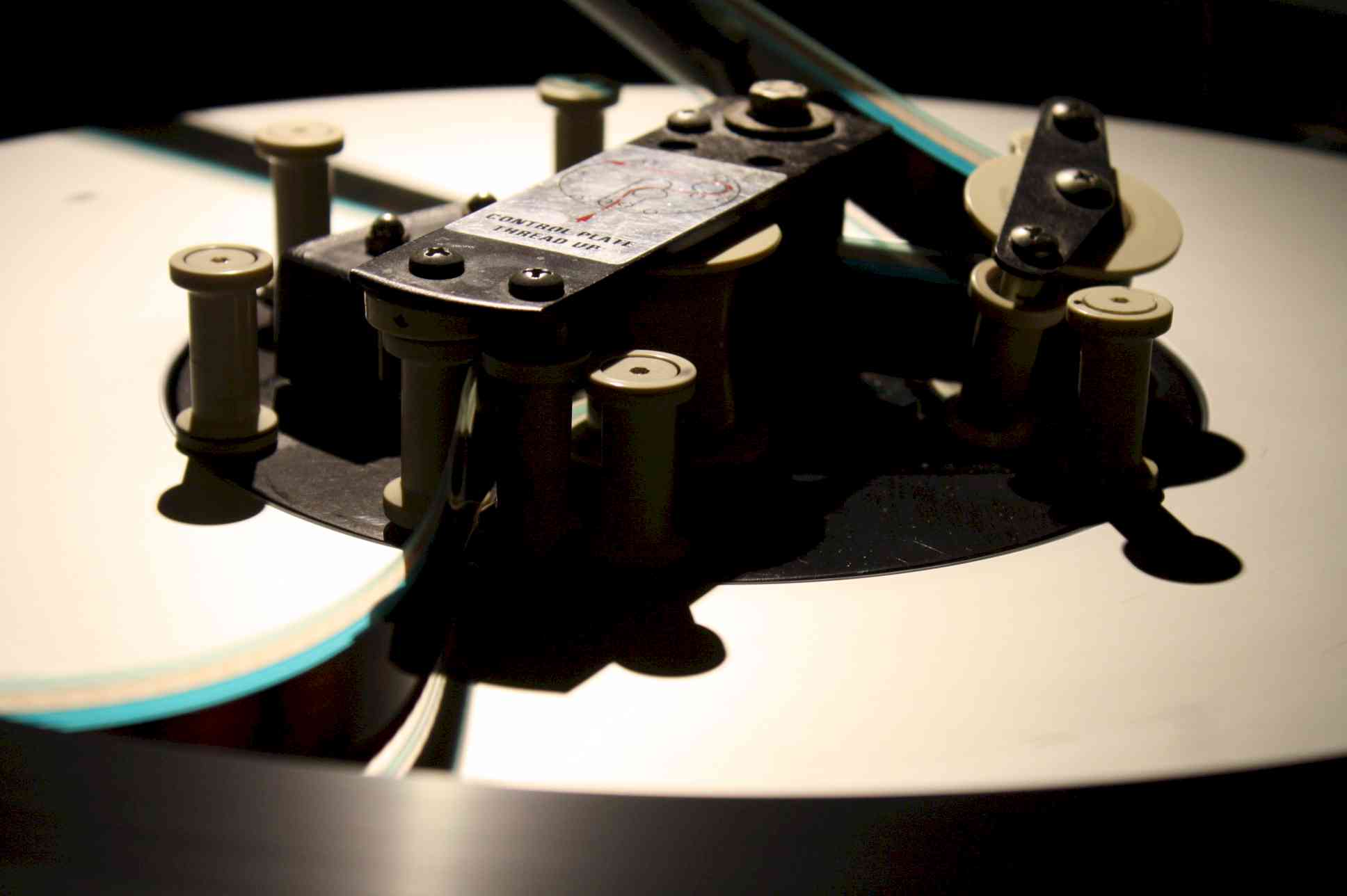
So this is the Brain, which sits on a platter with the film:
The film runs through the Brain, which determines the speed and prevents things from moving too quickly or too slowly. If the film moves too quickly or too slowly, it will begin to wrap around the Brain, hence the term "Brain Wrap." (Google apparently likes the term as one word, but I'll stick with my interpretation as amateur projectionist).
Brain Wraps can happen for other reasons as well; for example, if you thread the film the wrong way through the rollers or if a piece of film jumps over one of the rollers, it can cause the film to tighten around the brain until it can no longer feed through the projector and the film comes to a dead stop. The inert film will then melt as a result of the heat in the projector's lamp, which I gather you've seen or heard of in some form or the other. It's a nice "meta" technique in movies that want to draw attention to the projected image, as well as how Zack Snyder ended his trailer for Dawn of the Dead.
How it happened four times in one night is still something of a mystery, as one of the things I do is check and double check the platters and Brains while films are running. The platters and projectors are old, and the Brains are constantly being repaired. We're all aware that each projector has its own particular quirk (some run a little slow, some have film that jumps off of the rollers), so it's important to monitor them to make sure everything is going smoothly.
The first one seemed to be doing fine: it started normally, and when I came back to dim the lights and adjust the volume, it was still running through the Brain nominally, but when I came back upstairs from getting the next showtimes, something went wrong. And because I didn't go check on it sooner, Cap'n Howdy got to join the "Wall of Shame" where burned film hangs. Why it wrapped, we aren't sure, but wrap it did, to the point where the film around the brain was three or four inches around, which is really bad.
After that, I was extra vigilant, and since I was still training, the normally scheduled projectionist was also keeping a close eye out, which makes the next three all the more mysterious. I checked, double checked, and then was triple checked by the other projectionist, and everything was good. The threading was correct, the platters were on the correct setting, and there was no reason for a Brain Wrap. And yet, we came back to three separate projectors to find that the film had jumped over a roller and was beginning to wrap. All were easily fixed without having to make an emergency splice (therefore avoiding three more trips to the "Wall of Shame"), but my trainer was at a loss for how or why these phantom wraps occurred.
Nevertheless, this led to much running around, desperately trying to keep everything on schedule without letting a small problem get bigger (and it will) while hopefully keeping things invisible for the audiences below. For the folks who had to wait ten minutes for us to fix the melted Brain Wrap, I apologize. That's on me, and it won't happen again. I should have learned that lesson twelve years ago when a similar problem happened during Paul Verhoeven's Hollow Man. Alas, general incompetence gets us when we least expect it. Until next time...
Monday, October 17, 2011
News and Notes: Horror Edition
Welcome to another edition of News and Notes, where the Cap'n catches up on a few things I've been noticing and felt were worth sharing.
---
Far be it from the Cap'n to neglect the fact that October means more horror releases, especially on Blu-Ray, and this year there are some doozies. For example, right now you can buy Basket Case, Frankenhooker, The Frighteners, The Others, The Bad Seed, The Last House on the Left, Torso, Dead Alive, Guillermo Del Toro's director's cut of Mimic, Herschel Gordon Lewis' Blood Trilogy (Blood Feast, Two Thousand Maniacs, and Color Me Blood Red), The Hills Have Eyes, Hellbound: Hellraiser II, Maniac Cop, Troll Hunter, The Phantom Carriage, Dark Night of the Scarecrow, and The Ward.
That's right now. If that's not enough to fill up your queue, Attack the Block is coming next week, along with The House by the Cemetery and The Island of Lost Souls. If you're like me and feeling a bit industrious, you can shimmy on over to Amazon.co.uk and order the Nightmare on Elm Street Collection on Blu-Ray instead of waiting on a U.S. release next year. New Line figured it would be enough to leave Freddy fans with the existing first film on BD and a double feature of the best (Dream Warriors) and worst (Freddy's Revenge) Nightmare entries, the United Kingdom gets the whole shebang plus some new extras (including episodes of Freddy's Nightmares) in a Region Free package.
Yes, that's Region Free as in "it will play on your PS3 / Blu-Ray player / etc." And so I'm not sounding like a commercial, in the interest of full disclosure I already ordered one which means I paid what was roughly $55 bucks with currency conversion. It won't even arrive for another week and a half at the soonest, but it's worth the hassle for me. If it's available and the same thing I'm going to see twelve months from now, I'll drop a little more for the privilege of having all the Nightmare flicks in one box again.
I also put a little bit down for Arrow Film's Blu-Ray release of Day of the Dead, the much maligned third entry into Romero's "Dead" series. It's also region free, looks better than the Anchor Bay BD, and has something that no release of Day of the Dead has since VHS - the original audio track. For whatever reason, all of the Anchor Bay DVDs of Day of the Dead had slightly modified tracks that arbitrarily replaced profanity. Arrow Films found the original track and included it on the disc, along with new and old extras, a special effects commentary track (with the "N" and "B" of KNB plus two other crew members) in a really nice box that kicks the old BD all over the road. That I was able to find on the Amazon Marketplace for less than what a comparable set might sell for over here.
I'd considered Arrow's Dawn of the Dead, but the darned thing isn't Region Free, which makes it about as useful as the All the Boys Love Mandy Lane Blu-Ray I bought without reading carefully. Ah well, all the more incentive to seek out a Region Free Blu-Ray player down the line...
Oh, and just so we don't leave out Amazon.ca, they have [Rec], [Rec]2, and Martyrs on Blu-Ray, which has my attention (although not my wallet.... yet). So there are plenty of options out there for a high definition Horror fanatic with an urge to splurge. Which would be me, but currently isn't: of the massive list above, I only have The Phantom Carriage and Troll Hunter. That Frighteners discs is really calling me though - both cuts and everything from that flipper disc special edition!
---
In order to make this a proper "News and Notes" and not just a "hey gang, this is what's coming on Blu-Ray" I must stress my disappointment in the walloping that the prequel to The Thing is taking. I had a more than passing interest in seeing the film, but the negative buzz is such that I just can't bring myself to waste $10 for something that disappointing. Damn. Well, there's always Don't Be Afraid of the Dark, and Piranha 3DD when that comes out.
---
Far be it from the Cap'n to neglect the fact that October means more horror releases, especially on Blu-Ray, and this year there are some doozies. For example, right now you can buy Basket Case, Frankenhooker, The Frighteners, The Others, The Bad Seed, The Last House on the Left, Torso, Dead Alive, Guillermo Del Toro's director's cut of Mimic, Herschel Gordon Lewis' Blood Trilogy (Blood Feast, Two Thousand Maniacs, and Color Me Blood Red), The Hills Have Eyes, Hellbound: Hellraiser II, Maniac Cop, Troll Hunter, The Phantom Carriage, Dark Night of the Scarecrow, and The Ward.
That's right now. If that's not enough to fill up your queue, Attack the Block is coming next week, along with The House by the Cemetery and The Island of Lost Souls. If you're like me and feeling a bit industrious, you can shimmy on over to Amazon.co.uk and order the Nightmare on Elm Street Collection on Blu-Ray instead of waiting on a U.S. release next year. New Line figured it would be enough to leave Freddy fans with the existing first film on BD and a double feature of the best (Dream Warriors) and worst (Freddy's Revenge) Nightmare entries, the United Kingdom gets the whole shebang plus some new extras (including episodes of Freddy's Nightmares) in a Region Free package.
Yes, that's Region Free as in "it will play on your PS3 / Blu-Ray player / etc." And so I'm not sounding like a commercial, in the interest of full disclosure I already ordered one which means I paid what was roughly $55 bucks with currency conversion. It won't even arrive for another week and a half at the soonest, but it's worth the hassle for me. If it's available and the same thing I'm going to see twelve months from now, I'll drop a little more for the privilege of having all the Nightmare flicks in one box again.
I also put a little bit down for Arrow Film's Blu-Ray release of Day of the Dead, the much maligned third entry into Romero's "Dead" series. It's also region free, looks better than the Anchor Bay BD, and has something that no release of Day of the Dead has since VHS - the original audio track. For whatever reason, all of the Anchor Bay DVDs of Day of the Dead had slightly modified tracks that arbitrarily replaced profanity. Arrow Films found the original track and included it on the disc, along with new and old extras, a special effects commentary track (with the "N" and "B" of KNB plus two other crew members) in a really nice box that kicks the old BD all over the road. That I was able to find on the Amazon Marketplace for less than what a comparable set might sell for over here.
I'd considered Arrow's Dawn of the Dead, but the darned thing isn't Region Free, which makes it about as useful as the All the Boys Love Mandy Lane Blu-Ray I bought without reading carefully. Ah well, all the more incentive to seek out a Region Free Blu-Ray player down the line...
Oh, and just so we don't leave out Amazon.ca, they have [Rec], [Rec]2, and Martyrs on Blu-Ray, which has my attention (although not my wallet.... yet). So there are plenty of options out there for a high definition Horror fanatic with an urge to splurge. Which would be me, but currently isn't: of the massive list above, I only have The Phantom Carriage and Troll Hunter. That Frighteners discs is really calling me though - both cuts and everything from that flipper disc special edition!
---
In order to make this a proper "News and Notes" and not just a "hey gang, this is what's coming on Blu-Ray" I must stress my disappointment in the walloping that the prequel to The Thing is taking. I had a more than passing interest in seeing the film, but the negative buzz is such that I just can't bring myself to waste $10 for something that disappointing. Damn. Well, there's always Don't Be Afraid of the Dark, and Piranha 3DD when that comes out.
Tuesday, May 3, 2011
Retro Review: The Mission Valley Years
editor's note: while it may not appear to do so at first, this Retro Review will cover Payback, Idle Hands, Star Wars Episode I: The Phantom Menace, 8mm, Resident Evil, Last Action Hero, Jeepers Creepers, Harry Potter and the Sorcerer's Stone, Jurassic Park III, Lethal Weapon 4, The Matrix, American Pie 2, and Vanilla Sky.
From 1998 to 2002, there were many adventures at Mission Valley, a six screen multiplex in Raleigh. Sure, you could go to Imperial, which was closer, but there was an allure to Mission Valley, a theatre I'd been going to since childhood. Maybe the fact that there was a coffee place next door and a Record Exchange next to that. Or the North American Video not far away from the Rock-O-La Cafe, but Mission Valley was our home away from home when The Studio closed*.
At first, it was just that the dimly lit lobby was preferable to the bright, shiny, headache-inducing competition from Park Place 16, the new multiplex with its "stadium seating" and 25 cent summers (although we took advantage of that, too), but Mission Valley also had cheaper tickets, better popcorn, and "bladder busters" - the biggest damned drink cups in town, at a price that beat their megaplex competitors. Situated near NC State's campus, Mission Valley felt like a movie theatre instead of a conglomerated "big box" multiplex, so we gravitated towards it. Mission Valley eventually became the theatre that owners of The Rialto and Colony theatres replaced The Studio with, and while the others lean towards more "art house" fare, Mission Valley provided Hollywood fun at college-friendly prices.
While it's technically out of the year range listed above, I'd like to point out that I saw Last Action Hero at Mission Valley, and at the age of 14, it still seemed odd that the auditorium only had seven people inside (including my brother) on opening day.
The real fun kicked in during high school, as Waverly Place and Imperial slowly lost their appeal to the more fun Mission Valley. While we saw some of the "bigger" films of the late 90s and early 2000s (The Blair Witch Project, Godzilla, Lost in Space, The Fellowship of the Rings, There's Something About Mary) elsewhere, my favorite memories are tied to the lesser, but sometimes more enjoyable films.
Films like Payback, the film that would later become a comparison point for anything we hated, based on a casual response to seeing the film later that summer: "Yeah, I'd see Payback again." It was what we told everyone after watching the wretched 8mm, one of many films that could have benefited from Nicolas Cage's "Mega-Acting" but instead lumbered forward with leaden direction from Joel Schumacher. When anyone asked about 8mm, we responded with an affirmative "Yeah, I'd see Payback again."
There are a jumble of events, some tied to Idle Hands, some to Lethal Weapon 4, that I can't quite disentangle. One of the two resulted in "gum for the peasants," after we found a bin of Wrigley's gum in the lobby and dispensed them to the people waiting in line outside. The other involved a bin full of clown noses and a Patch Adams poster that two people may or may not have tried to swipe, only to stop when the assistant manager yelled "Stop!"
What I can remember is that we generally enjoyed Lethal Weapon 4 and left Idle Hands asking "now whose idea was it to see Idle Hands?" I've seen half of the former since, and none of the latter. I couldn't tell you much about Idle Hands, other than Seth Green was a zombie or something to that effect, I think he had a bottle in his head, and Devon Sawa had to save Jessica Alba from his(?) evil, severed(?) hand. That's about it.
The memories come in fits and spurts: laughing out loud when Keanu Reeves said "Whoa! I know Kung Fu" in The Matrix; spoiling The Phantom Menace for someone by pointing out the fact that since Liam Neeson's character has never been mentioned in any Star Wars film he was going to die; my total disdain for the "kid friendly" tropes of Harry Potter and the Sorcerer's Stone, where no main character was remotely in danger at any point and the hero murders someone and doesn't think twice about it; realizing that American Pie 2 was a steep drop-off from the first film; and catching a not-even-veiled reference to the film Vanilla Sky was a remake of, Abre los Ojos.
At a certain point, a few of us entered what I can only describe as the "MST3K" phase of movie-going, and embarrassing period where we were nearly thrown out of multiple auditoriums. This was no more evident than during Jeepers Creepers, a film that begins knocking off The Texas Chain Saw Massacre and only gets worse from there. We were heckling loudly, and someone complained, bringing the manager down to let us know we'd better shut up or be escorted out of the theatre. Of course, once the rest of the audience realized what they were actually watching, we sat quietly while they berated the movie.
The chatter didn't seem to borrow anyone during Paul "What Script?" Anderson's Resident Evil, a movie only surpassed in its crapitude by Resident Evil: Afterlife; we were not kind, but the film deserved its ridicule. Of course, seeing Resident Evil, Jeepers Creepers, Dungeons and Dragons, The In Crowd, and Highlander: Endgame only strengthened the theory that the Cap'n and friends would go see literally any horrible movie released in theatres (which, for 2000-2002 was probably true).
The last anecdote doesn't so much cover Jurassic Park III (a mostly forgettable film) as what followed it: a friend of mine was driving me home, and I don't think it's unfair to characterize him at that period as a "functioning alcoholic." He had two beers - one was open, one wasn't - and I trusted him to safely deliver me back, until we pulled right into a police stop, or "drunk trap." He, being underage at the time, panicked, and in his infinite wisdom opted to pour both bottles on the floorboard of his truck, so that the open containers of alcohol were at least empty. As you can gather, it didn't help, and while he went downtown, I drove a truck smelling strongly of alcohol home, and then picked him up several hours later outside the county jail. Comparatively speaking, I can tell you that the pterodactyl in Jurassic Park III looked ridiculous, and that the velociraptors had feathers. I guess that's a little better than Idle Hands.
I still don't know who picked Idle Hands, but for once, it wasn't me.
* The Studio, as I might have mentioned, was the closest thing Raleigh had to a "Grindhouse" theatre when I was a teenager. It was there I saw Trainspotting, Trees Lounge, The Faculty, and The Funeral.
From 1998 to 2002, there were many adventures at Mission Valley, a six screen multiplex in Raleigh. Sure, you could go to Imperial, which was closer, but there was an allure to Mission Valley, a theatre I'd been going to since childhood. Maybe the fact that there was a coffee place next door and a Record Exchange next to that. Or the North American Video not far away from the Rock-O-La Cafe, but Mission Valley was our home away from home when The Studio closed*.
At first, it was just that the dimly lit lobby was preferable to the bright, shiny, headache-inducing competition from Park Place 16, the new multiplex with its "stadium seating" and 25 cent summers (although we took advantage of that, too), but Mission Valley also had cheaper tickets, better popcorn, and "bladder busters" - the biggest damned drink cups in town, at a price that beat their megaplex competitors. Situated near NC State's campus, Mission Valley felt like a movie theatre instead of a conglomerated "big box" multiplex, so we gravitated towards it. Mission Valley eventually became the theatre that owners of The Rialto and Colony theatres replaced The Studio with, and while the others lean towards more "art house" fare, Mission Valley provided Hollywood fun at college-friendly prices.
While it's technically out of the year range listed above, I'd like to point out that I saw Last Action Hero at Mission Valley, and at the age of 14, it still seemed odd that the auditorium only had seven people inside (including my brother) on opening day.
The real fun kicked in during high school, as Waverly Place and Imperial slowly lost their appeal to the more fun Mission Valley. While we saw some of the "bigger" films of the late 90s and early 2000s (The Blair Witch Project, Godzilla, Lost in Space, The Fellowship of the Rings, There's Something About Mary) elsewhere, my favorite memories are tied to the lesser, but sometimes more enjoyable films.
Films like Payback, the film that would later become a comparison point for anything we hated, based on a casual response to seeing the film later that summer: "Yeah, I'd see Payback again." It was what we told everyone after watching the wretched 8mm, one of many films that could have benefited from Nicolas Cage's "Mega-Acting" but instead lumbered forward with leaden direction from Joel Schumacher. When anyone asked about 8mm, we responded with an affirmative "Yeah, I'd see Payback again."There are a jumble of events, some tied to Idle Hands, some to Lethal Weapon 4, that I can't quite disentangle. One of the two resulted in "gum for the peasants," after we found a bin of Wrigley's gum in the lobby and dispensed them to the people waiting in line outside. The other involved a bin full of clown noses and a Patch Adams poster that two people may or may not have tried to swipe, only to stop when the assistant manager yelled "Stop!"
What I can remember is that we generally enjoyed Lethal Weapon 4 and left Idle Hands asking "now whose idea was it to see Idle Hands?" I've seen half of the former since, and none of the latter. I couldn't tell you much about Idle Hands, other than Seth Green was a zombie or something to that effect, I think he had a bottle in his head, and Devon Sawa had to save Jessica Alba from his(?) evil, severed(?) hand. That's about it.The memories come in fits and spurts: laughing out loud when Keanu Reeves said "Whoa! I know Kung Fu" in The Matrix; spoiling The Phantom Menace for someone by pointing out the fact that since Liam Neeson's character has never been mentioned in any Star Wars film he was going to die; my total disdain for the "kid friendly" tropes of Harry Potter and the Sorcerer's Stone, where no main character was remotely in danger at any point and the hero murders someone and doesn't think twice about it; realizing that American Pie 2 was a steep drop-off from the first film; and catching a not-even-veiled reference to the film Vanilla Sky was a remake of, Abre los Ojos.
At a certain point, a few of us entered what I can only describe as the "MST3K" phase of movie-going, and embarrassing period where we were nearly thrown out of multiple auditoriums. This was no more evident than during Jeepers Creepers, a film that begins knocking off The Texas Chain Saw Massacre and only gets worse from there. We were heckling loudly, and someone complained, bringing the manager down to let us know we'd better shut up or be escorted out of the theatre. Of course, once the rest of the audience realized what they were actually watching, we sat quietly while they berated the movie.The chatter didn't seem to borrow anyone during Paul "What Script?" Anderson's Resident Evil, a movie only surpassed in its crapitude by Resident Evil: Afterlife; we were not kind, but the film deserved its ridicule. Of course, seeing Resident Evil, Jeepers Creepers, Dungeons and Dragons, The In Crowd, and Highlander: Endgame only strengthened the theory that the Cap'n and friends would go see literally any horrible movie released in theatres (which, for 2000-2002 was probably true).
The last anecdote doesn't so much cover Jurassic Park III (a mostly forgettable film) as what followed it: a friend of mine was driving me home, and I don't think it's unfair to characterize him at that period as a "functioning alcoholic." He had two beers - one was open, one wasn't - and I trusted him to safely deliver me back, until we pulled right into a police stop, or "drunk trap." He, being underage at the time, panicked, and in his infinite wisdom opted to pour both bottles on the floorboard of his truck, so that the open containers of alcohol were at least empty. As you can gather, it didn't help, and while he went downtown, I drove a truck smelling strongly of alcohol home, and then picked him up several hours later outside the county jail. Comparatively speaking, I can tell you that the pterodactyl in Jurassic Park III looked ridiculous, and that the velociraptors had feathers. I guess that's a little better than Idle Hands.I still don't know who picked Idle Hands, but for once, it wasn't me.
* The Studio, as I might have mentioned, was the closest thing Raleigh had to a "Grindhouse" theatre when I was a teenager. It was there I saw Trainspotting, Trees Lounge, The Faculty, and The Funeral.
Friday, February 4, 2011
The Cap'n Presents: Adventures in Projectioneering (part Three)
(editor's note: this is a part of an ongoing - if very sporadic - series of essays about when the Cap'n worked as a projectionist a decade ago. Here are parts one and two.)
Today's trip down memory lane deals with something many audiences may not be aware of - some multiplexes, while having up to twenty screens - have only one projectionist at any given time. The Carmike theatre the Cap'n worked for had sixteen screens, and during the week they often saw no purpose in having anyone other than me upstairs running all of the projectors.
This was not always the case, however: when I started at this theatre, there were anywhere from three to five projectionists on hand to serve a number of purposes. Some threaded films, others assisted management with troubleshooting or ordering canisters, but for the most part three of us would split up the screens while the other one / two would "build" the new arrivals.
Without being a bore, "building" a film is roughly what it sounds like; new arrivals arrived in cans containing reels of film, usually at eleven to fifteen minutes in duration, that needed being cut together. Each reel comes with a "header" and "footer" - lengths indicating to projectionists the number of the reel and where to make a splice. Typically, we'd cut the header and footer with one frame attached, so when "breaking down" a print, it was easier to link up reel with extraneous material. The process can be time consuming, as you're literally unwinding a reel of film until the image stops, removing the "footer," taking off the "header" of the next reel, and then joining the film together with a piece of clear tape.
I mention this because after a month of so if working as a team, management decided to cut back on payroll and staff, and reduced the projection crew to one person during the week and two people on Fridays and Saturdays. One of their rationales is that there are periods when all of the films are running that projectionists have an unmitigated amount of "free time," which I spent reading, but others would wander downstairs and flirt with the girls in concessions of box office, or just shoot the breeze.
It's true; we had stretches of free time, during which it appeared we did nothing, and I can understand why you might not want to pay five people to hang out upstairs when you could pay one instead. The catch is that when the films end - and all of them do - they need to be re-threaded, properly framed in the gate, set up to run again, and started by the time the next audience comes in. Multiply that by sixteen, drop the staff down to one person, and let the games begin.
Personally speaking, it wasn't an impossible task - challenging, yes, but not impossible. Every day I came in (and particularly when screening times changed), I needed to make a chart of what film started when, when it ended, when I needed to thread it, and what order to move from projector to projector in order to assure everything was copacetic for an audience that only expects their film to start when the schedule says it does. I assure you, they don't know only one person is running around like a maniac upstairs, nor should they.
The difficulty was that after I mastered this balancing act, the newly hired "projectionist manager" that was suspiciously never around when help was needed, would show up during "down time," assume that the entire shift consisted of sitting at a desk with a dim light reading Hunter S. Thompson*. Therefore I was ordered to start "building" new arrivals, which is a bit of a time consuming process, and one that tends to undermine a carefully organized schedule designed to juggle sixteen different films. It didn't help that you could only "build" a film using a lower tray of a projector you were already showing a film on, and the resulting weight differential could offset the film above it, causing "head wraps" - where the film wraps around the metal ring the reel feeds from.
I could build a film, and I could run all of the screens, but doing both meant that one or the other suffered. The manager didn't really care, because it was easier for him to go to lunch with the general manager and do whatever it was he did when I wasn't being accused of having an easy job.
Okay, let's qualify something - being a projectionist is an easy job, compared to 99% of other jobs out there. Don't get me wrong. It is a skilled job, in that not anyone could walk in off the street and do the job right (let alone well) without having some serious mentoring and training. Do one thing wrong - put the lens on "flat" instead of "scope," misframe the image, or thread the film one sprocket off - and believe me, you will be hearing from a disgruntled populace. While being a projectionist isn't on the level of most positions, it does require demonstrably more knowledge than the next step down in the theatre chain - the usher, who is responsible for tearing tickets, pointing audiences toward their screen, and cleaning up garbage.
After a month or two of barely getting films together on time and being chastised for not "building" films fast enough twice a shift (at best the most times I saw the manager) I reached my breaking point. I can do either very well, I can do both acceptably - most of the time - but doing both while being derided by an absentee authority figure was unacceptable for a one step above minimum wage job, so I put in my two weeks notice and moved on. I still think back fondly on the projectionist area - the foreboding darkness and silence in the morning, the clattering of projectors at night, the challenge of keeping every element in synchronicity while always appearing invisible to the attendees on the other side of the glass.
I certainly intend to make this a more regular feature on the Blogorium than it has been in the past - you've heard the end of the story, but it's far from the only anecdote I have about my time working directly with film, so stay tuned for future Adventures in Projectioneering...
* Or Thomas Harris' Hannibal or biographies of Jim Morrison...
Today's trip down memory lane deals with something many audiences may not be aware of - some multiplexes, while having up to twenty screens - have only one projectionist at any given time. The Carmike theatre the Cap'n worked for had sixteen screens, and during the week they often saw no purpose in having anyone other than me upstairs running all of the projectors.
This was not always the case, however: when I started at this theatre, there were anywhere from three to five projectionists on hand to serve a number of purposes. Some threaded films, others assisted management with troubleshooting or ordering canisters, but for the most part three of us would split up the screens while the other one / two would "build" the new arrivals.
Without being a bore, "building" a film is roughly what it sounds like; new arrivals arrived in cans containing reels of film, usually at eleven to fifteen minutes in duration, that needed being cut together. Each reel comes with a "header" and "footer" - lengths indicating to projectionists the number of the reel and where to make a splice. Typically, we'd cut the header and footer with one frame attached, so when "breaking down" a print, it was easier to link up reel with extraneous material. The process can be time consuming, as you're literally unwinding a reel of film until the image stops, removing the "footer," taking off the "header" of the next reel, and then joining the film together with a piece of clear tape.
I mention this because after a month of so if working as a team, management decided to cut back on payroll and staff, and reduced the projection crew to one person during the week and two people on Fridays and Saturdays. One of their rationales is that there are periods when all of the films are running that projectionists have an unmitigated amount of "free time," which I spent reading, but others would wander downstairs and flirt with the girls in concessions of box office, or just shoot the breeze.
It's true; we had stretches of free time, during which it appeared we did nothing, and I can understand why you might not want to pay five people to hang out upstairs when you could pay one instead. The catch is that when the films end - and all of them do - they need to be re-threaded, properly framed in the gate, set up to run again, and started by the time the next audience comes in. Multiply that by sixteen, drop the staff down to one person, and let the games begin.
Personally speaking, it wasn't an impossible task - challenging, yes, but not impossible. Every day I came in (and particularly when screening times changed), I needed to make a chart of what film started when, when it ended, when I needed to thread it, and what order to move from projector to projector in order to assure everything was copacetic for an audience that only expects their film to start when the schedule says it does. I assure you, they don't know only one person is running around like a maniac upstairs, nor should they.
The difficulty was that after I mastered this balancing act, the newly hired "projectionist manager" that was suspiciously never around when help was needed, would show up during "down time," assume that the entire shift consisted of sitting at a desk with a dim light reading Hunter S. Thompson*. Therefore I was ordered to start "building" new arrivals, which is a bit of a time consuming process, and one that tends to undermine a carefully organized schedule designed to juggle sixteen different films. It didn't help that you could only "build" a film using a lower tray of a projector you were already showing a film on, and the resulting weight differential could offset the film above it, causing "head wraps" - where the film wraps around the metal ring the reel feeds from.
I could build a film, and I could run all of the screens, but doing both meant that one or the other suffered. The manager didn't really care, because it was easier for him to go to lunch with the general manager and do whatever it was he did when I wasn't being accused of having an easy job.
Okay, let's qualify something - being a projectionist is an easy job, compared to 99% of other jobs out there. Don't get me wrong. It is a skilled job, in that not anyone could walk in off the street and do the job right (let alone well) without having some serious mentoring and training. Do one thing wrong - put the lens on "flat" instead of "scope," misframe the image, or thread the film one sprocket off - and believe me, you will be hearing from a disgruntled populace. While being a projectionist isn't on the level of most positions, it does require demonstrably more knowledge than the next step down in the theatre chain - the usher, who is responsible for tearing tickets, pointing audiences toward their screen, and cleaning up garbage.
After a month or two of barely getting films together on time and being chastised for not "building" films fast enough twice a shift (at best the most times I saw the manager) I reached my breaking point. I can do either very well, I can do both acceptably - most of the time - but doing both while being derided by an absentee authority figure was unacceptable for a one step above minimum wage job, so I put in my two weeks notice and moved on. I still think back fondly on the projectionist area - the foreboding darkness and silence in the morning, the clattering of projectors at night, the challenge of keeping every element in synchronicity while always appearing invisible to the attendees on the other side of the glass.
I certainly intend to make this a more regular feature on the Blogorium than it has been in the past - you've heard the end of the story, but it's far from the only anecdote I have about my time working directly with film, so stay tuned for future Adventures in Projectioneering...
* Or Thomas Harris' Hannibal or biographies of Jim Morrison...
Monday, October 11, 2010
Shocktober News and Notes
All right, gang: the Cap'n is back from a wedding and ready to talk some horror. Being that I'm a little slow on the uptake (or that the Cap'n posted ahead of time last week in case the trip from Santa Fe ran long), both stories come from the first weekend of October. At any rate, I'm hoping one will prove to be discussion-worthy and the other will prompt somebody to get back to me with a reaction.
---
It's no secret that I was no fan of Adam Green's Hatchet. Many people swear by its "Old School American Horror" tag line, and honestly I don't understand why (aside from some good gore effects, there's nothing remotely interesting about Hatchet, and certainly nothing "old school" if you want to split hairs), but it doesn't mean the Cap'n was any less surprised at the sudden removal of Hatchet II from theatres last weekend.
If you hadn't been following the Hatchet II saga, the film was released in theatres unrated, which is a major coup considering that the MPAA dictates just about everything that can and can't open theatrically. AMC theatres felt strongly about Hatchet II and made a deal with Anchor Bay to release it without a rating, and there was much rejoicing online. Honestly, while I had no plans to see Hatchet II, it was cool to hear about a movie opening without excessive editing or prolonged fighting*. In an age when "unrated" cuts are available in every medium except theatrically, it sounded like a nice precedent.
And then AMC pulled Hatchet II from domestic distribution, and then Canadian theatres, some of which had never screened the film. When I went back out into the ether of the internet to follow up on the "why," it appears the mystery still remains. An early press release from AMC suggested that low box office performance had something to do with the pull, although Green suggested on his Twitter page that his sources indicated otherwise. Either way, he's not able to discuss what happened, so speculation runs rampant.
Whatever happened, Hatchet II will eventually (probably sooner than later) arrive on DVD and Blu-Ray and make a killing - no pun intended - from both fans who wanted to see it and from people who heard about the controversy and want to see what all the fuss is about. So Hatchet II is going to be okay in the long run, and I'm sure that Hatchet III won't be ruled out forever. On the other hand, this doesn't bode well for major chains bucking the MPAA stranglehold and releasing films anyway, so we're stuck with watered down PG-13 horror films, the new "acceptable" rating for the genre, since R rated films cut down on first weekend business (which is now the barometer of all films and therefore the only thing worth marketing towards).
In short, if studios feel that no demand exists for "unrated," or even strongly rated content, they will continue to water down films in order to get the largest slice of the pie possible. Distributors will continue to kowtow to the MPAA as long as they dictate what is and isn't "permissible" for audiences, and films like Hatchet II will be less likely to ever play on the "big screen" before inevitable home release.
---
My second point is more of a query, directed at anyone reading this who watched Let Me In: I am not convinced that I want to see the film, as reviews seem to be evenly split between "a worthy remake" and "basically the same film" as Let the Right One In. The problem I find is that both use the same criteria as their supporting evidence (minor changes to the plot, tonal shifts, and similarities in major set pieces), so I'm at a loss as to whether it's worth checking out or not.
I do very much enjoy Let the Right One In (as you may have noticed, since it cracked my "Top Ten Horror Movies" list), and remain dubious about Let Me In on principle. That being said, I'm not opposed to checking it out if enough people think it's worth the trip. Good horror is often hard to come by, but I'm on the fence about horror I know I've already seen - just not in English. If some of the casual readers out there wouldn't mind filling the Cap'n in, it would be much appreciated.
---
Join me tomorrow for another trip to the Vaults, followed by more horrible horrors in Wednesday's Video Daily Double. Then, depending on the week ahead, I'll either have a new review up for you Thursday or a new edition of Five Movies devoted to newer horror films worth checking out.
* For the record, the MPAA gave Hatchet II an NC-17, which means that most theatre chains won't play the film and papers generally refuse to advertise it, thusly killing any chance of release outside of home video.
---
It's no secret that I was no fan of Adam Green's Hatchet. Many people swear by its "Old School American Horror" tag line, and honestly I don't understand why (aside from some good gore effects, there's nothing remotely interesting about Hatchet, and certainly nothing "old school" if you want to split hairs), but it doesn't mean the Cap'n was any less surprised at the sudden removal of Hatchet II from theatres last weekend.
If you hadn't been following the Hatchet II saga, the film was released in theatres unrated, which is a major coup considering that the MPAA dictates just about everything that can and can't open theatrically. AMC theatres felt strongly about Hatchet II and made a deal with Anchor Bay to release it without a rating, and there was much rejoicing online. Honestly, while I had no plans to see Hatchet II, it was cool to hear about a movie opening without excessive editing or prolonged fighting*. In an age when "unrated" cuts are available in every medium except theatrically, it sounded like a nice precedent.
And then AMC pulled Hatchet II from domestic distribution, and then Canadian theatres, some of which had never screened the film. When I went back out into the ether of the internet to follow up on the "why," it appears the mystery still remains. An early press release from AMC suggested that low box office performance had something to do with the pull, although Green suggested on his Twitter page that his sources indicated otherwise. Either way, he's not able to discuss what happened, so speculation runs rampant.
Whatever happened, Hatchet II will eventually (probably sooner than later) arrive on DVD and Blu-Ray and make a killing - no pun intended - from both fans who wanted to see it and from people who heard about the controversy and want to see what all the fuss is about. So Hatchet II is going to be okay in the long run, and I'm sure that Hatchet III won't be ruled out forever. On the other hand, this doesn't bode well for major chains bucking the MPAA stranglehold and releasing films anyway, so we're stuck with watered down PG-13 horror films, the new "acceptable" rating for the genre, since R rated films cut down on first weekend business (which is now the barometer of all films and therefore the only thing worth marketing towards).
In short, if studios feel that no demand exists for "unrated," or even strongly rated content, they will continue to water down films in order to get the largest slice of the pie possible. Distributors will continue to kowtow to the MPAA as long as they dictate what is and isn't "permissible" for audiences, and films like Hatchet II will be less likely to ever play on the "big screen" before inevitable home release.
---
My second point is more of a query, directed at anyone reading this who watched Let Me In: I am not convinced that I want to see the film, as reviews seem to be evenly split between "a worthy remake" and "basically the same film" as Let the Right One In. The problem I find is that both use the same criteria as their supporting evidence (minor changes to the plot, tonal shifts, and similarities in major set pieces), so I'm at a loss as to whether it's worth checking out or not.
I do very much enjoy Let the Right One In (as you may have noticed, since it cracked my "Top Ten Horror Movies" list), and remain dubious about Let Me In on principle. That being said, I'm not opposed to checking it out if enough people think it's worth the trip. Good horror is often hard to come by, but I'm on the fence about horror I know I've already seen - just not in English. If some of the casual readers out there wouldn't mind filling the Cap'n in, it would be much appreciated.
---
Join me tomorrow for another trip to the Vaults, followed by more horrible horrors in Wednesday's Video Daily Double. Then, depending on the week ahead, I'll either have a new review up for you Thursday or a new edition of Five Movies devoted to newer horror films worth checking out.
* For the record, the MPAA gave Hatchet II an NC-17, which means that most theatre chains won't play the film and papers generally refuse to advertise it, thusly killing any chance of release outside of home video.
Labels:
Blu Ray,
dvds,
extreme violence,
Horror Films,
MPAA,
Ratings,
remakes,
Theatrical Releases,
Unnecessary Sequels,
Unrated
Subscribe to:
Posts (Atom)