Showing posts with label Maybe Unnecessary Sequel. Show all posts

Friday, June 19, 2015

Blogorium Review: Jurassic World


 Jurassic World is a pretty good movie and a great example of corporate filmmaking at its best. That is to say that it reflects the kind of movie that fulfills all quadrants, offends nobody, and coasts along on enough charm that it does not bore or annoy audiences. Just don't think to hard about it, and you'll be just fine. It's weird, because I feel strange saying that I thought it was enjoyable. I've watched the Screen Junkies debate and I watched Red Letter Media's Half in the Bag review, and to be perfectly honest, I can't mount a defense of any of the problems raised about Jurassic World. The characters are barely one note, the contrivances and narrative conveniences are at time embarrassing, and yeah, there are plot holes you could drive a truck through. I'm not even going to try to defend the movie from the type of criticisms I'd normally hold it accountable for. I can't. By the same token, I've tried to talk myself out of the fact that I did enjoy it, and it's not sticking.

 Let's get the elephant out of the room right away: I don't view Jurassic Park with rose colored glasses. I feel like that's important to point out, because I didn't watch Jurassic World through the lens of nostalgia. I think Jurassic Park has some fun moments, mostly the suspenseful ones, but have always felt like most of the characters are broadly drawn cartoons who dress in such a way that you can easily tell their toys apart. I'm the weird person who still kinda likes the mostly terrible The Lost World, even though I just watched it again, and yeah, it's still pretty bad. The "Spielberg does Godzilla" part still makes me laugh, because it's such a stupid, audacious way to close out that movie. But I didn't really care about seeing Jurassic World. I wasn't interested at all, and when I did see it, my thought process was "what the hell, I just watched The Lost World yesterday, and it can't be worse than Jurassic Park III." And it's not. Unlike just about every review, I'm not going to say that Jurassic World is better than the sequels but not as good as Jurassic Park, because I don't hold the first one in the same standard as most people. Bear that in mind as we move forward, because your mileage may vary.

 For starters, I guess I do like the premise: Ingen finally got its shit together and John Hammond found somebody to reopen the park. His name is Simon Masrani (Irrfan Khan), and he's immediately not like the usual sleazy businessmen you've seen in the other Jurassic movies. He's one of those carefree billionaires who is managing the money and taking care of Hammond's vision, but mostly just wants to show off that he's almost finished his helicopter lessons. He leaves the actual running of the redubbed "Jurassic World" to Claire (Bryce Dallas Howard), who is a numbers, spreadsheet type that thinks of the dinosaurs as "assets" and is concerned about the bottom line and appeasing investors. In other words, the character we're probably not going to like but since she's a main character, she'll eventually see the error of her ways, right? Eh... maybe not so much. Back to that later. Claire is supposed to be hanging out with her sister (Judy Greer)'s kids, but she doesn't have time and foists precocious Gray (Ty Simpkins) and moody teen Zach (Nick Robinson) on her assistant Zara (Katie McGrath). They have VIP passes, so they can go anywhere which is a good way for us to see the park. It beats seeing the control room, which is where comic relief audience nostalgia surrogate Lowery (Jake Johnson) works. (He bought a Jurassic Park t-shirt on Ebay and has dinosaur toys on his work station).

 Anyway, nobody cares about the characters, because there's a new dinosaur. Like, a new, genetically modified dinosaur that never existed, and as dumb as Indominus Rex ends up being a lot of the time, but reason for her existence is actually a pretty sound one. In the universe of Jurassic World, the park reopened two years after Jurassic Park (well, actually they completely rebuilt it, as we find out) and it's been a tourist attraction with a cruise ship that takes people to Isla Nublar every day since then. Claire is explaining to investors from Verizon (no, really) that after twenty years, the allure of dinosaurs has started fading, and they want something new. Audiences want something they've never seen, something scary, so Dr. Wu (JP alum BD Wong) cooked up the I-Rex, a mystery hybrid that has super powers. We'll also come back to the convenient super powers later. The reasoning behind creating the new dinosaur plays like a commentary on moviegoers today. I mean, the novelty of seeing dinosaurs in a movie has pretty much worn off, so lets make them bigger stronger faster scarier. More CGI. More mayhem. Jurassic World the movie is the proof that Claire the character isn't wrong: people went in droves to see it.

 Indominus has been raised in her paddock, alone ever since she ate her sibling, and Masrani wants Claire to have ex-military consultant Owen Grady (Chris Pratt) to check it for security before the consider opening it to the public. Claire doesn't like that because of course they went on a date when he started working there and of course it didn't work out because she's into designing itineraries and he's into the Matt Foley school of living life. But he's Chris Pratt so we mostly like him and he's capable and manly and cracks jokes, etc. He cares about the dinosaurs and has raised a pack of Velociraptors from birth and is their alpha. Just in case we don't get that, their names are Echo, Delta, Charlie, and, uh, Blue. I guess maybe they thought audiences might not understand why a raptor was named "Bravo" or maybe the network said they couldn't use it, so it has blue markings instead.

 The raptor subplot is actually a lot less stupid than the trailer made it look, because Owen just barely keeps them in check for most of the movie. It's established early on that they accept him as the alpha, but only to a degree. They listen to him, but he still has to roll under the closing gate to get out of their pen when he saves some idiot who falls in. They know he's not like them, but he's their alpha, so it's a tenuous balance. You've seen the part in the trailer with the motorcycle, but that happens because he's following them as they follow the scent of the I-Rex, and that happens as a matter of last resort. Mostly thanks to subplot we didn't need in this movie character Hoskins (Adventures in Babysitting's Vincent D'Onofrio). His "lets militarize dinosaurs" contractor guy feels like a leftover plot thread from the abandoned John Sayles draft of Jurassic Park 4 with the human / dinosaur hybrid Dirty Dozen*.

 But anyway all of these characters have to converge so of course the kids are out in a gyrosphere rolling around when the I-Rex gets loose and Claire has to evacuate most of the park while the Asset Containment Unit gets slaughtered. See, the I-Rex can mask her thermal signature if she wants to, so she tricks them into thinking she's not in her cage and Owen can see how dangerous she is when she eats a fat slob red shirt (seriously, this dude has a tie that's not on straight, a barely tucked in shirt, and a safety hat that's tiled at an angle: he's clearly getting eaten from the moment we see him). I-Rex goes on a murder spree, killing everything, in a once again reasonably explained way. Owen correctly points out that having been raised in captivity with no contact at all, Indominus Rex has never encountered other dinosaurs (or anything) before, and doesn't know its place in the food chain. And they really don't want her to find out.

 Anyway, dumb kids somehow go "off road" and Claire and Owen have to find them. Hoskins takes over the control room, and everything goes straight to hell. This leads to the disaster part of the movie, where people die horrible, horrible deaths. Like, I was surprised how horrible in some instances. There's one character whose death is wildly disproportionate to their behavior in the movie, unless being inattentive means you should be pecked apart by Pterodactyls and then swallowed alive by the Mosasaurus, the Sea World-like attraction. I mean, the dude who grabs his margaritas while running doesn't even get it that bad. He might not die at all, and there's no way he ordered both of those drinks for himself, if he ordered them in the first place. There are people who totally deserve to have their arms bitten off or to be dino-stomped or Pterodactyl impaled**, but there's dome disproportionate brutality going on. Maybe director Colin Trevorrow had a bad vendetta with somebody or just hates Mary Poppins or something.

 Well, now's as good a time as any to transition into the "why people think this movie sucks and I can't even argue with them" part of the review. I'm going to start with two pieces of dialogue from the dumb kids who are only in Jurassic World because the movies are ostensibly aimed at kids (and not their 30-something parents who saw Jurassic Park twenty years ago). I'm going to slightly modify what they say to point out what incredible plot conveniences they introduce, but if you're SPOILER averse, you might as well skip ahead to the last paragraph.

 "Hey, do you still have those matches neither of us ever mentioned at any point before now even though we just got away from the I-Rex by jumping into water?"

 "Do you remember that time we fixed up Grampa's car which would totally mean we can repair this Jeep we found in the old Visitor's Center from Jurassic Park and then drive back?"

 Putting aside the fact that any theme park that offered a "gyrosphere" attraction without a guide should have a way to bring said gyrosphere back when the park is unexpectedly closed, those two lines are indicative us just how lazy the writing in Jurassic World is. They both happen within five minutes of each other, and I think they were hoping we'd be too caught up in fact that "hey, it's the old Visitors Center! I remember Jurassic Park! Omg!" to really think carefully about how contrived those plot points are. Almost as contrived as Indominus Rex, who is white (except when she's not), can mask her thermal signature (once), pulls out her own tracking device, and is part Raptor. How do we find out she's part Raptor? Someone in the movie has to say it. In fact, here's what Owen says:

 "No wonder they didn't tell us what's she's made of: she's part Raptor..."

 This happens at the end of the motorcycle scene, when the Raptors find I-Rex and, even though she's never seen a Velociraptor before, she begins communicating with them. Guess there's a new Alpha. Oh wait, that's also something Owen says. The Raptors of course turn on Owen and Hoskins men and kill them, and then go all the way back to their paddock to chase Claire and the stupid kids who are sitting in a truck that the boys for no apparent reason won't close the back doors of. It's one of the many, "wait, what?" moments that Jurassic World hopes you won't ask questions about, like "where did the other helicopter pilot go if Masrani and the helicopter are still on the island?" or "wait, wasn't the Mosasaurus attraction further away from the main park area?" or "would you really stop to comfort a dying dinosaur when there's nothing you can do to help at all and you're searching for two children that may or may not be in mortal danger?" Yes, the last question is the closest scene Claire has to a humanizing moment, and it may be the only dinosaur in the entire movie that isn't CGI, but if you give it a moment's scrutiny, why does it need to happen?

 And yet, I didn't really mind while watching it. Yes, in retrospect, the film compounds so many lazy, convenient, or "we hope you're not paying attention to this" moments that you probably won't even remember the loose plot thread they leave for the next Jurassic sequel (hint: BD Wong). Does it really matter what happened to Lowery? Eh, I didn't even think about him in the last scene. In truth, most people are only going to remember the final battle, and to Jurassic World's credit, it takes the humans out of the equation and goes for full on dino fight. And it's a pretty good fight with a great (if implausible) conclusion. You'll be excited, you won't care about product placement - I mean, have you been to a theme park? Is the Jimmy Fallon scene really that out of place? - and if you loved Jurassic Park, you might even cheer when T-Rex makes her grand return by crashing through a Spinosaur skeleton. Take that, Jurassic Park III. You never forget that everybody hates you. I'm sure there's tons of press material where producers and the director and four writers talk about making the fans happy, and that lip service is expected, but this movie was created by committee. And to be honest, for what it is, it's better than it has any right to be. I cannot pretend that it's a well constructed, well thought out film, but Jurassic World gives you what you came for. If you're the nostalgic type, there's a chance you might like it even more than I did. It's not really the best or the worst, which I know the internet hates, but that's how it is sometimes. Every now and then you get a mostly happy middle, and for reasons I can't quite fathom, Jurassic World was entertaining, in spite of itself.


 * I am not making that up.
 ** Although, if we're picking nits, one was done in The Lost World and the other was the original ending of the film before Spielberg took T-Rex to San Diego.

Friday, April 24, 2015

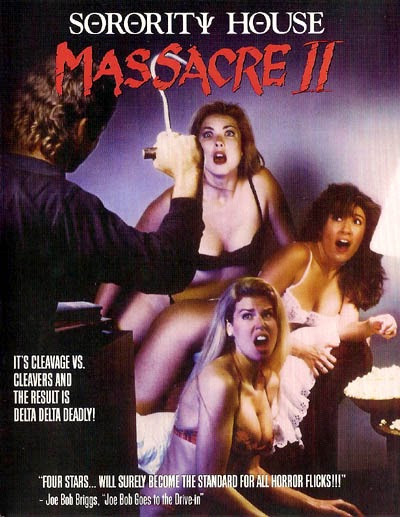
Cranpire Movie(s): Sorority House Massacre and Sorority House Massacre II


 Welcome back to Cranpire Movies! It's been a little while since I visited this feature of the Blogorium, so maybe a quick refresher is in order. There are bad movies I like to watch, but many more of them that I just can't (or won't) find time to sit through. When that happens, I'll hand then off to my friend Cranpire, who will watch just about anything I won't. He's fond of Syfy Channel Original movies, and not just the new ones - thanks to Bruce Campbell's presence in Terminal Invasion, Alien Apocalypse, and The Man with the Screaming Brain, Cranpire was on board early with their quickly manufactured schlock. Every now and then, the Cap'n ends up watching something (usually accidentally) that would normally fall into Cranpire's wheelhouse, and when that happens, they are reviewed accordingly.

 Today we're going to take a lot at the Sorority House Massacre series, specifically the first two. The third film - Hard to Die - is technically a sequel in that it has much of the same cast and uses the exact same back story, but it's also a Die Hard knock-off instead of a slasher flick, so I'll mention it in passing or when relevant. It's also worth noting that other than possibly using the same exterior, there's no continuity whatsoever between Sorority House Massacre and Sorority House Massacre II, although the second films does tie itself to a completely different slasher series. But more on that when we get to the sequel in name only.

 For a Roger Corman produced, late-era slasher cheapie, Sorority House Massacre is kind of... classy? It's a relative term, I realize, but considering where it came from and what the marketing sells the film as, there's a comparably nuanced story buried inside of slashing and T&A. Yes, it's borrowing (heavily) from A Nightmare on Elm Street during the dream sequences, but the imagery is also suggestive of Dario Argento in a way you wouldn't expect. If you somehow end up seeing the films in the wrong order, you'd be shocked at how much better Sorority House Massacre is than its "sequel". While Carol Frank didn't quite make a "Feminist Slasher" on the same scale as Amy Jones and Rita Mae Brown's Slumber Party Massacre, it's definitely a less voyeuristic approach to the subgenre than I had expected.

 Actually, it's debatable that Sorority House Massacre is even a slasher film at all, because the dream / psychic connection between the Final Girl and the Killer (shades of Halloween II) means we almost immediately meet our antagonist. Most of the film is about putting together how they're connected, what he's after, and what it has to do with the sorority house their paths collide in. By necessity, I'm going to SPOIL this, but it's hardly that since the audience is miles ahead of the characters for most of Sorority House Massacre. Beth (Angela O'Neill) is a withdrawn college student staying over at a friend's sorority house during Spring Break. Most of the girls are gone, including their sorority "mother," but when Beth arrives, she begins having nightmares about the house, of tables covered with blood and butchered mannequins. Her dreams begin to affect her waking life, and simultaneously Bobby (John C. Russell), an inmate in a mental institution, becomes more active, eventually escaping. He's looking for Laura, the only member of his family he didn't kill during a bloody massacre, and wouldn't you know it that Beth just happens to be her middle name...

Sorority House Massacre is not an especially violent or even gratuitous movie. Sure, there's nudity, but not in copious amounts (mostly taking place while Beth's friends (Wendy Martel, Pamela Ross, and Nicole Rio) try on the "rich" girl's clothes after she leaves, and during a Teepee make-out later in the movie), and most of the film's 77 minute running time is devoted to cutting between Beth's hallucinations / memories and Bobby coming "home". He kills just about everyone he runs into quickly, particularly the unfortunate boyfriends (Joe Nassi, Marcus Vaughter, and Vinnie Bilancio) of the main characters. What keeps Bobby interesting is that when he sees the women, it switches to his POV, where he imagines them as his sisters. He calls them not by their names, but by who he sees them as, almost as though he was killing them all over again. The disconnect between imagination and reality in the film actually makes the deaths that much more brutal.

 Of the two films, the first Sorority House Massacre is probably less deserving of being a "Cranpire Movie": it's a lower-to-mid-tier slasher film, but is surprisingly atmospheric for a low budget horror film. While it borrows from better movies, Frank at least manages to make the "lifts" seem interesting, and the characters are at least developed enough that you care when they die. Horror hounds looking for a quick and bloody fix should probably go elsewhere, as this is (surprisingly) reserved considering where it came from, but I might have a film that's right up your alley in the next paragraph...

 If Sorority House Massacre has some degree of class in the way it's presented, Sorority House Massacre II has all of the exploitation elements, and almost nothing else. Directed by Chopping Mall's Jim Wynorski, it offers gratuitous nudity, spurts of blood, leering perverts, dumb jokes, pointless subplot(s), and 60-ish minutes of nubile young ladies running around in their nighties, sometimes soaking wet. That said, as schlock goes, it's pretty entertaining, provided you're watching it in the right frame of mind. The opening should be a dead giveaway that it's not to be taken seriously, with an aggressive synthesizer soundtrack and pseudonyms in the credits like "Produced by Shelley Stoker" or introducing an actor as being the same person as his character.

 The jokey tone is heightened after we're introduced to the new sorority sisters moving into a house that may or may not be the same one from the first film (if it's not, the exterior is pretty close, but the interior looks nothing like it - just a generic "house" set). In short order, we meet Linda (Robyn Harris), Jessica (Samurai Cop's Melissa Moore), Kimberly (Stacy Zhivago), Suzanne (Michelle Verran), and Janey (Dana Bentley), who are staying at their new house overnight until the power and phone utility men come over the next morning. They got the house cheap because it was the site of a series of murders five years ago, which kind of creeps out the girls, but they have tequila, so it's okay. They also meet their creepy neighbor from across the street, Orville Ketcham (himself) who, in addition to keeping the key to their basement in his underwear, was present during the original massacre. Just not the Sorority House Massacre.

 For reasons unknown to me, instead of using the fact that there's already a Sorority House Massacre and it's kinda the same house and roughly five years later, Wynorski opts to use the back story from a completely different movie in both Sorority House Massacre II and Hard to Die. Even though the house looks nothing alike, all of the flashbacks to "Old Man Hocksteder" who went crazy and killed his family is footage from Slumber Party Massacre, another Corman produced slasher movie that has its own sequels. And it's a lengthy flashback to many of the "kill" scenes from Slumber Party Massacre, which uses a totally different murder weapon than the hook in Sorority House Massacre II. Why? Your guess is as good as mine, but it adds another layer of intertextuality, albeit a very silly one.

 The girls, having taken cold showers and slipped into something more comfortable, go down into the basement and find a Ouija board, so they have a little séance - as you do - which ends in a spooky way. And by "spooky" I mean "basically what happens in Night of the Demons but much cheaper". Maybe it's the framing, but it's easy to spot the boom mike in many scenes, most notably in the living room near the beginning. It's also a shockingly well lit house for only having candles and a few portable lamps. Maybe it's the lightning that helps, although that looks an awful lot like the same stock animation I saw in Hillbillys in a Haunted House...

 Anyway, so the girls try to get some sleep, but they have arguments about sleeping with a guy someone else is "going with," and somehow Jessica's 40-something boyfriend Eddie (Mike Elliott) never comes up again. Sorority House Massacre (mostly) waits until the boys come over to start a-murderin', but Sorority House Massacre II is ladies night through and through. Other than persistent cutaways to Ketcham looking menacing / loathsome, the bulk of the film is just gals in lingerie bouncing around the house, running into oddly placed bear traps (in the attic!) or getting murdered by a hook (despite the presence of a chainsaw in the basement). Interestingly, the drill that "Hocksteder" used to kill all of his victims in the "flashback" is nowhere to be found in the film.

 To keep the "appropriating Slumber Party Massacre as a prequel to this film," Sorority House Massacre II has a subplot involving to cops (played by Jürgen Baum and Karen Chorak) who are slowly investigating a phone call that came from the "old Hocksteder place" - which, for the record, is the house with no phone service. They don't want to drive through a roadblock (or something) because of the rain, so instead they head to a strip club. If you're asking "why?" the answer is more breasts on camera while the action slows down back at the house, but the plot excuse is that one of the survivors of the original massacre is now stripping to work through her trauma. Candy (Bridget Carney) has her own routine, followed by a sit down with the cops while another stripper does her show (all on camera, of course), and suggests that maybe Ketcham shouldn't have been ruled out as a suspect. While this should surprise nobody, Bridget Carney wasn't in Slumber Party Massacre, nor was there a character named "Candy." But hey, more boobs, am I right fellas?

 As it's really not clear where this movie should be going, Wynorski throws in a "possession" angle to justify the Ouija board, and while I won't tell you who ends up with Hocksteder's ghost at the wheel, I will give the director enough credit to make sure they're always where the killer would be or at least separated from the group. There's a lot of "let's split up" that you'd expect from really bad slasher movies, but in this instance it does serve as pretty good misdirection, at least until there aren't enough ladies left to rule out anybody else. Despite continually trying to imply that Ketcham is dangerous, it's pretty clear he's just a weirdo red herring, and despite being stabbed, choked with a chain, drowned in a toilet, and being shot by the police, he's still somehow alive at the end of the movie, not to mention the one who kills the, uh, Final Girl. It must have been all the raw meat he was eating earlier...

 While I can easily say that Sorority House Massacre is pretty good "for what it is," it's difficult to say the same for Sorority House Massacre II. It is exactly the lurid, dumb, gratuitous slasher movie you think you're getting based on the cover. So it has that going for it. If you want cheap thrills, you'll mostly get them without groaning too much. Gone is any hint of artfulness, replaced with a workman-like approach of showing the goods and getting out. The comedy isn't that funny (trust me, I'm not sure if we're really supposed to laugh at the "Arab" stereotypes at the strip club, or just marvel at how dated they are), the gore is mostly limited to blood splattering on the wall (and one bathtub scene lifted from Slumber Party Massacre 2 - oh, did I not mention that there are more than one Slumber Party Massacre films?).

 I guess the only thing that Wynorski really delivers on is the nudity, which I suspect Cranpire will agree is at least a selling point. They are attractive young women, and have no problem disrobing and taking cold showers for no reason, or standing directly underneath a porch dripping water in white nighties. Good for them? While Hard to Die is more of an "action comedy," it does have most of the same cast, including Orville Ketcham, playing the same kind of unkillable exposition machine he does in this one. Oh, and yes, the same flashbacks to a different movie. Well, the same different movie, because Hocksteder was a busy driller killer. As Cranpire Movies go, these are arguably better than his normal fare, but what is that really saying? I can easily recommend Sorority House Massacre and Sorority House Massacre II over the likes of Sharknado 2: The Second One and, uh, Sharknado 3: Oh Hell No, but they aren't going enhance your life or anything. Or maybe they will. Who knows, it might win you trivia one night, just by knowing what other series this one flashes back to. And if I'm being honest, the Sorority House Massacre movies are better than Slumber Party Massacre 2 and 3, so there's that. If you're the sort of person who hears the phrase "Cranpire Movie" and is excited, you're probably Cranpire, but if not, prepare for a fun double feature.

Thursday, January 15, 2015

Some Other Movies I Saw in 2014 (Part Two: A Few Better Ones, and Maybe Some Just Okay Ones)


 Picking up where we left off (working our way from the bottom to the top), I quickly realized that there was a movie omitted from Part One that probably should be there, because in no way does it represent a marked improvement from the last round. Hell, it doesn't even really represent a marked improvement from the last movie in the series it closes out, but when you start writing these recaps without a list, these things happen. So let's start with The Hobbit: The Battle of the Five Armies.

 Or maybe it should be The Battle of the Filler, because it's rare to see a film that is so (comparatively) short seem to totally inconsequential. I don't even really know where to start with the "bad ideas" that went into making two films into three, but it seems like every single one of them is on display in Battle of the Five Armies. Prologue that should have been the ending of The Desolation of Smaug? Check. Inordinate amount of screen time devoted to a character that doesn't exist in The Hobbit? Check. And I'm not even talking about Tauriel (Evangeline Lilly); oh no, Alfrid (Ryan Gage), the weasely assistant to the (quickly killed) Mayor of Laketown (Stephen Fry) has his own subplot that runs throughout the film, one that ends with no apparent rhyme or reason. While I don't like that Tauriel very quickly devolved into the "damsel in distress" during the battle, leaving Legolas to do all of the cool (read: wildly improbable) stuff, at least there's a character arc between her character and Thranduil (Lee Pace), and kind of with Fili (Aidan Turner). Alfrid serves no purpose whatsoever, and why Peter Jackson felt the need to keep him in the film but cut Thorin (Richard Armitage)'s funeral, I may never understand.

 Speaking of Thorin, any trace of development in The Desolation of Smaug goes out the window, replaced by "crazy, jealous Thorin, who covets the Arkenstone" and who suffers from (I am not making this up) "dragon madness." Like Smaug (Benedict Cumberbatch), and Sauron (Cumberbatch again), the carefully developed Thorin from the second film is quickly done away with. Worse still are the glimpses of who he was in scenes with Bilbo (Martin Freeman) - a tiny smile, the crack of his cartoonish façade - which punctuate chewing scenery aimlessly. After a dream sequence that's going to make the WETA digital team feel much better about King Kong's dinosaur stampede, he arbitrarily changes back to normal Thorin, which is evident not from what he says but because he changes clothes. But the dwarves need to fight alongside Dain (the voice of Billy Connolly, and the second thing WETA might not want to put on their showcase reel), so out they go, killing orcs where hundreds (thousands?) of dwarves and elves could not before.

 The titular battle rages on for most of the film, and it's hard to care about it, because the tactical maneuvering seems largely inconsequential. Cramming in a second orc army from the north to give Legolas a bat to ride on (again, not making this up) is only interesting in that it gives the film its stupidest line, possibly of the entire Middle Earth sextet: "These bats were bred for one purpose: war!" The only thing that might be as silly is the resolution to the Gandalf / Sauron storyline from Desolation, which involves Hugo Weaving and Christopher Lee's stunt double fighting the Nazgul in ghost form. It's about as logical as it sounds, and looks even sillier. Then Sauron shows up, Galadriel turns green, and blows him into the east. Gandalf takes off with Radagast (Sylvester McCoy) and by the time they're safely away, he goes from death's door to bloody nose and ready to rally the troops outside of Erebor.

 The other dwarves? Well, if your name isn't Thorin, Fili, Kili, or - to a much lesser degree - Balin or Dwalin, you pretty much don't have anything to do in the movie. At all. Also, we're going to put you in the credits after a bunch of characters from the last movie (including Alfrid), because even Peter Jackson can't be bothered to remember who's who. I suppose it's out of courtesy to James Nesbitt (Bofur) that his daughters don't get their own Alan Lee / John Howe credit sketch, let alone one that shows up before his.

 Have you noticed what I'm not talking about much, or rather, who I'm not talking about? That's right, the title character, and that's because Bilbo is sidelined in this film for most of the movie. Not because he's knocked out (like he is in the book), but because Jackson is too interested in cramming as much of every fight as he can onscreen, whether we needed to see it or not, in order to create bridges to The Lord of the Rings. Bilbo finally works into this plan during the epilogue, which at least neatly ties into the prologue from An Unexpected Journey. The less said about the quickly and haphazardly introduced Legolas, Thranduil, and Strider mid-quel bait, the better. As technically proficient as this film is, I feel like Jackson really failed to stick the landing, and that The Hobbit could have been two films with a hefty amount of extra material for extended editions, rather than three movies straining to maintain the narrative, and ultimately collapsing in the last stretch.

 On to more pleasant things, no? For example, St. Vincent, while totally predictable, coasts along largely on the presence of one Bill Murray at the namesake from the title. He's totally invested in playing a generally unlikeable curmudgeon with a thick New Yawk accent. He starts the film by telling a joke and closes it singing along to Bob Dylan's "Shelter from the Storm," which actually in no way SPOILs the film for you. That is, if you couldn't already figure out how the story plays out, based on the following synopsis:

 Vincent (Murray), is a loner, deep in debt to Zucko (Terrence Howard) for unpaid horse racing bets, as well as being a little behind paying Daka (Naomi Watts), a "dancer" that he sees once a week. He has other obligations which are going unmet, but Vincent's okay with drinking away his problems. A drunken night that leads him to crash his car into his fence and knock over his mailbox is only compounded the following morning when a moving crew for Maggie (Melissa McCarthy), and her son Oliver (Jaeden Lieberher) knock a branch loose from his tree, and landing it directly onto his car. Maggie is trying to start her life over during a nasty divorce, and her new job doesn't give her much time to watch Oliver, so Vincent reluctantly agrees to babysit - but not for free. He slowly takes a liking to the kid, but remains ever the grouch...

 Even with two wrinkles to the formula (why Vincent is nearly out of money and a mid-movie development I actually didn't see coming), you could be forgiven for thinking this is some variation on Bad Santa, Gran Torino, or even this year's Bad Words. Lieberher is actually less precocious than the young co-star from Jason Bateman's film (in particular, I challenge you not to laugh at his reaction: "that's a horrible comparison"), even if the ping-ponging of Oliver's story and Vincent's story aren't always equally interesting. McCarthy is given a harried, mostly non-comedic role, which is interesting in that you see her breaking out of the "type" she's associated with. Likewise Chris O'Dowd, who plays a mostly thankless role of "teacher who facilitates how the movie gets its title." He has a few moments of fun as a Catholic school teacher who doesn't know what to do with the "I think I'm Jewish" Oliver.

 The film is largely Murray's show, and I have no idea how first time writer / director Theodore Melfi talked the legendarily picky actor into taking the role. That said, I'm glad he did, because Murray keeps St. Vincent worth watching, despite the familiarity of plot devices, and when the movie does turn a bit, it gives him an opportunity to show a stubborn vulnerability. St. Vincent is the sort of film that I suspect your parents will like quite a bit (presuming that the people reading this aren't parents, in which case, you will probably really like St. Vincent. And thanks for reading).

 Speaking of movies your parents will like, and maybe chefs, too, there's Jon Favreau's Chef. I already reviewed it, so here's a link to an amiable little movie from the director of Iron Man and Cowboys & Aliens. I don't really have any qualms recommending it, and certainly no more or less than St. Vincent, which are ultimately harmless entertainment for the masses. For the record, there's nothing wrong with that, although the higher the list goes, I guess the more esoteric it gets. Well, other than the Marvel movies... (SPOILER for the end of the recaps).

 I didn't put up separate reviews for Life Itself, Stripped, or Supermensch: The Legend of Shep Gordon, because I couldn't think of anything to add to the existing commentary about them. I enjoyed all three, and if you're interested in the history and current struggle of the comic strip or showbiz manager extraordinaire Shep Gordon, or the final year of Roger Ebert's life, they come highly recommended. I would suppose my favorite of the three documentaries was Life Itself, which doesn't shy away from the less pleasant side of Roger Ebert, both during his career as a critic for the Chicago Sun Times but also as he struggles to live without a voice (or jaw, for that matter). It's also a great look into the heart of Chas Ebert, who I knew very little about, and about Roger as a family man.

 But if you're looking for insight into Siskel and Ebert at the Movies, you'll get that, or about his reputation as an egomaniacal young columnist, there's that too. It's a surprisingly in depth story of his life, one that coincided with his untimely death, which happens while director Steve James is working on interviewing Ebert about his fascination with film. Regardless how you feel about Ebert or his role in cultivating the concept of "film criticism" at the end of the 20th Century, it's a worthwhile investment to see Life Itself. Supermensch is also worth seeing in that I had no idea who Shep Gordon was, or how very important he was to the lives and careers of some of the (very) famous people interviewed in the film. Also, it's the first movie directed by Mike Myers that I've enjoyed in a long time, and that's worth noting in and of itself. Stripped included new illustrations by Bill Waterson (Calvin and Hobbes) and also has a rare audio interview with the reclusive cartoonist, along with the chance to put faces to names of people I've long known only for their daily strips. It's a bit more of a niche topic for documentary viewers, but no less worth your time.

It might come as a surprise to you that I'm putting Maleficent further up the ladder than The Hobbit, but while the film is not as especially devoted to revisionism as you would think, it is an interesting counterpoint to Sleeping Beauty, carried by Angelina Jolie. It has one of the most direct "rape" metaphors I can think of in a Disney film: Maleficent is the benevolent young ruler of the Fairy Kingdom, and the king wants to conquer it, so she fights back. Stefan (Sharlto Copley), a peasant turned servant of the monarchy, has known Maleficent since she was a child, and volunteers to kill her in order to ensure he ascends to the throne. But since he still kind of has feelings for her, Stefan drugs Maleficent, and while she's asleep he cuts off her wings to take back to the castle as proof of her death. That, in and of itself, is pretty rough stuff, but the "morning after" scene when Maleficent wakes up and discovers this violation is pretty potent. And as Disney movies go, it's tough to read that many other ways.

 Do I wish that Maleficent as a movie handled things a little more organically, rather than switching Sleeping Beauty around in ways that are more, let's say "convenient"? Yes. It does cast a different light on why Maleficent crashes the celebration of Aurora's birth, but the way that the film reaches around itself to connect the two is at times ineffective. The short version is that, after Aurora (eventually Elle Fanning) is shuttled off with Flittle (Lesley Manville), Knotgrass (Imelda Staunton), and Thistletwit (Juno Temple), Maleficent becomes a sort of guardian angel for the girl. The fairies are basically incompetent, and Maleficent, while angry and bitter at Stefan, becomes a surrogate mother for the girl. I mean, how else are we going to get to "true love's kiss"?

 And look, yes it's kind of sweet and certainly makes more sense (SPOILER FOR THE END OF MALEFICENT) that Maleficent wakes up Aurora from the curse and not Prince Phillip (Brenton Thwaites). I mean, he's only met her once, so take that, Disney Princess narratives! I'm actually more okay with the fact that Maleficent doesn't become the dragon when she comes to the castle; her raven, Diaval (Sam Riley) can change into other creatures at her whim. That he's usually human and generally speaking the conscience for Maleficent in the middle of the movie should be more trite, but for some reason it worked for me. The somewhat cartoonish / unfinished looking special effects, maybe not so much, but I'm inclined to be kinder to Maleficent than I suppose most people were. It seems like a lot of folks rejected the film in principle, which I can understand, but it's hardly the worst case of revisionism I've seen. It's thoroughly mid-grade Disney live action fare - neither as clever as Enchanted nor as, uh, well, I lost myself there. Enchanted and Maleficent are the only ones I can think of right now, and there's probably another, not watchable one in there.

 Speaking of Disney and something you already know, if 2011's The Muppets was The Muppet Movie for a new generation, Muppets Most Wanted is The Great Muppet Caper, but maybe not as good. I'm not sure, which is why I'm going to link Muppets Most Wanted to a movie you're almost certainly never going to hear it compared to again, 22 Jump Street. Yes, that 22 Jump Street. Allow me to make my case...

 Okay, so my distinct impressions while watching Muppets Most Wanted and 22 Jump Street were that I thought both weren't as fresh, as well written, or as fun as the movies they followed. Both films are operating on a "meta" level where they frequently comment on the fact that they are sequels, and make fun of the tropes and pitfalls that sequels often fall into, all the while also regularly falling into said pitfalls. Muppets Most Wanted literally begins at the end of The Muppets, with convenient stand-ins for Jason Segel and Amy Adams (unless they were cool with just being in 30 seconds worth of being shot from behind), which then becomes a song about sequels. If it's also a tongue-in-cheek take on The Great Muppet Caper, that's less apparent, or it's just been a long time since I saw The Great Muppet Caper. The Muppets continue their adventure, taking the show on the road under the management of Dominic Badguy (Ricky Gervais) - pronounced "bad-ghee" - through a European tour that just so happens to coincide with robberies of famous art museums by the newly released super-thief Constantine, who bears a striking resemblance to Kermit the Frog. In fact, all he has to do is remove his mole and put it on Kermit, and our hero ends up in a Siberian gulag run by Nadya (Tina Fey). Can he clear his name and salvage the prison's talent show? Will the Muppets end up taking the blame for Constantine's robberies, and what is he after, anyway?

 Meanwhile, on Jump Street, Schmidt (Jonah Hill) and Jenko (Channing Tatum) are finding new ways to ruin undercover investigations with a higher budget. After a drug bust goes horribly awry, Deputy Chief Hardy (Nick Offerman) sends them back to Jump Street, but to the new, more expensive facility across the street, where Captain Dickson (Ice Cube) assigns them to college. The scenario looks exactly the same as their last assignment (new drug on campus, students dying, find the supplier), so Schmidt and Jenko think they've got it easy. Jenko joins the football team to follow a suspect, and Schmidt investigates the dead dealer's roommate (Jillian Bell) and friends, inadvertently hitting it off with Maya (Amber Stevens). Jenko discovers that he's a natural for the football team and bonds with low level dealer Zook (Wyatt Russell), eventually pledging to the jock fraternity. The partners drift apart, bicker, and assume this is exactly the same case as last time. But this is the sequel, and one of the many wrinkles that directors Phil Lord and Christopher Miller and writers Michael Bacall, Oren Uziel and Rodney Rothman bake into the plot is that expectations are a mistake.


 This is, for example, a movie that identifies one of the suspects by his tattoo, which turns out to be his high school mascot. What is it? A Red Herring. Halfway through the film, Jump Street has to make budget cuts because it spent too much on the beginning, which, among other things, leads to a chase scene that we don't see most of (they break a lot of expensive things on campus, but we can't see it - get it?) Not all of it is so obvious, but in a lot of ways I think that the insistence on acknowledging 22 Jump Street is a sequel to a remake that nobody thought was going to be good wears out its welcome. The exception is during the end credits, which rattles through the next twenty or so Jump Street sequels, which take Schmidt and Jenko everywhere from cooking school to space, through cast changes and animated spinoffs, and at least one inappropriate children's game tied to fate of Rob Riggle's character at the end of the first film.

 Similarly, Muppets Most Wanted suffers from trying too hard to be like the last movie without adding anything to the equation. I'm struggling to remember any of the lyrics to any of the songs, but mostly it's just the concepts that come to mind: Constantine singing a vaguely disco song to Miss Piggy, Constantine and Ricky Gervais singing a song about being criminal masterminds. There's a big song and dance number at the gulag with Nadya that also includes a number of celebrity cameos as prisoners (including Jermaine Clement, Danny Trejo, Ray Liotta, and WWE Superstar Hornswoggle). The film has a sort-of "been there, done that" vibe that would exist even if it weren't conceptually similar to The Great Muppet Caper.

 Where both 22 Jump Street and Muppets Most Wanted work best is when the films strip away trying to stay ahead of the audience and just spend time with the characters. There's a twist in Jump Street that has very little to do with the investigation but that is, bar none, the funniest subplot in either film. I don't want to spoil it, but it increases Ice Cube's role as Dickson and Channing Tatum's reaction when Jenko finds out still makes me laugh. I'm not yet sold on Walter as the new addition to the Muppet team, but he does function as a voice of reason during some otherwise contrived character drama. Also, Muppets Most Wanted does integrate its cameos in more logically, and I chuckled at a throwaway line Frank Langella has as a priest during Constantine and Miss Piggy's wedding. Actually, the Sam the Eagle / EU Inspector Jean Pierre Napoleon (Ty Burrell) subplot might be more entertaining than the main story, as the prison subplot with Kermit frequently is. Fey and Burrell are clearly having a lot of fun hamming it up, while Gervais seems more constrained by the limits of Badguy.

 Ultimately, while I sat through the films feeling like they weren't quite "as good," my lasting impressions of both after they were done, warts and all, is largely positive. I remember them being more enjoyable than I did while I was watching them, and as I've revisited both, generally speaking they're better than I had talked myself into thinking they were. Maybe it was expectations, or reacting badly to the conceit of both, but 22 Jump Street and Muppets Most Wanted are both amusing, at times hilarious films that don't take themselves too seriously. If you liked The Muppets or 21 Jump Street, I strongly suspect you'll have a good time with either sequel. 22 Jump Street has the edge over Muppets Most Wanted, if I'm being honest, only because when it's firing on all cylinders, there are points where it is funnier than the first film, which is no small task. It is a hard "R," so think carefully about sitting down with the kids for a double feature...

 Coming up next: more recaps! More recommendations! Movies I liked even more than these! And also, sometime soon, ones I had high expectations for that may or may not have met those lofty goals. We shall see...

Tuesday, November 26, 2013

Cap'n Howdy's (Back)Log: Riddick


 Earlier this summer I thought I'd take a break from just reviewing movies that were new in theatres. The Cap'n is many things, but a newspaper movie reviewer isn't one of them. You can figure out if you want to see a movie or not yourself and if you need help there are plenty of resources out there. Of course, the problem with this is that I still saw most of those summer movies, and now I have a backlog to work with, some of which I feel more inclined to write about now. I probably won't write up all of them, only some, though - trust me, you'll find out what I though about R.I.P.D. when I get to the (SPOILER) "worst of" list at the end of the year. One such movie that bears mentioning is Riddick.

 I found it funny that the people where I work thought this was the second Riddick movie, although they couldn't seem to remember what the first one was. I think that David Twohy and Vin Diesel approached this third Chronicle of Richard Riddick the same way: "Hey guys, remember how badass Pitch Black was? You were all really impressed with what we did with a low budget and it was dark and violent and sometimes scary? Yeah! That was great. How about we make another movie like that? Cool? Okay, well, we know most of you don't like to talk about this, but we're going to spend a little time wrapping up The Chronicles of Riddick. Not long, because we know that everybody thought it looked like the Syfy Channel version of Dune and it was too convoluted for its own good. We'll keep it short and get to the good stuff, and we'll even get Karl Urban to come back for like 90 seconds. Didn't he kick ass in Dredd?"

 Now I personally believe that Twohy and Diesel and probably a medium size contingent fans like The Chronicles of Riddick more than I did, but Riddick definitely feels like a "getting back to our roots" movie - stripped down, mean, violent, and definitely no Judi Dench as a ghost or whatever those people could do. There are barely any Necromongers so I won't have to type the word "necromonger" but one more time in this review, and Riddick (Diesel) even uses their silly armor to do something badass (he uses it as a splint for his broken leg and literally screws it into the bone with his bare hands). At times it gets maybe a little too close to Pitch Black for its own good, but this third movie is an improvement from where I'm sitting.

 So the last time we saw Riddick was sitting all King Conan on the "you keep what you kill" throne of the *ahem* Necromongers but ruling doesn't really suit this dude. He wants out, and Vaako (Karl Urban, who must've had like 10 minutes of free time from Star Trek or something) senses an opportunity. Vaako promises to take Riddick to his home world (for more information on this and many other things that take up two hours, please refer to The Chronicles of Riddick), but instead sends some fluky with him to a planet designed to kill anybody dumb enough to end up on it. Riddick figures out the ruse quickly, but not quickly enough not to end up on at the bottom of a cliff with a shattered leg.

 This brings us to the first portion of Riddick, which is arguably the best: survival. With a minimum amount of dialogue and voiceover, we see our favorite space anti-hero (sorry, Han Solo, you sold out to the Rebellion) learn how to navigate the terrain, perform some painful amateur surgery and how to account for basic things like water and food. He runs into the indigenous life forms and most of them want to kill him, but Riddick is no chump. He even kind of rescues a dog-like creature and it follows him back to his cave. His first night there he technically buries himself alive under rocks. From his vantage point, he can see that there's a part of the planet that isn't constantly hot and covered with sand, but in order to get there, he has to get past these really nasty scorpion looking things that live in water.

 His solution is clever and appropriately foolhardy- he kills a smaller one and starts inoculating himself (and the dog thing) with the poison, even though we (and he) aren't really sure that's even going to work. It does, but it turns out that just avoiding the poison isn't enough, because those bastards can cut you to pieces, too, or just impale you with their stingers. It's a hard fought battle just to kill one of them, so you feel like Riddick's really earned it when he and his buddy run up those steps.

 This brings us to part two of the movie, which is maybe more fun if you don't like "lone survivor" movies: cat and mouse games. Riddick finds a bounty hunter outpost and decides getting off the planet might not be such a bad idea. Why? Because there's a massive storm coming from the direction he just left, and even a cursory glance at the ground below makes it clear that the scorpion things that live in water like to migrate during monsoon season. Uh oh.

 Riddick activates a homing beacon, and two teams of mercenaries arrive in a staggered fashion. The first is led by Santana (Jordi Mollà) and his number two, Diaz (Dave Bautista). They're a bunch of mean, dirty, nasty mercs that want Riddick's head and (literally) nothing else. He's worth twice as much dead as he is alive, but catching him is more than the team is up to. Fortunately, the better armed, better organized Boss Johns (Matt Nable) arrives with his number two, Dahl (Katee Sackhoff) and the teams grudgingly agree to work together after Riddick threatens both of their ships. (Riddick asks them to leave on ship for him and everybody lives, so you can imagine how they take that).

 There's a lot less of Diesel in this part of Riddick, but it's okay because we know he's out there and have the benefit of knowing what he can (and will) do to them when they invariably disregard his offer. In the meantime, the crews are interesting enough to spend time with, particularly Bautista and Sackhoff, but also Bokeem Woodbine in a smaller role that unfortunately ends sooner than it needed to. There's some sneaking around and a sketchy moment where Riddick is spying on Dahl while she's taking a shower that maybe didn't need to be in the movie. I'm not sure on that one. Since we're on a ticking clock of sorts that only Riddick knows about, the tension for the audience is higher than for the mercenaries but ultimately the stand-off between Riddick, Santana, and Johns is but a prelude to the third section of Riddick: assault.

 If you've seen the trailer then you know that the rain does get to the outpost and that everything goes out in the window in favor of just surviving, made all the more complicated by the fact that Riddick has fuel cells from both of the ships and hid them pretty far away. That means that they have to go get them, which involves some hover bikes and betrayals and revelations that tie this movie to Pitch Black more directly (hint: one of the names of the mercs should sound awfully familiar) all while hundreds of scorpion monster things are out there, attacking and tearing the outpost to shreds.

 Surprisingly, this is the shortest - or felt like the shortest - part of the movie. I didn't even realize that the climax of the film was the climax until the next scene, when everything is being wrapped up. I guess it's because the last chunk is basically a mini-redux of Pitch Black with similar rock formations and vaguely similar monsters and rain, which is not the best choice in my opinion but hey, it works. It's definitely the weakest part of the film but you do see characters pulling together in ways that seem more organic than when the assault begins. To be honest, the only reason it doesn't really work is simply because it reminds me of Pitch Black so much, because as the story is structured, it's a very good payoff of the set up for these monsters early in the film. It's just that we've seen this already. Or some of us have - I guess the ones that can remember which Riddick movie they already saw.

 It's pretty open-ended during the epilogue so there's a chance we could see another Riddick movie (Twohy and Diesel indicated they'd be making another one) where he goes to find his home world and probably take revenge on Vaako (good for Karl Urban fans but bad news for me not using that "n" word in future reviews), but it doesn't have to be. So if they end up not making a fourth movie, Riddick ends things on a high note and almost all is forgiven for having to watch The Chronicles of Riddick. 2 out of 3 is pretty good from where I'm sitting. It's maybe a little on the lower budget side but it never looks as obviously green-screened as Chronicles. I guess you can watch this on Blu-Ray in January (I will amend this review when it comes out) in what I will assume is an "Unrated" cut, which should be impressive since Riddick is a pretty hard "R" as it is. This one is worth your time if you like your science fiction dark and violent and action-y.

Tuesday, October 15, 2013

Shocktober Revisited: A Tale of Two Halloween II's (Part Two)


 Now, let's talk about Rob Zombie Presents Rob Zombie's Halloween II, not to be entirely mistaken with Halloween II but maybe for the first fifteen minutes if that's cool with everybody.

Allow me to point out that this is not a So You Won't Have To review, although I suspect many of you won't be checking out Rob Zombie's Halloween II. It's not a perfect film, to be sure, but I found the experience to be far more enjoyable than Halloween.

Many of you know that I was not, am not, and don't expect to be on board in the future with Zombie's remake. I just didn't like it. The familiar faces in supporting roles got to be absurd, the excessive profanity and sleaziness bordered on parodic, and I felt there were fundamental problems in the retelling that robbed Michael Myers and Laurie Strode's story. However, I had hoped that like The Devil's Rejects was to House of 1000 Corpses, so to would Halloween II be to Halloween. Rob Zombie did not disappoint.

From the get-go, Halloween II moves away from the limitations of a remake and forges onward in its own direction. Zombie, not feeling beholden to specific iconic imagery, moves at a different pace than the "slasher" portion of Halloween. In fact, Michael spends roughly half the film without a mask on. When Zombie does pay homage to the other Halloween 2 - a clever nod to the hospital siege - the end result is better than anything in the original sequel. I was more interested in the carnage Michael unleashed and Laurie's desperate attempts to get away than at any point during the original H2.

After the homage-turned-dream-sequence, we're reintroduced to Laurie Strode (Scout Taylor-Compton), Annie Brackett (Danielle Harris) and Sheriff Lee Brackett (Brad Dourif), living together in relative isolation. Laurie and Annie have severe psychological scarring (and Annie has some pretty serious physical scarring too), and Laurie's constantly teetering on the edge of a nervous breakdown. She's been having strange dreams with young Michael (Chase Wright Vanek, filling in for Daeg Faerch) and Deborah Myers (Sherri Moon Zombie) in spectral form. Some are bizarre, and at least one involving a pumpkin feast, is outright disturbing.

Speaking of disturbing, the violence in Halloween II is pretty rough. Like, rougher than even the last film rough. Michael (Tyler Mane) carves a path of carnage on his quest to reunite the Myers family - he too has the visions of a spectral mother and white horse - and though I consider myself to have a pretty tough horror constitution, some of the kills early in the film are pretty nasty. Sawing through a guy's throat with broken glass is one thing, but the repeated stabbings, each with increased force, until the sound design resembles someone punching a bag of rotten meat, was more than I expected.

Back to the plot for a second: Halloween II picks up two years after Halloween, and two years after the supposedly dead Michael disappeared. When we see him again, Mane often appears without the mask and instead has a long beard and scraggly hair. You've probably heard folks refer to these sections as "Hobo Michael", but I didn't feel like much of his wandering was aimless. The explanation - that he's following his visions - creates an internally coherent reason for why Michael ends up where he ends up during the film. Dr. Loomis (Malcolm McDowell) is exploiting the tragedy once more with a new book, one that threatens to expose Laurie to the truth about her history.

The "guest star" casting (as Tarantino has come to put it in his films) actually works in Halloween II where it did not in Halloween. Perhaps the reason is that while the faces are recognizable from time to time, everybody looks different enough that you don't say "hey! Mickey Dolenz!" or "Look, it's Sid Haig or Clint Howard or Udo Kier!" Instead, Zombie calls on Daniel Roebuck (Lost, Bubba Ho-Tep), Margot Kidder, Mary Birdsong (Reno 911), Caroline Williams (The Texas Chainsaw Massacre Part 2), Richard Brake (Batman Begins), Richard Riehle (Office Space, Casino), Howard Hesseman (Shampoo, Silent Movie), Duane Whitaker (Pulp Fiction, Feast), and Mark Boone Junior (Memento, The Quick and the Dead).

Where Halloween II succeeds in the way Halloween didn't is that with most of the bit parts, you'd have to really know these actors to spot them immediately. I really didn't recognize Mary Birdsong or Margot Kidder at first, and Daniel Roebuck is almost unrecognizable. Instead of saying "hey look, another person I recognize in a tiny role!", the impression is more like "that person looks familiar, but I couldn't tell you why", which should be the intended effect. Even "Weird" Al Yankovic fits within the scene he's in, which is a talk show sequence designed to undermine Loomis' credibility (the host is Chris Hardwick, of House of 1000 Corpses).

To be fair, not everything about Halloween II works. While Annie's dialogue is a lot better (reflecting a certain maturity in her post-traumatic experience), Laurie can periodically be shrill and annoying. I'm not saddling it all on Taylor-Compton, because the rest of the dialogue for her new friends (Brea Grant and Angela Trimbur) is occasionally cringe inducing. McDowell's Loomis is so glib and shitty that I do wonder if he'd really bother showing up at the very end of the film.

I also have questions about why Laurie, who seems to be frequently terrorized by dreams of being murdered by Michael, would so idolize Charles Manson. She has not only a huge poster of Manson above her bed, but also some hand painted slogan about what would Charley (sic) do or something to that effect. That was the only moment in set design that really did ring false. Also, the "when Michael puts his mask on vs when he doesn't" motif doesn't really have any rhyme or reason. He kills just as brutally without it outside of the strip club.

What most people are objecting to, however, is the kinda-far-out-there choice by Zombie to bring back Sheri Moon Zombie as ghost mom. Now, I will say that it can get kinda goofy, especially when she lapses into a Vampira-esque staredown with the camera, but I didn't find it to be as horrible as the audiences who vocally assaulted the film in theatres. It's an out there choice, but this is no longer the Halloween we expect; this is Rob Zombie's take on the story, going off in its own direction.

Speaking of which, I have to say that while I did see the Unrated Director's Cut, I have seen the theatrical ending (it was *ahem* online somewhere...) and I much prefer Zombie's cut. For one thing (potential spoilers here) killing Laurie earns the "white horse" coda in a better way than having her put on Michael's mask and go catatonic. I'm also of the mind that Laurie doesn't necessarily need to kill Michael for the story to work, so Michael killing Loomis and dying in a hail of gunfire was plenty appropriate. It's similar to the way that they don't show what Michael does to Annie, just its aftermath. True, it would be a cool kill, but the story doesn't need you to see it happen, just like the ending.

Ultimately, while people seem to really hate Halloween II, the Cap'n liked it. I thought that, even with its flaws, this is a sequel that bests its predecessor and works on its own merits. If you can accept that this is a very different kind of movie than any of the original Halloween films, but one with its own internal logic, you might indeed find it worth checking out.

Total Side Note: The Blu-Ray for Halloween II looks nice, but the picture is awash with grain. This was no doubt an aesthetic decision by Rob Zombie, so I'm not bagging the image quality, but I'm betting that if you find the DVD instead the picture won't be radically different.

Monday, October 14, 2013

Shocktober Revisited: A Tale of Two Halloween II's (Part One)


 So let's talk about the sequel to John Carpenter's Halloween. You know it as Halloween II.

Or, as the trailer puts it: "More of the night He came home".


Yes, that's what it really says, and it should give you a pretty good indication of the kind of sequel Halloween II is. It is, after all, a movie John Carpenter drank his way through writing. Believe me; it shows.

The Cap'n used to really like Halloween II, and without watching it for several years, I held it in pretty high regard. It was one of the first ten dvds I ever owned (along with Ghostbusters, Mallrats, Jaws, and Evil Dead 2: Dead by Dawn) and I've held it fondly in my memory, at least until three days ago.

But I'm getting ahead of myself. I'm going to err on the side of "yes, Cap'n, we've seen Halloween and Halloween II," so recapping the film is not necessary. Instead, I'm going to share my revised thoughts on the film, pros and cons, then provide a "wish list" of sorts for things from Halloween II I'd like to see in Rob Zombie's H2.

To be kind, let's start with things I did like:

- The opening recaps the last five minutes of Halloween quite nicely for audiences (it was three years between the first and second film) and quickly gives urgency for Dr. Loomis to find a very alive Michael Myers loose in Haddonfield.

- Starting and ending the film with "Mr. Sandman" is an inspired move. The song can, under the right circumstances, be rather ethereal and creepy (see Nan Vernon's version in Zombie's Halloween remake.) As it plays over a crane shot re-introducing the Jarvis house, you're in the frame of mind that this Halloween is anything but nostalgic.

- The early way Michael stalking scenes are handled well; a combination of first person perspective shots and well placed lighting that reveal Myers at exactly the right time. My favorite is when Michael slowly un-dissolves from the darkness in Dr. Mixter's office. The entire sequence with the Security Guard, Mr. Garrett, is also well executed.

- Some of the kills are pretty cool, particularly the inventiveness of the hospital murders. I'm thinking specifically of the "Tub" sequence, the hypodermic needle kills, and the blood drawing of Mrs. Alves.

- For a while, it looks like Halloween is going to address not merely Laurie and Dr. Loomis, but Haddonfield in a broader sense. Much of the first half of the film is about the way the citizens react to the murders of Halloween and the possibility that a killer is loose in their city. The "wake" for Annie at the Myers house does hint at a deeper movie than Halloween II ends up being, which is unfortunate. Had they not dropped so much of that depth, the film may have been better.

- I love that in order to throw a red herring into the Loomis chase of Michael that Halloween II just arbitrarily kills a guy who coincidentally looks exactly like Michael Myers. What's more, it's not enough to pin him against a truck with a police car; there has to be a huge explosion and lingering shots of faux-Michael burning to death.

- Speaking of burning, I do like the final shots of the film: one of Laurie in the ambulance and then a comparably lingering shot of real-Michael facedown in the hospital, burning to not-death (as we discover in Halloween IV).


Now, unfortunately, there are the cons.

- Many of the things I like about Halloween II are undone by its last 40 minutes, which are almost exclusively in the hospital. Key to the problems of Halloween II is the fact that Laurie Strode has nothing to do. So miniscule is her role in the film that the script frequently finds excuses for Laurie to pass out, lapse into a coma, or simply hide out when no one is looking for her, just to get her character out of the film.

- As a result, the "cat and mouse" elements of the film with Michael and Laurie, when they finally do happen, are awkward and unnecessarily drawn out. Since the geography of the hospital is never clearly established (I think we're supposed to believe that the Maternity Ward, Rehab Room, and Laurie's room are on the same floor of a three story hospital), the two chases involving Laurie and Michael just don't make any sense.

_ The other kills Michael commits in the hospital are also riddled with sensical errors. While drowning the nurse in a "boiling" tub, Michael's right hand spends as much time in the "scalding" water as her boiled face does, yet it's perfectly normal throughout the movie. In fact, the hand Michael puts in the boiling water is the same one he wields his knife with, so you see quite a bit of how not "scalded" it is. The one character (Paul) who doesn't die in the hospital has a great fake out that never gets a payoff. He slips and falls in a puddle of blood, and it splashes up on his mouth, making Paul look like another victim. Rather than use this to any effect in the chase scenes, Paul simply appears later, getting into the exact car Laurie happens to be hiding in. Then, he inexplicably passes out on the horn and disappears from the rest of the movie. One or two of these things might be acceptable by "slasher" standards, but to come one after the other for 40 minutes is too nonsensical to accept.

- Of course, there are a lot of things in Halloween II that don't make sense in a "bad" way. I can live with the random killing of a teenager to keep Loomis and Laurie apart, but there are a lot of "convenient" things that pile up on top of each other in such a way that you can't suspend disbelief near the end. Among them: Laurie is unable to scream for Loomis until after he goes in the hospital, the extent of her injuries change depending on how convenient it is for her to escape, Loomis is given a crucial piece of information while being dragged out of Haddonfield by a Marshall and then decides to commandeer the car at gunpoint, so he can finally confront Michael, knowing the truth about why he chose Halloween to return.

- And oh my, is it a BAD reason. For some reason I used to defend the "Laurie is Michael's sister" plot "twist" in Halloween II, at least until Halloween: H20. When it became a central plot point in Rob Zombie's Halloween, I stepped back, and watching the awkward way the twist is handled, I can't defend it any more. When Loomis finds out that Laurie was adopted by the Strodes after Michael's parents died, he says the following (verbatim):

"Geez! Don't you see what he's doing here in Haddonfield? He killed one sister fifteen years ago and now he's trying to kill the other!"

The line is delivered so flatly by Donald Pleasance that I had trouble not laughing. Carpenter's script sloppily handles this "twist" by introducing terrible flashbacks while Laurie is in the hospital that deliver ham-handed lines like "Laurie, I'm not your real mother" and a shot of young Laurie visiting Michael in the asylum. You know, the same asylum that Dr. Loomis spent fifteen years studying Michael, and yet he a) never saw Laurie visit Michael, and b) doesn't know about this extension of the Myers family because "it was sealed by the Governor two years after Michael was locked up to protect the Strodes."

Suddenly I find myself longing for Daeg Faerch calling baby Laurie "Boo" before slaughtering his family of trailer trash.

Speaking of which, having watched the sequel to Halloween, here are a few things I'd like to see Zombie include in his sequel to the remake:

- I'm really hoping that this "Hobo" Michael plot device means that we're going to get more of the citizens of Haddonfield in H2. Certainly, considering that the cast has only grown with more people in town (including Margot Kidder, Bill Moseley, Daniel Roebuck, Mark Christopher Lawrence, Caroline Williams, and Howard Hesseman), I can hope that the scale of H2 reflects the promise abandoned by Halloween II.

- Truthfully, since he's already hinted at the hospital massacre, is it too much to ask for the arbitrary kill to throw Loomis off of Michael's trail? It's such an out-of-left-field move for Halloween II that I can picture Zombie borrowing it.

- Could there maybe be a twist where Laurie isn't Michael's sister? Maybe it's Annie instead? That's so dumb it might actually work!

- While it's not technically from Halloween II, is there a way to incorporate the police reaction from Halloween IV? One of the things I loved about that movie is that instead of the local cops not listening to Dr. Loomis, instead they mobilize to keep everyone safe and it still fails. It was a great twist on the slasher convention from a sequel that's honestly better than part II.

- One final request that I know won't happen, but could H2 at least try keeping Loomis and Laurie together for more than three minutes? It's not that I find the two of them combined are much more effective (I mean, Loomis shoots Michael 13 times and Laurie shoots him twice to no avail) but to be honest I minded Scout Taylor-Compton less when Malcolm McDowell was also on-screen.

You know what? It almost doesn't matter if none of that happens because we have "Ghost Deborah Myers", played by Sheri Moon-Zombie, which I still contend is crazy enough to make H2 vaguely watchable. While it shouldn't be that hard to make H2 better than Halloween II, I remain skeptical.

Monday, May 20, 2013

Blogorium Review: Star Trek - Into Darkness


 There's an inconvenient truth I find myself dealing with when it comes to JJ Abrams' Star Trek movies - they are not, never were, and never will be made with Star Trek fans in mind. While the degree of "paying original fans lip service" isn't anywhere as heinous or calculating as, say the Michael Bay / Platinum Dunes model, when I hear Abrams or screenwriters Damon Lindelof (Lost) Alex Kurtzman and Roberto Orci (the Transformers trilogy) say that Star Trek: Into Darkness is a "love letter to Star Trek fans,"* I know this not to be true.

 And that's okay: the 2009 re-whatever you want to call Star Trek was a breath of fresh air to a series that choked to death with the one-two punch of Nemesis and Enterprise. It was a distillation of what the average audience knew about Star Trek into an action packed, thrill a minute hero's journey that borrowed heavily from Star Wars. To be honest, it was refreshing, even if it wasn't really Star Trek. Since Star Trek is probably never going to be "Star Trek" again, I was happy enough with what they'd come up with: the adventures of an "alternate universe" original crew and Leonard Nimoy along for the ride, as needed.

 I bring this up because it puts me in a strange predicament with Star Trek: Into Darkness, because when people ask me what I thought, my immediate answer is "it's pretty good." Not great, not awful, but somewhere in the high middle range. I don't think repeat viewings are going to change how I feel about the movie, because what I like about the movie (most of it) is seriously off-set by what I really, REALLY didn't like (three or four scenes).

 The problem is that what would be an otherwise crackerjack adventure with the new crew of the Enterprise (on the cusp of their "five year mission") is undermined by trying to insert a very specific kind of fan service in exactly the wrong way. So if you aren't aware of the worst kept secret in the history of Abrams' misdirection, just stop right here. Don't watch any old Trek, and especially don't watch "Space Seed" or Star Trek II. There be spoilers in these here waters, and I won't be treading lightly beyond this point.

*** SERIOUSLY, IF YOU HAVEN'T MANAGED TO FIND OUT WHO BENEDICT CUMBERBATCH IS PLAYING YET, DO NOT CONTINUE READING***

 Okay. you were warned, so let's get into the meat of the review. Rather than bitching like a Star Trek fanboy, something I've already demonstrated is pointless when dealing with post-2009 Trek films, I'll actually begin with what I really liked, because there's a lot to like.

 For one, the fact that Abrams, Kurtzman, Orci, and Lindelof did inject some political commentary into the film and in a way that's consistent with how the reboot happened, story-wise. So Nero came back from the future, destroyed most of Starfleet, destroyed Vulcan, and nearly got Earth too. Enter Admiral Marcus (Peter Weller), who is much more interested in defending Earth from any threats, present or future. He's even willing to go proactive, both in investing in weapons research and even pre-emptive war mongering, if need be. So he tracks down the Botany Bay and revives Khan (Cumberbatch), and uses his superior intellect to create better ships, better weapons, and to plant the seeds for war with the Klingons. Marcus doesn't trust the Klingons, so better to strike first than be caught with our pants down like when Nero arrived.

 Right away they've done two very interesting things with the Star Trek mythos that make the most out of a "new" history: 1) Starfleet is a conflicted organization unsure of its place in the universe, and cooler heads are clearly not prevailing. It's a nice parallel to the post-9/11 mindset, and lest ye think I'm straining to reach that one, the film ends with a title card saluting our soldiers for the last twelve years. It never feels heavy handed or too obvious because it's a logical extension of what happened in the last movie. Rather than just move on, some of the upper echelon in Starfleet are understandably concerned about this happening again.

 The second is, if you're willing to just put Space Seed aside, that they re-created Khan. They can go in any direction with him because his purpose has changed in this alternate universe. Like the new yet somewhat familiar relationships that Kirk, Spock, McCoy, Scotty, et al are forging, we're no longer burdened by the Khan who tried to take the Enterprise or who ended up on Ceti Alpha V only to escape and die trying to take his revenge on Admiral Kirk. It doesn't have to happen that way. He's basically a new character who serves a different role.

 Considering that the Kirk / Spock dynamic is still evolving and that Scotty has a character arc we've never really seen from the Chief Engineer before in Into Darkness, it isn't unreasonable to just take Khan and roll with him in ways we wouldn't expect. And, to some degree, they do. It's unexpected to see Kirk and Khan team up to stop Admiral Marcus and the USS Vengeance (which looks a bit like the Enterprise D crossed with the Battlestar Galactica). There's some genuine misdirection about what Khan is doing and what he wants for the first half of the film, but because his name is so recognizable, even to non-Star Trek fans, the spectre of the past kept creeping into the film, and that's where Into Star Trek: Into Darkness lost me again and again.

 Star Trek II: The Wrath of Khan is in all likelihood the film held in highest regard by Star Trek fans. It may not be the most successful (that belongs to Star Trek IV: The Voyage Home, or as non-Trek fans call it, "the one with the whales") but you're unlikely to find a fan of the series that doesn't love it. Wrath of Khan was both a blessing and a curse for the Star Trek film franchise: it proved that Trek didn't have to be glacially paced for average moviegoers (as The Motion Picture was) and that the original series could be mined for clever extensions of stories.

 The downside is that, with the exception of Star Trek IV - a movie with the cojones not to have villain but instead be about a space whale probe - every Trek movie that followed mistakenly tried to recreate the success of Khan. They're variations, to be sure, but the singular villain who takes on Kirk and company in order to do something potentially catastrophic to Starfleet / their home world / space and time / religion in general shows up in the good and the bad films to follow. The Borg Queen, Shinzon, Kruge, General Chang, and even Nero are essentially attempts to recreate Khan. While they work in different ways for their respective films, none of them come even close.

 Khan casts a long shadow over Star Trek, so if you're not going to just leave him alone in the reboot universe, the best possible thing to do is at least not remind viewers that you're cribbing mercilessly from Star Trek II, especially when you happen to be making your equivalent Star Trek II. But they did, and when it happens I'm afraid that it derails Into Darkness at points when I was really enjoying the story being told.

 So let's take three scenes, avoiding the shoe-horning of Carol Marcus (Alice Eve) into the story - she does a fine job with the limited character she has - into the story:

 1. The reveal that "John Harrison" is not actually some terrorist that Admiral Marcus sent Kirk to kill is handled, to put it mildly, badly. If it isn't evident that Cumberbatch is playing Khan when you walk in, watching him single-handedly take out a Klingon patrol and withstand a barrage of attacks from Kirk (while surrendering) should be the tip-off. It still makes sense that all of this happens because Kirk is understandably upset that "Harrison" killed Admiral Pike (Bruce Greenwood, whose presence will be sorely missed).

 When they finally have "Harrison" behind bars, Kirk and Spock interrogate him and he reveals that his name is Khan - something that means nothing to James Kirk. However, it's meant to be a BIG reveal for the audience, which is why the camera pulls in on Cumberbatch and then holds for what feels like ten seconds so the audience can gasp. It's purely a moment for the audience and not the characters, because there's no significance for them what this means. It also doesn't work because it's so transparently a moment of "look at who it is! It's KHAAAAAAAAAAAN!!!!! you guys!"

 2. Worse still is a moment later in the film, one that desperately needed to be left on the cutting room floor. No matter how much I appreciate seeing Leonard Nimoy as Spock, when Zachary Quinto's Spock calls him on "New Vulcan" and puts it up on the viewscreen for everybody to see, what happens next is a belly flop. Nimoy is asked to skirt around an exposition dump, one that exists for no apparent reason, since what young Spock does next didn't require his older counterpart's experience at all. It's mostly a moment to remind audiences that Spock died saving the Enterprise in Star Trek II, and that Khan is very dangerous even though we're essentially dealing with a different version of the character. This brings us to...

 3. The "death" scene. I'm inclined to imagine what happened in the writer's room went something like this:

 "Hey, I've got an idea - let's do the 'radiation scene' in our movie, just like they did in Wrath of Khan!"

 "That's a great idea! It's poignant and will really drive home the relationship between Kirk and Spock. We'll have them argue for the entire movie, and then when one dies saving the ship, it'll crystallize what their friendship really means!"

 "How about this, you guys? What if, instead of Spock sacrificing himself, it's Kirk that does it? Then Kirk can tell Spock about being afraid of dying and what it means to be friends!"

 "That's great! The Trek fans will NEVER see that coming!!!"

 "I've got an even better idea! After Kirk dies, Spock can scream 'KHAAAAAAAAN!' And then he can chase him down and have a fist fight!"

 "Awesome!"

 "Whatever you guys are doing is great - but don't actually kill Kirk. Bring him back with Khan's blod or something like that - show that it brings a dead Tribble back to life or something stupid like that. I'm going to work on Star Wars - there has to be some big secret I can withhold to fuck with them for the next two years..."

 The "death scene" is in Star Trek: Into Darkness specifically to remind audiences of Wrath of Khan. There's no other reason for it, and forcing it into the story when it's abundantly clear that Kirk isn't going to stay dead is no better than crass manipulation of the very fandom they claim to be writing a "love letter" to. The "death" is meaningless, rendering the point of Kirk's sacrificing comparably pointless. The first film clearly established that you can trade in on the iconic imagery of Star Trek without interrupting the flow of the story, threadbare as it may be. One thing I'd never done until Into Darkness was laugh out loud when a major character died for the "needs of the many", but it's done in this film without ever earning the relationship between Kirk and Spock.

 Fortunately for Stark Trek: Into Darkness, the pace is so relentless that you just don't have much time to be bothered. Before you know it, we're off to the next setpiece (and an impressive one, at that, as the Vengeance crashes into Starfleet headquarters) and Khan, Spock, and eventually Uhura have an improbable but visually exciting fight.

 But don't let that lead you to believe that it didn't linger with me, to keep me from enjoying the film as a whole. While I really liked Scotty resigning over a moral disagreement with Kirk and Spock's rationale for choosing not to deal with death emotionally, or Cumberbatch in general as Khan, it's a nagging feeling that parts of the film didn't need to be there. There's enough happening in the story, from Kirk's abandonment issues to Admiral Marcus' misguided war-mongering that we didn't need to be reminded of another, arguably better Star Trek movie. And not just those of us who represent the "Trekker / Trekkie" contingent - the average audience is done a disservice because of the insistence to adhere to a storyline the writers and director aren't beholden to any more.

 I hope that wherever the third Star Trek film goes, it doesn't feel burdened to re-introduce things everybody already remembers, or if it does, that they can be integrated more consistently with the story. The five year mission begins at the end of Into Darkness, so let's see what Strange New Worlds are out there - there are plenty of great Star Trek movies we haven't already seen out there to be made...


* I must admit that I'm paraphrasing because I can't remember the actual article, but the general idea is the same.