Showing posts with label Tim Burton. Show all posts

Monday, October 19, 2015

Shocktober Revisited: Mini-Reviews!


 Sometimes, horror movies get rolled up in other quick reviews, and accordingly can be missed. The following quick takes are from various points over the years, so the quality of the review(s) can vary wildly:

Die, Monster, Die! - Based on H.P. Lovecraft's The Colour Out of Space in the same way that The Haunted Palace is based on The Case of Charles Dexter Ward (loosely), this AIP production has some effective imagery, but finds a way to drag on long enough to make 78 minutes feel like two hours. It's not lacking in atmosphere, and Boris Karloff certainly gives as much as he possibly can (which is saying something, as the actor was in poor enough health that he spends most of the film confined to a wheelchair), but I had trouble remembering much about the film hours after finishing it.

 Lovecraft's town of Arkham, Massachusetts, is relocated to England so that American student Stephen Rinehart (Nick Adams) can travel to the Whitley manor on the outskirts of town. Nobody in Arkham wants to talk to him about the Whitleys, nor will they provide him with any means of transportation, so Rinehart has to walk. It gives us the opportunity to see the desolate lands on the outskirts of the manor, and what looks like a huge crater, surrounded by dead trees that crumble to dust when touched. After dodging a bear trap at the gate, he enters the Whitley manor to find himself unwelcome by its patriarch, Nahum Whitley (Karloff), despite having been invited by Nahum's daughter, Susan (Suzan Farmer).

 Something is obviously very wrong at the Whitley house, and Nahum's wife Letitia begs Stephen to take Susan away (they were students at an unnamed university in the U.S.), against Nahum's objections. Letitia is bedridden and refuses to let anyone see her, and Nahum is opposed to taking her to a doctor in town. Their maid went insane and lurks around the grounds under a black veil, and their butler Merwyn (Terence de Marney) is barely capable of lifting silverware without collapsing. A strange glow is coming from the (locked) greenhouse, and it's rumored that Nahum's father, Corbin Whitley, practiced black magic (because, you know, it kind of makes it sound like it's connected to The Haunted Palace, maybe?), which seems to be confirmed from the artwork scrawled in the cellar of the mansion.

 Unfortunately, for all of the mystery surrounding the Whitleys and what writer Jerry Sohl cobbled together from The Colour Out of Space and more topical concerns (circa 1965) about radiation, Die, Monster, Die! is mostly a movie about wandering around a spooky house with candles until something jumps out. Audiences who bemoan "jump" scares in modern horror films will roll their eyes at no less than three such moments in Die, Monster, Die!, all of which have the bad form to continue well after it's clear they aren't scary. There are some nice images - the matte painting of the meteor crash looks very good, and the "zoo" of deformed creatures / aliens (it's never very clear) in the greenhouse "shed" make an impression, but the pacing of the film drags on endlessly.

 Lovecraft fans will, in all likelihood, not enjoy the explanation given to why the meteorite causes strange and horrible things to happen to the vegetation (SPOILER - it's Uranium) or the way that Die, Monster, Die! devolves into a "we have to fight the monster before we escape," wherein Boris Karloff is replaced by a stuntman wearing a glowing prototype of the "Green Man" outfit under his suit. I honestly can't remember if they even explain what happens to the maid after she tries to attack Stephen and falls down, but it's not the kind of plot point I'm even worried about following up on. While I've seen worse adaptations of Lovecraft stories, I'd be hard pressed to say I've seen one that's more of a slog to get through than this one.

Terminal Invasion - Cranpire's love of this film used to vex me. Admittedly, I'd only seen it in pieces on the Sci-Fi Channel and it looked like their run of the mill crap, just with Bruce Campbell. Now that I've watched the whole thing, I can understand why he enjoys it so much. Kind of.

I'll give credit where credit's due: director Sean S. Cunningham (Friday the 13th) is a more competent director than most of the "Sci-Fi Original" stable of no-names. Terminal Invasion is a cross between Pitch Black and John Carpenter's The Thing, with a small dose of Assault on Precinct 13 thrown in for good measure, and Cunningham rises to the occasion. For what's essentially a ripoff of other sci-fi / horror movies, it's pretty good. There's certainly no fat on this movie, so every scene exists to set up something later.

The story takes place on a snowy night while a small band of travelers are trapped in a charter plane lobby. Campbell is a criminal being transferred who ends up in their midst, along with some nasty alien invaders disguised as humans. You can figure out where it goes from there if you've seen any of the movies above.

What I appreciated about Terminal Invasion is the way it sets up twists in the story based on things you assume to be true at the beginning. While I was pretty sure I knew who was an alien and who wasn't (and was mostly right), there's at least one genuine surprise halfway into the movie. Cunningham uses the limited geography of the terminal to telegraph plot points later, which I find to be rare of Sci-Fi Originals.

That being said, this is still a made for TV movie, and it shows. Most sets are over-lit so that shooting can commence from any angle, so even the dark scenes are pretty bright. The cgi, while used sparingly, is still five or six steps below the early Nasonex commercials. At least twice during Terminal Invasion, the movie "Fades to Commercial", and it looks silly without actual commercials.

However, most of these are acceptable if considered in the context of how Terminal Invasion came to be. The unfortunate cost cutting exercise comes during "attack" scenes involving the aliens. The camera is normally pretty stable, but when the aliens attack there's a postproduction "herky-jerky" effect that just looks dirt cheap.

Still, with expectations set properly, Terminal Invasion is pretty good for what it is, and I'd probably watch it again. Bruce is pretty good despite having to play the "stoic" type for most of the movie. Not many wisecracks to be seen here, but there is some decent gore and Terminal Invasion would be good times with a six pack and your buddies.

Dark Shadows and Frankenweenie - Tim Burton continues along his path of "things you recognize, re-imagined by a director you really used to like" by adapting the long running gothic soap opera Dark Shadows and his own short film, Frankenweenie, but this time it's stop-motion animated and three times as long.

Are you ready for the shocker? I actually liked Dark Shadows more than Frankenweenie. Nobody else did, but Dark Shadows isn't nearly as horrible as I expected it to be, and instead of nonstop jokes about the 1970s, it's a surprisingly atmospheric and violent meditation on family ties. That said, it has too many characters, superfluous cameos that really don't move the plot forward (Alice Cooper, I'm looking at you), and while it's better than I was prepared for, that doesn't mean it's even close to the best Tim Burton is capable of. I suppose after being disappointed by Sweeney Todd, Alice in Wonderland, Charlie and the Chocolate Factory, and Corpse Bride, the idea of a marginally entertaining Tim Burton film was refreshing. That said, everybody else seems to hate it, so be warned.

 Frankenweenie could be better if Burton could figure out how to stretch a 30 minute short film into a full narrative, but he didn't. Basically the structure of the original Frankenweenie has been elongated and stitched together with a clever pastiche of Joe Dante-esque "monsters run amok" - including the best (and possibly only) Bambi Meets Godzilla reference I can remember. Unfortunately, the first forty five minutes drag so much that it's more of a relief than a delight when the reanimated pets wreak havoc all over New Holland. I will say it was nice to (hear) Catherine O'Hara, Martin Short, and Winona Ryder return to the Burton-verse, but ultimately Frankenweenie overstays its welcome before it has the chance to be any fun.

 Zombeavers - I didn't go into Zombeavers expecting it to be any good. This sounds counter-intuitive with what I said earlier in the recaps about trying to avoid bad movies, but I didn't watch Sharknado and this seemed like it might be an acceptable substitute. I mean, it couldn't possibly get better than the poster, or the inherently stupid premise, right? It would quickly get lazy and then I would get bored, like I normally do with Syfy Originals or movies that look like that (*coughTheAsylumreleasescough*).

 So imagine my surprise to discover that Zombeavers is a (slightly) higher budgeted version of a movie like Blood Car or Rise of the Animals. True, this is not a scrappy, home made production - how could it be with a "From the Producers of American Pie, Cabin Fever, and The Ring" on the poster? - but it has the same anarchic spirit of those movies. At times, it's actually as bad as those can be, but what helps Zombeavers (a lot, actually) is that every time you think it's not worth sticking through, something you wouldn't expect either happens or comes out of someone's mouth. Either the film takes a truly unexpected turn - which it does - or one of the characters has a line that evokes a "wait, what?" and you don't mind sticking around.

 I felt like I was in pretty good hands during the prologue, which features Bill Burr and an unrecognizable John Mayer (yep, "Your Body is a Wonderland"'s John Mayer) as drivers hauling around chemical waste and shooting the shit, often in increasingly strange ways. They eventually hit a deer, which leads to a barrel of said chemicals rolling down into a stream and to (dun dun DUUUUNNN) a beaver dam. Because, yes, this is a movie about zombie beavers. Or Zombeavers, if you will. Also, there are three college students: Mary (Rachel Melvin), Zoe (Courtney Palm), and Jenn (Lexi Atkins), who are having a "girls' weekend" in order to forget about Mary's boyfriend Sam (Hutch Dano) cheating on her. But he shows up anyway, with Tommy (Jake Weary) and Buck (Peter Gilroy) in tow, so it becomes a slightly uncomfortable couples weekend. With Zombeavers.

 You might struggle through the "set up" part of the film, and I nearly turned it off while the girls were on the way to the cabin, but some of the lines are so out of left field that I stuck with it. The tone is borderline surreal, from the "is this serious" hunter (Rex Linn) that they run into, to the neighbors near the cabin (Brent Briscoe and Phyllis Katz), who turn out to be way more savvy about kids than you'd expect. And there's a bear, but mostly, it's the Zombeavers. Which look like nothing more than marginally articulated puppets and are hilarious. You see, sometimes a cheap looking monster can elevate a B-Movie from "that was okay" to "that was amazing," and the titular zombified beavers are worth the price of admission. It doesn't hurt that Zombeavers gets even weirder when the "rules of infection" kick in, but the monsters are the stars of the show. Stick around after the credits - which include a song about the movie that puts Richard Cheese to shame - for an even better zombie related pun. If it sets up a sequel, I could be onboard with that, but if not, well played, Jordan Rubin...

 John Dies at the End -This is a faithful adaptation of David Wong's novel by Don Coscarelli (Phantasm, Bubba Ho-Tep), at least for the first half. The film gets to about the halfway point in the book, and then realizes it has thirty minutes to wrap up the rest of the story, so liberties are taken. Honestly, I didn't mind them, because I knew what was being condensed and most of the spirit is kept intact.

 That said, I totally understand why people who haven't read John Dies at the End don't like the movie. There's a sense of context that's missing from the film as it hurtles towards its conclusion that further confuses the comedy / horror tone and probably loses a lot of people. If you haven't read the book, I wouldn't watch the movie at all. You're going to hate it because of how it collapses in the last thirty minutes. If you have read the book, know Coscarelli mostly made sensible changes (not going to Vegas, diminishing Amy's role in the overall story, dropping certain elements of Korrok's plan), and made at least one I don't really understand (changing Molly's name), and two I don't know how I feel about (no Fred Durst and John's band doesn't sound nearly as bad as I thought it would). I dig John Dies at the End, and if it ever happens, I'd watch This Book (Movie?) is Filled with Spiders, although with what they had to do on a low budget here, I can't imagine that ever happening. That's a shame.

 World War Z - One could suppose that if Warm Bodies was a zombie movie for teenage girls, then World War Z is a zombie movie for people who vaguely know the word "zombie" in popular culture. It's not even really a horror movie - more of an action / disaster hybrid with a redesigned third act that inches towards suspense but still ends up like a tamer 28 Days Later. And I watched the "unrated" version, for the record. I can only imagine how toothless World War Z must have been in theaters. Still, it has a scrappy, amiable charm for a big budgeted blockbuster studio "tent pole" movie.

 Based almost not at all on the book of the same name by Max Brooks, World War Z is the story of Gerry Lane (Brad Pitt), a retired UN investigator living with his family, until the zombie outbreak begins, that is. Then the Deputy Secretary General Thierry Umutoni (Fana Mokoena) brings him back in to travel around the world and see what caused the outbreak, from South Korea to Israel and eventually to a World Health Organization research center in Ireland. Separated from his family, and with continually dwindling support, Gerry finds that the zombie outbreak is capable of overcoming even the most fortified of cities, and unless they can find a cure, humanity is doomed.


 World War Z is essentially a travelogue designed to show off various big action set pieces, which director Marc Forster (Finding Neverland, Quantum of Solace) does fairly well, and which Brad Pitt responds to with a reasonable sense of urgency. The zombies are sometimes people in makeup but are usually great swaths of CGI mayhem, particularly during the siege of Jerusalem. The movie makes an abrupt turn in the section in Ireland, due in large part because the delay in World War Z's release had everything to do with the third act not working, so they scrapped the original ending in Russia and went with a more sparse, claustrophobic ending. It works, although you can see loose threads of plot line in the film as a result - the main example is Matthew Fox's UN soldier who doesn't seem to serve much of a purpose other than to help move Gerry's family around, but who in the original version "takes" his wife and daughter as his own. Now it just seems like an oddly high profile casting choice for a minor role at best. Doctor Who fans already know the prescient casting of Peter Capaldi as the WHO Doctor (that IS how he appears in the credits).

 There's not really much else to say about the movie. I thought it was watchable, if mostly average. The story behind the movie is more interesting than the finished product. The survival bits near the beginning and towards the end are good, but have been done better before. All of the big action sequences are bombastic and if you like explosions and zombies and some degree of violence, the unrated cut is certainly worth your time. It's popcorn fare through and through, which is fine and dandy every now and then, but I can't imagine that I'd be all that enthused for World War Z 2.

The ABCs of Death 2 - is like V/H/S 2 in that it takes everything that worked about the first film, jettisoned most of what didn't, and was more fun to watch. The premise is still the same: twenty six directors each receive a letter from the alphabet, and have free reign to come up with a 2-3 minute short film that conveys a word and, in some form or fashion, death. The ABCs of Death had some interesting entries ("Unearthed" was a good one), but leaned heavily on scatological humor ("F is for Fart" was the tip of the iceberg, it turned out), and then there were the "oh, I didn't need to see that, not ever" letters. Like "Libido" and "Pressure." It turns out there are things you might want to un-see, and several of them are in The ABCs of Death.

The ABCs of Death 2, by comparison, has nothing as traumatic, and I would suspect it would play a lot better with an audience than the first one did. Watching that one at Nevermore, there was a lot of... shall I say, stunned silence as the film went on. There are certainly some "what the hell was that?" parts in the sequel, but nothing you're going to apologize for exposing someone to. The only thing that comes close is the last segment, "Z is for Zygote," which is centered around an already unforgettable image that closes on an even more disturbing note. I know that people don't like "P is for P-P-P-P-Scary!" but I thought it had an unhinged quality, somewhere between the weirder Betty Boop cartoons and Black Lodge-era David Lynch, that worked for me.

 As with the first film, you'll find highlights ("A is for Amateur") and lowlights ("V is for Vacation"), but there's nothing in The ABCs of Death that comes close to 2's "M is for Masticate," a slow motion gross out with a wicked joke at the end. There's also "D is for Deloused," which reminded me a bit of a Brothers Quay short. I'll leave most of the discovery for you, but if you kind of liked the first film, I strongly suspect you'll enjoy this one more.

 Horns - I feel like there's a better movie somewhere in Alexandre Aja's Horns. Maybe it got lost in the editing, or maybe it's just inherent in the adaptation of Joe Hill's novel, but the finished product just don't quite work. It's as though Aja made a bitterly funny, black comedy, and also made a more generic, teen-friendly story of good and evil, and then smashed them together at the worst possible junctures. For the opening twenty minutes of Horns, you're probably going to think the movie is great: it has a wicked mean streak, Daniel Radcliffe is spot on as a guy everyone thinks is a murderer, that embraces the horns he grows and the power that comes with it. The way people react, first telling him their darkest fantasies and then acting on them when he says they should, is often hilarious.


 And then we hit the first of what turn out to be several, lengthy, flashbacks, giving us the backstory of Ig (Radcliffe) and Merrin (Juno Temple), leading up to her death - the one everyone assumes Ig is responsible for. Everyone, including his family - played by James Remar, Kathleen Quinlan, and Joe Anderson - is positive he did it and that he's lying, with the exception of his friend, Lee (Max Minghella). The "whodunit" is pretty easy to work out for yourself, even if Aja, Hill, and screenwriter Keith Bunin throw in a number of red herrings. I bet, without telling you anything else, you can guess who the real killer is. That's not the problem, so much as the flashbacks that put the mystery together. There's a massive tonal shift from black comedy to slightly tragic story of temptation and of good and evil (on a biblical scale), and for some reason, ne'er the twain shall meet in Horns.

 I can understand how it might have worked in Hill's novel - which I haven't yet read, but plan to - but as a film, the structure of the story is at times jarring and disruptive. Maybe there was no way to properly balance the two in a film, because Horns alternates between wicked and bland, between clever and obvious, without ever finding a good middle ground. There are some fantastic moments sprinkled throughout the film, and the cast is game for anything, playing both the best and worst versions of themselves as they encounter "evil" Ig, but Horns gets away from them. It's never quite the movie that it could be, so I'm left feeling ambivalent with the end result.

 The Innkeepers - From Ti West, the director of The House of the Devil, comes another slow burn horror film where tension continues mounting and the sense of dread is palpable. Instead of replicating the horror of the early 1980s, West's "haunted hotel" follow-up is set squarely in the present, and he's just as adept at creeping you out with slow tracking shots, suggested noises, and believable characters you relate to. Sara Paxton's Claire is a young woman without much of a clue what she want to do or be, who becomes way too interested in Luke (Pat Healy)'s hobby: ghost hunting. She's fixated on finding the spirit of Madeline O'Malley, a bride who killed herself in the hotel in the 1890s.

 On the last weekend that the Yankee Padler hotel is open, Luke and Claire trade off shifts, watching over the last remaining hotel tenants - former actress / new age guru Leanne Rease-Jones (Kelly McGillis) and a mysterious Old Man (George Riddle) - while they hunt for evidence of O'Malley's presence. West doles out the scares slowly but surely, and only towards the very end do things go the way most horror films go. In fact, if there's any fault to be found in The Innkeepers, it's that what comes before and after the climax of the film are undermined ever so slightly by what we know HAS to happen, even if the subtle clues of why it happens don't always add up. Without spoiling too much, I can say that the film is an example of the kind of movie 1408 could have been, one that eschews cheap histrionics and trickery and deliberately ratchets up the "willies" factor.

 Fans of The House of the Devil are going to find a lot to love about The Inkeepers, but if you like your horror fast and relentless, this may seem a little slow for your tastes. For me? Let's just say I had to watch something else after I finished it, because I wasn't going to bed.

Monday, April 1, 2013

"N" is for The Notebook


 Nah, I'm just pulling your chain. It's for something I'll regret much more than that: The Night Porter. So I'm going to try not to slow down too much, but the Cap'n's social calendar is picking up a bit, so the ABCs might be spread out a bit more for parts of April. It's why I pushed so hard to get to the halfway point before March was done, but never fear; I'll be done by the end of the month. While technically cheating, I've already watched "O" and "Q" and once I've subjected myself to The Night Porter, you'll find out what they are. I'll continue to post them in order, even if the opportunity comes to watch them by skipping around.

 I figured it would be cruel and unusual to all of us to let Ryan Gosling win, so while you're waiting for The Night Porter, here's an April Fool's Day past.

Monday, January 7, 2013

Cap'n Howdy Presents his 2012 Recap: The Middle


 The middle section of this recap of 2012 is the largest, and perhaps trickiest to deal with for the Cap'n. It's not as though I didn't enjoy many of these films, and most of them come recommended for one reason or the other, with some reservations. I have a good reason why the bottom of the middle include movies that are a marked improvement over the worst films I saw (which I'll explain), and the top of the list are movies that almost made the cut of my favorites. In fact, several of them may be on your "favorite" list, but I had to draw the line somewhere, and despite REALLY enjoying all of them, there's just a little something that keeps them from being among the very best I saw.

 But that doesn't necessarily explain why it's so tricky writing about the middle section. You'll find that many of the movies on here are films I didn't write reviews for, mostly because I didn't have much to say about them at the time. Lots of them are all right, but nothing special, and I just didn't think I could add anything to the discussion about them, which leaves me with the task of doing so now. So this is going to be the longest of the recaps, likely with the fewest links to original reviews. That's your warning; grab a bite to eat, a cup of coffee, and let's sit down and look at 2012 from The Middle.

 As I said, all of these films are recommended, mostly as something you could rent if you felt curious about the directors, cast, writers, or stories. They aren't films you need to run out and see right now - that's the next list - but on their own these films could provide an evening's entertainment that won't drive you into a Resident Evil induced rage.


 Starting at the bottom of the middle:

 Dark Shadows and Frankenweenie - Tim Burton continues along his path of "things you recognize, re-imagined by a director you really used to like" by adapting the long running gothic soap opera Dark Shadows and his own short film, Frankenweenie, but this time it's stop-motion animated and three times as long.

Are you ready for the shocker? I actually liked Dark Shadows more than Frankenweenie. Nobody else did, but Dark Shadows isn't nearly as horrible as I expected it to be, and instead of nonstop jokes about the 1970s, it's a surprisingly atmospheric and violent meditation on family ties. That said, it has too many characters, superfluous cameos that really don't move the plot forward (Alice Cooper, I'm looking at you), and while it's better than I was prepared for, that doesn't mean it's even close to the best Tim Burton is capable of. I suppose after being disappointed by Sweeney Todd, Alice in Wonderland, Charlie and the Chocolate Factory, and Corpse Bride, the idea of a marginally entertaining Tim Burton film was refreshing. That said, everybody else seems to hate it, so be warned.

 Frankenweenie could be better if Burton could figure out how to stretch a 30 minute short film into a full narrative, but he didn't. Basically the structure of the original Frankenweenie has been elongated and stitched together with a clever pastiche of Joe Dante-esque "monsters run amok" - including the best (and possibly only) Bambi Meets Godzilla reference I can remember. Unfortunately, the first forty five minutes drag so much that it's more of a relief than a delight when the reanimated pets wreak havoc all over New Holland. I will say it was nice to (hear) Catherine O'Hara, Martin Short, and Winona Ryder return to the Burton-verse, but ultimately Frankenweenie overstays its welcome before it has the chance to be any fun.

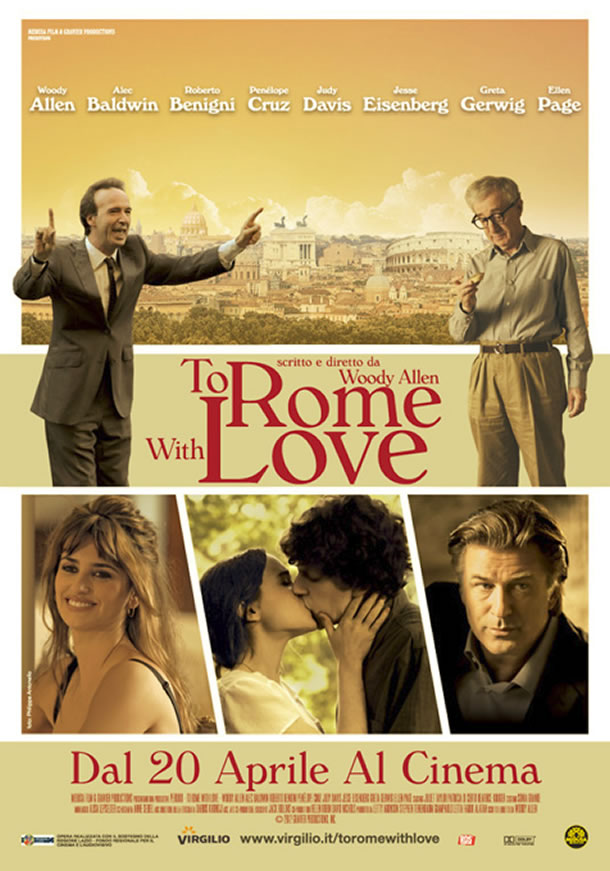
To Rome with Love - This is pretty much "mid-grade" Woody Allen - it's judged more harshly because of how great Midnight in Paris was, but To Rome with Love is nowhere near as bad as Small Time Crooks, Anything Else, or Curse of the Jade Scorpion. It's just a pretty good anthology film with all of the baggage that accompanies that genre: some good stories, one that's just okay, and one outright dud.

 My favorite of the four sections involves Jesse Eisenberg having a chance encounter with Alec Baldwin while the latter is visiting his old neighborhood. Both are architects, and Eisenberg invites Baldwin to join him for coffee with girlfriend Greta Gerwig. You've probably seen the trailer and know that Ellen Page shows up as Gerwig's friend, a notorious boyfriend stealer, and Baldwin is immediately aware of what's going to happen. What makes it successful is realizing that Baldwin's character isn't actually there for most of the story - he exists as a sort of Jiminy Cricket for Eisenberg, interacting with everybody only in his imagination.

 To Rome with Love has its moments, but most of the segments are slow to start (the Allison Pill / Woody Allen in particular is unbearable at the outset) but are salvaged by images like an opera singer who can only perform while in the shower. Only the section with Penelope Cruz never goes anywhere, but it's a mostly amiable effort by the prolific Allen.

Screaming in High Heels: The Rise and Fall of the Scream Queen Era -This is a pretty short documentary focused on the "Big Three" of Scream Queens: Linnea Quigley, Michelle Bauer, and Brinke Stevens. If you don't know who they are then I can assure you this documentary won't be of much interest to you, but if you're a fan of Night of the Demons, Slumber Party Massacre, Return of the Living Dead or Hollywood Chainsaw Hookers, then you'll have fun watching this. You get to know all three of them before, during, and after their runs as the faces (among other parts) of horror flicks in the 1980s. It is, at times, a little aimless in direction, but Stevens, Bauer, and Quigley are such entertaining subjects that it's worth checking out.

 The Woman in Black - A pretty good horror movie that works best by avoiding jump scares, but don't really reinvent the wheel. I will admit to being creeped out after watching the film alone and trying to sleep in an empty house.

 Absentia

 Some Guy Who Kills People

  Side By Side - This is a well made documentary about 35mm film vs digital film, hosted and narrated by Keanu Reeves, who manages to talk to the big names in digital and conventional filmmaking. Like who? Well, James Cameron, David Lynch, Steven Soderbergh, George Lucas, Robert Rodriguez, Christopher Nolan, Walter Murch, the Wachowski siblings, and Martin Scorsese, just to name a few. It's quite comprehensive and I wish I had enjoyed it more than I did. I enjoyed the debate, even if it leans heavily on the "digital" side of the argument, but I tended to drift while Side By Side explained how film is developed, edited, how cameras work, and what color timing is. While it makes perfect sense to explain it to audiences who don't know, it held me back from really getting into the film early on.

 V/H/S - This is a highly divisive combination of the anthology and "found footage" subgenres of horror, and if you have reservations about the latter or you get motion sickness from it, I'd go ahead and pass. The first and last segments are my favorites, with the others falling between "that was okay" and "I could do without that," and it's probably longer than it needs to be, but I liked it. Be warned, there are a lot of people who really hate this movie.

 The Expendables 2 - A more successful sequel than I think any of us were expecting, in large part because the narrative is streamlined to a "revenge" film. It benefits greatly from having Jean-Claude Van Damme as the villain, but is offset by the cameos from Arnold Schwarzenegger and Chuck Norris being mostly one-liners referencing their films, including a "Chuck Norris Fact" from the man himself. I guess the groan inducing nature of that is worth putting up with because The Expendables 2 is a better movie than The Expendables.

 Savages

  Cloud Atlas - So... I appreciate what the Wachowskis and Tom Tykwer were trying to do. Adapting David Mitchell's Russian Nesting Egg of a novel into a movie that is, essentially, about recurring motifs (emotionally, historically, and experientially) and not totally dropping the ball deserves some level of admiration, and the nearly three hour film tries hard to keep it together for most of its running time.

 I can admire it, and appreciate it, but I don't think it was that successful. I'm not certain I liked it, although I wouldn't say I disliked it or outright hated it. I'm still on the fence. After a while, the decision to have the cast play multiple characters (of varying ethnicity and, eventually, gender) ceased to be effective and instead became distracting. I didn't want to be able to identify Hugh Grant immediately every time he showed up in the film, but sure enough that's what ended up happening, especially during his turn as "Hugh Grant plays Michael Caine." Ultimately the film gets hung up on that gimmick, even though I'd like to believe that it's not an intentional case of gimmickry. Why it's necessary makes sense, from a narrative and tonal standpoint, but it just doesn't gel. Or it didn't for me.  

 Killing Them Softly - There's a great crime movie in Andrew Domink's adaptation of George Higgin's Cogan's Trade, but along the way in adapting it, the director of The Assassination of Jesse James by the Coward Robert Ford had an idea that just hamstrings the whole project. I can understand why Dominik saw parallels between the novel and the 2008 financial crisis - it concerns mob gambling being disrupted by corruption on the part of its higher ups - but by integrating those parallels into the film, he nearly ruins the entire movie.

 Brad Pitt is great as the hitman who comes in to clean up the mess made by two lowlife fuck ups played by Ben Mendelsohn and Scoot McNairy (who are also great) after they rob a game run by Ray Liotta, who once held up one of his own games and then bragged about it after the fact. Richard Jenkins is very good as the middle-man between Pitt and the faceless mob decision makers, who are so cowardly they can't even convey what it is they want the killer to do, and James Gandolfini has a nice smaller role as a hitman so destroyed by alcoholism and his divorce that he won't leave his hotel room. Most of the actual story is really compelling and I enjoyed it, but then EVERY SINGLE TIME a television or radio is on, we have to listen to news coverage of the financial crisis, usually with Bush or Obama making speeches about the impending bailout. If that's not heavy-handed enough (and its omnipresence is frustrating to say the least), the film opens and closes by reminding you that Obama is running for President and then wins, which is coupled with a dismissive commentary about the politics of "Change." Why? To be honest, I'm not sure, because the ultimate payoff of the final conversation between Pitt and Jenkins doesn't need this ham-handed political commentary. It's a shame, because otherwise I think I would really dig Killing Them Softly.

 This is 40 - Judd Apatow's latest film has the least plot of any of his directorial efforts, and that has to be saying something. It's less of a movie than a chunk of the lives of characters we kinda knew from Knocked Up (hence the "Sort of Sequel" tagline), devoted to the fact that both protagonists are turning 40 in the same week. They are having financial trouble but go on vacation, they fight, they have tenuous relationships with their parents, they have daughters trying to figure out their place in the world, and jobs that aren't going the way they planned. None of this necessarily pays off in any way, and while Apatow finds room for Jason Segel, Chris O'Dowd, Lena Dunham, Megan Fox, John Lithgow, Albert Brooks, Robert Smigel, Melissa McCarthy, and Billie Joe Armstrong from Green Day, neither Seth Rogen or Katherine Heigl's characters appear or, unless I missed it in passing, are even mentioned, even though both films end in a hospital and involve a surprise pregnancy (SPOILER).

 Despite the aimless nature of This is 40, it is an oddly appealing film, in no small part because of Leslie Mann and Paul Rudd. The film definitely leans more in the Funny People side of Apatow's films than the Knocked Up category, but if you don't mind spending a little over two hours watching people live fictionalized versions of the writer / director's experiences, there's a good time to be had.

 The Silver Linings Playbook - This is probably my least favorite David O. Russell movie, and I don't mean that as a sleight to The Silver Linings Playbook. Unfortunately, when the standard is set by Flirting with Disaster, I Heart Huckabees, and Three Kings, a movie as predictable as The Silver Linings Playbook is going to pale in comparison. And yet, despite the fact that you can watch the trailer and know exactly where the story is going to go, I did really enjoy the journey. The actors make most of the difference, although it doesn't hurt that all of them are playing characters with moderate to severe emotional issues.

 It's a funny movie in an uncomfortable way, especially in the awkward ways that Bradley Cooper and Jennifer Lawrence's characters try to navigate their emotional baggage, and that helps overcome the predictability. That, and it's also nice to see Robert DeNiro and Chris Tucker in a good movie for the first time in a while. I don't quite agree with the Academy Award nominations for acting, because while I liked The Silver Linings Playbook, I guess I didn't think it was anything more than just pretty good. Not great, but fun. 

 Indie Game: The Movie

  Prometheus - What I really enjoy about Prometheus is constantly being off-set by the truly stupid character beats and story turns, and while I am intrigued by a lot of the ideas in the film, the decision to introduce plot points for the express purpose of "saving them for the inevitable sequel" drives me nuts. Believe me, I've written about this before.

 By the same token, Prometheus is one of the few movies from 2012 that I've seen more than once this year (many of the others are on this list, oddly, although at least two will show up in the "Best Of"). I've watched the film in theaters, with the commentaries on (Ridley Scott's and the John Spaihts / Damon Lindelof bicker-fest), the deleted scenes and I watched The Furious Gods: The Making of Prometheus - all four hours of it. I mulled over Scott's decision to explicitly connect the Alien and Blade Runner universes, I've re-examined why characters made the idiotic decisions they made, and read the original draft of the screenplay.

 Somewhere in there, one can piece together where Prometheus went right and where it went very wrong, and I guess that makes it all the more frustrating. When Prometheus is firing on all cylinders, I'm blown away by Scott's vision and world construction. But so many inexplicably stupid things happen that I just can't overlook that it makes it hard to commit to the film, and no amount of appendices to the film itself can change that fact.

 The Hobbit: An Unexpected Journey - Speaking of appendices, can I suggest that for a movie called The Hobbit, Bilbo Baggins is actually mostly absent (or at least not a factor in any way) for most of the story? I actually liked The Hobbit, but often find myself telling people "it's not as bad as you've heard," which is never a good way to entice someone with reservations.

 The truth is that the negativity towards The Hobbit IS hyperbolic, and the film is nowhere as bad as you've probably heard. It's not perfect though, and I suppose that's the standard Peter Jackson is being held to. With the rose-tinted memory we have of The Lord of the Rings films and the misgivings about turning one book into three movies (not to mention the anti-Jackson backlash in the wake of King Kong and The Lovely Bones), as soon as critics and the internet smelled blood, they pounced. The Hobbit is... leisurely, to say the least. Not un-enjoyably so, but languidly paced nonetheless. Jackson tries very hard to make a small story a larger part of the Lord of the Rings narrative, and in doing so adds a LOT to the film that's either mentioned in passing or not mentioned at all in the book.

 I resisted writing a review because I didn't see the film in 48fps and was tired of reading about the experience from people who had, and there didn't seem to be much to say that hadn't already been covered ad nauseum elsewhere. For me, An Unexpected Journey was a lot like The Fellowship of the Ring, in good and bad ways, but overall it was a trip worth taking. Maybe all of the digressions weren't necessary, but I liked Radagast the Brown and the White Council. The Game of Riddles was fantastic, and Martin Freeman had a good go at Bilbo, even if he barely factors into his own story. So yeah, it's not what I guess everybody expected, but it's not the worst thing ever. Sorry if you genuinely hated The Hobbit, because I don't quite get where that would come from. It misses perfection, but it's unrealistic to expect that considering the extenuating circumstances.

 The Dark Knight Rises - I thought it was a fitting end to Christopher Nolan's interpretation of the Batman mythos. People really seem to hate this movie, at least if the internet is to be believed. In the link you can find some discussion of "plot holes" in The Dark Knight Rises, and why they don't matter thematically. I'd also add that Anne Hathaway was a great Catwoman and I wasn't expected the film to have so much humor early on. It was appreciated - including the hilariously bad remixing of Bane's dialogue on the plane, which makes him sound like he's speaking from a different room.

 Lawless - I really liked Lawless. The Proposition is still my favorite John Hillcoat movie, but Lawless is no slouch. Read the review to see the little things that endeared the film to me, and please don't let the presence of Shia LeBeouf keep you away. His character is quite appropriate to how you're likely to view him as a person, and you'll get to see Guy Pearce beat the ever loving shit out of him.

 Seven Psychopaths - Martin McDonagh (In Bruges) writes and directs a movie that ends up being about itself. It's a mixture of Adaptation and 8 1/2, filtered through the lens of movies about criminals and hitmen. Like In Bruges, it's frequently quite funny, often violent, and gleefully inappropriate. We laughed quite a lot during an employee screening, but I must admit I haven't seen it again yet. I want to, but the memory is fading, and like Lawless, while I really did like Seven Psychopaths, I prefer McDonagh's In Bruges more.

 The Man with the Iron Fists -  Not much I want to add here, other than I saw it again (twice) after writing the initial review. It's probably fair to mention that if you don't REALLY like kung-fu movies and the Wu-Tang Clan, The Man with the Iron Fists might not be your cup of tea. I mean, it might be, but I was pre-disposed to want to see a RZA movie, and it doesn't surprise me at all that for the most part I was satisfied with the end result.

 Wreck-It Ralph - Confession time: I'm not a huge video game nerd. I caught probably half of the "easter eggs" in Wreck-It Ralph - most notably a random Metal Gear Solid joke - but the good news is that you don't HAVE to be encyclopedic in your knowledge of arcade games from the 80s and 90s to have a good time watching the film. I think I was more surprised by Sarah Silverman than John C. Reilly, because she's very much against type in Wreck-It Ralph, and it works in a way I wasn't expecting. In fact, most of the film really works, including the reveal of the villain, which I honestly did not see coming. Impressive, Disney, most impressive.

 Haywire - I didn't get around to seeing Magic Mike in 2012 (I'll rectify that, I promise), so Steven Soderbergh's action movie gets the nod near the top of the "almost" list. The review pretty much covers why.

 John Dies at the End -This is a faithful adaptation of David Wong's novel by Don Coscarelli (Phantasm, Bubba Ho-Tep), at least for the first half. The film gets to about the halfway point in the book, and then realizes it has thirty minutes to wrap up the rest of the story, so liberties are taken. Honestly, I didn't mind them, because I knew what was being condensed and most of the spirit is kept intact.

 That said, I totally understand why people who haven't read John Dies at the End don't like the movie. There's a sense of context that's missing from the film as it hurtles towards its conclusion that further confuses the comedy / horror tone and probably loses a lot of people. If you haven't read the book, I wouldn't watch the movie at all. You're going to hate it because of how it collapses in the last thirty minutes. If you have read the book, know Coscarelli mostly made sensible changes (not going to Vegas, diminishing Amy's role in the overall story, dropping certain elements of Korrok's plan), and made at least one I don't really understand (changing Molly's name), and two I don't know how I feel about (no Fred Durst and John's band doesn't sound nearly as bad as I thought it would). I dig John Dies at the End, and if it ever happens, I'd watch This Book (Movie?) is Filled with Spiders, although with what they had to do on a low budget here, I can't imagine that ever happening. That's a shame.

 21 Jump Street - I don't think I've laughed that hard or that consistently at another comedy this year. I was not expecting this movie to be good in the first place, let alone as funny as it is. For some reason, "Korean Jesus don't have time for your problems" pops up at work in conversation regularly.

 I'll be back soon with the cream of the crop, and because I've given up on trying to put it in order, you can expect a structure similar to this one. Are you excited?

Tuesday, December 4, 2012

Retro Review: Batman (1989)


 Independently of the impending release of Christopher Nolan's The Dark Knight Rises, I had the urge to watch Tim Burton's 1989 reinvention of Batman last week. It's been a while since I watched what amounted to the first major re-launch of the Dark Knight on screens since the 1960s, and despite the fact that I've written at some length about Batman Returns (here, for example), there were certain lingering assumptions I'd made about the film that I wanted to test.

 One of the arguments I've long held (and one that appears in the Batman Returns review) is that Burton's first go-round with Bruce Wayne was filtered by studio involvement, including the prominence of a Prince-heavy soundtrack that doesn't really match Danny Elfman's score. I also contended that Michael Keaton was overshadowed throughout most of the film by Jack Nicholson's iconic take on the Joker, and that as a result the sequel represented a more "pure" expression of director and material. It's an easy position to take when you haven't watched Batman in its entirety for several years, so does that judgment hold up after revisiting the film?

 Well, I think I let memory dictate a lot of what I thought to be true about Batman. It is true that making Jack Napier (and by extension, the Joker) the killer of Bruce Wayne's parents elevates his role in Batman's origin story (thus allowing a "you created me, I created you" motif), and that Nicholson dominates every scene he's in, even ones with legendary scenery chewer Jack Palance ("You... are my numbah one guy!"). However, I allowed memory to disproportionately increase Nicholson's screen time, so it was a bit surprising how much of the first half of the film is devoted to Vicki Vale (Kim Basinger) and Alexander Knox (Robert Wuhl) trying in vain to track down something, anything about the mysterious Batman. We're introduced to Bruce Wayne through them, accidentally at that, and in more than one way - they go to Wayne Manor in order to track down Commissioner Gordon (Pat Hingle), District Attorney Harvey Dent (Billy Dee Williams), the Mayor (Lee Wallace) and get them on the record about the vigilante terrorizing criminals.

 What's interesting is that Burton and screenwriters Sam Hamm and Warren Skaaren set up Batman as the more important component of the Wayne / Dark Knight dynamic, but then devote most of the screen time to Michael Keaton with the mask off. Yes, the film begins with Batman in action (after a clever misdirection regarding whether we're starting with the origin story up front) and then shifts largely to Wayne and Vale, interrupted by the Joker's romantic advances. Unless you count the final showdown in Gotham Cathedral, the interactions between this unorthodox love triangle are split evenly between Batman (in the art museum) and Bruce (in Vale's apartment). While the art museum sequence is more visually dynamic, the Wayne / Joker showdown has more character resonance.

 The museum sequence is, for the record, the first of two (and only two, unless you count the closing credits) Prince songs that appear in the film. Despite my lingering memories of "Batdance," "Party Man" and "Trust" are the only songs featured in Batman in their entirety, and both are linked to the Joker, who dances along, making them diegetic to the world. So let's say, for the sake of argument, that the Joker is a big Prince fan. So much so that he has Prince songs you've never heard before that are, in one form or fashion, very appropriate in the scenes they appear. If we accept that the Danny Elfman score represents Bruce Wayne / Batman and the Prince songs are expressions of the Joker, I can overlook the apparent clash of styles. Also, while I don't love the way Nicholson gyrates to "Trust" in particular, it is a good fit for his attitude and style.

 I also found myself more fond of Keaton as Batman than as Wayne (even though the lack of a strong chin and smaller frame make him look like a skinny guy in a suit). Maybe it's that Wayne, while being in a LOT of the movie, doesn't register much as a character until the inevitable flashback to the death of Thomas and Martha Wayne (which happens more than an hour into the film). In fact, Bruce Wayne doesn't have much to do other than look intense or deep in thought between his charming introduction to Knox and Vale and when he unleashes on the Joker ("You want to get nuts? Let's get nuts!") and is blindsided by the clown's reply ("You ever dance with the devil in the pale moonlight?").

 But watching the film again, Batman himself isn't all that interesting - he's not a lot more than the sum of his "wonderful toys." The fight scenes aren't very memorably, his movement is a little awkward (watch him sneaking around Axis Chemicals or even when he lands on the rooftop in the beginning of the film) and without his grappling hook, Batman doesn't even defeat the Joker or save Vicki Vale at the end of the film. He's thwarted by his nemesis and left dangling as the Clown Prince of Crime escapes in a helicopter. The most impressive detective work done by the Dark Knight happens offscreen, as Wayne and Alfred crack the secret chemical reaction that causes Gotham's beauty products to become lethal (and effectively so - those frozen death grins stick with you).

 Additionally, I like how Billy Dee William's Harvey Dent is introduced in such a way that never indicates he'll ever become Two Face. He's just the District Attorney of Gotham City, trying to nail Carl Grissom and to contend with the new threat of the Joker.

 Still, Batman is not particularly the ineffective setup to a better sequel for Burton and Keaton. I found myself frequently engrossed by the film, by the world and art design of Anton Furst, and it was a strong reminder of when a Danny Elfman theme really stuck with you. I've been trying not to compare Burton's Batman to the Nolan films (in particular Nicholson to Ledger), but I do think that Batman is more successful in relaunching Batman the icon than Batman Begins is. Batman Begins is a great Bruce Wayne story, but Batman does a better job at balancing the necessity of the myth that Wayne must become. It doesn't always balance the two as well, but then again neither does Batman Begins. I can't help but wonder what Batman would be like if the necessity of linking Wayne to Napier hadn't been in place, or if the film had focused more on characters on the outside experiencing the vigilante (as much of the first forty five minutes is), but the film still works. It still entertains, and I'm amazed how dark this "family friendly" movie is, considering I saw it when I was ten.

Friday, May 25, 2012

Blogorium Review: Dark Shadows

 So, it's come to this: The Tim Burton Players presented Charlie and the Chocolate Factory, Sweeney Todd, Alice in Wonderland, and now Dark Shadows. Having finished the latest foray of Burton and company into the world of "things we already knew existed and probably liked the first time", I have to say that at least Dark Shadows has the benefit of not feeling "phoned in." It may be the fact that I've only spend two hours with Shadows, as opposed to the (usually) one-and-a-half times watching the other three, but this one was at least mostly successful.

 In the interest of fairness, I was once a Tim Burton "fanboy": to this day, I can watch any of his films from Pee Wee's Big Adventure to Sleepy Hollow without hesitation, and I also really like Big Fish as a stylistic, if not tonal, departure from what one expects when one hears the phrase "A Tim Burton Film". On the other hand, I have trouble finishing Planet of the Apes, Corpse Bride, Charlie and the Chocolate Factory, Sweeney Todd, and Alice in Wonderland, movies that struggle to capture the Burton "style" but feel labored and undercooked, so to speak.

 Additionally, while I may not be a "late" era Tim Burton fan, I am also no devotee of Dark Shadows the series. I am, however, aware of its existence and actually watched it in syndication on USA or the Sci-Fi Channel (I can't remember which) for a while*. I stopped watching not because of the soap opera plotting or the lack of Barnabas Collins (honestly, I think I saw him twice the entire time), but because I seemed to keep catching episodes where a member of the Collins family ended up traveling back in time to the 1700s. Rather than follow their story, the show would immediately jump into the lives of their ancestors while the displaced Collins descendant cooled their heels in jail. As I remember, this happened at least twice - once on the air and again on the videos I rented when it wasn't possible to see it during the day.

 So I come to this not as a Dark Shadows purist nor as a person who really "likes" Tim Burton movies anymore. Maybe that's why I enjoyed the film, even if it is a mess for long stretches.

 The prologue, with narration from Barnabas (Johnny Depp) explaining the Collins family journey from Liverpool to America in the late 1700s, has an appropriately Gothic sensibility and efficiently explains the tragedy of the "cursed" founders of Collinsworth. Barnabas chooses Josette DuPres (Bella Heathcote) over servant Angelique Bouchard (Eva Green), who is also a witch. She lures Josette to her death and transforms Barnabas into a vampire before bringing the townspeople to Collinwood Manor and burying him alive. So far, so good.

 But then we jump ahead to 1972, where Victoria Winters (Bella Heathcoate) arrives at the dilapidated Collinwood Manor to serve as the new governess to David Collins (Gulliver McGrath). She meets what's left of the family: matriarch Elizabeth Collins Stoddard (Michelle Pfeiffer), her daughter Carolyn (Chloë Grace Moretz), David's father Roger Collins (Johnny Lee Miller), live-in psychologist Dr. Julia Hoffman (Helena Bonham Carter), and caretaker Willie Loomis (Jackie Earle Haley). Oh, and thanks to some construction nearby, the freshly awakened Barnabas Collins.

 I appreciate the fact that the advertisements playing up the "fish out of water" jokes of an 18th century vampire in the 1970s don't dominate the film, because most of the ones in Dark Shadows don't really work. Aside from Barnabas' fascination with Carolyn's lava lamp, gags about keyboards and television or not understanding that Alice Cooper (Alice Cooper) isn't a woman don't really connect. Maybe it plays with some audiences but not so much with the Cap'n, but like I said, the trailers used pretty much every joke that's in the movie and it isn't what most of Dark Shadows is about.

 Instead, Dark Shadows occupies most of its time with Barnabas' devotion to family and to restoring the Collins name in the small fishing town, even if it means hypnotizing fishermen (including Christopher Lee) into breaking their deal with Angel Bay Fishery. Now in direct competition, Angel Bay's owner demands to meet with Barnabas and he comes face to face with the seemingly ageless Angelique, who it would seem is still a little hot for her spurned (spurning?) lover. Things get complicated when Barnabas takes a shining to Victoria, who bears a striking resemblance to Josette, much to Angelique's dismay.

 Dark Shadows doesn't have a large cast, necessarily, but it may still be too large for what amounts to a nine person ensemble. Victoria disappears for stretches of the film because there's simply nothing for her to do, and Johnny Lee Miller's Roger never figures into the film in any meaningful way. When Barnabas gives him an ultimatum and he chooses to leave, it's a hollow moment because Roger never amounted to anything in the story. Helena Bonham Carter fares a little better as Dr. Hoffman, but her sudden removal from the narrative only seems to happen in order to set up a sequel.

 Chloë Grace Moretz's Carolyn serves exactly two purposes in the film: one is to provide the 70s soundtrack to Collinwood Manor and the other is an arbitrary plot twist in the last act to justify her being around during the climactic battle between Angelique and the Collins family. Pfeiffer and Haley are at least somewhat memorable with broad characters and dramatic posing, but Dark Shadows is really about Eva Green and Johnny Depp, who go all out with their bizarro versions of "witch" and "vampire."

 Barnabas is so devoted to being a gentleman that he apologizes to people before killing them (in a moment that made me laugh, he informs a group of hippies that he "deeply regrets" the fact he's going to slaughter them) and is fiercely loyal to his "distant" relatives. After last year's Pirates of the Caribbean, I was worried he might sleep walk through another performance or go too weird like Willy Wonka, but Depp's Barnabas Collins is a monster trying to be a man. It may not be on the level of the Ed's (Wood and Scissorhands) but he isn't so far over the top that it borders on caricature.

 Eva Green has a tougher role to play: Angelique is a powerful witch that really only wants Barnabas to love her, and when he continually refuses she lashes out, even when it's clear she doesn't really want to do it. Her conflicted relationship with the monster she created gives Green the ability to be more than just the villain of the film. While the Angelique / Barnabas "sex" scene isn't really funny or titillating (and clearly it's meant to be both at different points), they do manage to destroy her office while a Barry White song plays. That cue at least makes more sense than the lengthy "happening" that Barnabas throws for the town, including Alice Cooper performing live for no good reason.

 In the end I guess I was pleasantly surprised that Tim Burton at least seemed to be interested in Dark Shadows. After the detached, lifeless Alice in Wonderland it really seemed like he didn't always care about the movies he was making, at least since Planet of the Apes, so to have nice flourishes in Dark Shadows like Angelique's skin cracking like china near the end were welcome. I don't know that I'm going to be in a hurry to put on Dark Shadows when it comes out on DVD, but I didn't mind watching it. I chuckled a few times and was able to overlook the meandering parts in the middle. It may not be a return to form for Tim Burton but there's some fun to be had and every now and then a glimmer of the good old days. Sometimes that'll do.


 * I also had (maybe still have) a VHS copy of Scariest Moments from Dark Shadows. It's a montage of scenes that, in context, might be "scary" but in this edited format with no clear idea of what's happening is just silly. Mostly it's the reveal of some kind of monster and someone gasping, which really doesn't have the desired effect of being scary to anyone.

Tuesday, February 14, 2012

Retro Review: Planet of the Apes (2001) and Final Fantasy - The Spirits Within

 I can't really remember how or why it happened, but Planet of the Apes and Final Fantasy: The Spirits Within ended up in an improbable double feature some time in late July / early August 2001. It certainly wasn't intentional - I know this because I saw two different films with two different people. The end result, appropriately, was the same: why the hell did we watch that movie?

 Let's start with Planet of the Apes, the remake that began my slow decline in interest for the films of Tim Burton. After Sleepy Hollow (which I really liked), I was interested (if wary) of his remake of a movie I happened to also really like. It feels like I should have put a colon after that and then typed "Planet of the Apes" or the name of some other movie that Tim Burton would later remake (badly), but I'm so past the point of being bothered by every announcement of "The Tim Burton Players Present ______ (insert name of TV show, musical, movie, or comic book you hold dear)" that the joke didn't seem worth it.

We've all seen his Planet of the Apes. Some of us heard the story about how Burton was rushed into completing the film by Fox's July 2001 release date and that the script (particularly the ending) hadn't been settled on during production. (I was generally under the impression that Burton was a late choice for director, but doing some research for this review, it seems like he was on board with the script written in 2000, so either I'm remembering this wrong or it's been whitewashed from film history) The end result is a film that looks pretty cool, doesn't make any sense most of the time and REALLY doesn't make sense with it's "Ape Lincoln" twist ending.

 I haven't really watched Planet of the Apes all the way through since. Well, the 2001 remake; I watched the 1968 Planet of the Apes not too long ago, before watching Rise of the Planet of the Apes. I'm not as obsessed with the series as Cranpire is, but I do watch the original films semi-regularly. When I try to watch Burton's "re-imagining" I usually get bored quickly - I'm not sure if it's Mark Wahlberg's "eh" performance or Estella Warren's vacant gaze, or the apes that look cool but get dull quickly. And we're talking about apes played by Tim Roth, Paul Giamatti, Helena Bonham Carter, Michael Clarke Duncan, David Warner, Glen Shaddix, and (briefly) Charlton Heston. The makeup by effects guru Rick Baker is top notch, the sets look great, but nothing works. The movie never seems to have any momentum or story or characters that do anything that makes sense. When I try to watch the film again, I usually turn it off shortly after Wahlberg is captured and sold to Limbo (Giamatti) because it isn't worth investing two hours in. There's always something better to watch.

 While I can't remember who I saw Planet of the Apes with (it was either my brother and his friends or another friend that should have been in Connecticut, but maybe was home for break), I do remember driving to Raleigh to pick up Neil to see Final Fantasy: The Spirits Within. Remember that movie? The "all CGI photo-realistic" film that was going to blow everybody away? I didn't think so. It's sort of a footnote in the CGI cinematic evolution, one remembered for not being very good but that it looked all right and is probably still something Final Fantasy fans watch.

 The rest of us? Well, I'll be honest and say I've seen Final Fantasy: The Spirits Within once - nearly eleven years ago. This is what stands out in my memory: characters who look like specific actors but with voices of different actors (like Alec Baldwin playing a guy who looks just like Ben Affleck) and that the spirits were... ghosts? Stars in the sky? Geez. Beats me. They weren't aliens - no wait, they were ghosts of aliens... hold on.

 Here, this is copied directly from Wikipedia:

In the year 2065, a future Earth is infested by Phantoms: alien life forms capable of killing humans by physical contact. The remaining humans living in "barrier cities" all over the world are engaged in an ongoing struggle to free the planet. After being infected by a Phantom during one of her experiments, Aki Ross (Ming-Na) and her mentor, Dr. Sid (Donald Sutherland), uncover a means of defeating the Phantoms by gathering eight spirit signatures that, when joined, can negate the Phantoms. Aki is searching for the sixth spirit in the ruins of New York City when she is cornered by Phantoms but is rescued by Gray Edwards (Alec Baldwin) and his squad "Deep Eyes", consisting of Ryan Whittaker (Ving Rhames), Neil Fleming (Steve Buscemi) and Jane Proudfoot (Peri Gilpin). It is revealed that Gray was once romantically involved with Aki.

Upon returning to her barrier city, Aki joins Sid and appears before the leadership council along with General Hein (James Woods), who is determined to use the powerful Zeus space cannon to destroy the Phantoms. Aki delays the use of the Zeus cannon by revealing she has been infected, and the collected spirit signatures are keeping her infection stable. This revelation convinces Hein that she is being controlled by the Phantoms. Aki and the Deep Eyes squad succeed in finding the seventh spirit as Aki's infection begins to worsen and she slips into unconsciousness.

Aki's dream reveals the Phantoms are the spirits of dead aliens brought to Earth on a fragment of their destroyed planet. Sid uses the seventh spirit to bring Aki's infection back under control, reviving her. To scare the council into giving him clearance to fire the Zeus cannon Hein lowers part of the barrier shield protecting the city. Though Hein intended that only a few Phantoms enter, his plan backfires and Phantoms invade the entire city. Aki, Sid and the Deep Eyes attempt to reach Aki's spaceship, their means of escape but Ryan, Neil and Jane are killed by Phantoms. Sid finds the eighth spirit at the crater site of the alien asteroid's impact on Earth. Hein escapes and boards the Zeus space-station where he finally receives authorization to fire the cannon.

Sid lowers a shielded vehicle, with Aki and Gray, into the crater to locate the final spirit. Just before they can reach it, Hein fires the Zeus cannon into the crater not only destroying the eighth spirit but revealing the Phantom Gaia. Aki has a vision of the Phantom home planet, where she is able to receive the eighth spirit from the alien particles in herself. When Aki wakes, she and Gray combine it with the other seven. Hein continues to fire the Zeus cannon despite overheating warnings and unintentionally destroys the cannon and himself. Gray sacrifices himself as a medium needed to physically transmit the completed spirit into the alien Gaia. The Gaia is returned to normal as the Phantoms ascend into space, finally at peace. Aki is pulled from the crater holding Gray's body and looking into the newly liberated world.

 No joke: I did not recognize any of that. I remember laughing during the movie, and laughing even more on the way back home, but the specifics of Final Fantasy: The Spirits Within? Nah. That sounds like it might be a watchable movie, but that doesn't fit with my experience of this film. Square Pictures went on to make one more short subject: The Final Flight of the Osiris, a part of The Animatrix / prequel to the equally unwatchable The Matrix Reloaded. They then disbanded and I guess someone else made Final Fantasy VII: Advent Children, which I also didn't watch.

 As you can see, neither film made much of an impression in the long run for Cap'n Howdy. Tim Burton made Big Fish, which I liked, and then Charlie and the Chocolate Factory, Corpse Bride, Sweeney Todd: The Demon Barber of Fleet Street, and Alice in Wonderland. I did not like any of those movies, which is why I sincerely doubt I'm going to like Dark Shadows, a full-length animated Frankenweenie, or the in-discussion Beetlejuice sequel. I'd love to be wrong, but again, from 2001-2011, he's one for six in Cap'n Howdy's book. That's not so promising.

 Next week, we'll look at a much more interesting double feature: Panic Room and Death to Smoochy. I did see those on the same day with the same people and while one of them isn't so great, it does make for a nice story...

Saturday, December 31, 2011

Blogorium Review: Rise of the Planet of the Apes

 Despite hearing over and over again that "it was WAAAAYYYY better than I expected," I came into Rise of the Planet of the Apes with some trepidation. Like many of you, I had been relieved to hear that the reboot / prequel to the series was actually good and not just a nostalgia cash grab, but the lingering taste of Tim Burton's incomprehensible mess from ten years ago kept me cautious. I also heard - often from even the best reviews - that while the apes were amazing, the humans were one dimensional and one longed to return to Caesar's story.

  To be sure, the story of Will Rodman (James Franco)'s search for a cure to Alzheimer's isn't all that engaging. John Lithgow does the best he can as Will's father, Charles, but most of the time he just plays "confused," "surprised," or "frustrated." Freida Pinto is left with even less as primate veterinarian Caroline Aranha, who somehow dates Will for five years and never thinks to ask him why Caesar is so intelligent or even look into his research on ALZ 112. Gen Sys project manager Steven Jacobs (David Oyelowo) is a bottom line driven, moustache twirling baddie, and for good measure there's Will's neighbor whose only emotion seems to be "indignant."

 A series of misunderstandings lead to the death of Will's test subject, Bright Eyes, and the cancellation of his research, so he smuggles home Caesar (Andy Serkis) and some of the ALZ 112 and tests it on his father. Bright Eyes genetically passed on the 112 to Caesar, and his intellect is formidable, which becomes threatening through more misunderstandings. The good news is that most of the film is less about Will and more about Caesar, and if you've seen Conquest of the Planet of the Apes, you have some idea why that justifies Rise of the Planet of the Apes in and of itself.

 It's telling that the apes are listed first in the credits, because Rise is very much their film. Any misgivings I might have about the humans (who fall into the "sympathetic to Caesar" or "evil jerks" with no shades of gray in between), Rise of the Planet of the Apes is totally compelling and successful when it Caesar and the other apes are on screen. After Caesar is separated from Will, he ends up in a primate refuge run by disinterested keeper John Landon (Brian Cox) and his cruel, bored son Dodge (Tom Felton), although they are secondary to what happens. We're treated to an ape version of a "prison" movie, and the way that Caesar not only takes control of the other apes but wins over his "alpha" competition, Rocket, is inspired storytelling. All of it done without dialogue and based entirely on Serkis' performance as Caesar.

 This is somewhat secondary to the review itself, but I'm not sure that Rise of the Planet of the Apes needed so many references to the original series. Now it isn't just Tom Felton saying (verbatim) Charlton Heston's "damn dirty ape" line, or naming many of the apes after memorable moments from the original series (Bright Eyes, Cornelia, Maurice, and Rocket*). It gets silly when you realize that Will's experimental drug is named after the running time of Planet of the Apes (no, really; the screenwriter nearly named it RT-112), and I don't know that we needed the subplot about the space mission to Mars and the Icarus disappearing, or necessarily how it was that apes began riding horses. On the other hand, I liked the way writers Rick Jaffa and Amanda Silver incorporated the line "it's a mad house! A MAD HOUSE!" into the film (also through Felton) and a hint of why humanity declined as apes ascended the evolutionary ladder.

 I really can't heap enough praise on Andy Serkis for bringing Caesar to life. I know that there are other performers behind Rocket, Buck, Koba, and Maurice, not to mention a host of WETA programmers and animators hard at work to make everything look real. The cgi is, initially, noticeable, especially when Caesar is very young, but before long I found myself engrossed in the story and how emotive Caesar was. Watching the raw footage in the extras, it's clear that Serkis is not only the physical template for Caesar, but his acting, his facial expressions, and his presence carry over perfectly. It would, I feel, be a shame if Serkis isn't nominated for Best Supporting Actor for the film, but I suspect instead the Academy will create a new award for Motion Capture. That said, what Serkis does goes beyond motion capture - without Serkis as Caesar, Rise of the Planet of the Apes doesn't go anywhere.

 So here's the deal: Rise of the Planet of the Apes may lack some of the pulpy touches that fans of the series are accustomed to, but the polished nature doesn't diminish anything going for the film. It erases the memory of 2001's Planet of the Apes remake and exists as a sort of alternate retelling of Escape and Conquest of the Planet of the Apes. You'll be pleasantly surprised how much better Rise is than anyone would hope from the studio who botched Alien vs Predator and Live Free or Die Hard (not to mention the Star Wars prequels). I'm actually looking forward to the next film, which has been hinted at as being a "Full Metal Jacket" of the Apes. With what Rupert Wyatt and 20th Century Fox have done with Rise, count me in.


* There's an extra on the disc that helpfully explains that Maurice is named after Maurice Evans, who played Doctor Zaius in Planet of the Apes, and that Rocket is named after one of the crew members in the film.

Tuesday, July 5, 2011

Retro Double Feature Review: Buffy the Vampire Slayer and Batman Returns

 This is a true story of one of the coolest (and when you think about the age-to-film relationship, strangest) double features I've ever been privy to in theatres. The only other double feature that springs to mind in the same ballpark is Death to Smoochy and Panic Room, and considering I saw them as a young adult, the edge still goes to Buffy the Vampire Slayer and Batman Returns.

 Here's the brief back story: My parents were going to a dinner party or... something. I'm not really sure, but it was the kind of social function that a 13 year old and his 11-going-on-12 year old brother would stick out at. They decided it was best to take us to Waverly Place, home of a multiplex that's not a gym, buy tickets for two movies playing in close proximity to each other, and let us walk from one screen to the other between them.

 Why Buffy the Vampire Slayer and Batman Returns? Well, there's a good chance we'd already seen Batman Returns when it opened, so they figured we'd be okay watching it again. We both liked Batman, after all, so that one made sense. Buffy the Vampire Slayer? Okay, I don't really know. Maybe the PG13 didn't worry them too much, maybe the comedy looked fairly innocent - I mean, it's a Valley Girl who learns she's the next in a long line of vampire killers. It had Luke Perry and Donald Sutherland and Paul Reubens. And Rutger Hauer - I mean, we'd already seen Blade Runner, even if we didn't understand it, so we knew most of these actors. It was a comedy about vampires, and the other options at the time were Universal Soldier, Mom and Dad Save the World, Boomerang, A League of Their Own, and Cool World*. Maybe the times just lined up right.

 This is going to sound odd, but I don't blame my reticence on watching the series Buffy the Vampire Slayer on the movie of the same name. I actually like the movie, or at least with the last time I saw it all the way through, which was probably ten years ago. Maybe it doesn't hold up, and maybe (okay, almost certainly) the series aged better than the film, considering it's Joss Whedon's unfiltered version of the Buffy mythos. Still, I have a fond place in my heart for the goofy charm of Kristy Swanson fighting Rutger Hauer at the prom, or of Paul Reubens losing his arm and his prolonged death scene (which extends beyond the credits).

 Whedon fans are well aware that Fran Rabel Kuzui and Donald Sutherland did some serious tinkering with his original screenplay, taking the story less seriously (or at least, overplaying the "tongue in cheek" aspects). The series was designed to reset perceptions about Joss Whedon's character, and it seems like the movie now has a bum rap (it has a 32% rating on Rotten Tomatoes and a 5.3 rating on IMDB). I enjoyed it enough in the theatres that there's a copy of Buffy the Vampire Slayer around here somewhere on VHS, and now I want to watch the film again...

 At the end of Buffy, we walked across the lobby and waited for Batman Returns to start. Since it came out almost a month before, we must have seen the film before, but I honestly can't remember what the reaction to seeing it a second time was. Instead, I frequently drift instead to The Nightmare Before Christmas, a movie we was in the same auditorium a year and change later**.


 I really had to think carefully about Batman Returns, because while I know that was the movie we walked across the lobby to go see, it just didn't make sense. My lingering sensation of Batman Returns is that it's a Christmas movie - that's when the film is set, Burton adopts his muted visual palette to include snow caked Gotham City and transitions the visuals to match the frigid tone of the film. Yes, Catwoman (Michelle Pfeiffer) is sexually charged, and the Penguin (Danny DeVito) is appropriately animalistic, but after Batman Returns begins on a Charles Addams inspired pre-credits sequence with the Cobblepot family (Paul Reubens and Diane Salinger), the film takes a persistent, emotionally frozen turn that bothered audiences.

 This is all the more surprising because Batman Returns was released in June of 1992, in the middle of the "Summer Season," where it seems the least appropriate. I genuinely had difficulty reconciling my memories of Batman Returns as a movie (tonally, at least) with when I saw it on the big screen. It didn't seem possible that Warner Brothers would want to release a "winter" movie in the summer, but they did. Batman Begins makes sense, as does The Dark Knight, which are movies piping with steam or basked in sunlight. Even the cartoonish Batman & Robin, with Mr. Freeze as the villain, feels more appropriate to release in June than Batman Returns.

 Speaking of appropriate, I mentioned in my Army of Darkness Retro Review that there was a semi-stringent policy about what the young Cap'n could and could not see during my teenage years (Army of Darkness and The Crow: "no", Pulp Fiction: "yes"), but having seen both films now over the years, Batman Returns is thematically more "adult" in tone than the exaggerated Army of Darkness. It's a continuation of themes of disfigurement, abandonment, and psychosis from Batman, and one could argue as "dark" as the ending of Edward Scissorhands, which I also saw at a young age. One might argue that in the late 80s and early 90s, what was considered "family friendly" was a little more lenient in terms of violence and disturbing content, which might explain the eccentricities of people around my age.

 Either way, I still watch Batman Returns, still enjoy it more than any of the other cinematic iterations until The Dark Knight, and also plan on watching it again soon. In fact, I might stage a "double feature" event for both films so that everyone can enjoy the "related by Paul Reubens, mostly" pair. Let's pencil that in sometime soon, shall we?


* By the way, I'd say by 1993 we'd seen all of those movies, save for Boomerang and probably Cool World. We saw A League of Their Own at Mission Valley. I'm pretty sure I didn't see Cool World until high school, and to be honest I sort of wish I had never seen it.
** Which is, by the way, how that the film was much more kid-friendly and less frightening than I hoped it would be. Once I moved past that initial disappointment, I was and remain a huge fan of Tim Burton and Henry Selick's stop motion masterpiece.