Showing posts with label Tom Hardy. Show all posts
Friday, May 29, 2015
Blogorium Review: Mad Max - Fury Road
(editor's note: please forgive the relative lateness of this review - the Cap'n insisted on seeing the film a second time before turning this in.)
Eh. It was okay, I guess. You know, nothing special.
Nah, I'm just pulling your chain. This is the internet, where everything either rules or sucks, and there's no level of hyperbole big enough to attach to something, but even I can't argue with the fact that Fury Road is the goods. For a little while there, at the beginning, I thought I maybe had, though: it's not for very long, but right after Max (Tom Hardy) crashes his Interceptor and gets captured, your fearless Cap'n was worried he might have overhyped himself for this movie. Something about the persistent flashback, um, flashes (that might not actually be what we think they are, but more on that later) and the strangely under-cranked action as Max tries to escape the Citadel just felt... off. Like, something wasn't working. Also, it felt less like under-cranked camerawork and more like someone set the video to play at 1.5 speed but kept the audio the same. Since we're in a digital projection world, I did worry that maybe that could actually have happened.
But then that went away and George Miller settled down and suddenly it was a Mad Max movie, and it just got better and better. And by that I also mean more bugnuts crazy until you thought it couldn't anymore and then there's the guy strapped to the wall of amplifiers on a truck who plays an electric guitar that also shoots fire while six dudes play massive drums behind him. All so you know that doom is coming. Also, his name is The Doof Warrior. That's not even the craziest character name in the film, which includes the likes of Immortan Joe, Imperator Furiosa, Rictus Erectus, The Splendid Angharad, The People Eater, and Cheedo the Fragile. All of a sudden, Max Rockatansky, The Humungus, and Aunty Entity don't seem so outlandish.
In the Retro Review for Mad Max Beyond Thunderdome, I singled out how much I liked the "world building" aspect of the film, specifically Barter Town. Miller ups the ante a bit in Fury Road by giving us three hubs of post-apocalyptic civilization (even if we only see one): Gas Town, The Bullet Farm, and The Citadel. We only spend any time in The Citadel, run by warmonger Immortan Joe (Hugh Keays-Byrne), but we meet The People Eater (John Howard) and The Bullet Farmer (Richard Carter), who run things. No Master or Blaster here. They don't seem particularly happy to be dragged into a "domestic squabble" when Joe's lieutenant Furiosa (Charlize Theron) smuggles his wives out of The Citadel inside of her "War Rig" - a fully loaded tanker truck designed for offense and defense. Joe doesn't take kindly to Furiosa stealing his "property," and takes great exception to The Splendid Angharad (Rose Huntington-Whiteley) writing "We are not Things" inside the vault he keeps them in. His "brides" are for breeding, just like his Warboys are for fighting, and the milk maidens are for, uh, milk.
Joe is a diseased ridden old man covered in cancerous tumors, but underneath his painted muscle shell and hidden behind his post-apocalyptic Darth Vader breathing apparatus, he's managed to brainwash the huddled masses of The Citadel into thinking he's a god. He gives them water when he feels like it, has a shrine of removable steering wheels, makes grandiose speeches and promises the equally "half life" diseased Warboys that their sacrifices will lead them to the gates of Valhalla. And they believe it. The Warboys and War Pups worship this guy, and in his defense it's not like Joe just sends out his minions to get Furiosa and the brides back. He packs into his "cars stacked on top of each other" monstrosity and leads the pack, aforementioned Doof Warrior along for the ride. Also in the convoy is a rebuilt V-8 Interceptor, freshly pilfered from The Citadel's newly acquired "blood bag": Max Rockatansky.
I'm sure you've noticed that we got a ways into the synopsis before Max figures into the story, but that's because, like in Thunderdome, he's dragged into another power struggle that he had no part in to begin with. We just spend a little more time with the players in this particular story than we did in Thunderdome or The Road Warrior. It's not Max's fight, and this time he really doesn't want to be involved, but since he's literally strapped to the front of Warboy Nux (Nicolas Hoult)'s car, feeding him "high octane road warrior universal donor" blood, Max has no choice. He's chained to Nux, and Nux is a hard core fanatic of Immortan Joe willing to die at least three times to stop Furiosa. And Max is stuck to this idiot, to the point that he literally has to carry him around after they miraculously survive an electrical storm Furiosa drives through to lose the convoy.
When Max finally catches up to the actual protagonists, there's a funny moment where Miller plays with the concept of the "male gaze" in introducing the "brides": Immortan Joe keeps women who look like supermodels and has them all in similarly scantily clad white... well, I guess cloth would be the right description. It's not really clothes. Max sees Splendid drinking, to the point where she's soaking wet, but it becomes clear very quickly that his (and the camera's) gaze is directed at the water, not the post-apocalyptic wet-shirt contest on display. And then there's a fight, because Max decides to hold them at gunpoint. The ladies have been using a bolt cutter to remove chastity belts that give the term "vagina dentate" a new meaning, and after a drink, he wants to lose some Nux dead weight. Furiosa, robot arm detached, doesn't take kindly to this, and a smarter than usual struggle involving Max, Furiosa, the brides, Nux, and the chain ensues. But Max isn't interested in killing anybody. He just wants out - this isn't his fight, but he'll take your War Rig, thanks.
Some folks have complained that Max is more of a supporting character in Fury Road, and that it's unfair to have his name in the title since Furiosa is more or less the protagonist of the film. However, the story isn't that much different than the way The Road Warrior or Beyond Thunderdome are structured: Max travels the wasteland, runs into trouble, and reluctantly helps a group of survivors before taking off again on his own (SPOILER for The Road Warrior and Beyond Thunderdome). The difference between those films and Fury Road is that we spend most of the expository period with Max, whereas in this one there's a lengthy period of time where he has little or no agency. Max is a prisoner all the way up until he wrestles the pistol away from Furiosa, and when her "kill switch" shuts down the War Rig, he's essentially at her mercy. Max doesn't so much agree to help them as he does go along for the ride, eventually deciding to do the right thing when they pass through the canyons.
(MILD SPOILERS FROM HERE ON OUT: There's an interesting, if underdeveloped parallel between Joe's obsession with his "property" and Max's continued protestation about the Warboys stealing what's belongs to him. He repeatedly shouts to the driver of his Interceptor that it's "mine," and the first thing he does after he's freed from Nux is take his jacket back. There's not really any kind of thematic resolution to being fixated on "things" for Max - the Interceptor is destroyed, but he keeps his jacket, and he's mostly replaced his stuff by the time he kills the Bullet Farmer)
What follows is a mostly non-stop chase in one direction, and then a chase back, after the "Green Place" Furiosa promised the brides no longer exists. It's actually impressive to consider that a film with this much uninterrupted action has enough of a plot that I'm leaving out everything that happens after the "wetlands"
I'm going to address and sidestep the "is this a reboot / is this a prequel" argument by saying that if Furiosa hasn't seen the Vuvalini in "7,000 days" - roughly twenty years and that Max was still a cop before the world collapsed, then maybe Fury Road is both. And by that I mean that since Miller (Happy Feet) has been working on this Mad Max film since 2003 (when it almost happened) that Furiosa could have been kidnapped post-apocalypse and taken to The Citadel while, let's say, The Road Warrior was happening. You could argue that a Mel Gibson-aged Max would have made sense in that timeline, while a Tom Hardy Max seems, um, a little young. And not just because he's three years younger than Theron. But since we have the math we have in Fury Road and it at the very least directly acknowledges Mad Max, let's just agree that none of them have to be sequels and are all stories set in the Wasteland. Chronology dodge activated.
That said, it was nice to have tiny, unobtrusive nods to the other Mad Max movies (and Peter Weir's The Cars That Ate Paris), ones that you might not have noticed. The music box one of the "wives" is playing with. The shot of Toecutter's eyes when Max is dreaming in the rig. My favorite is the Thunderdome reference, when Max is collecting weapons from Furiosa and completely misses the knife hidden in something else. They don't draw attention to themselves, but they're there. Miller's idea of "fan service" is to remind you of what world you're in without saying "hey, everybody, remember The Road Warrior, that movie was really cool!" Like everything else, it's about the economy of storytelling: showing, not telling. We learn a lot about the Citadel and the various factions in Fury Road without exposition dumps.
Take, for example, the moment that actually launches Fury Road: Furiosa's sudden turn left on the road to Gas Town. In most movies where someone working for a big bad guy decides to betray them, the people accompanying the "traitor" try to stop them, much to their detriment. What happens instead in Fury Road is an insight into the mentality of the War Boys. Without being told that they obey their power structure without question, we understand that they wouldn't dare question Furiosa when she says they're taking a "detour," even though she provides them with no explanation whatsoever. They fight for her and protect her, and end up dying to defend her mission without even knowing what she's trying to do.
It's the same unquestioning loyalty Nux has for Immortan Joe for the first half of the film, and even though we don't know much about Furiosa or Joe, we know that no matter what they decide, the War Boys support them. Nux is functionally our gateway into the mindset of Warboys, who are so naïve and sheltered that he doesn't even know what a tree is. The brides, in contrast, seem to have a better understanding of Immortan Joe's propaganda, but some of them (Cheedo in particular) believe he's capable of forgiveness in the same way they are. They stop Furiosa from killing Nux and convince her (and Max) to let him help, and their mercy contributes to the success of their plan. They also contrast well with the Vuvalini, the tribe of warriors Furiosa comes from. There's a conversation between The Dag (Abbey Lee) and the Keeper of the Seeds (Melissa Jaffer) where the former expresses surprise at the latter's boast she's killed everyone she met in the wasteland. "I thought you'd be above all that," she muses.
While I remain partial to The Humungus and admire the ambiguous threat that is Aunty, Immortan Joe is quickly rising on the list of "Mad Max villains." He's arguably just a combination of Humungus and Wez into one character, with a much better power structure, but Keays-Byrne conveys a sense of entitled insanity using only his eyes most of the film. He doesn't ever actually do anything other than drive, but the aggregate effect of his influence over the brides and the Warboys is palpable throughout the film. It raises the question of how someone so charismatic and control oriented would allow Furiosa to meet with the Rock Riders in the first place. He trusts her, and it's clear she's been in the Citadel since a very young age, but it seems unlikely that he authorizes trips anywhere other than Gas Town or the Bullet Farm. I'd also like to mention former WWE Smackdown Superstar Nathan Jones as Rictus Erectus, Immortan Joes' healthiest son (when you see Corpus Colossus, that will make more sense), who has a fantastic moment of pride when he announces that he had a baby brother, who was "perfect in every way!" He's surprisingly touching as the "heavy" of this film.
I'll get to Tom Hardy in a moment, but there's no point in discussing the actors in Fury Road without taking some time to appreciate what Charlize Theron does as Furiosa. She emerges early in the film as fully formed, even though she has arguably less back story than even Max. We know Max - we've seen him before - but Furiosa effortlessly takes the stage and keeps the stakes high. Theron balances a steely determination with eyes that reflect doubt at every turn. She's not making a mistake in what she's doing, but is how she's doing it going to work? Can she really trust Max or Nux, or are they just going to hinder her? We know very little about her relationship with Immortan Joe - he obviously trusts his Imperator, to a fault, but if she's been in the Citadel since a very young age, in what capacity? Was Furiosa a bride before she lost her arm? How did she lose it? What about the skeleton stencil on the War Rig? Is that some kind of reference? There's a lot to wonder about them, all of which comes to a head when she growls "remember me" near the end of the film. What she's seeking "redemption" for isn't always clear, but we want her to find it, and so does Max.
Oddly enough, Tom Hardy left less of an impression on me the first time I saw Fury Road. It wasn't until the second viewing that I really paid attention to Max, knowing where Furiosa's story was heading. Hardy has a strange balancing act, not quite sounding like Mel Gibson (or even Australian, at times), but still playing a character we know. I'm not going to lie that sometimes his pronunciation choices sounds just a little like Bane, but it was less distracting the second time. He's more chatty when tied to the front of Nux's car than I would have expected, but it's drowned out by the noise surrounding him. He's less chatty in the rest of the film, speaking more frequently through action (although the best moment in the movie happens off-screen). Hardy seems a little hampered by a character development I'll mention in a bit, but overall he assumes the role of Max well. It would have been interesting to see Gibson playing this part, but I think it might have radically changed the way audiences react to Max's fight with Furiosa.
Even after seeing the film for a second time, the feeling I came out with was still one of admiration. It's rare to see an action film that's so carefully constructed, so clearly thought out. These days I'll be happy for one that unobtrusively relies on quick edits or CG heavy sequences (Furious 7, I'm looking at you), but to see a film with action that's easy to follow and is still dynamic is really impressive. Georg Miller conveys his information visually, more so in Fury Road than in any of the other Mad Max films. He expands on the concept of post-apocalyptic "world building," but never lets it detract from the story. Everything you learn about the world surrounding the Citadel comes from seeing it and how the characters react. Something as simple as the people in stilts wandering through a radioactive swamp is evocative of a world we may never explore again. All of the tribes in the film are fully realized, even if we only get brief glimpses of them. It really is something to behold.
The one exception to this is an out of place reliance on Max's hallucinations / dreams about the people he couldn't save. I don't necessarily mind explaining to an audience thirty years later why the character is "mad," but the haunted quality is sometimes distracting from the immediacy of Fury Road. If I'm going to pick nits here, this is a recurrent them in Fury Road almost exclusively - Max never addresses things like this in The Road Warrior or Beyond Thunderdome. He doesn't say much of anything about his life "before" in either film, but I suppose if we're operating on the premise that there's no real chronology here, I can live with it. It keeps him alive at least once and is (mostly) resolved before he gets back to the Citadel, but even after the second viewing it sticks out to me. If the series continues - and announcements aside, there's no guarantee of that - I wouldn't miss dropping this version of "Mad" Max.
Of course, it's nice that Mad Max: Fury Road is technically a reboot that's content to be self contained. In an age where every movie needs to have an opening for a trilogy or a spin-off, I find it refreshing that as much as I like Furiosa, we've probably seen as much of her as we'll ever seen. Knowing Miller's penchant for Mad Max continuity, it's very unlikely that a major character - even one as memorable as hers - will appear again. There's plenty of Wasteland to explore, more towns and world building, and while it doesn't feel like audiences I saw the film with really embraced Fury Road (half empty auditoriums will give you that impression), maybe there's a chance for one more down the line. If not, there are now three great Mad Max movies, and Thunderdome, which I think is still mostly pretty good. I can't complain about that. Hell, I might go see it on the big screen one more time - if you're going to see it (and you should), you owe it to yourself to see it as large as possible.
Friday, February 13, 2015
Some Other Movies I Saw in 2014 (Part Four: Almost There...)
Well, gang, we're nearly done. After this roundup, the Cap'n is switching over to individual reviews for the "Best of 2014." I think you'll find that's easier to read, and, also because some of them are already written. Maybe they have been since last year, and you didn't see them the first time around. Either way, thanks for sticking around through these crowded recaps. Just looking back at it, 2014 may be the year I saw more contemporaneously released films than any time in the past. The challenge of writing up all of them - and trying not to include some of the spill-overs from January - has been daunting, to say the least. But we're very close now.
Is there something disingenuous buried deep within Iain Forsyth and Jane Pollard's "documentary" 20,000 Days on Earth? I don't know. There's certainly been talk about how much of the film, about Nick Cave celebrating the titular "event", is real and how much is staged. For my money, it doesn't really matter. At all. Certainly Cave didn't just happen to be driving around while collaborators from his past and present sat in the back seat, chatting about their working / personal relationships. The official synopsis refers to the film as "fictitious." But who cares? When you have a subject as riveting as Cave and a film as well made as 20,000 Days on Earth, what does it matter how the information is presented to you?
Think of the film more as a meditation on Nick Cave, if you prefer, and not a documentary. Sure, there's some candid footage of Cave and The Bad Seeds recording Push the Sky Away, and there are versions of the same songs being performed at a concert later in the film. Cave visiting his archives, and telling stories about living in Berlin in his twenties, or visiting Warren Ellis (not the writer, but his musical collaborator), and seemingly writing his own life story at a typewriter (see poster) may or may not have been captured so much as composed for the camera. It doesn't really matter. Nick Cave: musician, author, composer, screenwriter, sometimes actor. Partly truth, partly fiction. Just watching him be is worth the price of admission.
Yes, there's a certain artifice to having Cave drive around with Ray Winstone (The Proposition), Blixa Bargeld, a former member of The Bad Seeds, or Kylie Minogue, with whom he had the biggest "hit" of his career on the album Murder Ballads. He mostly listens as they talk, although Cave grows more animated with Minogue, as the seeming disparity between their perceived "place" in music crumbles onscreen. Similarly, a discussion with psychoanalyst Darian Leader doesn't feel spontaneous in the slightest, but is that necessary when it reveals more about Cave as a boy? It's a glimpse into the creative process of a renaissance man, one who doesn't always grasp - or care about - the significance of what he's doing. He only knows he needs to keep doing it, and we have an opportunity to enjoy the mercurial Nick Cave in as close to unguarded as we're ever likely to get. I don't give a lick how much of it is and isn't carefully composed for the camera: it's a great movie either way.
One thing you might have noticed that's been missing from this recap - at least since the "good" section started - is the presence of horror films. Science fiction ended up with its own recap, but for a change, I didn't see that much horror this year. At least not new to 2014. I think, technically speaking, everything from Nevermore would qualify as 2013 or before, which is why I'm not sure whether to include The Shower or not. The link to the review is embedded in the title, and it's absolutely worth seeking out (when you can). Until October, it was probably the most enjoyable new horror comedy I'd seen last year. Hopefully 2015 brings the means by which to show it to friends who weren't at Nevermore - the film spent most of last year on the festival circuit, but otherwise there was no way to see it.
While two sequels - V/H/S Viral and See No Evil 2 - made their way to the "Worst Of" list, there were two that not only lived up to their originals, but in many ways both are superior films. Let's start with The ABCs of Death 2, which is like V/H/S 2 in that it takes everything that worked about the first film, jettisoned most of what didn't, and was more fun to watch. The premise is still the same: twenty six directors each receive a letter from the alphabet, and have free reign to come up with a 2-3 minute short film that conveys a word and, in some form or fashion, death. The ABCs of Death had some interesting entries ("Unearthed" was a good one), but leaned heavily on scatological humor ("F is for Fart" was the tip of the iceberg, it turned out), and then there were the "oh, I didn't need to see that, not ever" letters. Like "Libido" and "Pressure." It turns out there are things you might want to un-see, and several of them are in The ABCs of Death.
The ABCs of Death 2, by comparison, has nothing as traumatic, and I would suspect it would play a lot better with an audience than the first one did. Watching that one at Nevermore, there was a lot of... shall I say, stunned silence as the film went on. There are certainly some "what the hell was that?" parts in the sequel, but nothing you're going to apologize for exposing someone to. The only thing that comes close is the last segment, "Z is for Zygote," which is centered around an already unforgettable image that closes on an even more disturbing note. I know that people don't like "P is for P-P-P-P-Scary!" but I thought it had an unhinged quality, somewhere between the weirder Betty Boop cartoons and Black Lodge-era David Lynch, that worked for me. As with the first film, you'll find highlights ("A is for Amateur") and lowlights ("V is for Vacation"), but there's nothing in The ABCs of Death that comes close to 2's "M is for Masticate," a slow motion gross out with a wicked joke at the end. There's also "D is for Deloused," which reminded me a bit of a Brothers Quay short. I'll leave most of the discovery for you, but if you kind of liked the first film, I strongly suspect you'll enjoy this one more.
Whilst on the subject of sequels, Dead Snow 2 might be more ambitious than even if can handle, but I'm not faulting Tommy Wirkola for going for broke and turning everything to "11." The parts of the film that don't work (the Zombie Defense Squad, mostly) come and go quickly enough, the film is nutty, to say the least, and Wirkola somehow manages to keep the ever expanding story from collapsing in on itself. Here's a portion of the Shocktober Review:
"Much of that is due to Wirkola's demented sense of humor and ability to acclimate to a larger budget. Dead Snow didn't necessarily feel hampered by its scale, but the sequel opens up in so many different ways that it's all the more admirable he manages to retain the anarchic sense of "anything goes" while not totally losing control of the story. The humor is still intact, and Dead Snow 2 is much funnier in its use of gore as a punch line (in this respect, I'd say it's fair to compare its approach as a sequel to Evil Dead 2). I thought that there was no possible way to use Bonnie Tyler's "Total Eclipse of the Heart" for comic effect again, but its placement in Dead Snow 2 is a great payoff of a setup you likely forgot from earlier in the film. To say any more would be to spoil the very end, which might have you laughing and gagging at the same time."
I didn't go into Zombeavers expecting it to be any good. This sounds counter-intuitive with what I said earlier in the recaps about trying to avoid bad movies, but I didn't watch Sharknado and this seemed like it might be an acceptable substitute. I mean, it couldn't possibly get better than the poster, or the inherently stupid premise, right? It would quickly get lazy and then I would get bored, like I normally do with Syfy Originals or movies that look like that (*coughTheAsylumreleasescough*).
So imagine my surprise to discover that Zombeavers is a (slightly) higher budgeted version of a movie like Blood Car or Rise of the Animals. True, this is not a scrappy, home made production - how could it be with a "From the Producers of American Pie, Cabin Fever, and The Ring" on the poster? - but it has the same anarchic spirit of those movies. At times, it's actually as bad as those can be, but what helps Zombeavers (a lot, actually) is that every time you think it's not worth sticking through, something you wouldn't expect either happens or comes out of someone's mouth. Either the film takes a truly unexpected turn - which it does - or one of the characters has a line that evokes a "wait, what?" and you don't mind sticking around.
I felt like I was in pretty good hands during the prologue, which features Bill Burr and an unrecognizable John Mayer (yep, "Your Body is a Wonderland"'s John Mayer) as drivers hauling around chemical waste and shooting the shit, often in increasingly strange ways. They eventually hit a deer, which leads to a barrel of said chemicals rolling down into a stream and to (dun dun DUUUUNNN) a beaver dam. Because, yes, this is a movie about zombie beavers. Or Zombeavers, if you will. Also, there are three college students: Mary (Rachel Melvin), Zoe (Courtney Palm), and Jenn (Lexi Atkins), who are having a "girls' weekend" in order to forget about Mary's boyfriend Sam (Hutch Dano) cheating on her. But he shows up anyway, with Tommy (Jake Weary) and Buck (Peter Gilroy) in tow, so it becomes a slightly uncomfortable couples weekend. With Zombeavers.
You might struggle through the "set up" part of the film, and I nearly turned it off while the girls were on the way to the cabin, but some of the lines are so out of left field that I stuck with it. The tone is borderline surreal, from the "is this serious" hunter (Rex Linn) that they run into, to the neighbors near the cabin (Brent Briscoe and Phyllis Katz), who turn out to be way more savvy about kids than you'd expect. And there's a bear, but mostly, it's the Zombeavers. Which look like nothing more than marginally articulated puppets and are hilarious. You see, sometimes a cheap looking monster can elevate a B-Movie from "that was okay" to "that was amazing," and the titular zombified beavers are worth the price of admission. It doesn't hurt that Zombeavers gets even weirder when the "rules of infection" kick in, but the monsters are the stars of the show. Stick around after the credits - which include a song about the movie that puts Richard Cheese to shame - for an even better zombie related pun. If it sets up a sequel, I could be onboard with that, but if not, well played, Jordan Rubin...
On the opposite end of the spectrum from gonzo creature features is Michaël R. Roskam (Bullhead)'s The Drop, which is a distant relative
Like Robert Pattinson's character in The Rover, it's hard to tell if Bob is slow and meek, or just wants you to think he is. One night, while walking home, he finds an abused dog in the trash can belonging to Nadia (Noomi Rapace). She doesn't trust him, but agrees to help him with the dog until Bob can decide if he's really willing to keep it. What Bob doesn't know is who put the dog there: Eric Deeds (Matthias Schoenaerts), a local heavy who claims to be a big time killer. He's also Nadia's ex, and decides to take exception to Bob adopting "his" dog. A robbery at Marv's Bar also brings in the attention of Detective Torres (John Ortiz), although Marv is more concerned about the men he answers to. Torres snooping around, however, could make things very difficult, especially when the Chechens decide that Marv is going to be the drop for the Super Bowl...
The Drop is a deceptively straightforward film, one that's so low key you might not even see where it's going until all of the pieces fall into place. It's not a big "twist" movie, but rather the sort of film where situations lead characters to hatch schemes that overlap, always underestimating the other guy (or gal). While it was nice to see Gandolfini one last time, The Drop is really more a showcase for Tom Hardy. Marv is a pretty one-note character, but Hardy's Bob is all internalized, all observant, with a hint of something just out of reach. I've heard he's fantastic in Locke, which I have not had the opportunity to see, but Hardy is the big draw in The Drop. The film has a similar "community first" tone to God's Pocket, but is even more ruthless in the way people behave towards each other. But, then again, we are talking about Dennis Lehane, so that shouldn't be too much of a surprise.
If you prefer your slow burns that explode into bursts of violence a little more Southern fried, may I suggest David Gordon Green's 2014 joint, Joe? It wasn't as well received as Prince Avalanche, but the Cap'n digs it. Yes, it's a bit of a downer, but it has a bit going for it. For starters, David Gordon Green excels when he makes smaller films, as you might have noticed in comparing Prince Avalanche to, say, The Sitter. Secondly, it continues the path of interesting choices for Tye Sheridan, who is quickly becoming a young actor I pay attention to, following him from The Tree of Life to Mud and now Joe. The final factor, I guess, might be the other reason why people were expecting something else, but for me a good restrained performance from Nicolas Cage is always worth checking out.
Yes, I complained that he didn't really go "Mega" in Left Behind, but that's because it was Left Behind and you only hire Nicolas Cage to be in a remake of Left Behind because you spend your afternoons watching clips of The Wicker Man on Youtube. If I see he's going to be in a David Gordon Green movie playing an ex-con with a temper problem trying hard to set and example for a younger kid, I'm not expecting "Mega." I know that it's hard to believe he can do anything else, particularly in the last ten years, but he was once also considered an actor worth watching not because he went crazy. Leaving Las Vegas is the easy go-to, but I'd also point you in the direction of Bringing Out the Dead. Sometimes, when Cage takes work not because he needs to pay off the T-Rex skull he bought or cover taxes on his castles in Europe, he might get invested in a role and really do something good. Like Werner Herzog's Bad Lieutenant: Port of Call New Orleans, another movie I bet you thought was terrible. (SPOILER ALERT: It's not)
Anyway, Cage is the titular character, who runs a probably slightly legally dubious business working for companies who need forests removed. The only problem is that they can't legally do that, so they pay Joe to hire day laborers to poison the trees. It's hard work, but Joe pays well for an honest week's labor and the guys he employs seem to trust him. He has a good reputation among them, even if he's known around town as a guy with a short temper. He's had a few run-ins with the law, and they harass him, mostly because once provoked he'll fight them, drunk or not (but often drunk). He was in jail for a while, and he and his dog get into some trouble at a local brothel (mostly because Joe brings his dog to fight the other dog, or I guess kill it). He's been warned to keep it together by his one friend on the police force, Earl (A.J. Wilson McPhaul ), but it's hard when nobody thinks you're worth it.
Joe sees himself in Gary (Sheridan), who comes looking for work. Gary is fifteen, and wants to provide for his mother and sister, because his father Wade (Gary Poulter) is a violent drunk. Wade, or G-Daawg, spends most of his time trying to find ways to drink, mostly by stealing money from his son. Wade has a shot to work for Joe, but immediately blows it and goes off to get drunk. It's clear from the first scene of the film that Wade is abusive, but there's a moment late in the film with a homeless man where you see just what he'll do. All to get some hobo wine. Rough stuff. Joe doesn't like what he sees, and admires Gary's genuine effort to better himself. He offers to sell Gary his truck, to help him learn a trade and defend himself, but this isn't the kind of place where improving your station in life is easy. Especially when people like Willie-Russell (Ronnie Gene Blevins) are around, with grudges they're happy to roll over from Joe to his protégé...
It is true that Joe isn't a fun movie to watch, and at times it's not even an easy movie to watch. The film is based on Larry Brown's novel, and screenwriter Gary Hawkins doesn't make anyone easy to like. Joe is stubborn to a fault when pressed, and it seems like he's incapable of letting it go when a deputy pulls him over. He blows a lot of opportunities to do something better, even as he helps Gary out of a nasty spot, one that gets nastier as the film goes on. I suppose I'm okay with the figurative rebirth metaphor at the end, which one could argue is kind of obvious, but is tied up with a monologue from someone who trusts Joe and his word. So I'll let it slide. Cage is very good, as is Sheridan, and Gary Poulter, who is no longer with us, is a fearsome presence indeed. He was, in fact, not an actor, but a homeless man that Green cast in the film, and he's hard to take your eyes off of when he's onscreen. Joe might not be an easy watch, but I'd say it's worthy of your time.
No one could accuse the real life Chris Rock of being like his character, Andre Allen, in Top Five. Other than the fact that they both started out as comedians who transitioned to film, there doesn't seem to be a lot of middle ground. Andre Allen quickly sold out and made actions movies where he's the voice of a Hammy the Bear. Rock has been remaking Erich Rohmer (I Think I Love My Wife) and producing documentaries about hair. But this is probably my favorite thing Chris Rock has been involved in since he produced Louis C.K.'s Pootie Tang, and it's the rare comedy that has something to say and doesn't feel heavy handed in the process. Where else can you hear a character argue that Tupac might be a senator if he'd lived, or he might be the "bad" boyfriend in a Tyler Perry movie?
Andre Allen is a man looking for respect, in spite of himself. He's marrying reality TV star Erica Long (Gabrielle Union), on television, but really he wants to talk about the movie he just made, Uprize. The one about the Haitian slave uprising, that no critic wants to watch. His fans want more action movies. His friends wonder why he abandoned standup after getting sober. And in the midst of this, Chelsea Brown (Rosario Dawson) wants to do an in depth piece for the New York Times. She'll follow him around, dig into his essence, or something that Andre couldn't care less about. But she's not leaving, and bit by bit she starts to break down his defenses. How much of Andre Allen is an act, or a reaction to negative reviews? Does it matter? How much of her prodding is he willing to take? What is she really after?
While Top Five does take the time to answer these questions, what's arguably more fun about the movie is the cast that Chris Rock assembled for Andre's friends. Most of the film is Chelsea following Andre around New York, where he hasn't been in a while, seeing his old friends. The best of these is an assemblage of SNL talent in an apartment: Jay Pharaoh, Leslie Jones, and Tracey Morgan, and Hassan Johnson, who knew Andre "back when," and are present for where the title comes from. Chelsea asks them to name their top five MC's, and the answers vary based on age and personal preference. She later asks Andre to name his top five comedians, which also an insight into Rock's influences (I'm going to go out on a limb and guess that this is another trait Andre and Rock have in common).
The "top five" thing only comes up a few times, because it's more about hanging out. J.B. Smoove plays his bodyguard / confidant, Kevin Hart has a cameo as his manager. Cedric the Entertainer plays a purple drank promoter in a flashback. Luis Guzman, shows up as his co-star in Hammy the Bear 3. Romany Malco has a small role as Erica (Union)'s assistant. The legendary Ben Vereen shows up halfway through the movie as an old timer who gives Andre grief for selling out, and who quietly asks him for money before he leaves. When he explains to Chelsea who it was, everything makes more sense. Even Tyler Perry technically has a cameo, thanks to a poster for a Madea movie that I know doesn't exist (yet). Apparently Louis C.K. was supposed to be in the film, but couldn't work it into his schedule. Rock finds a way to include him during a third act trip to a comedy club (one that will be very familiar if you watch Louie), so he's still there in spirit.
There are at least two celebrity cameos I wasn't expecting, neither of which I'm going to spoil. One makes sense, and happens during Andre's bachelor party (it's actually one of three people, all of whom play themselves and are friends of Rock). The other one is maybe the funniest moment in the second half of the movie, when things mostly get serious. I give a lot of credit to Chris Rock for ending the movie the way everybody assumed it would when you read the synopsis, but not in the way you'd expect it to. Instead it closes on a knowing smile from Smoove when one of the many seeds planted earlier in the film reappears. The film has a lot to say about the state of black actors in Hollywood as well, and I thought it was strange to read some of the negative reviews on IMDB. Some of them seem to be attacking Top Five for not being the kind of movie it's commenting on. The good news is that what it is not isn't as important as what it is, and that's a film you should seek out.
The Disappearance of Eleanor Rigby is actually three films: Her, Him, and the hybrid of the first two, Them. The only version I had the opportunity to watch before the recap began (it was actually the last movie I watched in 2014) was Them. From what I've read, writer / director Ned Benson would prefer Them be the one you should watch last, and reviews indicate that Them is the weakest of the three (ideally, they're designed to be seen the way I listed them above), but the choice was to not see it at all or to take what was available. I opted to be able to watch any version of it, and I'm glad I did. Without question, if Them is the weakest version of The Disappearance of Eleanor Rigby, then I very much look forward to watching Her and Him.
I'm not sure that the person who wrote the quote on the poster and I saw the same movie, but it certainly starts as a romance between Conor (James McAvoy) and Eleanor (Jessica Chastain). Them (and, presumably, Him and Her) moves backwards and forwards in time, in an elliptical fashion, jumping around to suit emotional states rather than narrative. When we meet them, Conor and Eleanor are eating at a restaurant, when he admits that he doesn't have enough money to cover the bill. They decide to pull a "dine and dash" and end up in a park nearby. By the next scene, Eleanor is on a bridge, and tries to kill herself. She's rescued after landing in the water, and Conor comes to visit her in the hospital, but we don't see the conversation they have. Eleanor decides to move home with her parents (Isabelle Hupert and William Hurt) and her sister (Jess Weixler). Conor tries to contact her, but she has no interest in speaking to him.We don't know what happened, and won't for much of The Disappearance of Eleanor Rigby. Benson reveals the details of the tragic event that fractures their relationship in small ways over the course of the film, and by the end we know the broad strokes, if not the specifics. I'm of the mind that it's better you not know going in, but it's not going to ruin the film if you read it somewhere. It's not as though the film hinges on why Eleanor decides to leave (that accounts for the title, in case you thought this was a more tradition thriller, ala Gone Girl). Benson is more interested in the way that the couple chooses to deal with her decision, and how it affects their friends and family in the process.
Assembled around Chastain and McAvoy is a surprisingly loaded supporting cast: Hurt and Hupert are a pointed contrast as Julian and Mary Rigby, who want to support their daughter but don't really understand her. Conor's father, Spencer (Ciarán Hinds) is as distant and withdrawn, in part because his son refuses his overtures to work for him (both are restaurateurs, but Spencer the more successful of the two). Julian helps Eleanor go back to school, where she meets Professor Friedman (Viola Davis), a no-bullshit, straight talker who doesn't want or need another student, but grudgingly takes her in. They bond more outside of the classroom than in, as their life experience overlaps in strange ways. Meanwhile Conor is trying (and failing) to keep his bar / restaurant open, with Stuart (Bill Hader) as his head chef and Alexis (Nina Arianda) tending bar. If, on the off chance, you don't recognize the name Jess Weixler, but her face seems familiar - as it did to me - she was the star of Teeth, a movie I'm quite fond of from 2007.
Generally speaking, though, The Disappearance of Eleanor Rigby is Chastain's film. Them attempts to keep McAvoy in the story, but it often distracts from Eleanor's story early in the film. When they cross paths again, there's a certain logic to cutting away to what he's doing, but I understand why Her and Him are necessary. Cutting down two 100 minute movies into one that's a little over two hours means a lot is going to get lost, and I can see how the parallel stories would juggle them better. When Eleanor and Conor's stories overlap, I'm guessing, is the bulk of Them. There are moments in the film that feel like something important is missing - like the aforementioned hospital scene - or where we're seeing part of a moment. What keeps Them together is Chastain's performance. Eleanor shuts down at the beginning of the film, and we don't really know much more about her than her parents seem to. Chastain internalizes Eleanor's pain, revealing it slowly, and in tiny moments, but all the while she remains and actress who is impossible not to be riveted by. I find it telling that Benson had originally planned for Eleanor to be a minor part in the story, only to increase the role when Chastain took the part and began asking questions. Them may not be the perfect marriage of two films, but it's certainly one with a lot of promise, and the good news is that there are two more out there with missing pieces. More importantly, I don't have to see them: I want to.
Finally, I've gone back and forth about where to put Nightcrawler in the recap. In the time since I reviewed it, I've softened a bit on its faults. It's a movie that sticks with me, despite my disdain for Louis Bloom as a protagonist (if ever there was a more appropriate anti-hero, I struggle to think of one). Nightcrawler has, perhaps rightly, been compared to Billy Wilder's Ace in the Hole. And, you know what, that's fair. Wilder was accused of being too cynical, and now, sixty years later, Nightcrawler accurately reflects the seedy underbelly of "journalism."
Still, I can't quite put it in the "Best of 2014" list, as I had originally considered. It's almost there, so close, but not quite. The music may be intentional, but it's nevertheless jarring and often inappropriate, ironic or not. Jake Gyllenhaal's performance is fantastic, and while I'll never understand not nominating him for Louis Bloom, the film will endure long after the snub. I may not love it quite as much as many critics do, but I admire it and remain haunted by what it says about humanity. Here's some of my original review:
"Nightcrawler follows the narrative structure of a
"rags to riches" story almost exactly, only to horrifying ends. Louis
buys a camera and a police scanner, makes mistakes, but eventually finds
some usable footage and sells it to the lowest rated news channel in
Los Angeles.[...] He
hires an intern and relentlessly insults his inability to do exactly what
Louis wants when he wants it. But they make it work: accident after
accident, crime scene after crime scene, Louis builds his reputation.
He's not above sneaking into somebody's house or moving evidence around
for better shot composition. When he arrives at an accident before the
police get there, Louis even moves a body in order to get more
compelling footage. [...]
I would recommend Nightcrawler on the strength of its performances, provided you don't mind seeing a movie where the evil are rewarded and the good mostly punished, or otherwise relegated to obscurity. The point of view in the film is strictly from Bloom's perspective, so don't be surprised if your impressions of him match the befuddled reactions during points when he does encounter a genuine human being. Louis isn't one, and he's perhaps the least likable antihero in a long line of them, but if you don't mind taking a ride into the depths of darkness, Nightcrawler is a compelling trip downward."
Okay, thus ends the long, crammed together version of the 2014 recap. From here on out, it's one entry per film. We are, at long last, at the top of the top, the crème de la crème of last year. Odds are you've noticed certain films missing from certain categories, so you might be able to guess. They should be coming more regularly than the longer pieces, if only because I only have to focus on one film at a time. Also, some of them might already be done, and you maybe missed them earlier this year. Stay tuned...
Monday, February 4, 2013
Blogorium Review: Bronson
Bronson is not the fictionalized story of Charles Bronson, just to get that out of the way. I know that many of you saw the cover (as I did) and thought (as I did not) "I don't remember Charles Bronson being bald or having a curly moustache. I mean, I guess he was tough but this guy looks like he could be Bane from Batman, for crying out loud," or something to that effect. That's a fair reaction, so just so you know, this is not a biopic about The Great Escape or Death Wish any more than the Jason Statham The Mechanic is a faithful remake of The Mechanic and not just a Jason Statham movie with a title you might maybe recognize.
It is, however, the fictionalized story of Charles Bronson (née Michael Peterson), who has the distinction of being "Britain's Most Violent Prisoner." As the movie (and the back of the DVD / Blu-Ray) tells us, he has "34 Years in Prison, 30 in Solitary Confinement," with the exception of the 69 days he was not in prison which was when he began bare knuckle boxing under the name "Charles Bronson." Bronson is quick to inform us that he's never killed anyone, although he really likes to get in fights, hold people hostage, and cover himself in grease, paint, or feces before fighting prison officials. All because he held up a post office (and then later stole a ring).
This might be confusing because I swear early in the film that one of the prison officials calls him "Charlie" when he's supposed to be sewing. That would be some time in the 1970s (between 1974, hen he's sent to prison, and when he's sent to an insane asylum), well before he chooses the name "Charles Bronson" which we see happen later in the film. At first I was taken aback but then realized that in a movie that exists in such a heightened state of "reality" that everything we're seeing only exists as Bronson sees it.
You'd think the parts where he's on a theatre stage addressing an audience while wearing a tuxedo and face paint would be a dead giveaway of that, but I made the mistake of taking some of the flashbacks at face value. My mistake.
Anyway, so most of the film is designed to be expressionistic or at the very least to not reflect any reality you or I could point to, although it does seem like the real Charles Bronson (not Mr. Majestyk) does actually have the reputation of doing these ridiculous things. There's a moment when he's explaining one of the mental facilities they sent him to before he was released and what happened there, and instead of recreating it he just stands in front of a screen showing (what I assume to be) actual news footage of the riot he caused. Some times the real thing is more effective than trying to re-enact it.
That said, I don't know how successful Nicholas Winding Refn and Tom Hardy are in conveying this to the audience. A lot of my friends hate Drive (I do not) and if you don't like that then you're really not going to like Bronson. It's way more self consciously "art-y" and has the same affinity for synth-heavy music (example: we learn that it's the 1980s in the movie when the inmates of the asylum are dancing to The Pet Shop Boys' "It's a Sin").
I liked much of what Refn did visually with the film and I thought Tom Hardy was charismatic and creepy and sometimes very awkward as Charles Bronson / Michael Peterson. There's a section of the film where he goes all "Bruce Willis in 12 Monkeys" in the asylum, drooling and shuffling around and generally not accomplishing his goal of "building an empire." I believe Hardy as Bronson when he says prison was his calling and that he believes it's his way of making a name for himself (I mean, they made a movie about him and not about the guy from Death Wish) and it once again steps Tom Hardy away from being Jean-Luc Picard's wimpy clone and towards being a guy who could break Christian Bale in half.
Maybe the problem is that Refn and co-screenwriter Brock Norman Brock don't ever convey that Charles Bronson is actually having the impact he wants to have. Part of this is that we rarely ever see other prisoners when he's in jail (and while he's in solitary for 30 years, he spends plenty of time outside of his cell) and because it's only the world as Bronson sees it, so there's no stepping back and seeing his actual impact on Britain or anything else that merits what we're told ABOUT Charles Bronson. The mistake they make is only showing us Charles Bronson through his eyes and not the eyes of others, with two exceptions near the end that don't bolster his case.
One is the Prison Governor(Johnny Phillips) who tells Bronson he's "pathetic" after the whole "building an empire" spiel, and the other Bronson's art teacher (James Lance), who sees his paintings as a way to make himself famous for "discovering" this imprisoned artist. Bronson thanks him by holding him hostage and painting on his face, then he demands the Governor play music while Charlie strips down, paints himself black, and prepares to fight a losing battle with the guards. I like that Bronson holds hostages even though he doesn't seem to want anything, but neither of these perspectives seem to reinforce what Charles Bronson wants his legacy to be. The real Charles Bronson at least popularized the "sock full of quarters" method of beatings as a viable form of revenge.
So yeah, I guess there are things I liked about Bronson, especially Tom Hardy, but also the movie doesn't quite do its subject justice, or at least adequately convey why it is that Charles Bronson deserves the reputation he has. It gives some anecdotal evidence but I think ultimately I'd have to overturn this verdict and say that the movie version of Michael Peterson is not deserving of the moniker Charles Bronson. I think the real Charles Bronson would agree, even from the grave, where I would still assume he could film Death Wish 6, if he desired. Still, Bronson is worth renting or watching streaming on Netflix. Unless you don't like Drive. If you don't like Drive then maybe you should watch Once Upon a Time in the West. That's on streaming, too.
Monday, January 7, 2013
Cap'n Howdy Presents his 2012 Recap: The Middle
The middle section of this recap of 2012 is the largest, and perhaps trickiest to deal with for the Cap'n. It's not as though I didn't enjoy many of these films, and most of them come recommended for one reason or the other, with some reservations. I have a good reason why the bottom of the middle include movies that are a marked improvement over the worst films I saw (which I'll explain), and the top of the list are movies that almost made the cut of my favorites. In fact, several of them may be on your "favorite" list, but I had to draw the line somewhere, and despite REALLY enjoying all of them, there's just a little something that keeps them from being among the very best I saw.
But that doesn't necessarily explain why it's so tricky writing about the middle section. You'll find that many of the movies on here are films I didn't write reviews for, mostly because I didn't have much to say about them at the time. Lots of them are all right, but nothing special, and I just didn't think I could add anything to the discussion about them, which leaves me with the task of doing so now. So this is going to be the longest of the recaps, likely with the fewest links to original reviews. That's your warning; grab a bite to eat, a cup of coffee, and let's sit down and look at 2012 from The Middle.
As I said, all of these films are recommended, mostly as something you could rent if you felt curious about the directors, cast, writers, or stories. They aren't films you need to run out and see right now - that's the next list - but on their own these films could provide an evening's entertainment that won't drive you into a Resident Evil induced rage.
Starting at the bottom of the middle:
Dark Shadows and Frankenweenie - Tim Burton continues along his path of "things you recognize, re-imagined by a director you really used to like" by adapting the long running gothic soap opera Dark Shadows and his own short film, Frankenweenie, but this time it's stop-motion animated and three times as long.
Are you ready for the shocker? I actually liked Dark Shadows more than Frankenweenie. Nobody else did, but Dark Shadows isn't nearly as horrible as I expected it to be, and instead of nonstop jokes about the 1970s, it's a surprisingly atmospheric and violent meditation on family ties. That said, it has too many characters, superfluous cameos that really don't move the plot forward (Alice Cooper, I'm looking at you), and while it's better than I was prepared for, that doesn't mean it's even close to the best Tim Burton is capable of. I suppose after being disappointed by Sweeney Todd, Alice in Wonderland, Charlie and the Chocolate Factory, and Corpse Bride, the idea of a marginally entertaining Tim Burton film was refreshing. That said, everybody else seems to hate it, so be warned.Frankenweenie could be better if Burton could figure out how to stretch a 30 minute short film into a full narrative, but he didn't. Basically the structure of the original Frankenweenie has been elongated and stitched together with a clever pastiche of Joe Dante-esque "monsters run amok" - including the best (and possibly only) Bambi Meets Godzilla reference I can remember. Unfortunately, the first forty five minutes drag so much that it's more of a relief than a delight when the reanimated pets wreak havoc all over New Holland. I will say it was nice to (hear) Catherine O'Hara, Martin Short, and Winona Ryder return to the Burton-verse, but ultimately Frankenweenie overstays its welcome before it has the chance to be any fun.
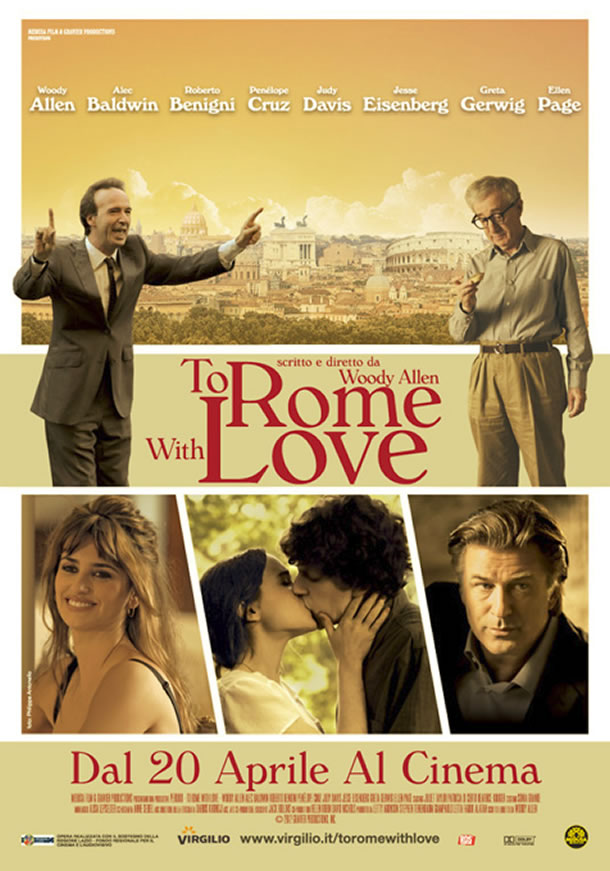
To Rome with Love - This is pretty much "mid-grade" Woody Allen - it's judged more harshly because of how great Midnight in Paris was, but To Rome with Love is nowhere near as bad as Small Time Crooks, Anything Else, or Curse of the Jade Scorpion. It's just a pretty good anthology film with all of the baggage that accompanies that genre: some good stories, one that's just okay, and one outright dud.
My favorite of the four sections involves Jesse Eisenberg having a chance encounter with Alec Baldwin while the latter is visiting his old neighborhood. Both are architects, and Eisenberg invites Baldwin to join him for coffee with girlfriend Greta Gerwig. You've probably seen the trailer and know that Ellen Page shows up as Gerwig's friend, a notorious boyfriend stealer, and Baldwin is immediately aware of what's going to happen. What makes it successful is realizing that Baldwin's character isn't actually there for most of the story - he exists as a sort of Jiminy Cricket for Eisenberg, interacting with everybody only in his imagination.
To Rome with Love has its moments, but most of the segments are slow to start (the Allison Pill / Woody Allen in particular is unbearable at the outset) but are salvaged by images like an opera singer who can only perform while in the shower. Only the section with Penelope Cruz never goes anywhere, but it's a mostly amiable effort by the prolific Allen.
Screaming in High Heels: The Rise and Fall of the Scream Queen Era -This is a pretty short documentary focused on the "Big Three" of Scream Queens: Linnea Quigley, Michelle Bauer, and Brinke Stevens. If you don't know who they are then I can assure you this documentary won't be of much interest to you, but if you're a fan of Night of the Demons, Slumber Party Massacre, Return of the Living Dead or Hollywood Chainsaw Hookers, then you'll have fun watching this. You get to know all three of them before, during, and after their runs as the faces (among other parts) of horror flicks in the 1980s. It is, at times, a little aimless in direction, but Stevens, Bauer, and Quigley are such entertaining subjects that it's worth checking out.
The Woman in Black - A pretty good horror movie that works best by avoiding jump scares, but don't really reinvent the wheel. I will admit to being creeped out after watching the film alone and trying to sleep in an empty house.
Absentia
Some Guy Who Kills People
Side By Side - This is a well made documentary about 35mm film vs digital film, hosted and narrated by Keanu Reeves, who manages to talk to the big names in digital and conventional filmmaking. Like who? Well, James Cameron, David Lynch, Steven Soderbergh, George Lucas, Robert Rodriguez, Christopher Nolan, Walter Murch, the Wachowski siblings, and Martin Scorsese, just to name a few. It's quite comprehensive and I wish I had enjoyed it more than I did. I enjoyed the debate, even if it leans heavily on the "digital" side of the argument, but I tended to drift while Side By Side explained how film is developed, edited, how cameras work, and what color timing is. While it makes perfect sense to explain it to audiences who don't know, it held me back from really getting into the film early on.
V/H/S - This is a highly divisive combination of the anthology and "found footage" subgenres of horror, and if you have reservations about the latter or you get motion sickness from it, I'd go ahead and pass. The first and last segments are my favorites, with the others falling between "that was okay" and "I could do without that," and it's probably longer than it needs to be, but I liked it. Be warned, there are a lot of people who really hate this movie.
The Expendables 2 - A more successful sequel than I think any of us were expecting, in large part because the narrative is streamlined to a "revenge" film. It benefits greatly from having Jean-Claude Van Damme as the villain, but is offset by the cameos from Arnold Schwarzenegger and Chuck Norris being mostly one-liners referencing their films, including a "Chuck Norris Fact" from the man himself. I guess the groan inducing nature of that is worth putting up with because The Expendables 2 is a better movie than The Expendables.
Savages
Cloud Atlas - So... I appreciate what the Wachowskis and Tom Tykwer were trying to do. Adapting David Mitchell's Russian Nesting Egg of a novel into a movie that is, essentially, about recurring motifs (emotionally, historically, and experientially) and not totally dropping the ball deserves some level of admiration, and the nearly three hour film tries hard to keep it together for most of its running time.
I can admire it, and appreciate it, but I don't think it was that successful. I'm not certain I liked it, although I wouldn't say I disliked it or outright hated it. I'm still on the fence. After a while, the decision to have the cast play multiple characters (of varying ethnicity and, eventually, gender) ceased to be effective and instead became distracting. I didn't want to be able to identify Hugh Grant immediately every time he showed up in the film, but sure enough that's what ended up happening, especially during his turn as "Hugh Grant plays Michael Caine." Ultimately the film gets hung up on that gimmick, even though I'd like to believe that it's not an intentional case of gimmickry. Why it's necessary makes sense, from a narrative and tonal standpoint, but it just doesn't gel. Or it didn't for me.
Killing Them Softly - There's a great crime movie in Andrew Domink's adaptation of George Higgin's Cogan's Trade, but along the way in adapting it, the director of The Assassination of Jesse James by the Coward Robert Ford had an idea that just hamstrings the whole project. I can understand why Dominik saw parallels between the novel and the 2008 financial crisis - it concerns mob gambling being disrupted by corruption on the part of its higher ups - but by integrating those parallels into the film, he nearly ruins the entire movie.
Brad Pitt is great as the hitman who comes in to clean up the mess made by two lowlife fuck ups played by Ben Mendelsohn and Scoot McNairy (who are also great) after they rob a game run by Ray Liotta, who once held up one of his own games and then bragged about it after the fact. Richard Jenkins is very good as the middle-man between Pitt and the faceless mob decision makers, who are so cowardly they can't even convey what it is they want the killer to do, and James Gandolfini has a nice smaller role as a hitman so destroyed by alcoholism and his divorce that he won't leave his hotel room. Most of the actual story is really compelling and I enjoyed it, but then EVERY SINGLE TIME a television or radio is on, we have to listen to news coverage of the financial crisis, usually with Bush or Obama making speeches about the impending bailout. If that's not heavy-handed enough (and its omnipresence is frustrating to say the least), the film opens and closes by reminding you that Obama is running for President and then wins, which is coupled with a dismissive commentary about the politics of "Change." Why? To be honest, I'm not sure, because the ultimate payoff of the final conversation between Pitt and Jenkins doesn't need this ham-handed political commentary. It's a shame, because otherwise I think I would really dig Killing Them Softly.
This is 40 - Judd Apatow's latest film has the least plot of any of his directorial efforts, and that has to be saying something. It's less of a movie than a chunk of the lives of characters we kinda knew from Knocked Up (hence the "Sort of Sequel" tagline), devoted to the fact that both protagonists are turning 40 in the same week. They are having financial trouble but go on vacation, they fight, they have tenuous relationships with their parents, they have daughters trying to figure out their place in the world, and jobs that aren't going the way they planned. None of this necessarily pays off in any way, and while Apatow finds room for Jason Segel, Chris O'Dowd, Lena Dunham, Megan Fox, John Lithgow, Albert Brooks, Robert Smigel, Melissa McCarthy, and Billie Joe Armstrong from Green Day, neither Seth Rogen or Katherine Heigl's characters appear or, unless I missed it in passing, are even mentioned, even though both films end in a hospital and involve a surprise pregnancy (SPOILER).
Despite the aimless nature of This is 40, it is an oddly appealing film, in no small part because of Leslie Mann and Paul Rudd. The film definitely leans more in the Funny People side of Apatow's films than the Knocked Up category, but if you don't mind spending a little over two hours watching people live fictionalized versions of the writer / director's experiences, there's a good time to be had.
The Silver Linings Playbook - This is probably my least favorite David O. Russell movie, and I don't mean that as a sleight to The Silver Linings Playbook. Unfortunately, when the standard is set by Flirting with Disaster, I Heart Huckabees, and Three Kings, a movie as predictable as The Silver Linings Playbook is going to pale in comparison. And yet, despite the fact that you can watch the trailer and know exactly where the story is going to go, I did really enjoy the journey. The actors make most of the difference, although it doesn't hurt that all of them are playing characters with moderate to severe emotional issues.
It's a funny movie in an uncomfortable way, especially in the awkward ways that Bradley Cooper and Jennifer Lawrence's characters try to navigate their emotional baggage, and that helps overcome the predictability. That, and it's also nice to see Robert DeNiro and Chris Tucker in a good movie for the first time in a while. I don't quite agree with the Academy Award nominations for acting, because while I liked The Silver Linings Playbook, I guess I didn't think it was anything more than just pretty good. Not great, but fun.
Indie Game: The Movie
Prometheus - What I really enjoy about Prometheus is constantly being off-set by the truly stupid character beats and story turns, and while I am intrigued by a lot of the ideas in the film, the decision to introduce plot points for the express purpose of "saving them for the inevitable sequel" drives me nuts. Believe me, I've written about this before.
By the same token, Prometheus is one of the few movies from 2012 that I've seen more than once this year (many of the others are on this list, oddly, although at least two will show up in the "Best Of"). I've watched the film in theaters, with the commentaries on (Ridley Scott's and the John Spaihts / Damon Lindelof bicker-fest), the deleted scenes and I watched The Furious Gods: The Making of Prometheus - all four hours of it. I mulled over Scott's decision to explicitly connect the Alien and Blade Runner universes, I've re-examined why characters made the idiotic decisions they made, and read the original draft of the screenplay.
Somewhere in there, one can piece together where Prometheus went right and where it went very wrong, and I guess that makes it all the more frustrating. When Prometheus is firing on all cylinders, I'm blown away by Scott's vision and world construction. But so many inexplicably stupid things happen that I just can't overlook that it makes it hard to commit to the film, and no amount of appendices to the film itself can change that fact.
The Hobbit: An Unexpected Journey - Speaking of appendices, can I suggest that for a movie called The Hobbit, Bilbo Baggins is actually mostly absent (or at least not a factor in any way) for most of the story? I actually liked The Hobbit, but often find myself telling people "it's not as bad as you've heard," which is never a good way to entice someone with reservations.
The truth is that the negativity towards The Hobbit IS hyperbolic, and the film is nowhere as bad as you've probably heard. It's not perfect though, and I suppose that's the standard Peter Jackson is being held to. With the rose-tinted memory we have of The Lord of the Rings films and the misgivings about turning one book into three movies (not to mention the anti-Jackson backlash in the wake of King Kong and The Lovely Bones), as soon as critics and the internet smelled blood, they pounced. The Hobbit is... leisurely, to say the least. Not un-enjoyably so, but languidly paced nonetheless. Jackson tries very hard to make a small story a larger part of the Lord of the Rings narrative, and in doing so adds a LOT to the film that's either mentioned in passing or not mentioned at all in the book.
I resisted writing a review because I didn't see the film in 48fps and was tired of reading about the experience from people who had, and there didn't seem to be much to say that hadn't already been covered ad nauseum elsewhere. For me, An Unexpected Journey was a lot like The Fellowship of the Ring, in good and bad ways, but overall it was a trip worth taking. Maybe all of the digressions weren't necessary, but I liked Radagast the Brown and the White Council. The Game of Riddles was fantastic, and Martin Freeman had a good go at Bilbo, even if he barely factors into his own story. So yeah, it's not what I guess everybody expected, but it's not the worst thing ever. Sorry if you genuinely hated The Hobbit, because I don't quite get where that would come from. It misses perfection, but it's unrealistic to expect that considering the extenuating circumstances.
The Dark Knight Rises - I thought it was a fitting end to Christopher Nolan's interpretation of the Batman mythos. People really seem to hate this movie, at least if the internet is to be believed. In the link you can find some discussion of "plot holes" in The Dark Knight Rises, and why they don't matter thematically. I'd also add that Anne Hathaway was a great Catwoman and I wasn't expected the film to have so much humor early on. It was appreciated - including the hilariously bad remixing of Bane's dialogue on the plane, which makes him sound like he's speaking from a different room.
Lawless - I really liked Lawless. The Proposition is still my favorite John Hillcoat movie, but Lawless is no slouch. Read the review to see the little things that endeared the film to me, and please don't let the presence of Shia LeBeouf keep you away. His character is quite appropriate to how you're likely to view him as a person, and you'll get to see Guy Pearce beat the ever loving shit out of him.
Seven Psychopaths - Martin McDonagh (In Bruges) writes and directs a movie that ends up being about itself. It's a mixture of Adaptation and 8 1/2, filtered through the lens of movies about criminals and hitmen. Like In Bruges, it's frequently quite funny, often violent, and gleefully inappropriate. We laughed quite a lot during an employee screening, but I must admit I haven't seen it again yet. I want to, but the memory is fading, and like Lawless, while I really did like Seven Psychopaths, I prefer McDonagh's In Bruges more.
The Man with the Iron Fists - Not much I want to add here, other than I saw it again (twice) after writing the initial review. It's probably fair to mention that if you don't REALLY like kung-fu movies and the Wu-Tang Clan, The Man with the Iron Fists might not be your cup of tea. I mean, it might be, but I was pre-disposed to want to see a RZA movie, and it doesn't surprise me at all that for the most part I was satisfied with the end result.
Wreck-It Ralph - Confession time: I'm not a huge video game nerd. I caught probably half of the "easter eggs" in Wreck-It Ralph - most notably a random Metal Gear Solid joke - but the good news is that you don't HAVE to be encyclopedic in your knowledge of arcade games from the 80s and 90s to have a good time watching the film. I think I was more surprised by Sarah Silverman than John C. Reilly, because she's very much against type in Wreck-It Ralph, and it works in a way I wasn't expecting. In fact, most of the film really works, including the reveal of the villain, which I honestly did not see coming. Impressive, Disney, most impressive.
Haywire - I didn't get around to seeing Magic Mike in 2012 (I'll rectify that, I promise), so Steven Soderbergh's action movie gets the nod near the top of the "almost" list. The review pretty much covers why.
John Dies at the End -This is a faithful adaptation of David Wong's novel by Don Coscarelli (Phantasm, Bubba Ho-Tep), at least for the first half. The film gets to about the halfway point in the book, and then realizes it has thirty minutes to wrap up the rest of the story, so liberties are taken. Honestly, I didn't mind them, because I knew what was being condensed and most of the spirit is kept intact.
That said, I totally understand why people who haven't read John Dies at the End don't like the movie. There's a sense of context that's missing from the film as it hurtles towards its conclusion that further confuses the comedy / horror tone and probably loses a lot of people. If you haven't read the book, I wouldn't watch the movie at all. You're going to hate it because of how it collapses in the last thirty minutes. If you have read the book, know Coscarelli mostly made sensible changes (not going to Vegas, diminishing Amy's role in the overall story, dropping certain elements of Korrok's plan), and made at least one I don't really understand (changing Molly's name), and two I don't know how I feel about (no Fred Durst and John's band doesn't sound nearly as bad as I thought it would). I dig John Dies at the End, and if it ever happens, I'd watch This Book (Movie?) is Filled with Spiders, although with what they had to do on a low budget here, I can't imagine that ever happening. That's a shame.
21 Jump Street - I don't think I've laughed that hard or that consistently at another comedy this year. I was not expecting this movie to be good in the first place, let alone as funny as it is. For some reason, "Korean Jesus don't have time for your problems" pops up at work in conversation regularly.
I'll be back soon with the cream of the crop, and because I've given up on trying to put it in order, you can expect a structure similar to this one. Are you excited?
Labels:
Anthologies,
Christopher Nolan,
Recaps,
Ridley Scott,
Tim Burton,
Tom Hardy,
Woody Allen
Tuesday, September 18, 2012
Retro Review: Star Trek - Nemesis
Lost amidst all of the 30th anniversary hoopla of now cult classics like Blade Runner and The Thing and Conan the Barbarian (as well as established classics like E.T., which beat up on those movies all summer, and maybe The Road Warrior too. I'd have to check, but that's not germane to this review) is the more important anniversaries, like, uh, Chasing Amy hitting the fifteen year mark. Or Good Will Hunting, and let's be honest here, if you'd asked the Cap'n which of those movies he's be watching again fifteen years later, younger me would be wrong in a big bad way. But we grow older and wiser, so we revisit things every now and then.
Speaking of movies that aren't any good, Star Trek: Nemesis, unlike Chasing Amy, was maligned when it came out ten years ago (this December) for "ruining" the Star Trek: The Next Generation film series (and with competition like Generations and Insurrection, that's saying something). It broke the "even numbered film = good / odd numbered film = bad" rule of thumb for Trek films, and pretty much guaranteed we'd never see Captain Picard on the big screen again. In fact, Paramount handed the keys to the franchise over to JJ Abrams, who rebooted the whole franchise and (with the screenwriters) relegated Picard, Data, Worf, and Geordi to a comic book prequel that assured us they wouldn't be showing up with Chris Pine and company.
For people who still want to argue that Nemesis "isn't that bad," I'll see you on the other side of the Mr. Plinkett review of the film. In fact, I'd almost considered just posting that as my "Retro Review" and writing "nuff said" because it covers almost all of the basis of why Nemesis is not, in fact, all right. It's yet another watered down retread of Star Trek II: The Wrath of Khan, which producer Rick Berman helpfully points out in the extras by explaining that Nemesis needed "a strong villain" because that's what made First Contact and Wrath of Khan successful. The jury is apparently out on what made The Voyage Home a bigger success, as its "strong villain" is a probe looking for humpback whales (SPOILER).
Anyway, so the reason I thought Nemesis might be worth coming back to had nothing to do with B-4, the stupid "dune buggy" away mission, the pointless transposition of the Kirk / Khan storyline into a TNG movie, using characters not designed for action movies in a totally inappropriate context (the Plinkett review of First Contact, by the way, covers in some detail why the TNG movies failed even in success). It's not about the "mind rape" sequence of Ron Perlman as a creepy
Where was I? Oh, right, Nemesis. It's hard to stay focused on such an unmemorable film. So I thought I'd check it out again because it was the only movie I associated Tom Hardy with until people started raving about Bronson**. In fact, it came as a surprise that Tom Hardy had a career resurgence (that continues to thrive) because he's so uninteresting as Shinzon, the Picard clone-turned-slave-turned-leader-of-the-Reman-Resistance that screenwriter John Logan opted to pair him with Ron Perlman as a vampire bat in order to make our villain vaguely menacing.
But I did think it was cool to see a young Tom Hardy screen test with Patrick Stewart and more than hold his own, which doesn't really translate to Nemesis. In the movie, it's not clear what the hell Shinzon really wants to do, or what he cares about, or really anything. Instead we get stupid Brent Spiner slapstick (doubled!) and pointless chase scenes and an ultimately inconsequential story about an upset in the Romulan Empire after Shinzon wipes the Senate out. Why inconsequential? Well, for one thing, that supernova completely wiped out Romulus, causing Nero to go crazy and travel back in time in order to destroy Vulcan and then fail to wipe out Earth. So not only do the alternate universe Romulans still distrust the Federation, but now one of their own was responsible for killing almost all of the Vulcans and disrupting history, etc.
Anyway, so needless to say that I was very impressed to see that Tom Hardy could be charismatic and menacing and have, well, screen presence after Nemesis. It's not his fault that the movie still sucks, and it's a testament to his work ethic in the studio system and beyond that it wasn't a career killer. Also, I don't hang it on director Stuart Baird (who also made Executive Decision and U.S. Marshals but also edited some much more impressive films), even though he gets a lot of grief for coming as a Trek "newbie" and making a movie like Nemesis. It's not totally his fault that Nemesis is a lousy Star Trek: The Next Generation movie, and the final action scenes between the Enterprise and the Scimitar look good. It's just the rest of the movie, including the awful wedding of Riker and Troi that kicks things off, that make the film so hard to sit through.
So ten years ago this was what we had to point to and say, "well, maybe Insurrection wasn't the worst TNG movie they could possibly make after all." Now we have a odd-numbered Star Trek movie that almost everybody seems to like (Star Trek) and people are looking forward to the sequel to that. Patrick Stewart is crossing his fingers that Charles Xavier doesn't have a cameo in the Wolverine sequel and that maybe they'll just ask him to come back for X-Men First Class: Days of Future Past, and Jonathan Frakes is directing television after the one-two punch of Clockstoppers and Thunderbirds. Meanwhile, Tom Hardy was in Bronson, Inception, Tinker Tailor Soldier Spy, The Dark Knight Rises, and Lawless***. I did not see that coming, but at least something good came from such a limp closing to "classic era" Star Trek.
* What this means for the implied connection over the series between Romulans and Vulcans has probably been explored in more depth on a Trek site I don't have time to look for, but are Remans also distantly related to Vulcans? Does it even matter?
** I haven't seen Black Hawk Down, along with several other Ridley Scott movies not featuring Tom Hardy, like G.I. Jane, 1492: Conquest of Paradise, and anything after American Gangster and before Prometheus.
*** And coughThisMeansWarcough...
Subscribe to:
Posts (Atom)