Sunday, October 20, 2013
Horror Fest VIII (Day Three): The Wolf Man, Frankenstein Meets the Wolf Man, and John Dies at the End
"Even a man who is pure of heart
and says his prayers by night
may become a wolf when the wolfsbane blooms
and the autumn moon is bright"
That's the poem uttered three times in the first twenty minutes of The Wolf Man, so that audiences won't forget that the movie they came to see (The Wolf Man) is about a man who becomes a wolf. The man in question is Lawrence Talbot (Lon Chaney, Jr.) although you wouldn't know that from the opening credits, which bill Chaney as "The Wolf Man." I must imagine that when The Wolf Man ran on television during the 1950s and 60s that its opening looked familiar to children: title cards introducing the characters play over a brief clip of them from some point in the film, a template of sorts for most TV sitcoms and many dramas.
Back to the poem for a moment, because the one takeaway I had from watching The Wolf Man this time is that Lawrence Talbot isn't really a man who is "pure of heart" at all. In fact, he's kind of sleazy: not only does he use his father's telescope to spy on Gwen Conliffe (Evelyn Ankers), but he then uses that information while in her father's pawn shop to put the moves on her. He gives her some business about being psychic, but even when he eventually comes clean about how he knew about her earrings, it's still in an unrepentantly smarmy fashion. It's no wonder that she doesn't want to go with him to the gypsy camp and brings along her friend Jenny (Fay Helm).
It's a good thing that Talbot buys a cane with a silver wolf's head, because the gypsy woman Maleva (Maria Ouspenskaya) is hiding a secret: her son, Bela (Bela Lugosi) is a Dracula... no, wait. That's not right. He's also a wolf man, and while reading Jenny's fortune, Bela realizes she's his next victim. He sends Jenny away, but she can't run fast enough and he attacks her in wolf form (more like German Shepherd form, but you get the idea) and Talbot is injured while killing said wolf with his cane.
I'm being a little unkind to The Wolf Man, one of the Universal Classic Monster movies that I was always the fondest of, and I do feel bad about that. I had always remembered Lawrence Talbot as something of a tragic figure, something that continued as long as Chaney reprises the role in various quasi-sequels (House of Frankenstein, Abbot and Costello Meet Frankenstein), but it's hard to feel too sympathetic about a guy who clearly doesn't care that Gwen already has a boyfriend and who behaves in such an underhanded way when he meets her. Perhaps it's supposed to be charming, but when he reveals that he has a telescope and she says "from now on I'll be sure to draw the curtains" and he tells her not to, that's just creepy.
Talbot is more sympathetic in Frankenstein Meets the Wolf Man, to be sure; after having been killed by his father (Claude Rains, the Invisible Man himself), Lawrence is placed in the family mausoleum, where he at least has peace (as promised by Maleva upon his death). That is, until the two graverobbers show up and break in, looking for jewels. They open Lawrence's coffin and move some of the wolfsbane so they can take his ring (but not before saying the poem for people who might not remember) but seeing as it is a full moon, after all, it's hard to keep a dead werewolf down...
Revived and apparently immortal, Talbot is found in Cardiff and taken to a nearby hospital with head trauma (the cane wound that killed him) and he's patched up by Dr. Mannering (Patric Knowles) while the authorities try to figure out who their mystery man is. Lawrence Talbot has been dead for four years, so the man in the hospital can't possibly be who he claims he is. And the following night a police officer is murdered by a wolf, something that Talbot seems to know about.
In The Wolf Man, Sir John Talbot and the authorities regard Lawrence's claims of being "dangerous" as an illness of the mind, but Dr. Mannering seems much more willing to accept his "affliction," although there's quite a while between when they are together in the story. Lawrence leaves the hospital (and Wales) to track down Maleva and find a way to die. He has no interest in being cured, only in no longer living - which is fair, considering that he was dead.
Frankenstein Meets the Wolf Man opens the scope of the first film considerably, and by necessity. Maleva is not only somewhere in Europe, but she's also nowhere near where the two of them need to be in order to help Lawrence. Maleva has heard of a man, named Frankenstein, who might be able to help Talbot, so they travel to Vasaria, the (fictional) home nation of the Frankenstein family, only to find that Ludwig Frankenstein is dead and that the burnt down castle has been abandoned.
The person I was watching Frankenstein Meets The Wolf Man with had not seen Ghost of Frankenstein, which caused a bit of a conundrum here, because until Baroness Elsa Frankenstein (Illona Massey) mentions that the experiments killed her father AND her grandfather, it's not stated in the film which Frankenstein is dead when Talbot arrives. As this is a sequel to both The Wolf Man and Ghost of Frankenstein, it's a good idea to be caught up on both series. (They do play it a bit fast and loose with chronology, though: in The Wolf Man you can clearly see cars driving around town, but by Frankenstein Meets The Wolf Man either there are no cars in Eastern Europe and Cardiff or Lawrence was dead for four years and traveled backwards in time. By the same token they have a hydroelectric dam in Vasaria - they mention that it powers the equipment in the castle - so it's anybody's guess)
At any rate, Talbot finds Frankenstein's monster (Bela Lugosi) frozen in ice and thaws him / it out in the hopes of finding some way to end his existence, and ultimately decides to contact the only surviving Frankenstein (Massey) to see if she can help him. The Baroness is not a scientist and wants nothing to do with the family, but during the Vasarian equivalent of Oktoberfest, Dr. Mannering finds Talbot and the merry band settle in at the castle to see if energy can be drained from Talbot and the monster, finally killing both of them.
The villagers are, understandably, weary of any activity involving a Frankenstein. They have good reason to be, as Mannering can't help but try to bring the monster back to full strength. Lucky for him (and us), they choose to experiment during a full moon. Well, that's a little fuzzy. I'm not sure if it's a full moon or if the experiment causes Talbot to turn into the Wolf Man (which Chaney is again billed as), but what's important is that the monster smackdown ensues to close out the film. How the Baroness and Dr. Mannering (and, I'm hoping, Maleva) manage to escape the exploding dam above the castle is a manner of movie convenience, but the two monsters presumably perish in the ensuing flood - as would everyone in the village below.
Interesting tidbit time: Bela Lugosi and Patric Knowles appear in both The Wolf Man and Frankenstein Meets the Wolf Man, albeit playing different roles each time. Ilona Massey, who plays Elsa Frankenstein, replaces Evelyn Ankers, who played Elsa in Ghost of Frankenstein, because it might be a little weird for the woman who played Gwen Conliffe to also be Baroness Frankenstein. All of the monster (Lugosi)'s dialogue was cut from Frankenstein Meets the Wolf Man, which makes it tricky to understand why it walks arms outstretched. The reason? In Ghost of Frankenstein, the monster is blind as a result of receiving Ygor (Lugosi again)'s brain. Vasaria, is, by the way, a post-World War II replacement for Germany, where the original Frankenstein was set, created by writer Curt Siodmak.
---
Finally we come to John Dies at the End, the best possible adaptation of David Wong's novel that Don Coscarelli could make with the budget he had. That's not a knock on the movie, because I can't imagine it would be easy to faithfully adapt that book considering how many crazy, outlandish, and disgusting moments are on nearly every page. Without the money to clear the many songs mentioned in the book, or to include Fred Durst, or to even be able to include the section in Vegas (it should happen instead of going straight to the mall, for those who have only seen the movie), let alone what happens AFTER David and John come back from the dimension Korrok originates from, it's impressive how close to the book John Dies at the End is. The first hour or so picks up all of the major beats with only a few omissions (where David works, Amy's brother, and some of the names of characters in the film).
As much as I want to resist the temptation to compare the book to the movie, it tends to happen without trying. So many people I know read John Dies at the End (how can you not when someone describes it as "GrossBusters"?) and while I'm glad that the movie works for audiences who haven't read it, I have no idea how it would play if I didn't know where the story was going. It's a collection of some of the stranger moments you'll ever see onscreen. I am impressed that Coscarelli turned what is an episodic structure in the book and made it more streamlined (mostly by dropping some of the detours) even if the ending is... abrupt.
I would imagine even if you hadn't read the book, the sudden leap from "things from another dimension that invade people and cause them to explode" to "welcome to the dimension of Korrok" must be a little jarring, even in a film where a guy's mustache flies off and attacks our hero. The last section of the film happens so quickly and is so packed with exposition that I'm kind of impressed it works at all. The coda during the credits eases things a bit, and the resolution to Arnie's frame story is surprisingly bittersweet for a movie so ready to shrug off the bizarre with "what's next?"
And yes, it still plays well the third time. I suspect it will the fourth, fifth, and so on, to boot. John Dies at the End may not be the level of "cult" film of Coscarelli's Phantasm series or as beloved as Bubba Ho-Tep, but I suspect that it will grow an audience for a long time on home video. It's just a shame that Coscarelli killed one major character, making a This Book is Full of Spiders adaptation very, very difficult, if not out right impossible. Then again, if they ran out of money for the spiders scene in John Dies at the End and had to animate it, there's probably no chance you could make This Book is Full of Spiders into a movie (the scope is considerably larger). But read both books, if you haven't. It isn't going to hurt the movie one bit.
Horror Fest VIII has come to a close, and I'll tell you it's been a good year for the Cap'n and Fests. Bad Movie Night was a blast, Summer Fest 5 had some great moments, and Horror Fest VIII may be my favorite to date, rivaling only III and V. I'm looking forward to next year - I hope you are too.
Saturday, November 24, 2012
Horror Fest VII Day Two: Bela Lugosi Triple Feature
One of the things the Cap'n doesn't do as much as I'd like to during Horror Fest is showcase older horror movies. Oh sure, every now and then I'll throw in something from the 50s or 60s, but they're few and far between, and in all honesty, I first came to be a fan of horror films because of a friend of my father's. He used to tape AMC's Monster Fest for me, back when AMC showed movies without interruption and had Robert Osborne providing information before the films (in other words, when AMC was Turner Classic Movies), and they used to have Universal Classic Monster triple features on Saturdays. I still have those tapes, with Dracula and Frankenstein, The Wolf Man, The Mummy, The Invisible Man, The Bride of Frankenstein, and my personal favorite at the time, Frankenstein Meets the Wolf Man. They would even have non-Universal films like King Kong, and that's how I slowly made my venture into watching "scary" movies.
It's my own doing, but I've never really shared that experience with Horror Fest audiences. In fact, the only movie with Bela Lugosi I've ever shown at a Fest was Plan 9 from Outer Space, which a) barely has any Lugosi in it and b) was used as a key example of why I found M. Night Shyamalan's The Happening so amusing. So it seemed like seven years in, it was time to give classic horror it's due.
I chose three Bela Lugosi vampire films - Dracula, Mark of the Vampire, and Return of the Vampire - because there's an interesting through line for the first two and the third one is clearly designed to use the name recognition of the second, but also because they're all better than one might expect in their own right. Lugosi tends to get the short shrift of the classic horror stars, in part because he worked a lot, and a lot of the films he worked on weren't very good, but also because these days he's as associated with Ed Wood as he is with playing Count Dracula, and not in a good way. It's a shame, because there are a lot of very good Bela Lugosi films (The Black Cat, The Raven) or roles where he plays a fine supporting role (Son of Frankenstein). Still, I thought it would be fun to have a vampire triptych, so let's take a look at that, shall we?
---
If it's all right with you, I'm going to spend the least amount of time on Tod Browning's Dracula, because I suspect that's the film most of you have seen. Dracula did, after all, start the Universal Classic Monster craze (even if Lon Chaney in The Phantom of the Opera preceded it by several years), and while it's a looser adaptation of Bram Stoker's novel than some might like, Browning's macabre sensibilities and atmospheric lighting and set design do make it memorable.
And, of course, there's Lugosi as Dracula, who loves his "children of the night" and "never drink(s)... wine." Reprising the role that made him famous on the stage, Lugosi's gaze and Hungarian accent make him instantly memorable to anyone who has ever seen the film. Both menacing and alluring, repulsive and erotic, Dracula benefits immensely from Lugosi's presence, keeping the rather dull second half and abrupt conclusion palatable.
---
Meanwhile, Baron Otto (Jean Hersholt) is charged with taking care of the estate, including the impending nuptials of Karell's daughter Irena (Elizabeth Allan) to Fedor (Henry Wadsworth), both of whom appear to be the new targets of Count Mora and Luna. With the arrival of Professor Zeller (Lionel Barrymore) comes the promise of saving the family from this vampire curse, and from the castle they've abandoned, even as Mora resurrects Karell to join his undead cabal.
For most of the film this seems to be where Mark of the Vampire is going, until it takes an abrupt turn with about fifteen minutes to go, and to say anymore risks massive SPOILER territory. So I'm going to mark the next section accordingly and if you don't want to know what the twist in Mark of the Vampire is, I'll meet you in the Return of the Vampire section.
SPOILERS FOR MARK OF THE VAMPIRE BEGIN HERE
It turns out, in a very unusual transition, that there ARE no vampires. Professor Zeller, in an attempt to trick Baron Otto into confessing to the murder of Sir Karell, constructed an elaborate ruse involving Count Mora, Luna, and an undead Karell in order to hypnotize the Baron. Everyone, with the exception of Fedor, is in on the hoax, we're led to believe (or need to believe if you want to accept the sudden shift in narrative and tone). Mora and Luna are actually actors hired to play the vampires, playing into the Baron's superstitious nature, and Irena goes along, despite her reservations. To be fair, the Professor is exploiting her father's death and using a look-a-like that she needs to pretend is her father as they re-enact the night of his murder. It is a little tasteless.
The twist is a little difficult to reconcile because so much of the film involves characters who must have known that this was a hoax (especially, as we learn, because the Professor arrives a year AFTER Karell's death) but disappear shortly after the twist is revealed (in particular I'm thinking of the Maid, who comes in as part of the Professor's plan, it would seem, but either doesn't know that Luna and Mora aren't vampires or is very good at playing scared for characters who are in on the ruse. There are a number of scenes that have nothing to do with the Baron that advance the vampire story, misleading the audience until very late in the film.
After we discover what the film is really about, Browning wraps things up nicely with a few scenes of our heroes celebrating, and then Mora joking to Luna that he should be the lead vampire next time, much to her amusement.
SPOILERS FOR MARK OF THE VAMPIRE END HERE
---
Lady Jane Ainsley (Frieda Inescort), with the help of Doctor Walter Saunders (Gilbert Emery), seek to stop Tesla after he attacks Saunder's daughter Nicki (Sherlee Collier) and before he can reach her son John (Donald Dewar). They track down Tesla to his tomb and manage to drive a stake through his heart, freeing Andreas from his servitude, and Ainsley takes the former wolf man back to her institute to rehabilitate him.
Twenty three years later, Saunders dies in a train crash and Sir Fredrick Fleet (Miles Mander) of Scotland Yard comes into possession of his diaries. Needless to say, he's not pleased with the idea of Lady Ainsley driving a stake into someone's heart, and orders an investigation of her actions. Unfortunately, the Nazis are bombing London, and during one of the Luftwaffe air raids, they blow open the unmarked grave Saunders and Ainsley moved Tesla to. Two gravediggers unwittingly remove the stake from his heart and re-bury the vampire, but he returns.
To Return of the Vampire's credit, when Tesla comes back, he isn't content simply to be a vampire in London. No, he wants revenge on Lady Ainsley for stealing twenty three years, and he starts by finding Andreas and transforming him back into a wolf (a talking wolf, but I'll overlook that), but using his servant's association with the Lady to his advantage. After Andreas kills the real scientist, Tesla poses as Doctor Hugo Bruckner, a scientist smuggled out of a concentration camp and back into London, who Ainsley provides unfettered access to her facilities. Tesla sets his sights on ruining the wedding of the now adult John Ainsley (Roland Varno) and Nicki Saunders (Nina Foch) as his ultimate revenge...
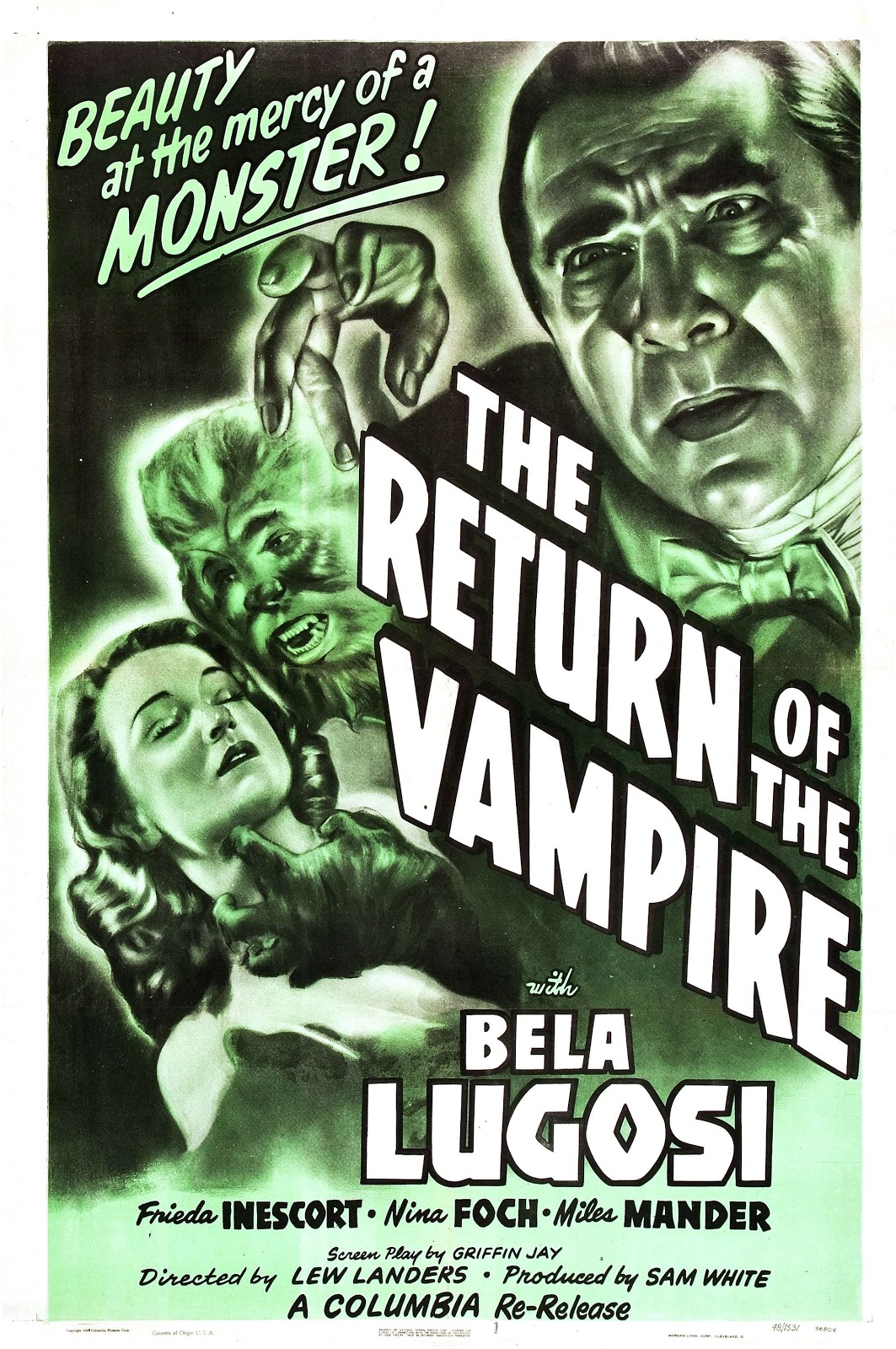
I wasn't expecting too much from Return of the Vampire - the 1943 (IMDB says 1944) production seemed suspiciously like a cash-in on Lugosi's decade plus affiliation with Dracula (even Mark of the Vampire was from 1935), but the film cleverly uses World War II to its advantage, and the bombed out portions of London become the setting of a very different sort of vampire film. It also helps that Tesla has a plan and implements it, rather than wandering around aimlessly finding victims (like Mora in Mark of the Vampire). The struggle between Ainsley and Tesla is as interesting as the back and forth between Van Helsing and Dracula, and while the resolution is largely out of their hands, there is at least one great scene showcasing their battle of wills.
It's certainly a better constructed film than I was expecting, with the opening section of the film being a surprising prologue / flashback designed to set the stakes before we're even aware that Return of the Vampire is going to leap to (roughly) present day. Like Mark of the Vampire, it openly acknowledges the difficulty for authorities (in this case, Scotland Yard) to believe such a fantastic story, but as Fleet and his detectives discover, the evidence is hard to ignore, even when it points to werewolves and vampires.
This trifecta proves to me that classic horror films have as much of a place in Horror Fest as the more contemporary fare, and in the future I resolve to include more of it for everybody to see. But for now, it's time to close out with a very recent film indeed, The Cabin in the Woods.
Tuesday, April 12, 2011
Reto Review: Frankenstein Meets the Wolf Man
The title is actually a little misleading: for the first half of the film, the story is actually a continuation of The Wolf Man. Lawrence Talbot, dead from the silver cane blow to the head, is resurrected by the full moon thanks to grave robbers (one of whom isn't lucky enough to escape the newly transformed werewolf), and finds himself in Cardiff, Wales, four years later. Unaware that he died, Talbot begs a doctor at Queen's Hospital to lock him away, but in an attempt to verify he is who he claims to be, the Wolf Man escapes and tracks down Maleva (Maria Ouspenskaya in an extended cameo), the gypsy woman whose son infected him.Only then does the Frankenstein series enter the equation: Maleva, thinking that Dr. Frankenstein can "cure" Talbot, takes him from Wales to Vasaria (a modified version of Germany) where the Frankenstein estate is. Here, we learn that this film is functionally also a sequel to Ghost of Frankenstein, as the Doctor is already dead as a result of the fire at the end of that film. While Talbot does eventually meet Frankenstein's monster (played alternately by Bela Lugosi, stuntman Gil Perkins, and possibly Lon Chaney, Jr.), but the only "Frankenstein" he actually meets is Baroness Frankenstein (Ilona Massey).
There are little touches that I really love in Frankenstein Meets the Wolf Man, like the way the moonlight creeps up on Talbot in the mausoleum and in Queen's Hospital, or the dread on Chaney's face during nearly every scene - the face of a man who finds solace only in death, a fate no one will assist him in achieving. The Lawrence Talbot story is enriched considerably in this film (which ought to be little more than a quick mash-up of horror monsters) because of Lon Chaney Jr.'s performance, a combination of melancholy and apprehension any time the moon is full.
I also get a kick out of the careful balance the film finds between the definitively 20th century Wolf Man (which begins with Talbot driving a car from the 30s or 40s) and the presumably 19th century Frankenstein world (the film is careful to include telephones and photographs, but hedges its bets when it comes to vehicles, sticking closely to carts and wagons whenever possible). The way that Frankenstein's monster (who is blind if you follow the Frankenstein films) takes to Talbot right away is interesting, particularly because the poster promises a fight (which you do eventually get, albeit in very small doses).
The villagers of Vasaria are actually quite clever in Frankenstein Meets the Wolf Man, and quickly find the transformed Talbot, injuring him and subsequently capturing Maleva. They also put two and two together when Dr. Mannering (Patrick Knowles) arrives in town looking for Talbot (who has disguised himself as Mr. Taylor in order to lure Baroness Frankenstein back under the pretense of selling her castle). However, at this point the film begins to buckle under its own weight, and an abrupt character shift happens for no apparent reason.
There's no good reason for Dr. Mannering to abruptly decide to ignore the requests of Talbot (to die) and of Baroness Frankenstein (to kill her father's creation) and instead say "I must see his creation at full power," but that's exactly what happens. The logic of all of the other characters is sound to one degree or the other: the townspeople are divided between trusting the strange doctor and wanting to rid their village of the monster*; the Baroness wants the creature destroyed and thinks Talbot is insane; Maleva wants to help Talbot; in fact, the monster is the only character with no motivation whatsoever, which isn't helped as the film lurches towards the inevitable smackdown between creatures.
In a manner of speaking, Frankenstein Meets the Wolf Man simply runs out of time, which saves it the trouble of explaining how draining electricity from Talbot would do anything (or even work) or why a super-charged Frankenstein's Monster would immediately try to drag off the Baroness (or why the Wolf Man would then try to save her). Instead, the two titans of Universal horror are allowed to throw each other around for two minutes until they both (presumably) drown and "A Universal Picture" title card comes up. The film deserves better than its ending; Frankenstein Meets the Wolf Man is far more resourceful in blending together two horror worlds, especially in light of films like Freddy vs. Jason.
Still, I have fun putting the film on every now and then, and at least Frankenstein Meets the Wolf Man is 80% coherent, which is more than one can say for subsequent monster collections like House of Dracula or House of Frankenstein. It's a relic of my childhood that still holds up better than one might expect, and in its own right a sequel that almost improves on two series of horror films.
* Ultimately, the fate of both monsters is in the hands of a character taken seriously by almost no one, which is actually a clever move on the part of screenwriter Curt Siodmak.
Tuesday, October 19, 2010
From the Vaults: Frankenstein
editor's note: continuing with the past two weeks, here is another critical essay from Hollywood Horror and Beyond.
James Whale’s Frankenstein
Mary Shelley’s novel Frankenstein, it could be argued, has little in common with James Whale’s Frankenstein (and, indeed, this is James Whale, not Universal’s, picture). Granted, the core of the story remains the same: Frankenstein defies the laws of man and creates a “monster” designed from cadavers and given life through electricity, but the similarities end shortly thereafter. Shelley’s is a tale of science gone awry; Whale’s a veiled commentary on persecution.
James Whale was perhaps most famous for being a homosexual at a time when it was not considered wise to be open in such matters, and his films are infused with a perspective unlike that of many horror directors, and in time would come to be identified as “camp”. With subsequent pictures The Old Dark House and Bride of Frankenstein, Whale’s wicked sense of humor grew more refined, but Frankenstein is nevertheless infused with his unique outlook on the world.
After a prologue William Castle would be proud of, Frankenstein begins proper with two title cards. Whether the art on these cards was the conception of Whale or of Carl Lammele Jr., we are unsure, but they speak some volume of what is to come. The first such image, superimposed by the film’s title, is of an ominous half-face peering above a wall, eyes casting beams below, and hideous claws outstretched. Clearly, this is meant to set about unease in the 1931 audience’s mind, but the second image is less clear. As the cast, crew, and director are identified, a series of disembodied eyeballs rotate on the screen like some hypnotist’s wheel, and in the center, a bodiless head which resembles nothing so much as Nosferatu himself, with its bald head and elongated ears and chin. This image has nothing to do with the film to come, does it?
From the outset, Whale begins toying with his audience. The camera begins on a coffin, panning up and around to a series of grieving and pious villagers, and as it moves past them, to a statue depicting Death as the Grim Reaper. Then, behind an iron fence, the hideous face of Fritz (Dwight Frye), who cannot contain his enthusiasm and must be reined in by Henry Frankenstein (Colin Clive), who is only just visible behind Fritz. After the funeral ends and everyone leaves, Frankenstein and Fritz dig up the body frantically, and one subtle joke passes almost unseen: as Frankenstein hurls dirt with his shovel, he quite literally throws dirt into the face of Death.
As we follow Frankenstein and Fritz along their path of grave and gallows robbing, something seems off. Clearly, this is supposed to be outdoors, but by shooting these sequences in studio, Whale creates an “unnatural” sensation using the artificial as an exaggerated version of reality (he will continue to play on expressionistic influence as we move into Frankenstein’s refuge, with high ceilings and curiously angled stairways and walls).
A major point of contention in Whale’s adaptation is the inclusion of a sequence where Fritz is dispatched to find a suitable brain for Frankenstein’s creation, culminating in his break in of the village university. Immediately preceding this, Dr. Waldman (Edward Van Sloan) lectures his students on the danger of the “abnormal” brain, and explains that the specimen on display there belonged to a brutish, violent man. When Fritz accidentally destroys the “normal” brain specimen, he is forced to take the “abnormal” sample. Some point to this is a prime example of shifting the cause of the monster’s actions later in the film, but perhaps, knowing what we know about the director, there is an alternate reasoning behind the “abnormal” brain.
Running concurrently with this is a side plot involving Henry’s fiancée, Elizabeth (Mae Clark), and her increasing concern over Frankenstein’s “experiments”. She appeals to his friend Victor (John Boles) to contact Dr. Waldman and bring some sense to Henry, who she fears is increasingly becoming distant from her. When Elizabeth, Waldman, and Victor discover Frankenstein’s “secret”, their reaction is shock. Frankenstein has created a man from the cadavers of other men, and intends to bring his creation to life using the power of a heretofore unknown ray.
The monster himself, played with nuance by Boris Karloff, is conceived in a womb of electrical pulses and birthed in a flash of lightning, to the awe of Frankenstein’s spectators, who are unsure what to make of Henry’s obsession, a being he “created with [his] own hands”. Waldman urges Frankenstein to destroy his creation, viewing it to be an aberration of God and Science, a viewpoint which, with some subtle word shifts, could mean something entirely different. (The elder figure disapproves of his protégé’s choices, and urges him to recant.)
As Frankenstein welcomes his creation into the world, Victor and Elizabeth return to Baron Frankenstein’s home, concocting a story to distract the Baron (Fredric Kerr) from the truth about his son. Here, for the first time, Whale’s sense of humor comes out through Baron Frankenstein, who is nothing so much as a cantankerous old man with disdain for authority figures and being duped. He is convinced Elizabeth is disguising Henry’s infidelity under the guise of “scientific experiments”, and that there is “another woman”, who he will root out. In a sly twist, there is, of course, no other woman, but rather another man, whom Elizabeth and Victor are willing to lie about for the sake of Henry.
We are introduced to the monster in a dimly lit room, coming through the doorway backwards, and turning around to maximize the effect of his appearance to the audience (indeed, Whale cuts to his face with three successive close-ups). The monster, however, is little more than an oversized infant, unsure of his ability to walk erect and bent in angles that seem to accentuate the set. But the monster with the “abnormal” brain is not a brute initially; in fact, he seems confused and susceptible to directions like “sit down”, and only becomes physically active in response to the sadistic torture from Fritz, who delights in tormenting him with torches.
Eventually, through conditioning, the monster becomes hostile in defending himself, killing Fritz and attacking Henry before Waldman is able to sedate him. Not coincidentally, the struggle occurs immediately before Elizabeth and Victor arrive, with The Baron in tow. Waldman hides the monster, and Henry is taken back to the village with his fiancée.
If the first act of the film is an expressionistic world of high angles and long shadows, then the second is one of stark contrast, with well lit, formal interiors and natural location shooting of villagers and forests. Henry is seen rehabilitating with Elizabeth, who seems relieved to have the man she loves come back to her, and for his part, Frankenstein is happy to be in the care of a woman. A wedding is arranged hastily by Baron Frankenstein, who frequently references his desire for Henry to have “a son”, blissfully unaware of the “abnormal” son in the laboratory.
Waldman, ever the skeptic of Frankenstein’s experimentation with humans, dies trying to dissect the creature, and the monster, free for the first time, enters the world. We see the monster interact with nature, where his rigid stature begins to loosen, but he remains in stark contrast to the “natural” world, a being of vertical angles primal grunts. He ventures closer to the village, meeting the first (and last) true stranger shortly thereafter.
Universal demanded two key alterations to the film before release (numerous local censors made more drastic changes): one, that the line “I know what if feels like to be God” be removed, at it was considered blasphemous, and two, the shortening of a scene that considerably alters the monster’s storyline. The monster, upon meeting a young girl, is amazed and curious about this strange creature, who casts no judgment upon him. In fact, she wants to play with him, and casts flowers into a nearby lake. The monster also throws his flowers into the water, and squeals in delight as they float. But he runs out of flowers, and not capable of differentiating, throws the girl into the water, accidentally drowning her. He tries to help, but only makes things worse, and panicked, flees. At least, this is what Whale shot. Universal insisted the scenes of the monster throwing her into the water and trying to save her be removed, deeming it too horrific. As a result, prior versions of the film simply have Karloff reaching for the girl, followed by a scream, and then we next see her dead in her father’s arms. The alteration renders the monster more horrific; instead of accidentally killing her, the audience has no idea what he did prior to her death, and the mob revenge is more apropos. Because of the removal of two shots, the monster goes from misunderstood and confused to brutish and violent.
Of course, the third act of the film takes curious directions which support both possible interpretations, for the monster’s actions from this point on alternate wildly from scene to scene. Elizabeth is attacked by the monster while locked inside of her room, perhaps because she stands between Frankenstein and his creation, or is it because the monster has developed a predilection for killing females?
While Elizabeth survives, Henry is convinced he must destroy his creation, and joins the mob growing outside. Armed with torches (which, although they have no notion of this, is the only thing the monster fears) the mob splits up and searches the forest, marshes, and mountain trails. After taking considerable effort to show the audience both the forest and the marshes, Whale once again takes us into the realm of the “unnatural”, returning to his false exteriors for Frankenstein’s final encounter with his doppelganger, his automaton, where both men must meet their fate.
As Henry once again comes face to face with his “experiment”, his ability to scare the monster with fire is met with failure. He is unable to exert control over his creation, and the monster overpowers him, taking an unconscious Frankenstein to a nearby windmill, as the mob closes in.
The final sequence, taking place with the monster and Frankenstein in the windmill and the angry mob outside (using a heretofore unseen battering ram to breach the door - how curiously phallic) culminates with the monster rejecting Frankenstein and throwing him to the mob below. The villagers react by setting the windmill ablaze, taking Frankenstein back to the village to recuperate, and leaving the “deviant” monster to burn in his figurative funeral pyre. Surely this is reminiscent of the practice of burning witches, also considered to be unnatural and deviant, and with little stretch of the imagination could be applied to the persecution of homosexuals.
Whale’s film, which is finally available in its uncut form, uses the Frankenstein story as a springboard to address what is perceived as unnatural by people (the villagers) and frowned on by respectable people (Dr. Waldman), but is, in the end, something a person decides to do, regardless of how much “experimentation” he or she does. The Baron Frankenstein ends the film reiterating his desire for a grandson to the “House of Frankenstein”, and with Elizabeth and Henry together, perhaps all’s well that ends well. Of course, Whale would have the last laugh with Bride of Frankenstein, but that is a different matter altogether. Perhaps the monster is not some murderous brute, but rather a confused young man who has no conception of what he is here for; condemned as “abnormal”, and punished for being only what he was created to be.
Friday, October 8, 2010
Top Ten Horror Movies
His message, in its entirety, read "top ten horror films..."
So you try that. Try to do it quickly. Maybe you can, maybe you can't. Do you go for the easy answers? The best known favorites? Do you throw in something that you love but you know others aren't as familiar with? Is that why he asked the Cap'n in the first place? Am I supposed to go unorthodox?
After mulling it over, I put in the first two without hesitation. Here's the entire list (which is technically twelve movies, so sue me):

The Haunting (1963)
The Evil Dead
Let the Right One In
Re-Animator / From Beyond
The Wicker Man (1978)
Night of the Living Dead
In the Mouth of Madness
Hellbound: Hellraiser II
Friday the 13th: The Final Chapter
From Beyond the Grave / Tales from the Crypt
Notice I left out the entirety of the Universal "Classic Horror" films, in part because as much as I love Frankenstein, The Wolf Man, The Mummy, The Invisible Man, The Creature from the Black Lagoon, and Dracula, I feel like everybody's seen them at one point or another in their life. The same cannot always be said of The Evil Dead and Night of the Living Dead, which are recognized more for having popular sequels than are seen.
I left off A Nightmare on Elm Street... well, I'm not sure why. Most of you (I'd imagine all of you reading this) have seen the first Nightmare over and over again, and maybe I just wanted to branch out a little bit. Even rabid fans of Re-Animator haven't necessarily seen From Beyond, which is as good if not better. I remain an ardent supporter of John Carpenter's In the Mouth of Madness, in part because it's construction replicates the experience of reading H.P. Lovecraft in a way most direct Lovecraft adaptations don't.
As sequels go, Hellbound and The Final Chapter are on par with the original film and in many ways both more successful. From Beyond the Grave and Tales from the Crypt are two of my favorite anthology films, a sub-genre in horror that doesn't get enough love from my perspective.
Oh, and The Haunting and The Wicker Man just creep me out. Put them on late at night, in the dark, right before bed. Good luck sleeping.
One thing I'd like to point out is until the very last second Terrovision was in the "top ten" list, and then I replaced it with Let the Right One In, which is a hard - but fair - substitution. Slashers films didn't get much of a showing there, and neither did "true story" movies like Henry: Portrait of a Serial Killer or The Texas Chainsaw Massacre. Horror comedies went largely unrepresented, but what can you do? I had ten spots to fill and no more.
As I challenged him, so too do I challenge you to provide me with your top ten horror films. Would you include Near Dark? Return of the Living Dead? Black Christmas? Ginger Snaps? An American Werewolf in London? The Fall of the House of Usher? Suspiria? The Hills have Eyes? The Horror of Dracula? Nosferatu? The Exorcist? Martin? The Thing? Phantasm? [REC]? Cat People?
You have ten slots to fill. You can push it to twelve, but they'd better be closely linked, and no more. Good luck.
Friday, February 12, 2010
Classic Monsters and Menacing Doctors
Still, I just can't decide if I want to watch the movie, considering all of the insane stories about various directors, effects permutations, and cuts of the film. Is it worth dropping $10 for?
Thanks, Mr. Budweiser with Clamato. Sometimes I lose sight of the important things, like movies with werewolves. And not ones with werewolves fighting mopey vampires*, but actual werewolves tearing people up and being hunted by Hugo Weaving. And where the gypsy woman is Geraldine Chaplin, for crying out loud!What folly possessed the Cap'n?
---
It is amazing, considering how cgi-happy studios are, that no one's tried mounting an Invisible Man movie since Hollow Man. Of course, when even the director of Hollow Man (Paul Verhoeven) calls his movie a "piece of shit", maybe it's not so surprising.
Oddly, I'm sadder about the impending Creature from the Black Lagoon remake, even though it stands a chance of being more suspenseful just by dropping the ubiquitous "Creature" theme:
Seriously, that "Bum bah Baaaaaaaaah!" plays every. single. time. the Creature is on camera. It's ridiculous. As much as I heart that movie, the score kills me, because it instantly makes you not afraid of the Creature.
This has nothing to do with Creature from the Black Lagoon, but I guess I do have to thank those awful Mummy remakequels for giving the world The Scorpion King. That's some small comfort, right?
---
And finally:
This is tangentially related to film, insofar as it chronicles the difficulties of setting up a home entertainment system. Really, I'm including it because a) who is making the complaint and b) how hard it made me laugh by the end:
* I know you thought I was talking about Twilight, but in this case the Underworld movies are just as, if not more, apropos.