Showing posts with label Louis C.K.. Show all posts

Saturday, January 18, 2014

Cap'n Howdy's Best of 2013: Blue Jasmine


 Woody Allen has been making a movie every year for a while now, and while consistency has never been his strong suit, that's always something to look forward to. Sometimes he makes great ones (Midnight in Paris, Match Point), sometimes he makes popular ones (Scoop, Vicky Cristina Barcelona), sometimes just okay ones (From Paris with Love), and sometimes you get the rotten egg (You Will Meet a Tall Dark Stranger). Of course, every now and then he makes the one only I like (Whatever Works), but I'm happy to say that Blue Jasmine is one of the really good ones. It might even be one of the great ones, in large part because of Cate Blanchett, playing a woman in the middle of a mental breakdown with serious denial issues.
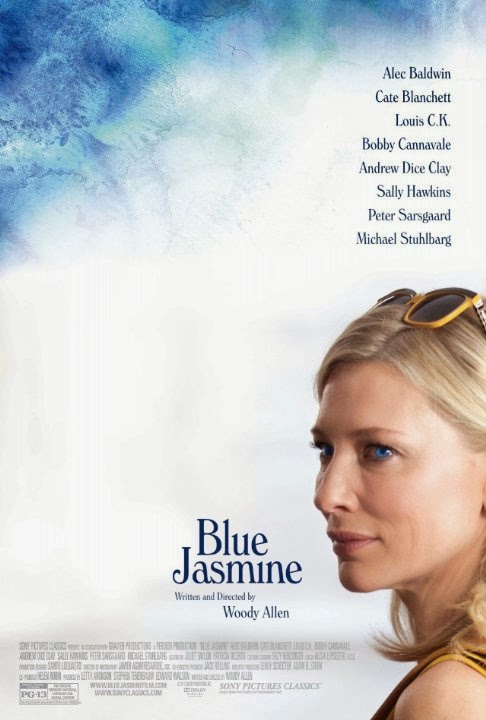
 Jasmine Francis (Blanchett) was married to Hal (Alec Baldwin) and lived the life of a socialite in New York. Hal was an investment manager, but he was also not-so-secretly running a serious Ponzi scheme, and when he got caught, couldn't take the heat and killed himself in prison. With no support and with all of her assets seized, Jasmine reluctantly moves to San Francisco to live with her sister, Ginger (Sally Hawkins). Jasmine and Ginger aren't actually related (both were adopted), and Jasmine only barely spoke to her much poorer, "lower class" sister when Ginger was married to Augie (Andrew Dice Clay), but she's out of options. By the same token, Ginger's always been a little jealous of Jasmine, the "pretty one," who was always more successful, so it's a tenuous situation. It also means her new boyfriend, the sweet but tempermental Chili (Bobby Cannavale) can't move in as planned.

 Oh, by the way, Jasmine isn't her name - it's Jeanette, but she changed it because she liked the color. Like much of her life, Jasmine deludes herself into believing it's actually her name and that her mother gave it to her, but she also has some serious mental stability issues. Throughout the film, as Allen jumps backwards and forwards in time to fill in the gaps of how their lives collapsed, he'll often cut back to Jasmine repeating dialogue from the flashback to herself, out loud. People nearby often don't know how to react, and the woman sitting next to Jasmine on the plane to San Francisco gets more than anybody ever wanted to hear just for asking "were you talking to me?"

 Augie is still in the picture, and the reason his marriage with Ginger broke up is the same reason he doesn't trust Jasmine moving in with her: Hal tricked Augie into giving him lottery winnings to invest, largely upon Jasmine's insistence, and they lost everything. Ginger might have also seen Hal with another woman, but she can't be sure and won't tell her, even when Augie says he would. Ginger seems happier with Chili, but Jasmine is more disgusted with him than she was with Augie, and works to split them up. Uncertain of what she's supposed to do (other than drink to keep the depression, anxiety, and trauma at bay), Jasmine takes a job as a receptionist for dentist Dr. Flicker (Michael Stuhlbarg) so she can pay to take computer classes in order to be able to become an interior decorator on an online course. Meanwhile, she insists she was oblivious to Hal's illegalities, even as the flashbacks continue to fill in the pieces.

 Things begin to look up when Jasmine drags Ginger to a party and they each meet new men: Ginger meets Al (Louis C.K.), a nice guy who sets up stereo equipment, and Jasmine meets Dwight (Peter Sarsgaard), a diplomat with expensive tastes and political ambitions. But, as seems to be the case with the sisters, not everybody is being entirely honest at the beginning of these budding relationships, although it might surprise you who isn't and why. Everybody seems nice (well, except Jasmine) and everybody means well, but it's not always so easy to just be honest with themselves or each other.

 If I'm making Blue Jasmine out to sound terribly serious, I don't mean to. It's actually a very funny movie, if tinged with a dark undertone. Much of the humor comes from the oblivious, deluded Jasmine, who struggles to maintain her superiority over Ginger and everyone else early in the film, and the flashbacks which make it abundantly clear how open Hal is about the fact that he's ripping people off (there are a number of scenes where he's scheming with his lawyers to keep things appearing to be above board). Blanchett and Hawkins are an excellent study in contrast: the former a complex, nuanced performance in maintaining a facade while falling to pieces mentally, and the latter a woman disrupted, torn between the life she enjoys and wanting to please someone she looks up to.

 Added to that is a surprisingly sweet turn from Andrew Dice Clay, as the sincere but beleaguered Augie, who wants to do right by Ginger but can't stand what Jasmine and Hal did. Louis C.K. is only briefly in the movie, but plays a less sardonic verison of his character from Louie. Bobby Cannavale's Chili is, even during violent outbursts, a man madly in love with Ginger that doesn't understand why Jasmine can't just let them be happy. I was also quite taken with Sarsgaard, who plays a mostly materialistic character until one scene late in the film where his reaction to Blanchett will remind Allen fans of the best kinds of Woody blow ups. Alec Baldwin is stuck with the sleazy part, and he does it well, but his purpose in the flashbacks is largely to get us to the last revelation, the one that really put Jasmine where she is mentally.

 If Midnight in Paris was too whimsical for you, I think Blue Jasmine might be the best mix of sweet and sour Woody Allen we've had in a while. You'll laugh, and marvel at Blanchett's performance, which is at times mesmerizing, and by the end be impressed at the sleight of hand. It's been a while since I saw an Allen film that surprised me at the very end, and credit where it's due for structuring the film in such a way that even I wasn't quite sure where it was headed - other than "not well." Blue Jasmine comes highly recommended, for casual viewers but also for dedicated Woody Allen fans. You never know what's coming next, but at least there's another candidate to join the great ones in the meantime.

Saturday, May 7, 2011

Standing Up is Hard to Do

Hi there. The Cap'n here. As you've noticed, this is also not a review. There wasn't a review on Monday, which is weird, I suppose. It might not be, since the Blogorium is always at the whim of the Cap'n (that being me), and I shouldn't feel as though I've locked myself into some pattern of "reviews now" or "feature then." Anyway, here's what I've been up to, which ought to help in some ways explain why I'm not specifically reviewing something.

I've been watching several stand-up specials (and at least one released theatrically): Louis C.K. - Hilarious, Ricky Gervais - Live Science, Aim Low - The Best of Dylan Moran, and HBO's Talking Funny, which is a sit down discussion between Gervais, C.K., Chris Rock, and Jerry Seinfeld. The problem is that, Talking Funny aside, I don't actually have a good way to review stand-up specials.

Comedy is very subjective, so it's hard to recommend one comedian working through their newest routine in front of an audience unless you know readers are predisposed to liking that comedian. Louis C.K. does a very blue, very working class, non-politically correct set that you either really take to or you don't. A good litmus test would be to watch a few episodes of Louie, his show on FX; it's very much an episodic form of his bits. The same applies for Gervais, who likes to push his comedy into very uncomfortable territory, comment on the uncomfortable nature of the comedy, and move forward. Dylan Moran is going to be a bit confusing for people who haven't seen Black Books, the show I knew him from (his role in Shaun of the Dead doesn't really prepare you) - his rambling, disheveled delivery can be off-putting, I suppose, even directionless at times, but the jokes are solid.

Again, without commenting on specific routines - and thereby spoiling the reason you're watching the special - it's hard to comment on them. You either already know who these comedians are and would be inclined to watch their specials, and if you don't, I can sort-of point towards shows or films they've appeared in to give you a general idea. But that's not actually reviewing the special, per se.

The other problem, at least from the perspective of someone who reviews films as a visual medium, is that there's not much to say about the aesthetic appearance of these specials. They are, with minor variations, exactly the same - two or three camera angles on the comedian standing against a curtain or set with the occasional audience reaction shot. There's nothing inherently wrong with this, but it is the formula of this kind of filmed performance, and I can't say I've seen many people attempt to alter or toy with it. There's no cause to - the specials are designed to replicate the experience of seeing them live, and as someone who's seen Patton Oswalt in person and on DVD, they do the subject justice. Having said that, you've seen the limit of what I have to say about stand-up specials from a technical standpoint: I can see them and hear them clearly.

Talking Funny is at least worth mentioning because the summit does something I really wasn't expecting from comedians ever: an actual conversation about the construction of "bits" of how jokes work and the motivation behind them, or why audiences respond to certain versions of material. Jerry Seinfeld explains why he stopped using "the 'F' word" in his routine by demonstrating the last piece he used it with, and why he felt it was more of a crutch than part of the routine.

And then something fascinating happens - Gervais, having listened attentively to the "bit," explains that the reason it didn't work without language is less about the word than the audience's ability to key in on his frustration, necessitating its use. I'm so accustomed to seeing comedians dodge discussing comedy, or to simply be "on" all the time, that Talking Funny was both revelatory and still hilarious. The section explaining why a stupid song parody being funny isn't ironic on the part of the audience, but how it actually works on a level the comedian didn't plan for, is both fun and surprising. The show is a rare glimpse behind the curtain of what makes comedy funny, of how the really talented comedians do what they do, and how they crack each other up in the process of discussing it.

At the same time, I have no idea if people would want to watch this. I suppose it's a question of whether you're predisposed to be interested in Jerry Seinfeld, Chris Rock, Louis C.K., or Ricky Gervais. If you aren't, then there's not much Talking Funny can do for you, because so much of the discussion is centered around their particular approaches to stand-up. With most movies I can at least steer readers in a number of directions, of points of entry into the film that you can use to build on when watching the rest of the movie. Stand-up is so performer-centric that while I've enjoyed all of them, I have little idea how to give you a point of entry for these specials. I guess you could look for them elsewhere (for example, Louis C.K. wrote a number of Chris Rock's films, most notably Pootie Tang), and then see if their approach to comedy is something you'd like to spend 70-90 minutes with exclusively.

The other thing I've been doing is starting movies and not finishing them yet. Most of them have been bad, like Season of the Witch (which I'll get to at some point in a review) or disappointingly bad, like Burke & Hare (the first John Landis movie in thirteen years, that hasn't been released stateside, and with a good reason; let's just say they could put "From the Director of Blues Brothers 2000" above the title and it would be appropriate). I'm halfway through The Dungeon Masters, a very good documentary that's cringe-worthy in the same way Trekkies is, which doesn't make me feel good about eventually reviewing the film.

I have seen a very recent, large-budgeted summer tent-pole release, and it was pleasantly surprising and more than "just good," but I don't know when I'll get around to writing that up. Let's just say if you were on the fence about a certain Norse God turned Comic Hero, your money will be well spent, just don't see it in 3-D. So yeah, no real review today, but it's not such a bad thing that I switch things up around here. It'll keep me from getting into a rut, and hopefully will give you something unexpected to look forward to.