Sunday, October 20, 2013

Horror Fest VIII (Day Two): Curse of Chucky and Trick 'r Treat


  After an episode of Tales from the Crypt ("Beauty Rest," for those curious) and waiting for some attendees to run to get some food, it was time for the double feature "main event," the unveiling of Curse of Chucky for audiences who barely knew it existed and the return of Trick 'r Treat for the first time since Horror Fest IV: The Final Chapter! As I expected, neither disappointed, but other than Demons, Horror Fest VIII has (to this point) been quite the success.

 Like All the Boys Love Mandy Lane, attentive readers are no doubt aware that I already reviewed Curse of Chucky to kick off Shocktober. Unfortunately for those of you reading this, I don't have much to add to that review (feel free to click on that link, I'll be here when you get back), but as it's been a few weeks since the beginning of the month, I'm comfortable spoiling a little bit of the movie and describing how it plays with a larger crowd.

 As the Cap'n suspected, Curse of Chucky works very well with fans and relative newbies to the Child's Play series alike. Some long time fans came in with trepidation, but Don Mancini's willingness to play with expectations goes a long way towards easing any doubts about Curse's "direct to video" stigma. The misdirect about who the nanny was "shtupping," about how Nica's family fits into the Charles Lee Ray back story (and how that retcons into Child's Play), and the kills in particular were big hits, but the cameos that close out the film really sealed the deal. Aside from having to explain why Jennifer Tilly appeared as Tiffany (again, if you haven't seen the ending of Seed of Chucky in a while, you might want to jog your memory), that was the most welcome of the two.

 It was a little trickier with the post-credits Alex Vincent reprising Andy Barclay, mostly because you don't immediately recognize him (for obvious reasons). They do a pretty good job of catching you up quickly, but the interaction between Chucky and Andy is so brief and the final cut so abrupt that I almost with Mancini had left it out. Yes, it helps set up an inevitable Child's Play 7 or Chucky 4 or however you like to keep track of them, but the actual, post-Jennifer Tilly ending with the "hide the soul" and grandma is a more effective way to close out the film. It also leaves you with the question about whether Chucky did transfer his soul or not, because there's no way that little girl would know who Andy was.

 But I'm picking nits, here, folks; Curse of Chucky is not only a better movie than any of us thought we'd get, but probably up there in the Child's Play series overall.

---

 While several people had to split after Curse of Chucky (it was getting late and we're getting old and boring, what can I say?), I had the distinct pleasure of watching Trick 'r Treat with one person who had seen the film and one person who hadn't. The nice thing is that both of them still saw the movie a new way.

 Looking back at my Horror Fest IV coverage, I noticed something: the recaps were a LOT shorter. Take a look at this and see if you can come away with much of anything about Trick 'r Treat of substance. I couldn't, and I wrote it. And that was four years ago, when I had the stamina to watch all of those movies and get reviews together before going to bed (oops... *SPOILER*). Well, it's been four years and the Cap'n is nothing if not long winded these days, so let's give you a more "proper" look at Michael Dougherty's excellent addition to the Horror Anthology pantheon.

 I still contend it's better not to know all of the twists and turns of Trick 'r Treat going in, because the construction of the anthology is such that it rewards the uninitiated. Watching it a second, third, or fourth time, even when you know how the chronology works (SPOILER: the movie isn't told sequentially, and the overlapping stories aren't always intercut to reflect that), you're going to catch things in the background that give you some idea of where the beginning of the movie fits in with the school bus story, the Principal's story, Mr. Kreeg's story, and the girls' night out story.

 The trickiest editing is actually right after the prologue, where two stories (not going to spoil which ones) cut back and forth when a major character overlaps between the two and they seem to take place hours apart. In fact, I'm only a little fuzzy about how early in the story Principal Wilkins' story is supposed to take place (it has to happen before the prologue and during Kreeg's fight with Sam), but it also has to take place well before the pumpkin collectors take Rhonda (Samm Todd) to the quarry. Why? Because there's a direct spoiler to the "twist" in the Laurie (Anna Paquin) / "vampire" story - while they're in the elevator going into the quarry, Rhonda identifies the howling well before we cut back to Sheep's Grove (as is evidenced by the fact that Sam made it back from the quarry and is watching the girls party). It makes sense in a fashion, but Wilkins (Dylan Baker) and his son (Connor Christopher Levins) must have taken care of Charlie well before the news report about the Halloween parade downtown.

 Every time I watch Trick 'r Treat (and I try to every year near Halloween), I pick up on some other detail in Dougherty's insanely planned narrative. It's quite a draw to revisit the film, even if it weren't already a fun, suspenseful, and at times downright creepy experience to begin with. Some day, I'd love to see this in a theatre with a really big audience; I bet it plays like gangbusters.

 One final note that came up during a post-movie discussion: both of the guys who stayed late to watch Trick 'r Treat have kids, so we ended up talking about what a shame it is that parts are so violent / disturbing, because the movie does a great job of explaining why Halloween / Samhain is important culturally, but also why there are "rules." There may be no better demonstration of why you should always check your candy than the beginning of the Principal Wilkins story, why we decorate our yards and dress up, or why respecting the dead is important. They're packaged in a supernaturally charged fashion that is, almost without fail, exceptional, but underneath everything is a celebration of why Halloween continues to be such an instrumental holiday, and why October is the best month of the year for a lot of people, the Cap'n included.

 Up Next: Why am I still awake? Oh, right, because Day Two closed out with The Haunting and The Woman in Black! I may never get to sleep...

Saturday, October 19, 2013

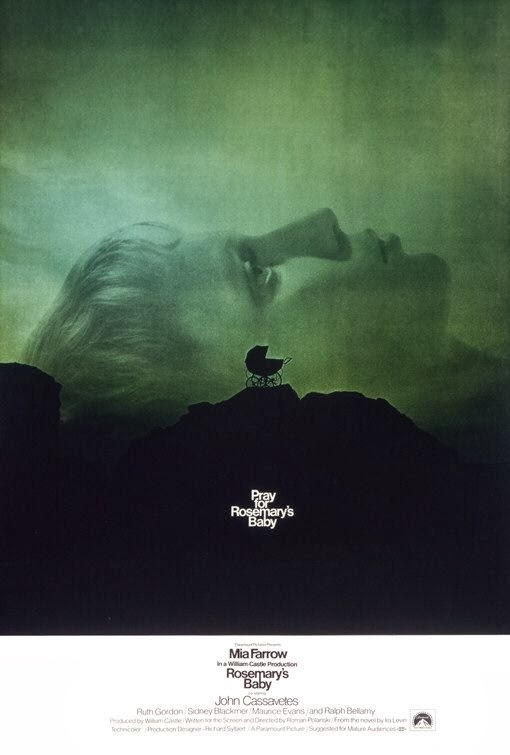
Horror Fest VIII (Day Two): Rosemary's Baby

Rosemary’s Baby may be based on the novel by Ira Levin (Son of Rosemary) and be produced by William Castle (The Tingler) directed by Roman Polanski (I can only imagine what’s going to happen now that I’ve mentioned his name again on this blog), but it’s really the story of a book. And not just any book, because while Rosemary Woodhouse (Mia Farrow) has a lot of books, including the conspicuously placed copy of Yes, I Can: The Story of Sammy Davis Jr.*, the most important one appears about an hour into the film.
Of course, I speak of All of Them Witches.
 Oh sure, the title is an anagram (although not the one Rosemary figures out – for the record, you can make “Hell a Cometh Swift from the title), but for whatever reason, it became the running joke of the rest of the movie. There was a lengthy discussion about follow-up books like Some More of Them Witches, The Rest of Them Witches, That Should Cover Every Last One of Them Witches This Time, and the legally obligated retraction book Not All of Them Was Witches After All, and many a chuckle was had.
  
I realize that it’s probably disrespectful to Rosemary’s Baby to talk about it this way when I’ve never properly written about the film here before, but sometimes when you’ve seen a movie enough times and you’re with a crowd of people who have as well, instead of focusing on the actual story you begin to fixate on silly details or make jokes. While I often try to give a film its proper perspective on the Blogorium, much of what constitutes a Horror Fest recap is trying to convey the atmosphere surrounding the screening as well.
 For the record, I was not the first person to make a tasteless John Lennon joke about the Dakota Building. I made the second, and it was in reference to an audience member being unhappy that nothing bad happens to Guy Woodhouse (John Cassavetes) at the end of the film. I responded that she needn’t worry, because “there’s a guy outside waiting for phonies.”
 There were many jokes and references to Cassavetes films (as actor and as director), to Planet of the Apes, Harold and Maude, Midnight Run, The Wolf Man, and to Frank Sinatra, Robert Evans, William Castle, and any number of other ridiculous observations, like what was playing at Radio City Music Hall with Fred MacMurray (our theory – Walt Disney’s The Shaggy Dog: The Musical, or Son of Flubber: The Musical).
 (This is a total side note, but since I mentioned John Carpenter’s references in Prince of Darkness, it’s worth pointing out that at the beginning of In the Mouth of Madness,  John Glover’s character’s name is Dr. Saperstein, a slight variation on the name of Ralph Bellamy’s character in Rosemary’s Baby.)
 All joking aside (and it’s really the big point at the fest where the audience participation took over, which the Cap’n fully endorses as long as you can still enjoy the movie), Rosemary’s Baby is a great horror movie. It’s so well constructed and so limited to one character’s perspective that even though you know what’s happening to Rosemary and you desperately want her to get away from the Castevets and the conspiracy in The Bramford, you understand why she’s confused and can’t leave. The world is set against poor Rosemary from the outset, in arguably more insidious ways than even Suzy Bannion faces in Suspiria (it turns out witches, Satan, and issues with pregnancy emerged as the consistent themes this Horror Fest).
 Her husband is distant and verbally abusive, especially after he gets close with Roman and Minnie Castevet (Ruth Gordon and Sidney Blackmer), her doctor recommends doing nothing when she feels pain during pregnancy, and then her old doctor (Charles Grodin), hands her over to the enemy when she comes to him for help. Her only real ally in the film, Hutch (Maurice Evans), is the victim of witchcraft – as is Guy’s original agent – and the first friend she makes in The Bramford plunges to her death not long after they meet. All the while, Polanski keeps us tightly locked in on Rosemary (although not quite as uncomfortably framed as Catherine Deneuve in Repulsion) as we slowly move towards June of 1966, when her baby is due. I shouldn’t need to spell that out for you, and it’s not as blatantly stated in the film, but if you do the math from when conception happened to when the baby should be due, it only makes sense.
 The use of dream sequences and somewhat ambiguous dream logic (another recurring motif this fest) helps disorient the audience early in the film, so that even forty five years later, it’s not abundantly clear what Rosemary is imagining and what we’re actually seeing when plans are set in motion. The ending still gets me, despite the presence of one of the worst Asian stereotypes since Mickey Rooney’s unfortunate appearance in Breakfast at Tiffany’s. “What have you done to his eyes, you maniacs!” and, eventually, “You’re rocking him too hard.” It’s unsettling, but inevitable.
 If we jest during Rosemary’s Baby, it’s only because we like it so. Also, All of Them Witches would want it that way. Hail Satan!
Up Next: Curse of Chucky and Trick ‘r Treat!
* Now, it’s entirely up to you whether Yes, I Can is there because of the Rat Pack connection or just as another subtle hint about the Satanism to come.  In the interest of full disclosure, we leaned towards the former.

Horror Fest VIII (Day Two): Prince of Darkness


 It’s been almost a decade since I last watched Prince of Darkness. In fact, the last time I did was followed by the first time I saw Visiting Hours, which turned out not to be such a good idea for Visiting Hours. I suppose I should watch the latter again now, because Prince of Darkness is pretty good but nowhere near as great as I remembered it being.

  For those of you who follow John Carpenter to any degree (or just read the end of the last recap), you are probably already aware that Prince of Darkness is the second part of what he calls the “Apocalypse Trilogy.” If you’re just a casual fan of his movies, you’ve probably heard of the other two films – The Thing (has not played at a Fest… yet) and In the Mouth of Madness (Horror Fest III) – all of which deal with the end of the world in some capacity. At the risk of spoiling both films, let’s just say they don’t end well for the protagonists. Prince of Darkness has the, shall we say, “happy” ending of the three, if you can call it that.
 Thematically, The Thing, Prince of Darkness, and In the Mouth of Madness deal with different aspects of the human experience: in The Thing, it’s the inability to trust one another, and with In the Mouth of Madness, it’s about notions of reality. Prince of Darkness is about the uneasy space between science and religion, and Carpenter poses some intriguing questions but doesn’t always get around to addressing them.
 Writing under the pseudonym Martin Quatermass (the first of several references to the British science fiction film series), Carpenter ties together quantum physics with religious prophecy and makes a somewhat uneasy mix, largely because of the uneven nature of the film. Donald Pleasance plays a priest invited to see a dying colleague, who passes holding a metal box. Inside the box is a key that unlocks the basement of the Godard Church, where the “Order of Sleep” has been keeping something ancient and almost certainly evil in a large glass container. Convinced that this green liquid is a physical manifestation of the “prince of darkness,” he contacts Professor Howard Birack (Victor Wong) to investigate its origins.
 Birack teaches quantum theory at Kneale University, and brings along his PhD students (including cast members Jameson Parker, Lisa Blount, and Dennis Dun) to help him study the cylinder.  (It’s worth pointing out that while Parker’s Brian Marsh says something to the effect of getting his “doctorate” in physics, there’s also a scene where Birack says “now I know none of you have your degree in this” which puts a puzzling  conundrum about how old these students are supposed to be). At the church, they set up equipment and meet a number of other scientists, including chemists and microbiologists led by Caler (Jessie Lawrence Ferguson) and Dr. Paul Leahy (Peter Jason), as well as a theologian (Ann Yen), there to help translate a book resting near the green liquid. Of concern to almost everyone inside is an ominous – and growing – contingent of the homeless outside of the church, including Alice Cooper (billed as “Street Schizo”).
 Undoubtedly there’s some creepy imagery (nature also seems to respond to the presence in the basement, so there’s a lot of creepy crawly business and one great scene involving beetles) and admittedly some novel combination of religion and science (one of the many discoveries in the book are a set of equations that go beyond what any of Birack’s students recognize). The hook comes halfway into the film, when a collective “dream” sets in: we later discover that it’s a transmission from the future (1999!) sent to warn people in the present that they have to stop the coming of Satan and the release of the “Anti-God.” It seems to change slightly every time we see it, but would be served better had it not been introduced so late into the narrative.
 The problem with Prince of Darkness is that there are so many good ideas swirling around that it’s disappointing when most of them go undeveloped. Blame it on a cast that keeps growing in the first thirty or forty five minutes, to the point that we’re continually being introduced to people and just barely aware of what purpose they serve, other than to (SPOILER) be possessed. The grand “plan” to release the “Anti-God” isn’t really clear until nearly the end of the movie and is resolved so quickly that it barely has any impact. Moreover, it’s meant to be a “tragic” ending for Marsh, but Jameson Parker has more of an impact for his rockin’ (if uneven) mustache than his chemistry with Lisa Blount’s Catherine. It’s also puzzling that the most obnoxious character ever – Dennis Dun’s Walter – makes it all the way through the movie when his “type” is usually marked for death from the first inappropriate comment.
 I don’t actually mind that Walter lives – it’s a good bit of misdirection for Carpenter – but the why of who is and isn’t possessed is unclear and the seemingly endless discussions between Pleasance and Wong about their respective fields don’t add any insight to either position. Prince of Darkness has some good ideas knocking around, but Carpenter (as he would later admit) doesn’t quite know what he wants to say about them. The end result is a very good premise that’s diluted in the execution, giving the film a somewhat earned cult status among John Carpenter fans. It’s certainly worth watching, but for my money the weakest entry in the “Apocalypse Trilogy.”
 Up Next: Speaking of Satan, how about Rosemary’s Baby?

Horror Fest VIII (Day Two): All the Boys Love Mandy Lane and A Nightmare on Elm Street


 As some of you have already noticed, I re-posted a review of All the Boys Love Mandy Lane earlier this month, with more contemporaneous thoughts about the film (as much as two years’ worth of reflection allows, at any rate), so I don’t have much more to add. It’s strange how the intervening years (Jonathan Levine made the film before the smartphone was a regular presence in the life of teenagers) make Mandy Lane more “quaint” than it would be otherwise: the choice in music and many choices in editing resemble any of the CW-style “modern” slasher film, but the lack of always connected, social networking makes for strange bedfellows.

 It’s a modern horror movie that isn’t quite modern enough, and not enough of a “throwback” (as loathe as I am to use that term) to feel different. I understand why people aren’t responding to it now, but I’m curious how it would fare in the height of remake-mania seven years ago. I apologize again for not spoiling the end of the movie – this is the third time I’ve brought up All the Boys Love Mandy Lane without directly addressing the ending of the film. To be honest, it’s why I like the movie, and why I think people interested in Final Girls as a horror trope would find it worthwhile. If this gives you any hint to how it ends, Mandy Lane would have beaten Scream 4’s “twist” to the punch by five years, and only been behind High Tension by a year. It’s a newer, if under-examined, development in Final Girl theory.
---
Along similar lines, I feel like I’ve written about A Nightmare on Elm Street so many times that I’m not sure what to say about it. I appreciate how grimy Freddy Krueger is in the film, how disgusting and creepy without relying on puns or horror showmanship. Robert Englund is clearly relishing the opportunity to make Freddy (really, it’s more “Fred” in the first film) as sadistic as possible. The more I watch A Nightmare on Elm Street, the more I notice that, frankly, surprise me that I didn’t remember from the last time. To wit:

The “dream logic” of the first film is much more, let’s say “practical” than in the subsequent films. It’s more like actual dreams are than what people might associate with the series (although Dream Warriors did push it in a direction that was almost impossible to come back from). The craziest “nightmare” moment early in the film is a goat in Tina (Amanda Wyss)’s dream that opens the film, and after that it’s largely limited to things Freddy can do: the (terrible) extended arm effect, cutting off his fingers, pulling off his face, etc. When Nancy (Heather Langenkamp) starts experimenting with her dreams, we see simple things, like the door into her basement leading to the boiler room at the high school. It’s more of an Inception level of “dream logic” than what people assume when they think of the series. They resemble dreams we’ve had, where one place becomes another but it seems to make sense in the dream.
 This is not to say there isn’t some nightmarish imagery in Nancy’s dreams – while it’s hard to forget Tina in the body bag while Nancy sleeps at school, I’d totally forgotten about the second time she appears later in the film. Nancy is dreaming and Glen (Johnny Depp) is supposed to be watching her (more on this in a moment), and in the dream Tina appears again, her feet covered with worms writhing around on the pavement. It’s an effectively unsettling image, as much so as the trail of blood Nancy follows in the hallways of school.
 Now, speaking of Glen, it’s worth pointing out that Wes Craven does something in A Nightmare on Elm Street that would subsequently be picked apart and reconfigured for the sequels (and, apropos to this discussion, a Simpsons Treehouse of Horror segment) that I completely forgot was in the film. Nancy is at home, watching The Evil Dead, and nodding off when Glen climbs in through the window. She asks him to sit next to her while she’s dreaming and wake her up if she starts struggling, which he agrees to do.
 Nancy then enters the “dream world” and is walking down Elm Street, when she turns and asks Glen if he’s still watching her. Inside the dream, Glen appears from behind a tree with to let her know that he is, and then disappears again. With the other films, and also The Simpsons in mind, this is an odd moment, because Nancy is dreaming, not talking out loud, and if Glen is in her dream, there’s a good chance he’s not awake. Now it turns out he isn’t, but they aren’t sharing the dream, so either Nancy imagined Glen reassuring her in the dream or he really was responding to her from the “real” world. I bring up The Simpsons because when Lisa appears in Bart’s dream, that’s how Bart knows she isn’t awake to save him. It’s not something that harms the film – as I mentioned before, I forgot it even happened – but upon reflection, it’s an odd moment.
I also picked up some dumb details that I’d never seen before, like the poster of a cat wearing a Hawaiian t-shirt and riding a trolley in San Francisco in Dr. King (Charles Fleischer)’s office. While he’s monitoring Nancy, you can’t miss it behind him on the wall.
It’s not difficult to spot the palm trees in the background of A Nightmare on Elm Street (like in John Carpenter’s Halloween, Craven is doubling California for the Midwest – Springwood is supposed to be in Ohio and Haddonfield in Illinois), but for some reason I’d never focused on how prominently a palm tree appears in one scene. When Nancy and Glen are on the bridge having a conversation about homemade weapons and giving dreams power, there’s a rather large palm tree right in the middle of the frame. I guess I’d been focused enough on the story that I willingly blocked it out, but it’s really hard to miss.
The last one is just an odd tidbit I picked up, one that only has any relevance if you’ve listened to the Wes Craven / Heather Langenkamp commentary before: during the bathtub scene, Langenkamp and Craven point out that the girl pulled into the tub and trying to escape is a body double. No, fanboys, that’s not a nude Heather Langenkamp you’re seeing. On the other hand, when Nancy is pretending to sleep so her mother will leave her alone, she does get up and change shirts, exposing her bare back to the camera in a shot that is Langenkamp. I suppose it’s a “neither here nor there” addition to the conversation, but I did know because of the commentary that she avoided any nudity in the film, so it was a scene I didn’t remember being in the film (technically it’s not nudity, but it’s a shot that implies it and doesn’t necessarily add anything to the plot).
 Up Next: John Carpenter’s Prince of Darkness, the middle chapter of his “Apocalypse Trilogy.”

Horror Fest VIII (Day One): Demons and Suspiria


 Lamberto Bava’s Demons is a movie with a great premise… and that’s about it. I will grant you that the gore and makeup effects are nice, but after a spell even those become tiresome, in large part because there’s so little happening in the film that even the demons are boring after a while. For a film that isn’t even ninety minutes, Demons feels padded and overlong, and it’s a shame.
  Quickly, I’d like to dispel an erroneous assumption on the part of attendees at Horror Fest VIII: Dario Argento did not direct Demons; he wrote it and has a “Presented By” title card at the beginning of the film. Now it’s not inconceivable that one would leap to that conclusion, as a) the titles were in Italian (even though I chose the English dub) and b) if you don’t know Italian horror cinema very well, you could make the mistake that if Dario Argento is involved at all, he was a strong influence, but no, it’s a Lamberto Bava film. Bava was Argento’s assistant director on Inferno and Tenebre, but he’s probably better known as a director in his own right (A Blade in the Dark), or for being the son of the legendary Mario Bava.
  At any rate, Argento and Bava co-wrote Demons with Dardano Sacchetti and Franco Ferrini, and it’s hard to imagine that it took four people to write a movie where so little happens. The film is based around a mysterious “Man in Black” (Michele Saovi, director of Cemetery Man and The Church, also known as Demons 3) handing out golden tickets to the Metropol theatre. The tickets are for a very special screening, and we meet a handful of people in the lobby, including a student (Natasha Hovey), a blind man (Alex Serra), and a pimp (Bobby Rhodes). Okay, I’m making an assumption on that last one, and IMDB’s synopsis doesn’t exactly match my reading of it, but it’s not hard to leap to that conclusion when he brings to girlfriends to the movie.
 The plot of the movie within a movie is that four college students are looking for the grave of Nostradamus, and they find one that seems to match, but in the coffin they find a strange mask and a book (which, of course, they read from). If you put the mask on, something sharp cuts into your face and you become a demon, which is interesting because one of the pimp’s girlfriends put on a similar mask in the lobby and has a similar cut on her face…
 As the move plays out, more people are infected and become demons, and as the audience desperately tries to escape, they discover the doors are a façade – the front of the building is now simply concrete, and they’re trapped inside. If anyone is injured by a demon, they become a demon, so they barricade themselves on the balcony and try in vain to find a way out. And that’s pretty much when Demons ceases to be interesting in any way, shape, or form. There’s only so much “bait and switch” Bava can employ when people pair up and split off from the main group, and it’s always the “which one is going to be the demon?” variety. The survivors eventually break through the wall of the balcony and cut off the projector and find an adjacent building, but even that goes nowhere as the building is abandoned and the only room they bother going into is walled off.
 To demonstrate just how disjointed (and front loaded) the plot of Demons is, Bava introduces four totally unrelated punks in the middle of the film, tooling around town and doing coke out of a Coke can (okay, I will admit that’s clever). If you’re under the impression that they’ll be saving the survivors in any way, don’t hold your breath – their purpose in the story is to enter the theatre, but only because one of the demons needs to get out in order for the ending to make any sense.
 Aside from a ridiculous scene involving a motorbike, a samurai sword, and a helicopter crashing through the theatre’s ceiling – all of which happen without any sense of causality – nothing happens in the second half of Demons. People wander around, they die. There’s no sense of tension at all, and the apocalyptic ending is just an excuse for another “bait and switch” to end the film on after the credits finish rolling. Characters abruptly change personalities – the usherette, for example, when introduced appears to be in on what’s happening (or about to happen), but as soon as the demons run amok she transforms into another terrified patron, seemingly without reason.  I understand that people really like Demons, and I remembered enjoying it when I was younger, but the film is too threadbare to really invest in. Sometimes gore just isn’t enough, and the atmosphere only goes so far.
---
  Are you ready for the fun part of this recap? I just slammed Demons for its slight narrative and I’m about to do the exact opposite for Dario Argento’s Suspiria. To be fair, Suspiria has a “through-line” story to go along with strong atmospherics, stylish color schemes, and at times disturbing gore, but the main difference is that while Demons peters out as soon as the plot should be kicking into high gear, Suspiria builds to a literally explosive conclusion. I’m also more willing to accept Suspiria’s dream logic structure over Demons nightmarish buildup, but perhaps it’s just a matter of personal preference.

I’ve also seen Suspiria more often than Demons, and have come to have a certain affinity for its story construction. We know as much as Suzy Bannion (Jessica Harper) does when she arrives at a ballet academy in Germany, with an added benefit of a brutal murder for a former student and her friend (this is an Argento film, after all). Information is revealed slowly, punctuated by strange events and even stranger behavior (maggots in the ceiling, suspicious activity by the staff, people leaving and then being murdered), mostly without clear reasons. Anyone who tries to find out too much about the staff, particularly Ms. Tanner (Alida Valli) and Madame Blanc (Joan Bennett) end up dead, under mysterious circumstances. At least, to the students: as the audience, we’re privy to what happens to the pianist and Suzy’s friend Sara (Stefania Casini), although the how is often unclear.
Am I spoiling anything by telling you that Madam Blanc and Ms. Tanner are familiars for the witch Helena Markos? If so, I guess *SPOILER*, but I can’t imagine anybody reading a Horror Fest recap this far hasn’t heard of or seen Suspiria, the first of Argento’s “Three Mothers” trilogy (followed by Inferno and, much later, Mother of Tears). I’ve been meaning to show it at a Horror Fest for years, but it always gets bumped at the last minute by something or would fall victim to exhaustion from participants. To be honest, the dreamlike logic of the film was even more effective for me this time because towards the end of the film (specifically around the dubbed Udo Kier scene), I was drifting in and out of consciousness myself. It’s how I always intended Suspiria to play at one of these festivals – late at night, when the mind is prone to wander, leaving you unsure whether what you saw really happened in the film or your imagination.
 I wouldn’t recommend anyone watch Suspiria this way for the first time, but the film lends itself well to a relaxed mind, one that wants to remain invested but is also hovering between lucid and sleepy. Never fear, because just when you think you’ll drift off, the memorably creepy score by Goblin rattles you awake. It was an excellent way to close out the first night of Horror Fest, but there’s a lot more fun to go tomorrow…

 Up Next: All the Boys Love Mandy Lane and A Nightmare on Elm Street!

Friday, October 18, 2013

Horror Fest VIII (Day One): V/H/S 2


 V/H/S 2 is a marked improvement on just about every aspect of V/H/S, and this is coming from someone who enjoyed the first film. It’s a weird point of cognitive dissonance for me, because I love anthology films but mostly hate “found footage” films, so V/H/S had to overcome its conceit with interesting segments and succeeded half of the time (I largely prefer the first and last entries in the film – the bat-creature and the haunted house). That said, it was too long, stretched the “frame” story too far, and is something I “liked” more than really “enjoyed.” I haven’t seen it again since last year and don’t know that I will any time soon.
 On the other hand, I've already seen the second film twice this year; V/H/S 2 drops the segments, cuts down on the length, and provides a more satisfying overall experience, which is critical for any anthology. The “frame” story, “Tape 49” is more focused and streamlined while still loosely tying in to the first film, and three out of the four “tapes” are winners, with the other one an inspired effort. Let’s take a look at how the film breaks down:
 “Tape 49” – from Simon Barrett (the writer of You’re Next), follows a dubious private investigator and his assistant as they break into the house of a missing college student, only to find a familiar setup involving VCRs and TVs in the living room. A laptop video from the missing student suggests that playing the tapes “in the right order” will change you, and they seem to be having an odd effect on the investigator’s assistant.

“Phase I Clinical Trials” – Adam Wingard (The ABCs of Death) directs and stars as an accident victim who receives an experimental artificial eye which is, for research purposes, filming everything. Things seem to be going well until he notices strange goings-on in his house, and a stranger turns up to warn him that the longer he can see dead people, the more they can interact with him. How does she know? Her cochlear implant has the same effect, and it may already be too late for both of them…
“A Ride in the Park” – from Eduardo Sánchez and Gregg Hale (The Blair Witch Project), a biker has plans for a nice ride through the woods when he runs into a familiar horror monster, and thanks to his helmet camera, takes us on a first-person journey through the “eyes” of the undead.
“Safe Haven” – from Gareth Evans (The Raid: Redemption) and Timo Tjahjanto (The ABCs of Death), a documentary crew is allowed access to the compound of a cult promising “Paradise on Earth.” Little do they realize that their spy cameras will do more than expose what’s going on behind closed doors – their arrival signals the beginning of the end…
“Alien Abduction Slumber Party” – from Jason Eisener (Hobo with a Shotgun) comes, well, exactly what it promises. Teenagers put up with their obnoxious preteen brothers and friends, until invaders from another world decide they want everybody, including the dog.
 The “frame” story benefits from stripping down the main characters to two (there were too many people in the first film) and keeps the in-between segments shorter and to the point. While you might miss it the first time, there are quite a few references to the first film and the “mythology” behind why somebody would collect these tapes. I would imagine this will expand as the series goes on (it’s hard to see why there wouldn’t be more), so it doesn’t feel intrusive and people who hadn’t seen the first V/H/S didn’t feel lost in the meantime.
 Every one of the entries is an improvement over the first film, not simply because they’re shorter (“Safe Haven” is the longest of the four and deservedly so). While it’s still hard to argue why anybody would transfer this footage tape, let alone circulate bootlegged copies, there’s nothing as credibility straining as the “Skype” segment from V/H/S. “A Ride in the Park” manages to take the overdone (if still wildly popular) zombie story and present it from a perspective you haven’t seen before and mixes in other camera angles in a fairly clever way. “Phase I Clinical Trials” makes good use of a limited perspective “first person” camera and builds some tension with creepy imagery.
 If there’s a weak link in the lot, it’s probably “Alien Abduction Slumber Party”, and mostly because it comes after the truly fantastic “Safe Haven.” Evans and Tjahjanto’s tour-de-force is an almost impossible act to follow, and “Slumber Party” is good, even when you consider that Eisener breaks three cardinal rules of movie-making (don’t work with children, don’t work with animals, and don’t kill either if you do). His novel use of the camera attached to the dog makes the frenetic chases near the end more interesting and explains the “why are they still filming this?” problem inherent to “found footage.”
 The undisputed winner is “Safe Haven,” for reasons I don’t want to spoil for people who haven’t seen V/H/S 2, because you should see the film if for no other reason than this segment. It’s an ominous buildup that turns into a rollercoaster of “holy shit!” with a perfect final line that’ll make you chuckle. I didn’t even realize I’d missed the last line until the second time I saw it, which caps off an already impressive exercise in ratcheting up the stakes for a film crew in far over their heads. The rest of V/H/S 2 is icing on the cake, which is not to diminish Eisener’s effort or the conclusion to “Tape 49,” which is more satisfying than the end of V/H/S.
Before we watched V/H/S 2, the Cap’n screened “Incubator,” a short I saw last year at Nevermore, and “One Last Dive,” another short from Eisener that shows just how much you can do with one minute. While I enjoy Hobo with a Shotgun to a degree, Jason Eisener has to this point really impressed the Cap’n with the short films he’s directed, edited, and produced. Not to bag on his feature length endeavor, but he really knows how to pack a punch in a short film.

Up Next: Lamberto Bava’s Demons, followed by Dario Argento’s Suspiria!

Horror Fest VIII (Day One): Friday the 13th Part VIII: Jason Takes Manhattan


To kick off the fest, it only made sense to start with the only part 8 I was willing to watch (sorry, Hellraiser: Hellworld) - Friday the 13th Part VIII: Jason Takes Manhattan. While not the wisest decision, Jason Takes Manhattan did at least start Horror Fest on a high spirited tone. It was only after we’d begun that I discovered two people had never seen a Friday the 13th film before, so the Cap’n did have the common decency to apologize for starting them off with such a bad entry point.
 There aren’t a lot of seventh sequels out there, but one has to imagine that Jason Takes Manhattan would still take the cake for managing to disappoint fans of the Friday series. Paramount slashed the budget to the point that director Rob Hedden shot most of the film in Vancouver, had to change most of the major set pieces involving New York landmarks, and the “cruise ship” became more of the focus than what the title promised. The end result is more “Jason Takes a Cruise Ship and Eventually Gets to Times Square,” which is, let’s be fair, not the bill of goods we were sold in that fantastic teaser trailer.
 And yet, Jason Takes Manhattan has some enjoyable moments to be gleaned from its overlong run time and mostly bloodless kills. If you wanted a slasher movie that thoroughly covered all of your favorite character tropes and encapsulates what people think of when you say “80s”, Manhattan has it. Rocker with a boombox hooked up to her electric guitar? Jason can use that to kill you. Guy who looks like River Phoenix that films everything with a camcorder? Check. Bitchy prom queen doing coke with The Scorpion King’s Kelly Hu that knocks our Final Girl into the ocean? Yup, got that too. Creepy uncle with a leathery face and a stuffy suit? Yessir. A disco? Wait… a disco? Well, sure, why not?

 If left to just that, we might have a moderately entertaining movie, but thankfully Hedden managed to throw in a few curveballs to compensate for the watered down gore and lack of “Manhattan” in Jason Takes Manhattan. And I don’t even mean the scene with the punks or Jason in front of a giant hockey mask. Not even the toxic waste sewage flood that happens at midnight every night in New York. Obviously that has to happen or the C.H.U.D.s would pack up and leave.
 No, the real enjoyment to be gleaned from Jason Takes Manhattan come from pointless subplots like Rennie (Jensen Daggett)’s stupid dog, who vanishes for most of the middle of the film only to show up in the lifeboat just in time to leave the cruise ship that Jason managed to blow up (? Burn up?), or the ridiculous way she (Rennie, not the dog) is connected to Jason. Beyond that, Daggett’s frumpy outfit (consisting of too-high jeans, poofy shirt and overlong vest) make Rennie look ten years older than she actually was during the making of the film and fifteen years older than the high school graduate she was supposed to be. Oh yeah, did I mention that the cruise ship Lazarus is taking high school seniors on their graduation cruise from New Jersey to New York. Don’t ask how Jason got from Camp Crystal Lake to the ocean; what’s important is that when they reach international waters, his murder spree is no longer illegal.
 Also of note is the way that Jason wanders around the Lazarus, and by that I mean rather than moving around with some sense of purpose, Hedden simply has Kane Hodder open doors and poke his head in to see what’s going on before moving on. This may be the least effective Jason I’ve seen in any of the Friday the 13th films, because he doesn’t seem to know what he’s supposed to be doing, and we’re talking about the same Jason who punches a guy’s head off in a boxing match later in the film. Oh, *SPOILER*. He does kill a guy with a hot sauna stone, which manages to set said victim’s intestines on fire, which looks cool even if it doesn’t make sense. As it’s one of the few kills we see in any detail, you have to take what you can get. It does seem like Jason’s strict moral code now extends to people who lose while sparring, people who play the guitar, and people that own diners. I’ll chalk that up to being resurrected by underwater electrocution, though.
 Special attention must be paid to Scott Reeves, playing Sean Robertson, the son of the Lazarus’ Captain. I understand he was a late replacement for another actor, but in nearly every scene Reeves can be observed looking off camera as though to be prompted for his next line before responding to another character. It prompted the running gag of someone saying “line?” as soon as anyone asked Reeves a question in Jason Takes Manhattan, and without fail he’d look past the other actor before saying anything. I could be nice and pretend that it was just a coincidence, but Jason Takes Manhattan isn’t deserving of that benefit of the doubt. While charming in its own stupid way, it’s not hard to understand why Paramount gave up on the series after eight films.

 Up next:  V/H/S 2!

Thursday, October 17, 2013

Shocktober Revisited: Four Reasons (Friday the 13th Edition)

It's been a while since the Cap'n did a "Four Reasons", and we certainly learned a bit during our mini-Friday the 13th marathon, so I thought I'd share a few of them with you, under the auspices of "Four Reasons You Should Consider Watching the Jason Films Again":

1. Misdirection - We tend to think of the Friday the 13th films as fitting the "slasher" mold perfectly: character types are set up who are easily predictable as "oh, they'll die. he'll die. she's totally dead" and then play out accordingly. However, by the second Friday the 13th film (and the first we watched), director Steve Miner is already fucking with those rules.

There are a bunch of counselors introduced in Friday part 2, and only a handful of them die. Many of the ones Jason kills probably don't even deserve it - the dude in the wheelchair, his would-be girlfriend, the crazy old man. Okay, the skinny dipper and her jerky, clothes stealing, boyfriend probably deserved it, but the hippie kids didn't do much worse than wandering over to Camp Crystal Lake. They weren't even having sex there, because a cop made them go back to their camp! For his trouble, what does the cop get? Killed! And he was on Jason's side of the argument: close the camp down.

The most egregious break in "slasher movie" rules is that the "Prankster" type lives by virtue of the fact that he NEVER GOES BACK TO THE CAMPSITE! He stays at the bar when Ginny and Paul go back. We never see him again, but I suspect that fucker lived a long and productive life of playing stupid pranks on people, like having their cars towed or providing Jason with spears to murder people. This, I strongly suspect, is why Shelly gets it the way he does in Friday part 3 - it's justice being visited upon him for something he had nothing to do with, which brings us to reason number 2...

2. For Critical Analysts, there might be a hint of Antisemitism in the first four films - I'd have to watch the first one again to be perfectly sure about this, but certainly for parts 2-4, you do yourself no favors by being Jewish in a Friday the 13th film. Every character who looks vaguely of Abrahamic descent in these films is destined to an undeserved punishment from Jason. Worse still, they're often the ones who aren't doing anything that breaks slasher movie "rules". Only Shelly really does anything wrong by being the prankster, but the girl in Part 2 dies for having a crush on Wheelchair dude, and the girl in part 4 should, by all counts, be the "Final Girl', down to the fact that I can't account for what happens to her in the film.

I'm not necessarily saying Jason is pro-Nazi in the Friday the 13th films, but it's the only really consistent thread we noticed through the early films about who does and does not die. If you wanted to go way out into the realm of speculation, one could argue that based on his last name, Corey Feldman's character goes insane at the end of part 4, but even I admit that's pushing it a bit...


3. Shameless Product Placement Undermined by Tiggling Jitties - This pertains specifically to the hippie couple in part 2. For some reason, every time there's a prominently placed corporate sign (Exxon, Coca Cola) in the background, the foreground is consumed by the bra-less antics of hippie girl, who is almost always jiggling. It doesn't matter if she's running or just standing still - it's like the living embodiment of an Aqua Teen Hunger Force line, "Commence the jiggling!"

In some ways, it undermines the shameless product placement philosophy of the early 80s. Not to mention that despite the fact that she's constantly bra-less or just wearing a bikini top, hippie girl never joins the ranks of slasher movie "gratudity". Friday the 13th part 2 manages to undermine both cliches of the 80s in this regard, and it's pretty funny.

4. The early Fridays look much better than Jason X - Until we put Jason X on at the end of the night, I never would have argued that a grainy, beat up, low-budgeted product of 1981-84 could look better than a film from 2002. Alas, it is so. The one thing that's consistent from the beginning of Jason X to the end of Jason X is how cheap it looks. How we never noticed this, I don't know, but in retrospect I can now understand why there was no Jason XI. Shot on what looks like cheap digital on sets that look like they were borrowed from television, X wears its very low budget on its sleeve.

That being said, it's still a fun movie. Not a great movie, and you definitely don't want to compare it to the early Friday the 13ths - as we discovered - because despite the "meta" nature of most of the film, the pacing isn't as good, there's very little surprising about suspense, and not one of the characters really deserves to live to the end. Jason doesn't even kill two of them directly, although he does (by proxy) kill thousands of people in a space station.

At any rate, while I do recommend Jason X, it's probably better to watch it in the context of Jason Goes to Hell as part of the New Line era of Vorhees films, before Freddy vs Jason and Platinum Dunes got a hold of the character. The earlier films, by comparison, do manage to look pretty good by utilizing actual locations and considerably better camerawork. I really never thought I'd say that, but these are the things you learn during these mini-thons.

Tuesday, October 15, 2013

Shocktober Revisited: A Tale of Two Halloween II's (Part Two)


 Now, let's talk about Rob Zombie Presents Rob Zombie's Halloween II, not to be entirely mistaken with Halloween II but maybe for the first fifteen minutes if that's cool with everybody.

Allow me to point out that this is not a So You Won't Have To review, although I suspect many of you won't be checking out Rob Zombie's Halloween II. It's not a perfect film, to be sure, but I found the experience to be far more enjoyable than Halloween.

Many of you know that I was not, am not, and don't expect to be on board in the future with Zombie's remake. I just didn't like it. The familiar faces in supporting roles got to be absurd, the excessive profanity and sleaziness bordered on parodic, and I felt there were fundamental problems in the retelling that robbed Michael Myers and Laurie Strode's story. However, I had hoped that like The Devil's Rejects was to House of 1000 Corpses, so to would Halloween II be to Halloween. Rob Zombie did not disappoint.

From the get-go, Halloween II moves away from the limitations of a remake and forges onward in its own direction. Zombie, not feeling beholden to specific iconic imagery, moves at a different pace than the "slasher" portion of Halloween. In fact, Michael spends roughly half the film without a mask on. When Zombie does pay homage to the other Halloween 2 - a clever nod to the hospital siege - the end result is better than anything in the original sequel. I was more interested in the carnage Michael unleashed and Laurie's desperate attempts to get away than at any point during the original H2.

After the homage-turned-dream-sequence, we're reintroduced to Laurie Strode (Scout Taylor-Compton), Annie Brackett (Danielle Harris) and Sheriff Lee Brackett (Brad Dourif), living together in relative isolation. Laurie and Annie have severe psychological scarring (and Annie has some pretty serious physical scarring too), and Laurie's constantly teetering on the edge of a nervous breakdown. She's been having strange dreams with young Michael (Chase Wright Vanek, filling in for Daeg Faerch) and Deborah Myers (Sherri Moon Zombie) in spectral form. Some are bizarre, and at least one involving a pumpkin feast, is outright disturbing.

Speaking of disturbing, the violence in Halloween II is pretty rough. Like, rougher than even the last film rough. Michael (Tyler Mane) carves a path of carnage on his quest to reunite the Myers family - he too has the visions of a spectral mother and white horse - and though I consider myself to have a pretty tough horror constitution, some of the kills early in the film are pretty nasty. Sawing through a guy's throat with broken glass is one thing, but the repeated stabbings, each with increased force, until the sound design resembles someone punching a bag of rotten meat, was more than I expected.

Back to the plot for a second: Halloween II picks up two years after Halloween, and two years after the supposedly dead Michael disappeared. When we see him again, Mane often appears without the mask and instead has a long beard and scraggly hair. You've probably heard folks refer to these sections as "Hobo Michael", but I didn't feel like much of his wandering was aimless. The explanation - that he's following his visions - creates an internally coherent reason for why Michael ends up where he ends up during the film. Dr. Loomis (Malcolm McDowell) is exploiting the tragedy once more with a new book, one that threatens to expose Laurie to the truth about her history.

The "guest star" casting (as Tarantino has come to put it in his films) actually works in Halloween II where it did not in Halloween. Perhaps the reason is that while the faces are recognizable from time to time, everybody looks different enough that you don't say "hey! Mickey Dolenz!" or "Look, it's Sid Haig or Clint Howard or Udo Kier!" Instead, Zombie calls on Daniel Roebuck (Lost, Bubba Ho-Tep), Margot Kidder, Mary Birdsong (Reno 911), Caroline Williams (The Texas Chainsaw Massacre Part 2), Richard Brake (Batman Begins), Richard Riehle (Office Space, Casino), Howard Hesseman (Shampoo, Silent Movie), Duane Whitaker (Pulp Fiction, Feast), and Mark Boone Junior (Memento, The Quick and the Dead).

Where Halloween II succeeds in the way Halloween didn't is that with most of the bit parts, you'd have to really know these actors to spot them immediately. I really didn't recognize Mary Birdsong or Margot Kidder at first, and Daniel Roebuck is almost unrecognizable. Instead of saying "hey look, another person I recognize in a tiny role!", the impression is more like "that person looks familiar, but I couldn't tell you why", which should be the intended effect. Even "Weird" Al Yankovic fits within the scene he's in, which is a talk show sequence designed to undermine Loomis' credibility (the host is Chris Hardwick, of House of 1000 Corpses).

To be fair, not everything about Halloween II works. While Annie's dialogue is a lot better (reflecting a certain maturity in her post-traumatic experience), Laurie can periodically be shrill and annoying. I'm not saddling it all on Taylor-Compton, because the rest of the dialogue for her new friends (Brea Grant and Angela Trimbur) is occasionally cringe inducing. McDowell's Loomis is so glib and shitty that I do wonder if he'd really bother showing up at the very end of the film.

I also have questions about why Laurie, who seems to be frequently terrorized by dreams of being murdered by Michael, would so idolize Charles Manson. She has not only a huge poster of Manson above her bed, but also some hand painted slogan about what would Charley (sic) do or something to that effect. That was the only moment in set design that really did ring false. Also, the "when Michael puts his mask on vs when he doesn't" motif doesn't really have any rhyme or reason. He kills just as brutally without it outside of the strip club.

What most people are objecting to, however, is the kinda-far-out-there choice by Zombie to bring back Sheri Moon Zombie as ghost mom. Now, I will say that it can get kinda goofy, especially when she lapses into a Vampira-esque staredown with the camera, but I didn't find it to be as horrible as the audiences who vocally assaulted the film in theatres. It's an out there choice, but this is no longer the Halloween we expect; this is Rob Zombie's take on the story, going off in its own direction.

Speaking of which, I have to say that while I did see the Unrated Director's Cut, I have seen the theatrical ending (it was *ahem* online somewhere...) and I much prefer Zombie's cut. For one thing (potential spoilers here) killing Laurie earns the "white horse" coda in a better way than having her put on Michael's mask and go catatonic. I'm also of the mind that Laurie doesn't necessarily need to kill Michael for the story to work, so Michael killing Loomis and dying in a hail of gunfire was plenty appropriate. It's similar to the way that they don't show what Michael does to Annie, just its aftermath. True, it would be a cool kill, but the story doesn't need you to see it happen, just like the ending.

Ultimately, while people seem to really hate Halloween II, the Cap'n liked it. I thought that, even with its flaws, this is a sequel that bests its predecessor and works on its own merits. If you can accept that this is a very different kind of movie than any of the original Halloween films, but one with its own internal logic, you might indeed find it worth checking out.

Total Side Note: The Blu-Ray for Halloween II looks nice, but the picture is awash with grain. This was no doubt an aesthetic decision by Rob Zombie, so I'm not bagging the image quality, but I'm betting that if you find the DVD instead the picture won't be radically different.

Monday, October 14, 2013

Shocktober Revisited: A Tale of Two Halloween II's (Part One)


 So let's talk about the sequel to John Carpenter's Halloween. You know it as Halloween II.

Or, as the trailer puts it: "More of the night He came home".


Yes, that's what it really says, and it should give you a pretty good indication of the kind of sequel Halloween II is. It is, after all, a movie John Carpenter drank his way through writing. Believe me; it shows.

The Cap'n used to really like Halloween II, and without watching it for several years, I held it in pretty high regard. It was one of the first ten dvds I ever owned (along with Ghostbusters, Mallrats, Jaws, and Evil Dead 2: Dead by Dawn) and I've held it fondly in my memory, at least until three days ago.

But I'm getting ahead of myself. I'm going to err on the side of "yes, Cap'n, we've seen Halloween and Halloween II," so recapping the film is not necessary. Instead, I'm going to share my revised thoughts on the film, pros and cons, then provide a "wish list" of sorts for things from Halloween II I'd like to see in Rob Zombie's H2.

To be kind, let's start with things I did like:

- The opening recaps the last five minutes of Halloween quite nicely for audiences (it was three years between the first and second film) and quickly gives urgency for Dr. Loomis to find a very alive Michael Myers loose in Haddonfield.

- Starting and ending the film with "Mr. Sandman" is an inspired move. The song can, under the right circumstances, be rather ethereal and creepy (see Nan Vernon's version in Zombie's Halloween remake.) As it plays over a crane shot re-introducing the Jarvis house, you're in the frame of mind that this Halloween is anything but nostalgic.

- The early way Michael stalking scenes are handled well; a combination of first person perspective shots and well placed lighting that reveal Myers at exactly the right time. My favorite is when Michael slowly un-dissolves from the darkness in Dr. Mixter's office. The entire sequence with the Security Guard, Mr. Garrett, is also well executed.

- Some of the kills are pretty cool, particularly the inventiveness of the hospital murders. I'm thinking specifically of the "Tub" sequence, the hypodermic needle kills, and the blood drawing of Mrs. Alves.

- For a while, it looks like Halloween is going to address not merely Laurie and Dr. Loomis, but Haddonfield in a broader sense. Much of the first half of the film is about the way the citizens react to the murders of Halloween and the possibility that a killer is loose in their city. The "wake" for Annie at the Myers house does hint at a deeper movie than Halloween II ends up being, which is unfortunate. Had they not dropped so much of that depth, the film may have been better.

- I love that in order to throw a red herring into the Loomis chase of Michael that Halloween II just arbitrarily kills a guy who coincidentally looks exactly like Michael Myers. What's more, it's not enough to pin him against a truck with a police car; there has to be a huge explosion and lingering shots of faux-Michael burning to death.

- Speaking of burning, I do like the final shots of the film: one of Laurie in the ambulance and then a comparably lingering shot of real-Michael facedown in the hospital, burning to not-death (as we discover in Halloween IV).


Now, unfortunately, there are the cons.

- Many of the things I like about Halloween II are undone by its last 40 minutes, which are almost exclusively in the hospital. Key to the problems of Halloween II is the fact that Laurie Strode has nothing to do. So miniscule is her role in the film that the script frequently finds excuses for Laurie to pass out, lapse into a coma, or simply hide out when no one is looking for her, just to get her character out of the film.

- As a result, the "cat and mouse" elements of the film with Michael and Laurie, when they finally do happen, are awkward and unnecessarily drawn out. Since the geography of the hospital is never clearly established (I think we're supposed to believe that the Maternity Ward, Rehab Room, and Laurie's room are on the same floor of a three story hospital), the two chases involving Laurie and Michael just don't make any sense.

_ The other kills Michael commits in the hospital are also riddled with sensical errors. While drowning the nurse in a "boiling" tub, Michael's right hand spends as much time in the "scalding" water as her boiled face does, yet it's perfectly normal throughout the movie. In fact, the hand Michael puts in the boiling water is the same one he wields his knife with, so you see quite a bit of how not "scalded" it is. The one character (Paul) who doesn't die in the hospital has a great fake out that never gets a payoff. He slips and falls in a puddle of blood, and it splashes up on his mouth, making Paul look like another victim. Rather than use this to any effect in the chase scenes, Paul simply appears later, getting into the exact car Laurie happens to be hiding in. Then, he inexplicably passes out on the horn and disappears from the rest of the movie. One or two of these things might be acceptable by "slasher" standards, but to come one after the other for 40 minutes is too nonsensical to accept.

- Of course, there are a lot of things in Halloween II that don't make sense in a "bad" way. I can live with the random killing of a teenager to keep Loomis and Laurie apart, but there are a lot of "convenient" things that pile up on top of each other in such a way that you can't suspend disbelief near the end. Among them: Laurie is unable to scream for Loomis until after he goes in the hospital, the extent of her injuries change depending on how convenient it is for her to escape, Loomis is given a crucial piece of information while being dragged out of Haddonfield by a Marshall and then decides to commandeer the car at gunpoint, so he can finally confront Michael, knowing the truth about why he chose Halloween to return.

- And oh my, is it a BAD reason. For some reason I used to defend the "Laurie is Michael's sister" plot "twist" in Halloween II, at least until Halloween: H20. When it became a central plot point in Rob Zombie's Halloween, I stepped back, and watching the awkward way the twist is handled, I can't defend it any more. When Loomis finds out that Laurie was adopted by the Strodes after Michael's parents died, he says the following (verbatim):

"Geez! Don't you see what he's doing here in Haddonfield? He killed one sister fifteen years ago and now he's trying to kill the other!"

The line is delivered so flatly by Donald Pleasance that I had trouble not laughing. Carpenter's script sloppily handles this "twist" by introducing terrible flashbacks while Laurie is in the hospital that deliver ham-handed lines like "Laurie, I'm not your real mother" and a shot of young Laurie visiting Michael in the asylum. You know, the same asylum that Dr. Loomis spent fifteen years studying Michael, and yet he a) never saw Laurie visit Michael, and b) doesn't know about this extension of the Myers family because "it was sealed by the Governor two years after Michael was locked up to protect the Strodes."

Suddenly I find myself longing for Daeg Faerch calling baby Laurie "Boo" before slaughtering his family of trailer trash.

Speaking of which, having watched the sequel to Halloween, here are a few things I'd like to see Zombie include in his sequel to the remake:

- I'm really hoping that this "Hobo" Michael plot device means that we're going to get more of the citizens of Haddonfield in H2. Certainly, considering that the cast has only grown with more people in town (including Margot Kidder, Bill Moseley, Daniel Roebuck, Mark Christopher Lawrence, Caroline Williams, and Howard Hesseman), I can hope that the scale of H2 reflects the promise abandoned by Halloween II.

- Truthfully, since he's already hinted at the hospital massacre, is it too much to ask for the arbitrary kill to throw Loomis off of Michael's trail? It's such an out-of-left-field move for Halloween II that I can picture Zombie borrowing it.

- Could there maybe be a twist where Laurie isn't Michael's sister? Maybe it's Annie instead? That's so dumb it might actually work!

- While it's not technically from Halloween II, is there a way to incorporate the police reaction from Halloween IV? One of the things I loved about that movie is that instead of the local cops not listening to Dr. Loomis, instead they mobilize to keep everyone safe and it still fails. It was a great twist on the slasher convention from a sequel that's honestly better than part II.

- One final request that I know won't happen, but could H2 at least try keeping Loomis and Laurie together for more than three minutes? It's not that I find the two of them combined are much more effective (I mean, Loomis shoots Michael 13 times and Laurie shoots him twice to no avail) but to be honest I minded Scout Taylor-Compton less when Malcolm McDowell was also on-screen.

You know what? It almost doesn't matter if none of that happens because we have "Ghost Deborah Myers", played by Sheri Moon-Zombie, which I still contend is crazy enough to make H2 vaguely watchable. While it shouldn't be that hard to make H2 better than Halloween II, I remain skeptical.