I've long wanted to check out Mortuary because of its fantastic trailer. It doesn't tell you much of anything, features no footage from the film, but is short, memorable, and promises a properly spooky film:
Going into the film, I wasn't sure what to expect based on the trailer, but I guess it wasn't roller skating or people quacking like ducks. The trailer may be misleading (okay, it's blatantly misleading about the actual film), but Mortuary actually has plenty going for it in its own right.
After Christy (Mary McDonough)'s father , Dr. Parson (Danny Rogers) dies in a pool related "accident," she's prone to nightmares and spells of sleepwalking. Her boyfriend Greg (David Wallace) and his pal Josh (Denis Mandel) are dropping by the warehouse of a mortuary Josh used to work for, when they discover the mortician, Harry Andrews (Christopher George) holding a seance with a woman that appears to be Christy's mother (Linda Day George). The guys are separated, and just as Josh finds what appears to be the body of Mrs. Andrews, he's killed by a mysterious figure in a cape. Greg arrives in time to see someone speeding off in his van, and he and Christy set off to discover what happened to her father, Josh, and what the behind all of these clandestine activities. Is Christy losing her mind? Are Mrs. Parson and Mr. Andrews scheming behind her back? And who is the stranger terrorizing them in the night?
Mortuary is a pretty straight forward mystery with some clever twists and turns. After a slasher-like set up, the film shifts between Greg's attempts to find Josh and Christy's delicate grip on reality. Is she really being followed at night, or are they part of her walking nightmares? Did Josh really leave to join the Navy (okay, no; we see him die), or is Mr. Andrews colluding with the Sheriff (Bill Conklin) to railroad Greg? And what about Paul Andrews (Bill Paxton), Harry's well-meaning, if slightly loopy son? He has a crush on Christy, but his innocent flirtation and awkward social stylings don't seem to be doing him any favors.
Even if you've already figured out who the killer is (and it won't be hard about an hour in when they pretty much tell you), Mortuary finds other ways to misdirect you and keep you invested in the mystery for 87 minutes. Just when you think you have it figured out, a revelation shifts your perspective on motives and leads you in a different direction, which I always appreciate. It offsets the slow chase scenes and overlong game of cat-and-mouse towards the end. At the risk of spoiling too much, I'll say the ending is an interesting variation on Psycho, but with a final shot that you might not see coming, even though they set it up briefly.
I'd like to highlight a young Bill Paxton, who nearly steals the show as the awkward Paul Andrews, a guy who doesn't know much about other people but is an ace around the dead. He's endearing, a little off-putting, and just "off" enough to keep you watching, even when the pace gets a bit sluggish.
Was I a little disappointed that Mortuary isn't at all like its trailer? Well, yeah. It wasn't the movie I was hoping to see; the one I was promised. On the other hand, Mortuary is still a fun movie from the early 1980s with a more sophisticated plot than many of its contemporaries. The gore is sparing, the body count not high, and the gratudity is pretty limited for 1983, but what is there makes sense in the story. While not exactly what I wanted, I'm happy to say that Mortuary still delivers in its own way.
Showing posts with label 80s Cheese. Show all posts
Friday, October 30, 2015
Sunday, October 18, 2015
Shocktober Revisited: Death Spa and Killer Workout
editor's note: this review originally appeared as part of the Summer Fest 5 coverage.
For whatever failings Prisoners of the Lost Universe has (and there are many), Death Spa and Killer Workout were the palette cleanser we needed to get back on track for Saturday. While it is rare that I'll program one movie, let alone two, sight unseen*, I had enough faith in the slasher movies of the 1980s not to let me down and went in blind. And I'm glad I did.
Death Spa is not in the traditional sense what one would call a "slasher" movie, although it shares a similar structure. It also doesn't actually take place in a spa, necessarily, which disappointed one attendee who looked forward to "killer facial peels" and other "spa"' related kills. Nevertheless, while it commits two cardinal sins of "false advertising," the movie is bizarre enough and and of itself to compensate.
If I were to compare Death Spa to anything, I guess you could call it a spiritual successor to Death Bed: The Bed That Eats. It isn't quite as formless as Death Bed, but amidst the three or four competing plots in Death Spa, there's definitely a "this gym / health center / indoor swimming pool is haunted and is killing people." A ghost is using the totally automated system against people who go there, seemingly at random. To say much more about who the ghost is or what it wants would spoil parts of the movie that generate the most "what the hell?" moments.
Fortunately, there's a bunch of other crap in Death Spa I can talk about that's just as weird. Like the group shower scene where the spa shoots tiles at naked ladies, or the killer fish (yes, a killer fish in a gym). There's the package loading ramp at the bottom of the stairs in the basement that serves no purpose, or the "Parologist" (I'm assuming he studies haunted rocks) hired by the owner to investigate the haunting. There's the conspiracy to shut down the gym before the big Mardi Gras party (no amount of killings will close this Death Spa!) and the question of whether the place is haunted or if somebody is killing people in order to make it look like it is.
SPOILER ALERT: It's both. Yes, on top of the ghost, there are people also killing random gym members to make the owner look bad. And the owner's brother-in-law has an, um, "unhealthy" relationship with his dead sister. The dead sister who set herself on fire after a miscarriage left her wheelchair bound (the flashbacks to this are unto themselves strange enough to recommend Death Spa).
There's so much going on in Death Spa that I can't possibly cover all of it, and yet it manages to hang together well enough that you want to know how the hell it's going to resolve them. And it does. Well, kind of. But even that's fun to watch too. Also, Ken Foree (Dawn of the Dead, From Beyond) has an extended cameo where he only has to appear at the beginning and the end of the movie and gets to live (SPOILER).
---
Killer Workout (Aerobicide) is, by contrast, a more straightforward slasher movie, but one with its own particular set of charms. It follows an extremely basic structure: a long montage of an aerobics routine featuring some, *ahem*, chesty ladies (sometimes also a morbidly obese guy in overalls riding the exercise bike), then a conversation with owner Rhonda Johnson (Maniac Cop's Marcia Karr), and then somebody being murdered, usually with gym equipment. Although not always: sometimes the killer uses and over-sized safety-pin (shades of Student Bodies).
There's some procedural work done by Detective Lieutenant Morgan (David James Campbell), and an undercover agent posing as a new employee (Uh, I forgot his character's name and IMDB isn't helping), but mostly it's a slasher movie from the 1980s, which means some creative kills, a twist-y backstory for the killer, and lots of nudity. Actually, not as much nudity as you'd expect, and a lot less than Death Spa, but there's MUCH more time devoted to the aerobics routines Jaimy (Teresa Vander Woude) puts together, many of which appear to offer no exercise value whatsoever. So while you don't get as much nudity, there's a lot more jiggling.
But don't worry, ladies, there's also a lot of guys in impossibly short shorts too. This unintentional recurring motif of Summer Fest was perhaps never more in evidence than during Killer Workout.
What really helped Killer Workout as a companion piece to Death Spa was the weird touches, like David James Campbell's unfortunately high-pitched voice, one that in no way matches his imposing physical presence. It made it nearly impossible to take him seriously, all the way up to his final scene that must have, in some abstract way, inspired the series Dexter. There was also the guy we nicknamed "Johnny Pervo" with his pervo mustache that we later realized was two different characters that just looked alike and both happened to be sleazeballs.
And then there's the "twist" of the film, which the Cap'n will immodestly admit I called twenty minutes in, about who the killer is. What I didn't realize until the "reveal" was it tied into a prologue most of us had forgotten about involving a tanning bed accident. Unlike Death Spa, Killer Workout doesn't have a supernatural angle, but it does have what one viewer described as "pudding tits."
The two films do share some interesting connections, though: both Death Spa and Killer Workout close on freeze-frames of the villain, implying that both of them secretly won (well, in Killer Workout, it's flat out saying they did). And in Killer Workout, the reputation for murder makes the gym a target for vandals, one of whom spray paints "DEATH SPA" on the window... interesting...
Up next is a blast from Horror Fest past with the return of Kingdom of the Spiders!
* Not since the Matango / See No Evil debacle at Horror Fest IV.
Sunday, October 11, 2015
Shocktober Revisited: Don't Go In the Woods
M. Night Shyamalan once famously tried to "re-brand" The Happening as a "B Movie" after audiences (and critics) had a chance to see how terribly inept it was. At one point, I had to prove to a friend of a friend that it wasn't the case by showing them the special features on the Blu-Ray, which has Shyamalan lauding his cast and crew on what a terrifying thriller they were making, one that would open people's eyes. Now, I suppose, it's possible that when he saw the finished cut, he revised his strategy, but given his typical stance of believing his turds are golden eggs, I think it was studio pressure to salvage his eco-disasterpiece. But that's just my theory. The Happening does all of the heavy lifting by itself - you decide if this was supposed to be schlocky or just ended up that way as a result of gross incompetence.
What bearing does this have on Don't Go in the Woods (sometimes with "...Alone!" at the end)? As I learned after watching this 1981 slasher movie, director James Bryan intended the film to be a comedy, and not just a "me too" entry into the subgenre. That would put the film in the same company as Student Bodies, but the problem with this characterization of Don't Go in the Woods is that it's almost impossible to tell while watching the film. Bryan seems (well, seemed - I won't pretend I'm familiar with his filmography) to lack any basic semblance of pacing, editing, or sensible shot composition, and somehow makes a movie that's barely 81 minutes feel twice that long. It doesn't work as a comedy or as a slasher film, and yet, is oddly appealing in fits and (blood) spurts.
One wouldn't be mistaken in assuming there's no plot to be had during the first twenty minutes of Don't Go in the Woods, as Bryan haphazardly jumps from one hastily cobbled together "kill" to the next, in rapid succession. Other than the fact that someone - or some thing - is hunting anyone who wanders into the forest outside of Park City, Utah, there's no connective tissue whatsoever that can be identified. Bryan's notion of setting up a "kill" is to throw a character on screen, without any sense of context, cut to hand-held "POV" shoots of the murderer, and then go straight for the gore. If you get a kick out of seeing the camera run into branches, lose balance, and then unexpectedly cut to a guy losing his arm, Don't Go in the Woods has you covered. We eventually learn that he was an ornithologist (McCormick Dalton), which is relevant in no real capacity, but that is the only one of Bryan's procession of victims we have any sense of back story for.
Also wandering around in the woods, presumably just to be murdered, are a girl running around (Alma Ramos), a newlywed couple in their customized shag van (pun intended) (Carolyn Braza and Frank Millen), an artist (Cecilia Fannon), a tourist (Dale Angell), his mother (Ruth Grose), a fisherman (Hank Zinman), and a guy in a wheelchair (Gerry Klein) who is, inexplicably, slowly rolling himself up a dirt road. His struggle, including at least two times when his chair tips over, are agonizingly cross-cut with the final showdown between our heroes, the police, and the killer. For the record, my favorite theory about the killer prior to discovering it was just a Killbilly was that it was a "bear with a knife," which is really what it looks like when the artist dies and her toddler-aged daughter disappears.
Yes, I did mention "heroes," didn't I? Eventually, in the midst of all of this random killing for killing's sake, we do actually meet the four twenty-somethings that one expects to find in a slasher movie: Craig (James P. Hayden) Ingrid (Mary Gail Artz), Joanne (Angie Brown), and Peter (Jack McClelland). Craig is leading the expedition out to a cabin in the woods - relax, we never see it, and it is never mentioned again once the killer shows up - with the rest in tow. He's the natural leader, Boy Scout type, and Peter is the "tenderfoot" who makes mistakes and resents Craig. Ingrid and Joanne are, um, the girls. One of them has short hair and the other one doesn't. To be honest, without looking at them in the movie, I can't remember which is which, but I think Ingrid is the one who lives at the end (SPOILER). Since I'm SPOILING, this breaks with the at-the-time nascent concept of "Final Girl" theory by also having Peter survive, but Craig and Joanne are long dead. Like the rest of the murders, there's no real rhyme or reason for this decision.
I should mention that in the midst of hiking to a cabin, they spend the night in the woods twice, despite the fact that the cabin is close enough to walk to "by mid-day tomorrow." The killer isn't even stalking them at that point - he's instead murdering another group of campers (Leon Brown, Jr. and Linda Brown, although I could have sworn there were more people). It might have been a clever "bait-and-switch" if it were possible to tell what the hell was going on in Don't Go in the Woods. By that point, Bryan is stretching the story out in all possible directions, also including the morbidly obese Sheriff (Ken Carter). He's responding to the missing ornithologist report, until he just decides to give up in the middle of flying over the woods. No, really, that's what happens. He requests a plane to fly over, in the hopes of seeing, um, something, and then tells the pilot they'll never find the guy, he probably went home. But don't worry, the police and a local militia will be back for the "big" finale.
Perhaps Bryan's notion that Don't Go in the Woods being a "comedy" comes from the sensory overload of ridiculous, bloody murders that make up the first half of the film. If so, he failed miserably, because there's nothing particularly comical about having the tourist's dead body lying on a rock just above two frolicking teenagers - a shot he returns to after killing the mother. There's nothing particularly tragic or ironic about it, either, because the composition is so in-artful. The closest thing to outright comical happens during the honeymoon - and honestly, you can't even tell they're married until you see it on the side of the van - when, after the couple is slashed thoroughly, the killer decides to flip the van over, into a ravine. And it explodes. I laughed at the audacity, and again when somehow nobody noticed that this happened, despite what is clearly a crowded forest.
To be fair, I go into most slasher films with a healthy suspension of disbelief. The ridiculous nature of murder set pieces were part and parcel of the subgenre, even in 1981. I can even put up with sometimes amateurish execution, as long as the payoff is worthwhile. What's difficult to reconcile about Don't Go in the Woods is the stunning lack of tension. We barely have time to register that someone is on camera before they're being stalked and summarily slaughtered, and none of it is done with any degree of flair. There's no suspense in the film because there's no sense of geography for the characters, or any attempt to set up anything. If you'd like to make a case that the killer's M.O. resembles the Texas Chain Saw Massacre (and his cabin is clearly designed to) and therefore is somehow meant to make it "random," I'd listen, but then you'd have to explain the ending as something less coherent than "repeating the cycle." What begins as a slasher film slowly devolves into a mishmash of The Hills Have Eyes, but with random asides not unlike the police subplot in The Last House on the Left. And I somehow doubt that Wes Craven or Tobe Hooper would be happy to have their films compared to Don't Go in the Woods.
And yet, I did say I kind of enjoyed it, didn't I? Well, that is true. It's an excruciatingly boring movie from the halfway point onward, but the random killings at the beginning are amusing in and of themselves. It's a little bit like that DVD, Boogeymen: The Killer Compilation, which was just clips of famous monster movies without any semblance placement within their respective films, crammed together. It's not the ideal way to watch a slasher, but the sheer willingness to throw narrative away and just randomly murder people with no rhyme or reason is amusing. And I reiterate: whether intentional or not, the fact that the killer pushes a van off of a cliff (sideways) is humorous. Some of Don't Go in the Woods is so stupid that you can't help but chuckle. The "score," by H. Kingsley Thurber (Frozen Scream), is a synth-heavy cacophony of "was that the right choice?" Every now and then he provides the punch line for a joke, which is funny in all the wrong ways, especially for the musical "fart" that accompanies Peter soiling himself.
So, in fairness, while Don't Go in the Woods is frequently an interminable bore, there are moments of sheer stupidity, of incompetence in the direction and writing (how could I leave out Garth Eliasson, he who wrote the story and the script?), that will make you chuckle. If it had, oh, a sense of pacing, let alone a better sense of one, I would be inclined to recommend it, because some of the kills are decent, and before you know what the killer is, there's a sense of baffling confusion. As it stands, I would only recommend it to slasher die-hards who have exhausted most of the better offerings. Don't Go in the Woods isn't bottom of the barrel - it is watchable, if nothing else - but you might find yourself struggling against seeing how much time you have left.
What bearing does this have on Don't Go in the Woods (sometimes with "...Alone!" at the end)? As I learned after watching this 1981 slasher movie, director James Bryan intended the film to be a comedy, and not just a "me too" entry into the subgenre. That would put the film in the same company as Student Bodies, but the problem with this characterization of Don't Go in the Woods is that it's almost impossible to tell while watching the film. Bryan seems (well, seemed - I won't pretend I'm familiar with his filmography) to lack any basic semblance of pacing, editing, or sensible shot composition, and somehow makes a movie that's barely 81 minutes feel twice that long. It doesn't work as a comedy or as a slasher film, and yet, is oddly appealing in fits and (blood) spurts.
One wouldn't be mistaken in assuming there's no plot to be had during the first twenty minutes of Don't Go in the Woods, as Bryan haphazardly jumps from one hastily cobbled together "kill" to the next, in rapid succession. Other than the fact that someone - or some thing - is hunting anyone who wanders into the forest outside of Park City, Utah, there's no connective tissue whatsoever that can be identified. Bryan's notion of setting up a "kill" is to throw a character on screen, without any sense of context, cut to hand-held "POV" shoots of the murderer, and then go straight for the gore. If you get a kick out of seeing the camera run into branches, lose balance, and then unexpectedly cut to a guy losing his arm, Don't Go in the Woods has you covered. We eventually learn that he was an ornithologist (McCormick Dalton), which is relevant in no real capacity, but that is the only one of Bryan's procession of victims we have any sense of back story for.
Also wandering around in the woods, presumably just to be murdered, are a girl running around (Alma Ramos), a newlywed couple in their customized shag van (pun intended) (Carolyn Braza and Frank Millen), an artist (Cecilia Fannon), a tourist (Dale Angell), his mother (Ruth Grose), a fisherman (Hank Zinman), and a guy in a wheelchair (Gerry Klein) who is, inexplicably, slowly rolling himself up a dirt road. His struggle, including at least two times when his chair tips over, are agonizingly cross-cut with the final showdown between our heroes, the police, and the killer. For the record, my favorite theory about the killer prior to discovering it was just a Killbilly was that it was a "bear with a knife," which is really what it looks like when the artist dies and her toddler-aged daughter disappears.
Yes, I did mention "heroes," didn't I? Eventually, in the midst of all of this random killing for killing's sake, we do actually meet the four twenty-somethings that one expects to find in a slasher movie: Craig (James P. Hayden) Ingrid (Mary Gail Artz), Joanne (Angie Brown), and Peter (Jack McClelland). Craig is leading the expedition out to a cabin in the woods - relax, we never see it, and it is never mentioned again once the killer shows up - with the rest in tow. He's the natural leader, Boy Scout type, and Peter is the "tenderfoot" who makes mistakes and resents Craig. Ingrid and Joanne are, um, the girls. One of them has short hair and the other one doesn't. To be honest, without looking at them in the movie, I can't remember which is which, but I think Ingrid is the one who lives at the end (SPOILER). Since I'm SPOILING, this breaks with the at-the-time nascent concept of "Final Girl" theory by also having Peter survive, but Craig and Joanne are long dead. Like the rest of the murders, there's no real rhyme or reason for this decision.
I should mention that in the midst of hiking to a cabin, they spend the night in the woods twice, despite the fact that the cabin is close enough to walk to "by mid-day tomorrow." The killer isn't even stalking them at that point - he's instead murdering another group of campers (Leon Brown, Jr. and Linda Brown, although I could have sworn there were more people). It might have been a clever "bait-and-switch" if it were possible to tell what the hell was going on in Don't Go in the Woods. By that point, Bryan is stretching the story out in all possible directions, also including the morbidly obese Sheriff (Ken Carter). He's responding to the missing ornithologist report, until he just decides to give up in the middle of flying over the woods. No, really, that's what happens. He requests a plane to fly over, in the hopes of seeing, um, something, and then tells the pilot they'll never find the guy, he probably went home. But don't worry, the police and a local militia will be back for the "big" finale.
Perhaps Bryan's notion that Don't Go in the Woods being a "comedy" comes from the sensory overload of ridiculous, bloody murders that make up the first half of the film. If so, he failed miserably, because there's nothing particularly comical about having the tourist's dead body lying on a rock just above two frolicking teenagers - a shot he returns to after killing the mother. There's nothing particularly tragic or ironic about it, either, because the composition is so in-artful. The closest thing to outright comical happens during the honeymoon - and honestly, you can't even tell they're married until you see it on the side of the van - when, after the couple is slashed thoroughly, the killer decides to flip the van over, into a ravine. And it explodes. I laughed at the audacity, and again when somehow nobody noticed that this happened, despite what is clearly a crowded forest.
To be fair, I go into most slasher films with a healthy suspension of disbelief. The ridiculous nature of murder set pieces were part and parcel of the subgenre, even in 1981. I can even put up with sometimes amateurish execution, as long as the payoff is worthwhile. What's difficult to reconcile about Don't Go in the Woods is the stunning lack of tension. We barely have time to register that someone is on camera before they're being stalked and summarily slaughtered, and none of it is done with any degree of flair. There's no suspense in the film because there's no sense of geography for the characters, or any attempt to set up anything. If you'd like to make a case that the killer's M.O. resembles the Texas Chain Saw Massacre (and his cabin is clearly designed to) and therefore is somehow meant to make it "random," I'd listen, but then you'd have to explain the ending as something less coherent than "repeating the cycle." What begins as a slasher film slowly devolves into a mishmash of The Hills Have Eyes, but with random asides not unlike the police subplot in The Last House on the Left. And I somehow doubt that Wes Craven or Tobe Hooper would be happy to have their films compared to Don't Go in the Woods.
And yet, I did say I kind of enjoyed it, didn't I? Well, that is true. It's an excruciatingly boring movie from the halfway point onward, but the random killings at the beginning are amusing in and of themselves. It's a little bit like that DVD, Boogeymen: The Killer Compilation, which was just clips of famous monster movies without any semblance placement within their respective films, crammed together. It's not the ideal way to watch a slasher, but the sheer willingness to throw narrative away and just randomly murder people with no rhyme or reason is amusing. And I reiterate: whether intentional or not, the fact that the killer pushes a van off of a cliff (sideways) is humorous. Some of Don't Go in the Woods is so stupid that you can't help but chuckle. The "score," by H. Kingsley Thurber (Frozen Scream), is a synth-heavy cacophony of "was that the right choice?" Every now and then he provides the punch line for a joke, which is funny in all the wrong ways, especially for the musical "fart" that accompanies Peter soiling himself.
So, in fairness, while Don't Go in the Woods is frequently an interminable bore, there are moments of sheer stupidity, of incompetence in the direction and writing (how could I leave out Garth Eliasson, he who wrote the story and the script?), that will make you chuckle. If it had, oh, a sense of pacing, let alone a better sense of one, I would be inclined to recommend it, because some of the kills are decent, and before you know what the killer is, there's a sense of baffling confusion. As it stands, I would only recommend it to slasher die-hards who have exhausted most of the better offerings. Don't Go in the Woods isn't bottom of the barrel - it is watchable, if nothing else - but you might find yourself struggling against seeing how much time you have left.
Thursday, October 8, 2015
Shocktober Revisited: The Final Terror
There's no certainty that people would even know that The Final Terror existed today, were it not for the fact that most of its cast of young stars went on to bigger and better roles a few years later. In fact, The Final Terror was shelved in 1980 and not released for another two years, and only then because it suddenly had "name" talent in it. It's not hard to see why producers might find the film hard to sell - it just barely qualifies as a "slasher" film - but there's a scrappy, underdog quality to The Final Terror that makes it worthwhile. Coupled with some soon to be well known names was director Andrew Davis, who these days is probably better known for The Fugitive, but back then still had a keen eye for visuals, which is important considering the entire movie takes place in the woods.
Forest rangers Mike (Mark Metcalf), Nathaniel (Ernest Harden, Jr.), Boone (Lewis Smith), Zorich (John Friedrich), and newcomer Marco (Adrian Zmed) are heading up for a weekend of clearing brush and river rafting in the Pacific Northwest*. Against the advice of their mechanic, Eggar (Joe Pantoliano), they decide to bring along some girls: Windy (Daryl Hannah), Melanie (Cindy Harrell), Margaret (Rachel Ward), and Vanessa (Akosua Busia). They also choose one of the most remote paths back to where Eggar is going to take the bus, and during campfire storytelling, Boone shares the story of a crazed old woman who escape from the local asylum and lives in the woods. But it turns out that might not just be a story...
There's actually nothing supernatural about The Final Terror (which is pretty ambiguous based on its poster what the "terror" is supposed to be - aliens?), and by the twenty minute mark, before anybody's been killed (although Marco goes missing) we have a general idea who the backwoods slasher is or is going to be. You can actually guess even earlier than that based on clues that are not so subtly dropped on the way to the woods, or the fact that one character is clearly more deranged than everyone else. Still, Davis does a good job of misdirection throughout the movie, causing you to wonder if Boone's story is entirely accurate, or if there's a Psycho-esque angle at play. And when the kills do start, they are pretty brutal. There's actually a pre-credit double kill of two unrelated characters that Davis shot when producers informed him the body count (three) was "too low" for a slasher film.
The Final Terror is nevertheless more "survival horror" than "slasher film," and it hews more along the lines of Walter Hill's Southern Comfort than something like The Burning. Most of the movie is spent with our protagonists trying to outrun the killer and make it back to the bus (their alternative is a 45 mile hike), with military enthusiast Zorich becoming the de facto leader and resorting to survivalist tactics. The end of the film is more or less a showdown in the middle of the woods that, in the ensuing three decades, is unfortunately going to remind a lot of people of Predator, even though The Final Terror had it beat by six years. Aside from a few tense sequences on the bus and a few good kills early on, you'd be hard pressed to really include The Final Terror in the "classic" slasher era.
On the other hand, you probably noticed in the synopsis just how many names you recognized, even if vaguely. After Zmed's career took off with TJ Hooker and Daryl Hannah figured prominently in Blade Runner (and would make it big with Splash the following year), The Final Terror was deemed worthy of cashing in on, but they're far from the only recognizable names. Joe Pantoliano would appear in Risky Business the same year, and go on to memorable roles in The Goonies, Midnight Run, The Matrix, and The Fugitive (again directed by Davis). Rachel Ward had already appeared in Dead Men Don't Wear Plaid and Sharky's Machine, and would star opposite Jeff Bridges in Against All Odds the following year. Mark Metcalf might not be a name you recognize, but he was both Niedermeyer in Animal House and The Master on Buffy the Vampire Slayer. Even less familiar names, like Ernest Harden, Jr. went on from The Jeffersons to The Final Terror and would pop up in White Men Can't Jump and J. Edgar. Lewis Smith who, coincidentally, joined the cast of Southern Comfort after filming this, would go on to make North and South and appeared in Wyatt Earp.
In that regard, it's fun to watch The Final Terror and see so many people on the cusp of stardom or, barring that, recognize-ability. It's similar to The Burning, which was the film debut of Jason Alexander, Holly Hunter, and Fisher Stevens, although the end product is perhaps less memorable. I don't want to give the impression that this film is a long lost gem (although it has been MIA for a while) - at best it's a pretty good thriller / suspense film with some horror elements. It's well shot, has a pretty good pace, and an ending that doesn't disappoint, but I'd hesitate to leapfrog The Final Terror to the top of my "horror" list. Still, I'm glad I got the chance to check it out, and if you've seen everything under the full moon, this one is worth seeking out for a throwback to when "slasher" was a little more nebulous in its formula.
* I don't recall if it's specifically stated in the film, but The Final Terror was shot in Northern California and Oregon.
Forest rangers Mike (Mark Metcalf), Nathaniel (Ernest Harden, Jr.), Boone (Lewis Smith), Zorich (John Friedrich), and newcomer Marco (Adrian Zmed) are heading up for a weekend of clearing brush and river rafting in the Pacific Northwest*. Against the advice of their mechanic, Eggar (Joe Pantoliano), they decide to bring along some girls: Windy (Daryl Hannah), Melanie (Cindy Harrell), Margaret (Rachel Ward), and Vanessa (Akosua Busia). They also choose one of the most remote paths back to where Eggar is going to take the bus, and during campfire storytelling, Boone shares the story of a crazed old woman who escape from the local asylum and lives in the woods. But it turns out that might not just be a story...
There's actually nothing supernatural about The Final Terror (which is pretty ambiguous based on its poster what the "terror" is supposed to be - aliens?), and by the twenty minute mark, before anybody's been killed (although Marco goes missing) we have a general idea who the backwoods slasher is or is going to be. You can actually guess even earlier than that based on clues that are not so subtly dropped on the way to the woods, or the fact that one character is clearly more deranged than everyone else. Still, Davis does a good job of misdirection throughout the movie, causing you to wonder if Boone's story is entirely accurate, or if there's a Psycho-esque angle at play. And when the kills do start, they are pretty brutal. There's actually a pre-credit double kill of two unrelated characters that Davis shot when producers informed him the body count (three) was "too low" for a slasher film.
The Final Terror is nevertheless more "survival horror" than "slasher film," and it hews more along the lines of Walter Hill's Southern Comfort than something like The Burning. Most of the movie is spent with our protagonists trying to outrun the killer and make it back to the bus (their alternative is a 45 mile hike), with military enthusiast Zorich becoming the de facto leader and resorting to survivalist tactics. The end of the film is more or less a showdown in the middle of the woods that, in the ensuing three decades, is unfortunately going to remind a lot of people of Predator, even though The Final Terror had it beat by six years. Aside from a few tense sequences on the bus and a few good kills early on, you'd be hard pressed to really include The Final Terror in the "classic" slasher era.
On the other hand, you probably noticed in the synopsis just how many names you recognized, even if vaguely. After Zmed's career took off with TJ Hooker and Daryl Hannah figured prominently in Blade Runner (and would make it big with Splash the following year), The Final Terror was deemed worthy of cashing in on, but they're far from the only recognizable names. Joe Pantoliano would appear in Risky Business the same year, and go on to memorable roles in The Goonies, Midnight Run, The Matrix, and The Fugitive (again directed by Davis). Rachel Ward had already appeared in Dead Men Don't Wear Plaid and Sharky's Machine, and would star opposite Jeff Bridges in Against All Odds the following year. Mark Metcalf might not be a name you recognize, but he was both Niedermeyer in Animal House and The Master on Buffy the Vampire Slayer. Even less familiar names, like Ernest Harden, Jr. went on from The Jeffersons to The Final Terror and would pop up in White Men Can't Jump and J. Edgar. Lewis Smith who, coincidentally, joined the cast of Southern Comfort after filming this, would go on to make North and South and appeared in Wyatt Earp.
In that regard, it's fun to watch The Final Terror and see so many people on the cusp of stardom or, barring that, recognize-ability. It's similar to The Burning, which was the film debut of Jason Alexander, Holly Hunter, and Fisher Stevens, although the end product is perhaps less memorable. I don't want to give the impression that this film is a long lost gem (although it has been MIA for a while) - at best it's a pretty good thriller / suspense film with some horror elements. It's well shot, has a pretty good pace, and an ending that doesn't disappoint, but I'd hesitate to leapfrog The Final Terror to the top of my "horror" list. Still, I'm glad I got the chance to check it out, and if you've seen everything under the full moon, this one is worth seeking out for a throwback to when "slasher" was a little more nebulous in its formula.
* I don't recall if it's specifically stated in the film, but The Final Terror was shot in Northern California and Oregon.
Labels:
80s Cheese,
Killbilly,
Shocktober,
Slasher Flicks,
trickery,
Vocational Hazards
Tuesday, October 6, 2015
Shocktober Review: Satan's Blade
Satan's Blade is, hrm... it's tricky to really describe this movie because it's not exactly a slasher movie. For most of the mid-section, it follows basic slasher rules, but the beginning and end of the film have this "throw it at the wall and see what sticks" quality. Is it a crime movie? A demonic possession movie? Maybe a "crazy killer in the woods" movie? At first, I thought it was just going to settle down and be a slash and stalk kind of horror film, but then there's an out of left field final scene that confirms a backstory we only half heard, leading to one of the strangest last shots I've seen in a while. It's almost Death Bed-esque in the "what the hell?" randomness. And that's not even taking into account the beginning.
We don't actually start Satan's Blade in the ski lodge where most of the film is set, but instead at a bank somewhere back in town. Two masked robbers force their way in at gunpoint, make the tellers give them all of the money, sadistically cut their clothing off (gotta get in that gratudity early), and then shoot them. It's more than a little unseemly and misogynistic, but oh wait, what a twist, the bank robbers are WOMEN you guys! They go check into the lodge and hide their ill gotten gains, and while they're waiting for "George," their accomplice, it's time to strip down. There's some betrayal, and then a mysterious stalker kills them both and paints a symbol on the wall using their blood. (It does turn out at the end that the hidden money isn't just a MacGuffin, although I won't tell you who comes to collect it).
After that lovely prologue, we meet our overstuffed main cast, consisting of two groups: a group of sorority sisters looking to relax and two couples celebrating one of the husbands passing the Bar Exam. The girls are there to party, the couples are there to relax, maybe do some fishing - it's a slight contrast of age, intermingled with some sexual tension. Oh, plus the story of a giant mountain man who killed people with a weapon from the "evil spirits of the mountain" to kill anyone who came to the mountain, and also kill his family. He had an evil blade and maybe lives in the lake as a monster. But let's not scare the tourists. Also, one of your cabins is where the women from the prologue were killed, but we did our best to clean it up. Enjoy your stay!
For a while, Satan's Blade transitions into a pretty standard slasher, cutting back and forth between the two cabins (well, it might have been one cabin redressed, considering this was a pretty low budget affair). The guys decide to prank the college girls, then they get drunk while their wives justifiably grouse about them hitting on younger women. There's a dream sequence to add an extra level of kills to the proceedings, and also so horror fans don't get too bored while director L. Scott Castillo, Jr. spends a lot of time developing various characters. Did I mention that, not counting the police or the criminals in the prologue, there are 9 protagonists? The lion's share of the storyline is spent with the couple, but you can't wipe out all of the college girls (SPOILER) except one without at least spending a cursory amount of time getting to know them. Of course, the deaths happen in such rapid succession that they barely register. Satan's Blade is the sort of movie that crams in a bunch of kills at once, builds a little bit of tension and then does it again. It's not really surprising that the dream sequence happens, and it actually ends up being more memorable than when they actually die.
Kudos to you, by the way, if you happen to remember the prologue after all of this mayhem, because the "George" - who does comes to pick up the money - is (SPOILER FOR THE END OF THE MOVIE) the Sherriff's Deputy who is also the killer. Yep. Let that sink it, because this is when Satan's Blade also gets even weirder. He's too young to have been the original killer, and the Sherriff was a deputy when the murders happened the first time, but there's an explanation! The story the old lady told is true, and the knife he's using (*coughtitleofthemoviecough*) is possessed, or something. He kills the Sherriff, goes stumbling around in the woods for a while, washes his bloody hands off in a creek, and then throws the knife into the lake we saw earlier. Then, a hand raises up from under the water, holding the knife, and throws it back. It lands in a tree where some unwitting hiker is passing by, who sees the knife and decides to touch it. The cycle begins anew? Uh, maybe?
The demonic possession angle is so briefly touched upon during the Lodge Keeper's story that you wouldn't be blamed for missing it, because it really just seems like a "guy who went crazy and killed everyone, including his family" story. But nope, possessed demonic blade that turns you into a killer with an Excalibur-esque delivery system. It's introduced so quickly and with so little fanfare that my honest first reaction was "what?" To be fair, it is so unexpected that this one plot twist makes Satan's Blade more memorable than it would be otherwise. Between the stilted line delivery and many dead-end subplots, I'd almost forgotten the whole "evil spirits gave him a blade" part. After all, the killer doesn't seem supernatural, just pretty good at slashing. In fact, he tries to keep the murder scene "shut down for a few days" as deputy, presumably so he can get the money and run. So why is any of the "possessed knife" part necessary? It wasn't until I watched the lodgekeeper's mother tell the story again that, oh yeah, I guess they did lay it all out. It's just that Satan's Blade is weird and meandering enough that you'll totally forget it has a plot to begin with.
That and the open-matte Blu-Ray, which about halfway through the film becomes a game of "spot the boom mic". If nothing else, I would recommend Satan's Blade for its inexplicably disjointed twists and turns, held together by only the barest of threads. If you're looking for gore or gratuitous nudity, this is probably not going to scratch your itch. Having a set of (comparatively) older protagonists is a nice contrast to the usual "nubile young college girl" trope, but it doesn't amount to much. Really, it's the last ten minutes that leave you scratching your head giving Satan's Blade an edge over more conventional slasher fare.
Friday, October 2, 2015
Shocktober Revisited: The Mutilator
editor's note: this review originally appeared as part of Horror Fest 7 coverage, but as the film is scheduled for release later this year, it seemed appropriate to include it.
So... The Mutilator. What the hell was that?
I don't know if you remember Sleepaway Camp, or have even seen Sleepaway Camp (which you clearly should, if you haven't), but it has a prologue and some really bizarre flashbacks during the movie that slowly hint that Angela is in fact a dude (SPOILER), something revealed at the very end of the film.
Nothing that outlandish happens in The Mutilator, but it does have an opening every bit as inexplicably odd and an ending that's up there with Pieces in the "Wait! That can't happen! What the hell?" category. Also, I guess it might help to have seen Pieces so that the last sentence was in any way relevant to what I was talking about. Oh well, if you'd been at Horror Fest V, you would have seen Pieces, and if you wanted to watch Sleepaway Camp I can only assume you would have already. If not, I guess you could watch them and then read the rest of this review, even though I'm not really going to mention either film again.
So The Mutilator (written and directed by Buddy Cooper) begins with young Ed Jr. (Trace Cooper) and his mother (Pamela Weddle Cooper) getting ready of Jack Sr. (Jack Chatham - and I know that should say Ed Sr, but I'm sticking with what IMDB says)'s birthday. Ed Jr. decides he's going to clean all of his father's guns while his mother makes a cake, and like the genius he is he also pulls the trigger, accidentally killing his mother. Oh sure, technically it's his father's fault for keeping a loaded rifle in an unlocked cabinet where his kid could accidentally kill his mother, but Ed Jr. is clearly an idiot.
Anyway, so Jack Sr. comes home, tries to kill Ed Jr., then drags his dead wife into the study where his guns are, pours himself a drink, and then pours a drink for his dead wife. He also tapes the "For Your Birthday, All Cleaned By Me" sign that Ed Jr. put on his gun case to her body. Just because, I guess. And then we hear police sirens while the kid stares on (did he call the cops?).
From this promising beginning, we leap forward ten years or so, when college-aged Ed Jr (Matt Mitler) is sitting in the local hangout arcade / pizza joint with his friends, deciding what to do for Fall Break. When his father inexplicably calls him AT THE arcade / pizza joint, to tell him that he has to come to Jack Sr.'s beach condo to "close it up for the winter," Ralph (Bill Hitchcock), Sue (Connie Rogers), Mike (Morey Lampley), and Linda (Frances "related to Claude" Raines) talk him into letting them come along to party for Fall Break. They also bring along Ralph's girlfriend Pam (Ruth Martinez), so everybody can pair up and have sex. Well, almost everybody, anyway.
When they arrive at the beach condo (in Atlantic City, NC, which means the college is probably ECU since they complain about not being close to the beach and they have southern accents that come and go) it's already unlocked. Little do they know that Jack Sr., aka "The Mutilator" is planning on killing all of them, and pretty much anybody else.
This begs the question: was he just planning on killing his son and it's just a bonus that Ed Jr. brought five friends, or was Jack Sr. just insanely over-prepared for his murder rampage. Considering that he never says a word to his son, or really anyone else ever (including at the beginning of the film), it's hard to know what his motives are.
The condo is filled with his trophies of previous kills and Ed Jr. mentions he's hunted everything except for humans (foreshadowing) so we can kind of guess what Jack Sr. is planning, especially since it's not long before we see him hiding in the garage downstairs, cradling his battle axe and dreaming about murdering his son (as a child). He is, however, not much of a mutilator, although there's a reason for that I'll get to in a moment. See, Jack Sr. does drown somebody, and he uses a motor boat to rip someone's guts out, and he also decapitates a police officer ("special appearance by" Ben Moore), but it isn't until much later in the film that he does anything that would qualify as "mutilating." That said, when he does it's a real doozy. I mean, I've seen some creative kills with a hook before, but this one takes the cake by a long shot.
So I mentioned the whole "mutilator" thing, in part because the title of the movie wasn't The Mutilator until it came out on VHS. Prior to that, it was called Fall Break, which explains the lengthy title song that plays over the credits while the gang is driving from unnamed college (ECU) to unnamed beach (Atlantic City, NC) which is also the least slasher movie theme song you're ever going to hear.
So I guess by 1985 maybe Buddy Cooper and company decided that Fall Break wasn't a sufficient holiday to make the title of a slasher flick, so the film was renamed The Mutilator. I can't say for certain whether one is better than the other, but it's a weird movie indeed. In addition to all of the strange dialogue ("you're more likely to get struck by lightning on the beach" while the moon is visible in the background) or the fact that these wild college kids spend most of their time playing Monopoly and a version of Blind Man's Bluff that looks suspiciously like Hide and Seek mashed together with Sardines, interspersed with some gratudity and a killer that unlocks the door to the kitchen so he can sneak back into the condo he has the keys to later that night... look, a lot of The Mutilator doesn't make any sense. And that's part of the charm, even if it isn't very good. I found it strangely entertaining in the same way that Splatter University is. Now that doesn't make it good, but it makes it watchable, and I'll take watchable over Moontrap any day.
Also, the killer is cut in half at the end but still manages to stay alive long enough to chop off a cop's leg before dying, just for kicks. Spoiler.
Thursday, October 1, 2015
Shocktober Review: The Dorm That Dripped Blood
The Dorm That Dripped Blood (aka Death Dorm aka Pranks) came out relatively early in the "slasher" craze (1982), which is why it's often lost in the shuffle. While rough around the edges, first time writer / directors Stephen Carpenter and Jeffrey Obrow do include a few story elements that, even for the time, are novel enough to recommend the film. It's not an excessively violent film, so gorehounds might be frustrated at the amount of time between slashing, but many of the kills are vicious, which makes up for the relatively low body count. Its surprisingly bleak denouement has been repeated, to better effect, in the ensuing years, but it does stand out among its contemporaries for going in a different direction.
On the eve of winter break, students are throwing a party at Dayton Hall, a dormitory designated for conversion into an apartment complex. Once everybody leaves, it's up to a small group of volunteers to inventory, move, and clean up Dayton: Joanne (Laurie Lapinsky), Craig (Stephen Sachs), Patti (Pamela Holland), and Brian (David Snow). Debbie (Daphne Zuniga) was supposed to help out, but her parents are picking her up early. The foursome is staying in Dayton while they clear the desks and furniture out, to be sold to wholesaler Bobby Lee (Dennis Ely). Unfortunately for them, there's also a mad killer somewhere in the building, who we see hacking up some poor guy's hand at the beginning of the film. Could it be the janitor, Bill (Jake Jones)? Could it be major sleazeball Bobby Lee, who tells Joanne he likes to drive by the dorm at night? Maybe it's John Hemmit (Woody Roll), the wiry haired weirdo that digs through garbage and stares at them through windows at night. What's he even doing on campus?
The killer takes advantage of the vast space in Dayton Hall, which is several stories, and the small group's inability to search all of campus at any one point. Debbie (SPOILER) gets knocked off when she finds her parents dead in their car, but since she's leaving, who's going to know anyway? What is the killer after, and who will survive until the end? None of this is really reinventing the wheel for a slasher movie, but Carpenter and Obrow get a lot of mileage out of the seemingly abandoned college campus. The students are basically on their own, and because they've volunteered to handle the busy work of cleaning Dayton Hall out, other than Bill, there's nothing resembling an authority figure to be found. Police aren't a factor until late in the film, in part because the killer is careful who to pick off so that their absence won't be missed. They're also pretty sure that it's just Hemmit, who doesn't speak to anyone and might just be playing pranks.
The Dorm That Dripped Blood specializes in misdirection, although not always to its benefit. There's a lot of time devoted to setting up one story thread and then heading in another direction: at the party in the beginning of the film, we learn that Joanne is hesitant to take her relationship with Tim (Robert Frederick) to the next level. She sidesteps his offer to move in, and has clearly prioritized Dayton Hall over going skiing with Tim. It's not long after this that we meet Brian, who she spends most of the time hanging out with. Is there romantic entanglement? Well, not actually, because it turns out that Patti has a crush on Brian, and Joanne knows it. Where does that leave Craig? Not really clear, but he's kind of the clown of the group, so I can understand why Patti's not that interested. He is the kind of guy who puts a plastic bug on their eggs while Joanne is cooking.
At the risk of going full on SPOILERS, I think it's fairly obvious to most seasoned horror fans that John Hemmit is a red herring, although the degree to which Carpenter and Obrow push him as the killer goes well beyond suspension of disbelief. It's fine to have him in the same room with Brian's body and for Joanne to assume he killed him, but to reduce Hemmit to being unable to even finish a sentence so late in the film is pushing a bit too far. Even though it adds up who the real killer is if you think about it, it's clear who it isn't, and they just keep trying to sell it. Similarly, Bobby Lee isn't just a red herring, he's almost a superfluous character: he makes an inexplicable decision to leave his girlfriend in bed at 2 in the morning to drive to Dayton Hall, for what turns out to be a plot convenience that makes the end of the film possible. He's the perfect scapegoat for the killer, who didn't even know he was coming, but who knows the police are on their way.
I will give The Dorm That Dripped Blood a lot of credit for the way the film ends (SPOILERS, again): while Final Girl theory was still in its evidence gathering stages in 1982, Carpenter and Obrow head in a completely different, more nihilistic direction with their film. It's in keeping with the brutal ways people die in the film - a drill to the head, spiked baseball bats and machetes to body parts, a garrote to the throat, running over people, or boiling them alive - but the brazen way the killer fakes being a victim in order to finish the job is particularly cruel. Joanne does her best to stay alive, so to be knocked out and stuffed into an operating furnace is especially dark. Worse still, the film closes with the still oblivious police commenting on the smell coming out of the furnace. Ouch.
The pacing is, at times, a little lopsided, and the low budget creeps through a few times during The Dorm That Dripped Blood, but overall the Cap'n would put it in the higher end of mid-tier slasher films. It doesn't quite have the atmosphere of a Halloween, or as many inventive kills of something like The Prowler. Its twist isn't as good as Friday the 13th, but the ending is more bleak and downbeat, and it's not as much of a slog as Splatter University or Final Exam. You might even care about the uncharacteristically non-sexualized protagonists; I certainly felt bad when they started dying. It's weird seeing Spaceballs' Daphne Zuniga in her first role, and even though it's clear she won't last long, how she goes is pretty rough. The Dorm That Dripped Blood won't vault itself into your favorite slasher movies, but if you're in the mood to dig deeper into the subgenre, this is a good flick to start with, and a great kick-off to Shocktober.
Labels:
80s Cheese,
extreme violence,
Final Girl,
Shocktober,
Slasher Flicks,
Spoiler,
trickery
Saturday, July 11, 2015
Summer Fest 7 Recap (Day One): Terminator Genisys, Kung Fury, and Revenge of the Ninja
After seven long years, it was time to have another Summer Fest Field Trip Movie, and while they can't all be The Happening, you have to give an "A" for effort to this year's outing. I have a pain in my brain, and its name is Genisys. I could maybe live with the fact that this mediocre (at best) fifth Terminator film undoes all of the other movies in order to create a dumber multi-verse if it made any sense. Or even just adhered to its own internal logic, such as it is. But no. It doesn't do that. I could tell early that Genisys was already losing the brave souls who joined me when Skynet had a voice announcing that the time machine was activated and to send the T-800 back to 1984. Let's stop right there. Since when does an automated system like Skynet need to tell itself what it's going to do? Oh, it's for the audience members too stupid to keep up with what is obviously going on? Because this is the first Terminator movie they've ever seen? Okay, fine. Believe me, if that bothers you - and it did for at least two people sitting with me - that's nothing compared with what's coming.
Guess what? I'm guessing you're not going to see Genisys until it's on the Syfy Channel one Saturday afternoon and you're waiting for Sharknado 5 or something like that. I mean, it's pretty obvious nobody is going to see it on the big screen; there were maybe 11 people at a 7:35 showing on a Friday night, and the multiplex had already dumped Terminator Genisys into one of its "crappy" auditoriums. How do I know? Well, you don't usually go to a theater to see widescreen bars at the top and bottom of the screen. But there they were, because Crossroads 20 couldn't be bothered to put it on anything better than a screen matted for 1.85:1. That's how much they cared about Terminator Genisys.
I could give you a laundry list of things that would make you simultaneously want to watch Genisys and also to run away in horror, but maybe you'll split the difference and pay two dollars for it in a couple weeks. Or watch it for whatever you spend on cable television next year. Honestly, I'd go for the two dollars, because you can be baffled along with the other four or five people who pay to see it. We can start with recreating scenes from The Terminator (specifically the Griffith Park Observatory and Kyle Reese arrivals), but making them way dumber by throwing in an extra Terminator (old Arnold digitally young-ified) who fights an all digital 1984 version (Bodybuilder Brett Azar replaced completely with pixels), or having a T-1000 chase digital actor Jai Courtney (I think he's playing Kyle Reese, but nobody bothered finishing the "acting" job in the computer) until Sarah Connor (also digital actor Emilia Clarke, similarly unfinished) bursts through the department store and shoots guns. So many guns.
Anyway, The Terminator never happened. T2 never happened. Terminator 3 never happened, and mercifully, Terminator: Salvation probably won't happen. I'm not even clear how Genisys happens, because after old Arnold Terminator who came back in time to 1974 to protect younger Sarah Connor uses a homemade time machine to send Kyle and Sarah to 2017, there's no way they can still have John Connor and he'd be the right age to send Kyle back.... agh. My brain hurts. Hey, remember "Bad Boys," also known as the theme song from COPS? That's in this movie, for a "being arrested montage" which includes the second of three "Arnold tries to smile" jokes from the deleted scenes in Terminator 2: Judgment Day. Also Matt Smith (Lost River) has replaced Helena Bonham Carter as the embodiment of Skynet and he turns John Connor (Jason Clarke) into a machine/man/something and then sends it back to 2014 to ensure Skynet will be created with the help of Miles and Danny Dyson, except now it's called Genisys and is an operating system that controls all of our devices. Kyle tells his younger self this because the timeline has been changed and now he has memories of both lives because Nexus point blah blah blah Quantum Magnetics.
Quantum Magnetics.
Terminator Genisys is such a stupid movie that I insist you all see it. There are multiple plot holes (like who sent back Pops, er, Guardian... er, forget it, Old Arnold?) that are designed to be addressed by sequels that probably won't be made because that's what happens when you come in 9th on your opening weekend. America has spoken, and it wants Minions. And, uh, they're probably right, but Terminator Genisys was the movie that Summer Fest 7 deserved. I gave it to 'em, and I don't regret it one bit. And look at it this way: if you're Phil Collins, from now on when someone talks about how much they hate Genisys, you can at least be uncertain for a few more seconds...
Since I'm such a nice guy, when we got back to the Blogorium, I put on Kung Fury. In case you somehow avoided the internet a few weekends ago, it was all the rage on social media and everybody was reposting the link on Twitter and Facebook and, what the hell, let's pretend someone still uses MySpace. Fortunately for me, the masochists who followed me back from Terminator Genisys had somehow missed all of that, and had no idea what Kung Fury was. In truth, explaining what the short film is actually makes it sound worse than the finished product, but I'll do my best.
Try as I might, there have been very few movies in the "neo-Grindhouse" movement that the Cap'n has actually enjoyed. Planet Terror had a fun John Carpenter vibe, but Hobo with a Shotgun was to relentlessly dour to really enjoy its grimy, 80's inspired aesthetics. Wolfcop pretty much went nowhere, and I've tried to avoid the glut of other, VHS-era inspired independent films because they promise a lot and rarely deliver. All of this is a means of explaining that Kung Fury is one of the rare "inspired by the 80's" concept films that actually does what it sets out to do. It's compact, wildly entertaining, and continually finds ways to surprise you and up the ante. Fest-er's laughed out loud repeatedly by its audacity, even though they'd groaned audibly when I told them about Triceracop before watching it.
And that's the catch, because yes, there's a Triceratops wearing a police uniform, and of course he has a British accent. He's Kung Fuy (David Sandberg)'s partner, although Kung Fury doesn't want a partner. He works alone, after his original partner was brutally murdered by a kung fu master and then he was struck by lightning and bitten by a cobra at the same time. That's how he became Kung Fury, a cop in Miami, circa 1985. And by that, I mean a few actual sets mixed with liberal usage of green screens, playing in what looks like a grimy ambience of an oft-used VHS tape. Tracking errors are used to mask budget limitations early in the short, when Kung Fury is fighting an out of control arcade box, but everything is so over the top that it's really hard to find fault in the way that Sandberg (who also wrote and directed) presents it.
Leave it to the Swedes to give us a short film where the hero hacks his way back in time to fight Hitler (The Lonely Island's Jorma Taccone) - pardon me, Kung Fuhrer - but goes too far and ends up in "Viking Times," which means Laser Raptors, Direwolves, and Gatling Guns. I'm not even going to tell you what happens after that, because telling you too much about Kung Fury ruins the fun of discovering just how far down the rabbit hole Sandberg is willing to go. I will take a moment to note my appreciation for Triceracops preferred method of killing Nazis - it only makes sense, in that it doesn't make any more sense than anything else that happens. And, of course, the song that plays over the end credits is performed by David Hasselhoff. It's kind of great, and quite appropriate for Kung Fury. One of our Fest-ers described it as "the best thing to come out of Kickstarter," which is true. As I understand it, the short is Sandberg's "proof of concept" to secure funding for a feature length film, and if he can sustain this level of manic energy for 90 minutes, count me in.
Now, it's a high mountain to climb to top the level of 80's cheese-tastic-ness that was Kung Fury, but I had no doubts that Golan-Globus could deliver the goods with Revenge of the Ninja. Remember, after all, that the 1983 not-exactly-a-sequel to Enter the Ninja is, in many ways, a template for the kind of "that can't happen" action movie Kung Fury is drawing from. We're talking about a film that begins with a ninja attack in progress, one that wipes out Cho (Shô Kosugi)'s entire family - save for his infant son - while he's hanging out with art dealer Braden (Arthur Roberts). They return to his home to find his entire family dead, and Cho - who I swear everyone pronounces his name as "Joe" - takes out the evil ninja clan single-handedly. Okay, I guess Braden shoots one of them. And then, without missing a beat, Braden offers Cho a job in America working at his art galleries.
(SPOILERS ABOUND) Braden is, of course, evil, and is using Cho to traffic heroin in the dolls he delivers to the galleries. While Revenge of the Ninja never directly addresses this, I think we can all safely assume that Braden arranged for Cho's family to be killed. Again - if at any point any character says this out loud, I missed it. Instead, I just kind of guessed it when someone asked why Cho was a character in this movie at all. That's because, despite the fact that we spend inordinate amounts of time with Shô Kosugi, his son Kane Kosugi, and "Grandmother" (Grace Oshita), they're actually completely superfluous to the plot of the movie. Revenge of the Ninja is, for the most part, about Braden's drug dealing and dispute with the Mafia. Braden is actually also a ninja (with a ridiculous silver mask), and he decides to take out the mob without Cho having anything to do with the story. I mean, at all. For all intents and purposes, the title could refer to Braden taking "revenge" on the Mob for screwing him out of a drug deal.
Cho eventually finds out about the drugs, which leads to Braden hypnotizing Cathy (Ashley Ferrare) into kidnapping Kane, and thugs try to kill Cho (and fail). Since "only a ninja can kill a ninja" or something ridiculous like that, Cho also has to dress up as a ninja and infiltrate the mob compound after Braden has so they can have the most drawn out fight possible. Also, I guess he's going to save Kane, but since Kane saves himself (and Cathy, who is inexplicably placed in the worst "death trap" possible - it involves a Jacuzzi) and Cho never even looks for him, let's stick with the fight scene. I mean, you don't hit 80 minutes with the story they've got.
I mentioned that Revenge of the Ninja isn't really a sequel of Enter the Ninja, and by that I mean it isn't in any way a sequel to Enter the Ninja. It's also not a prequel to Ninja III: The Domination - a previous Fest favorite - but since all three feature Shô Kosugi in some capacity, they form the loosest definition of a "trilogy" you're likely to see. This is the only one to outright star Kosugi (and his son), but Cho is so incidental to the actual story that you'd be forgiven for thinking he's just another supporting character. That said, Revenge of the Ninja has all of your favorite elements of 80s action cinema, including ethnic stereotypes: not even just the odd interpretation of "ninja," but also the Mafia goons and their one hired assassin who is dressed like a Native American and of course uses a Tomahawk. Revenge of the Ninja also features what may be the most uncomfortable fight scene in the history of Summer Fest, when Cathy is sent to kidnap Kane, and we're forced to watch a grown woman fight a six year old boy. It's much more of a back and forth battle than you'd think, but I'm not really sure that benefits anyone.
After that, we realized we were old and tired and boring, so everybody went home without watching Traxx or Shark Attack 3: Megalodon. Fortunately, there's always tomorrow...
Thursday, May 14, 2015
Retro Review: Mad Max Beyond Thunderdome
So there's some kind of Mad Max movie coming out this weekend, but I heard it sucks so there's no point in talking about that, right? Why waste time talking about some dumb reboot when we can discuss the true highlight of George Miller's post-apocalyptic saga, the only one to have earned its own dedicated Mystery Science Theater 3000 joke? Of course, I'm talking about Mad Max Beyond Thunderdome, and all joking aside, I do actually like it. I know that Thunderdome is the "black sheep" of the Mad Max movies, if only because most people have only seen Mad Max 2 (The Road Warrior) and / or forget that Mad Max 1 (Mad Max) is nothing like its sequels, vehicular mayhem aside. That's okay, because they're kind of right to think that Thunderdome is not as good as The Road Warrior, but that doesn't mean it doesn't have its charms. As long as those charms don't involve the term "Captain Walker".
There's significantly less vehicular mayhem on display for most of Beyond Thunderdome, starting with the fact that Max (Mel Gibson) is riding on a camel-drawn truck, which he quickly loses to Jedediah (Bruce Spence), who is not the gyro-copter pilot from The Road Warrior* but is another pilot who has a son (Adam Cockburn). We don't even know it's Max right away, but I mean, who else is the movie going to start with? Max has scraggly, long hair, and one of his eyes is a different color after the crash Wez (Vernon Miller) caused in the last movie, but it's still him. He's understandably not pleased that someone knocked him off of his vehicle and took it, so he follows the trail of detritus to Barter Town. If you meet somebody who will admit to liking Thunderdome (as I do), this section of the film is probably their favorite part. It is for me, but that's because I'm a sucker for world-building in post-apocalyptic cinema, and Barter Town is a great example of how humanity reforms itself after collapse.
Max has to enter with the rabble, because who is he? Nobody. No one in Barter Town cares that he used to be a cop or that he saved a whole community and smuggled out their gasoline from Lord Humungus (Kjell Nilsson) that one time. Those stories don't get passed around until the Feral Kid (Emil Minty) grows up, anyway. To Barter Town, he's just some dude who walked in, just like everybody else. He doesn't have anything worth trading with The Collector (Frank Thring) at the gate, so he has to be a little more, shall we say, persuasive, but you still have to turn in your weapons or get lost. You can keep the flyswatter, I guess. The pilot has to be here somewhere, so Max has one hour to find him. Instead, he meets Aunty (Tina Turner)**, and her goons.
Aunty likes Max's moxie, and when he dispatches some goons with the knife hidden inside his flyswatter, she's even more impressed. Like Max, Aunty was someone else before, and she senses that he's resilient, and adaptable. Mostly that he's dangerous, which is good, because Aunty has a problem. She likes to think she runs Barter Town, but there's a bit of a power struggle. See, in order to keep the power running, she needs the generator to keep running, and only Master (Angelo Rositto) knows how to keep the pig shit / methane production going underground. Master's a diminutive fellow, but that's why he has Blaster (Paul Larsson) as his muscle. As long as Master Blaster is a unit, Aunty doesn't really run Barter Town. Master runs Barter Town, and if he feels he's being slighted, he cuts the power off to prove it.
The way that Master and Blaster are introduced leans heavily on presenting them as antagonists, even though there's clearly something about Aunty that's not to be trusted. Max goes down to Underworld, where Master runs everything, in order to learn more about Blaster. If he can defeat him in combat, everything the pilot stole will be returned to him, plus methane. Of course, once he's down there, it becomes clear who has his truck: Master. Max rigged it to explode, so any attempts to repair it have been thwarted. Master draws a hard line with Max, but in the process reveals Blaster has a weakness: high pitched sounds, including a penny whistle that Max has been carrying around. Max takes Aunty's offer and we're off to Thunderdome. Two men enter. One man leaves.
It goes without saying that the Thunderdome portion is the best part of the movie, not only because it's an inventive, exciting action sequence, but also because it has some of the best examples of world-building in the film. Aunty keeps the citizens and criminals of Barter Town in line by giving them gladiatorial-like combat, provided in a dome they can hang onto. She also gives them easy to remember catchphrases to keep them invested: "Two men enter. One man leaves." "You break the deal, you spin the wheel." Nobody watching Max fighting Blaster seems to know or care about the stakes, and it's not necessarily clear that anyone cares who really runs Barter Town. There's a fight in Thunderdome, and Blaster is the reigning champ. There is, of course, another twist, one that we find out at the same time Max does, that almost immediately reverses our sympathies towards the otherwise loathsome Master. Aunty gets what she wants, even when Max "breaks the deal," and he has to "spin the wheel". Luckily for Max, he lands on "Gulag". It may not be so lucky for us.
So Aunty ships off Max, on the back of a horse with a paper mache mask, into the desert, thus exiting the "Barter Town" section of the film. Unfortunately, it ushers in the "Never, Neverland" portion of Beyond Thunderdome, which feels like it belongs in a different movie. Mostly because it does: the original concept, prior to being appropriated into a Mad Max film, was about a group of children left alone in the post-apocalypse, who form their own Peter Pan-esque society. It turns out that when you drop Max into the equation, that doesn't harmonize as well as one might think. I'm not opposed to juxtaposing the hardened Max Rockatansky with innocent children, many of whom seem to have completely forgotten about the plane crash they survived (and almost everything else), but the mid-section of Beyond Thunderdome grinds whatever narrative progress there was to a halt. Okay, the children think he's "Captain Walker," the pilot of the plane they crashed in who left to get help. Only he's not, and they figure that out, but decide they can still find the "Tomorrow-Morrow Land" Captain Walker promised them, so he reluctantly follows them back into the desert. I wonder where they'll end up?
In the defense of Mad Max Beyond Thunderdome, things do pick up when they decide to rescue Master and escape using the locomotive he lives in, with the help of Jebediah and son. The chase scene is largely what Miller directed (George Ogilvie handled the rest of the movie), and it's reminiscent of some of the better moments in Mad Max and The Road Warrior, even if the comically un-killable Ironbar (Angry Anderson) eats up much of the screen time. The ending is surprisingly reminiscent of The Road Warrior, substituting Savannah (Helen Buday) for the Feral Child, as Max once again becomes a story of a budding society. Epilogue aside, I do appreciate the last scene between Max and Aunty, when she and her gang have him dead to rights, having once again separated from the others in an act of sacrifice. There's no reason she shouldn't kill him, having functionally ruined Barter Town and costing her Master, but she just laughs and lets Max go. There's the grudging respect between two survivors we saw early in the film, and after everything goes to hell, what's the point in killing him? We don't need another hero. He's alone in the desert, and she's going back to Barter Town. Let the chips fall where they may.
To be honest with you, despite being a studio mandated "American" presence for this Mad Max sequel, I really like Tina Turner as Aunty. There's a lot about this movie that seems kind of like a watered down version of Mad Max, but Turner seems really invested in playing this ridiculous character with her ridiculous haircut. She's an equal onscreen with the not quite Lethal Weapon-level famous Gibson (one could argue that Tina Turner was a bigger star than Mel Gibson in 1985), and even though he destroys everything she built, something tells me that Aunty will be all right. She'll set up shop again, re-open Thunderdome, and Barter Town will be back. Meanwhile, Max will roam the wasteland, hopefully not running into more kids. I guess maybe the brides of Immortan Joe or Toecutter or whatever he's calling himself. Max will get his Interceptor back and somehow be younger or something. You know, reboot crap.
I mean, if we're being honest here, there's no way that Mad Max Beyond Thunderdome isn't a better movie than Mad Max: Fury Road. Even with the stupid kids. No chance I could eat crow or something like that. Happy 30th, Thunderdome. You might not be everybody's favorite Mad Max movie - or anybody's - but you're good enough for me.
* Or maybe it is. It depends on what story you hear or what person is citing George Miller at what point. A similar problem exists when you try to figure out whether Mad Max: Fury Road is a reboot or whether it fits somewhere between The Road Warrior and Thunderdome, or after Thunderdome, because over the last five years, Miller has vacillated a bit about that. Although the current position is that it's a reboot. A terrible, no good, nobody likes it, reboot.
** I know the credits say "Aunty Entity," but I challenge you to find me any point in the movie where someone says the word "Entity" in relation to her. Hell, Max only says his name one, and that's to Master.
Friday, April 24, 2015
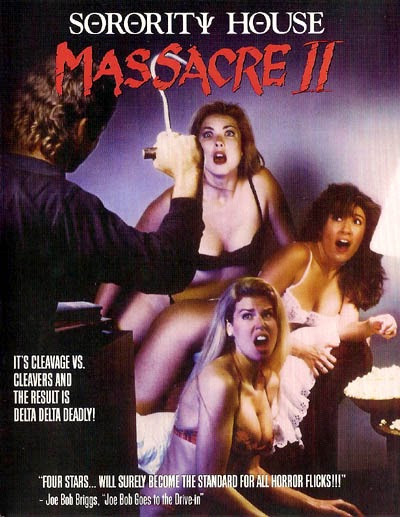
Cranpire Movie(s): Sorority House Massacre and Sorority House Massacre II
Welcome back to Cranpire Movies! It's been a little while since I visited this feature of the Blogorium, so maybe a quick refresher is in order. There are bad movies I like to watch, but many more of them that I just can't (or won't) find time to sit through. When that happens, I'll hand then off to my friend Cranpire, who will watch just about anything I won't. He's fond of Syfy Channel Original movies, and not just the new ones - thanks to Bruce Campbell's presence in Terminal Invasion, Alien Apocalypse, and The Man with the Screaming Brain, Cranpire was on board early with their quickly manufactured schlock. Every now and then, the Cap'n ends up watching something (usually accidentally) that would normally fall into Cranpire's wheelhouse, and when that happens, they are reviewed accordingly.
Today we're going to take a lot at the Sorority House Massacre series, specifically the first two. The third film - Hard to Die - is technically a sequel in that it has much of the same cast and uses the exact same back story, but it's also a Die Hard knock-off instead of a slasher flick, so I'll mention it in passing or when relevant. It's also worth noting that other than possibly using the same exterior, there's no continuity whatsoever between Sorority House Massacre and Sorority House Massacre II, although the second films does tie itself to a completely different slasher series. But more on that when we get to the sequel in name only.
For a Roger Corman produced, late-era slasher cheapie, Sorority House Massacre is kind of... classy? It's a relative term, I realize, but considering where it came from and what the marketing sells the film as, there's a comparably nuanced story buried inside of slashing and T&A. Yes, it's borrowing (heavily) from A Nightmare on Elm Street during the dream sequences, but the imagery is also suggestive of Dario Argento in a way you wouldn't expect. If you somehow end up seeing the films in the wrong order, you'd be shocked at how much better Sorority House Massacre is than its "sequel". While Carol Frank didn't quite make a "Feminist Slasher" on the same scale as Amy Jones and Rita Mae Brown's Slumber Party Massacre, it's definitely a less voyeuristic approach to the subgenre than I had expected.
Actually, it's debatable that Sorority House Massacre is even a slasher film at all, because the dream / psychic connection between the Final Girl and the Killer (shades of Halloween II) means we almost immediately meet our antagonist. Most of the film is about putting together how they're connected, what he's after, and what it has to do with the sorority house their paths collide in. By necessity, I'm going to SPOIL this, but it's hardly that since the audience is miles ahead of the characters for most of Sorority House Massacre. Beth (Angela O'Neill) is a withdrawn college student staying over at a friend's sorority house during Spring Break. Most of the girls are gone, including their sorority "mother," but when Beth arrives, she begins having nightmares about the house, of tables covered with blood and butchered mannequins. Her dreams begin to affect her waking life, and simultaneously Bobby (John C. Russell), an inmate in a mental institution, becomes more active, eventually escaping. He's looking for Laura, the only member of his family he didn't kill during a bloody massacre, and wouldn't you know it that Beth just happens to be her middle name...
Sorority House Massacre is not an especially violent or even gratuitous movie. Sure, there's nudity, but not in copious amounts (mostly taking place while Beth's friends (Wendy Martel, Pamela Ross, and Nicole Rio) try on the "rich" girl's clothes after she leaves, and during a Teepee make-out later in the movie), and most of the film's 77 minute running time is devoted to cutting between Beth's hallucinations / memories and Bobby coming "home". He kills just about everyone he runs into quickly, particularly the unfortunate boyfriends (Joe Nassi, Marcus Vaughter, and Vinnie Bilancio) of the main characters. What keeps Bobby interesting is that when he sees the women, it switches to his POV, where he imagines them as his sisters. He calls them not by their names, but by who he sees them as, almost as though he was killing them all over again. The disconnect between imagination and reality in the film actually makes the deaths that much more brutal.
Of the two films, the first Sorority House Massacre is probably less deserving of being a "Cranpire Movie": it's a lower-to-mid-tier slasher film, but is surprisingly atmospheric for a low budget horror film. While it borrows from better movies, Frank at least manages to make the "lifts" seem interesting, and the characters are at least developed enough that you care when they die. Horror hounds looking for a quick and bloody fix should probably go elsewhere, as this is (surprisingly) reserved considering where it came from, but I might have a film that's right up your alley in the next paragraph...
If Sorority House Massacre has some degree of class in the way it's presented, Sorority House Massacre II has all of the exploitation elements, and almost nothing else. Directed by Chopping Mall's Jim Wynorski, it offers gratuitous nudity, spurts of blood, leering perverts, dumb jokes, pointless subplot(s), and 60-ish minutes of nubile young ladies running around in their nighties, sometimes soaking wet. That said, as schlock goes, it's pretty entertaining, provided you're watching it in the right frame of mind. The opening should be a dead giveaway that it's not to be taken seriously, with an aggressive synthesizer soundtrack and pseudonyms in the credits like "Produced by Shelley Stoker" or introducing an actor as being the same person as his character.
The jokey tone is heightened after we're introduced to the new sorority sisters moving into a house that may or may not be the same one from the first film (if it's not, the exterior is pretty close, but the interior looks nothing like it - just a generic "house" set). In short order, we meet Linda (Robyn Harris), Jessica (Samurai Cop's Melissa Moore), Kimberly (Stacy Zhivago), Suzanne (Michelle Verran), and Janey (Dana Bentley), who are staying at their new house overnight until the power and phone utility men come over the next morning. They got the house cheap because it was the site of a series of murders five years ago, which kind of creeps out the girls, but they have tequila, so it's okay. They also meet their creepy neighbor from across the street, Orville Ketcham (himself) who, in addition to keeping the key to their basement in his underwear, was present during the original massacre. Just not the Sorority House Massacre.
For reasons unknown to me, instead of using the fact that there's already a Sorority House Massacre and it's kinda the same house and roughly five years later, Wynorski opts to use the back story from a completely different movie in both Sorority House Massacre II and Hard to Die. Even though the house looks nothing alike, all of the flashbacks to "Old Man Hocksteder" who went crazy and killed his family is footage from Slumber Party Massacre, another Corman produced slasher movie that has its own sequels. And it's a lengthy flashback to many of the "kill" scenes from Slumber Party Massacre, which uses a totally different murder weapon than the hook in Sorority House Massacre II. Why? Your guess is as good as mine, but it adds another layer of intertextuality, albeit a very silly one.
The girls, having taken cold showers and slipped into something more comfortable, go down into the basement and find a Ouija board, so they have a little séance - as you do - which ends in a spooky way. And by "spooky" I mean "basically what happens in Night of the Demons but much cheaper". Maybe it's the framing, but it's easy to spot the boom mike in many scenes, most notably in the living room near the beginning. It's also a shockingly well lit house for only having candles and a few portable lamps. Maybe it's the lightning that helps, although that looks an awful lot like the same stock animation I saw in Hillbillys in a Haunted House...
Anyway, so the girls try to get some sleep, but they have arguments about sleeping with a guy someone else is "going with," and somehow Jessica's 40-something boyfriend Eddie (Mike Elliott) never comes up again. Sorority House Massacre (mostly) waits until the boys come over to start a-murderin', but Sorority House Massacre II is ladies night through and through. Other than persistent cutaways to Ketcham looking menacing / loathsome, the bulk of the film is just gals in lingerie bouncing around the house, running into oddly placed bear traps (in the attic!) or getting murdered by a hook (despite the presence of a chainsaw in the basement). Interestingly, the drill that "Hocksteder" used to kill all of his victims in the "flashback" is nowhere to be found in the film.
To keep the "appropriating Slumber Party Massacre as a prequel to this film," Sorority House Massacre II has a subplot involving to cops (played by Jürgen Baum and Karen Chorak) who are slowly investigating a phone call that came from the "old Hocksteder place" - which, for the record, is the house with no phone service. They don't want to drive through a roadblock (or something) because of the rain, so instead they head to a strip club. If you're asking "why?" the answer is more breasts on camera while the action slows down back at the house, but the plot excuse is that one of the survivors of the original massacre is now stripping to work through her trauma. Candy (Bridget Carney) has her own routine, followed by a sit down with the cops while another stripper does her show (all on camera, of course), and suggests that maybe Ketcham shouldn't have been ruled out as a suspect. While this should surprise nobody, Bridget Carney wasn't in Slumber Party Massacre, nor was there a character named "Candy." But hey, more boobs, am I right fellas?
As it's really not clear where this movie should be going, Wynorski throws in a "possession" angle to justify the Ouija board, and while I won't tell you who ends up with Hocksteder's ghost at the wheel, I will give the director enough credit to make sure they're always where the killer would be or at least separated from the group. There's a lot of "let's split up" that you'd expect from really bad slasher movies, but in this instance it does serve as pretty good misdirection, at least until there aren't enough ladies left to rule out anybody else. Despite continually trying to imply that Ketcham is dangerous, it's pretty clear he's just a weirdo red herring, and despite being stabbed, choked with a chain, drowned in a toilet, and being shot by the police, he's still somehow alive at the end of the movie, not to mention the one who kills the, uh, Final Girl. It must have been all the raw meat he was eating earlier...
While I can easily say that Sorority House Massacre is pretty good "for what it is," it's difficult to say the same for Sorority House Massacre II. It is exactly the lurid, dumb, gratuitous slasher movie you think you're getting based on the cover. So it has that going for it. If you want cheap thrills, you'll mostly get them without groaning too much. Gone is any hint of artfulness, replaced with a workman-like approach of showing the goods and getting out. The comedy isn't that funny (trust me, I'm not sure if we're really supposed to laugh at the "Arab" stereotypes at the strip club, or just marvel at how dated they are), the gore is mostly limited to blood splattering on the wall (and one bathtub scene lifted from Slumber Party Massacre 2 - oh, did I not mention that there are more than one Slumber Party Massacre films?).
I guess the only thing that Wynorski really delivers on is the nudity, which I suspect Cranpire will agree is at least a selling point. They are attractive young women, and have no problem disrobing and taking cold showers for no reason, or standing directly underneath a porch dripping water in white nighties. Good for them? While Hard to Die is more of an "action comedy," it does have most of the same cast, including Orville Ketcham, playing the same kind of unkillable exposition machine he does in this one. Oh, and yes, the same flashbacks to a different movie. Well, the same different movie, because Hocksteder was a busy driller killer. As Cranpire Movies go, these are arguably better than his normal fare, but what is that really saying? I can easily recommend Sorority House Massacre and Sorority House Massacre II over the likes of Sharknado 2: The Second One and, uh, Sharknado 3: Oh Hell No, but they aren't going enhance your life or anything. Or maybe they will. Who knows, it might win you trivia one night, just by knowing what other series this one flashes back to. And if I'm being honest, the Sorority House Massacre movies are better than Slumber Party Massacre 2 and 3, so there's that. If you're the sort of person who hears the phrase "Cranpire Movie" and is excited, you're probably Cranpire, but if not, prepare for a fun double feature.
Tuesday, April 14, 2015
Bad Movie Night Recap
The time has once again come for Bad Movie Night: my shameless celebration of the movies that just aren't quite good enough, but also aren't so terrible they become unwatchable. It's a fine line, and sometimes it's just the right goofy element that pushes it over. Sometimes it's just who you watch it with, and the Cap'n has a fairly loyal crew of masochists willing to descend on Blogorium Headquarters every year. Even though I subjected them to Things last year, they came back. What that says about their cinematic fortitude is up to you, but I'm proud to call them my friends. This year, I opted to give them a less agonizing experience, but not without some serious brain bending. Let's take a look at what you (hopefully) missed out on:
We started with Devil Girl from Mars, based on the hit London stage play (or, that's what I'd like to believe), and it shows. Despite the fact that a Martian spaceship lands outside of a remote Scottish Inn, most of the motley crew of patrons are concerned with their own stupid problems, leaving time for Naya, the titular character, to enter and exit through the same door, repeatedly. At least it's nice to know that Martians also call their planet Mars. They - well, she - arrived on Earth with her new prototype spaceship, which has organic metal and runs on an engine that creates nuclear reactions that explode inward, creating perpetual motion. Their science is vastly superior to ours, but in the great war of the sexes, all men were wiped out and they need some breeding stock, if you catch my drift. Perhaps if she'd landed in America, rather than Scotland, this would have been an easier task, because the citizens of the United Kingdom are more interested in cockamamie plans to shoot or electrocute her, to no avail.
Brave newspaper columnist Mike Conner (or Carter, depending on who's saying his name) has the scoop of a lifetime, but would rather his on a fashion model hiding out in the inn. Thankfully his indeterminate accent doesn't bother her, and she even falls in love with him in the two hours between when they meet and when he agrees to join the Devil Girl on her ship. That, of course, is a ruse for him to try to steal the remote control for Johnny, a robot who "looks very similar to you Earth people," in that he looks nothing like humans but instead a guy in a robot costume. Naya has a ray gun that's effective on everything but glasses, constructs an invisible wall that the only scientist in the group somehow runs into headlong, and loves to open the same doors over and over and make sweeping pronouncements about how stupid we humans are. There are other characters, because we clearly care about an escaped adulterer who murdered his wife or some dumb kid, but the innkeeper's husband's name is Jamie Jameson, which is amusing. Also, they sit down to eat dinner at 10 o'clock at night. If only Mike and the Professor had taken the turn to "Loch Something" (actual line), they might have missed this unfortunately duller than it sounds movie.
Speaking of dull, I hadn't seen Disney's knock-off of Star Wars, The Black Hole, in close to 25 years, so I didn't remember what a bore it was. Fortunately, I also didn't remember a lot of other things about it, like the fact that a 90 minute film had an overture and that all of the music - by James Bond composer John Barry - sounded just like any other Bond music. I did remember the robot with the Texas accent, and that Event Horizon lifted quite a bit from this terrible, terrible movie. When it's not ripping off Star Wars, it's borrowing liberally from the released-the-same year Star Trek: The Motion Picture, and Forbidden Planet, and Battlestar Galactica, and pretty much any other vaguely popular science fiction film they could think of. To be perfectly honest with you, we lost interest about fifteen minutes in, started talking about the new music on Star Wars and about The Hobbit, and eventually made some jokes about Ernest Borgnine's libido and the movie Alligator, while pausing to note just how badly one could steal from George Lucas. I might have even said something kind about The Phantom Menace, which might be a first for the Cap'n.
High School Confidential! eased us out of the "boring" zone of bad movies - hey, I try, but sometimes things just don't land with the crowd - by being entirely too interested in being "hip" and "with it". That works wonders in its favor, because the ridiculous overuse of slang, coupled with what seems to be not even veiled suggestions about incest between Tony (Russ Tamblyn) and his aunt Gwen (Mamie Van Doren). In Tony's defense, it's mostly one way, and given there's a twist, I guess it's possible that they maybe aren't related, but why would he refer to her as his aunt behind closed doors? There are a number of questionable "bait and switch"-es in High School Confidential!, a movie about Tony moving in to town and taking over the high school drug trade in the course of two or three days. He's tough talking and backs it up, and pops his collar, even when it's on a sweater. Why? Because he's hip, daddy-o.
There are so many ways to address how hard the writers are trying to sound "cool" and failing miserably: the hip version of Columbus that J. I. Coleridge (John Drew Barrymore) "lays" on his class, or the awful (even for Beat Poetry) performance at a "Jazz Club" the kids all go to. Or the notion that marijuana is a gateway drug to heroin, and nothing else. Tony, a "7th year" high school student, immediately starts hitting on his teacher and also moves in on Coleridge's girl, who turns out to be a junkie. The drug kingpins in town are played by Charles Chaplin, Jr. and Jackie Coogan. Yes, Uncle Fester forces Tony to shoot up to prove he's not a narc. But wait, he is! (SPOILER) Tony is really Mike, who works with the cops, and there's a big shootout at the jazz club when a deal goes bad. Fortunately, the leader of The Rangers - played by Michael Landon - is there to help out, even though they're the rival gang to Tony's Wheelers and Dealers. Also, Jerry Lee Lewis begins and ends the film playing the title song, in what appears to be the same shot.
High School Confidential! picked up the pace a bit, and after a musical interlude, it was time to dive right into Raw Force. It's an almost perfect storm of kung-fu zombie cannibalism interspersed with gratuitous nudity and hokey special effects. And yet, some people were grumbling, perhaps because I oversold the "cannibal monks who raise kung-fu zombies" part of the movie. Yes, most of Raw Force's 86 minutes is devoted to a Kung-Fu cruise to "Warrior Island," where disgraced martial artists are buried. It's also where Hitler sells prostitutes in exchange for jade. Is his name Hitler in the movie? I honestly don't remember, but if he looks like Hitler and talks like Hitler, we're going to go with "that guy is Hitler". The cannibal monks eat the girls because it gives them power to raise the dead, which they use (eventually) for the final showdown.
In the meantime, there's a lot of showing off of kung-fu skills, coupled with late 70s / early 80s clothes, music, and nudity aboard the cruise ship. Almost everyone on the boat - from the cook to the bartender - seem to know how to fight, and are therefore well equipped to handle Hitler's lackeys. You see, despite the fact that Warrior Island is the home of an illicit human trafficking ring, it's also the subject of its own tourism guide. Because, why wouldn't it? When the cruise ship catches on fire (or, rather, has fire overlaid over the image), some of the passengers escape, and the rest are presumably killed. We never hear from them again, so let's just assume they died. What's important is that the life raft lands on Warrior Island and the monks raise the dead. There's lots of chop sockey, some decapitations, some dynamite, and piranhas. How are there piranhas in salt water, in the ocean? My guess is they couldn't find any stock footage of sharks. So Hitler gets munched on by piranhas (SPOILER).
Rather than launching into the "Luc Besson Presents an Affront to Science" double feature as promised, I gave them the option of getting the Trappening out of the way, which they decided was best. What they didn't know was that this year's mystery feature wasn't just a Bad Movie - it was a Great Bad Movie. By no stretch of the imagination could one call Commando a "good" movie, but I'll be damned if it isn't one of the most fun films to throw conventional cinema out the window. Continuity errors? Check. Bad one liners? Yessir. Gratuitous nudity? Well, it has absolutely nothing to do with the fight scene, so yep. The mall from Chopping Mall? Sure is! Arnold Schwarzenegger killing an entire army, single-handedly? You know it.
To get Alyssa Milano back, Arnold will plow his way through David Patrick Kelly (John Wick), Bill Duke (Predator), Dan Hedaya (Alien Resurrection), and finally The Road Warrior's Vernon Wells (Weird Science) for the mother of all bad puns. Oh, and his name is John Matrix, because Rambo is a pansy. I firmly believe that Commando is what everybody thinks all action movies from the 80s are like (that, and First Blood Part II), and why they hold the admittedly average Expendables series to an impossible standard. Matrix is introduced hauling a log down to a cabin (on his shoulder), and then eats ice cream and feeds a deer with his daughter. Because he's tough, but sensitive. Until you steal his daughter, and then he just kills you. Rae Dawn Chong's Cindy isn't even developed enough to have Stockholm Syndrome when she assumes the role of "new mom" at the end, having been kidnapped by Matrix less than twelve hours before. Commando is all killer and no filler, but I asked attendees to give it the same scrutiny as any of our other howlers, which is exactly the point at which you realize the many logic gaps and inherent flaws that make it technically "Bad." Now that everybody was in a great frame of mind, it was time to throw common sense out the door and let Luc Besson insult our basic intelligence...
I've been hosting official fests for nearly a decade now, and in all that time I have never heard the phrase "wait... what?" as many times as I did during Luc Besson's Lucy. Perhaps the mini-review in the "Worst Of" recap didn't quite convey just how painfully cavalier Lucy is with the concept of "science," but the reactions were hilarious. During the film, at least one large bottle of Kraken was consumed, and descriptions of what they'd seen ranged from "an atrocity" to "amazing." A friend of mine whose dissertation is on Philip K. Dick insists that it's not science fiction at all, but rather a brilliant example of "slipstream," a newer iteration of magical realism. The entire room erupted with laughter when Lucy (Scarlett Johansson) explained that she could "feel her brain" in what's supposed to be heartfelt scene over the phone with her mother. The comical, video-game-esque use of brain percentage "unlocked" was also a source of enjoyment, but nothing stood out quite as much as figuring out how long it took for Johansson to "say this horseshit with a straight face." One viewer worried that she could no longer take Morgan Freeman's Through the Wormhole seriously after seeing him in Lucy. I freely admit that Lucy is a bad movie, but it's a very entertaining one, and it was somewhat validating to see the baffled reactions as they tried to take Besson's affront to science seriously.
That said, I made a critical mistake in putting Lockout after Lucy, because by comparison, the former is just a "run of the mill bad science fiction film". It's true that after you've heard Scarlett Johansson explain what it's like to feel your bones growing, or to become the monolith from 2001, a high speed unicycle chase just doesn't have the same impact. Even my favorite line of awful science, "the gravity should keep you floating" just can't compete with Besson's double-down on Insane Clown Posse-like disdain for science. Lockout is still a bad movie, and it's insistence on identifying everyone and every location on screen (repeatedly, in the case of the latter) is amusing, but it just wasn't the same head-scratcher that it was in 2012. On the other hand, the outcries of mental anguish reconciling what Lucy was saying vs. what they knew to be true was more than worth it.
By the end of Lockout, just about everybody was ready to go, but a few stragglers felt like they had one more Bad Movie in them. Despite the fact that it meant Cap'n's Choice - I hadn't planned on anything past Lockout - they were willing to suffer through another one. Being that it was late, or comparatively late (we can't do movies until sunrise anymore), I opted to go short and show Cranpire a "Cranpire Movie": Sorority House Massacre II. As I'll be writing about that and the first Sorority House Massacre soon (and possibly Hard to Die), I won't go too into detail about it, but he enjoyed it. There's barely a plot, and most of the first half of the movie is devoted to showing as much gratuitous nudity as possible, followed by another 30 minutes or so of women running around a house in their nighties and going out in the rain for no good reason. Jim Wynorski (Chopping Mall) even takes a pointless side-trip to a strip club to shoehorn in more nudity under the specious logic that one of the characters from a flashback is now dancing topless. Classy stuff.
For the immediate future, I think I've hit my quota of schlock (although that doesn't rule out watching Furious 7). There's enough time to reload the queue in time for Summer Fest, where I think 80s cheesefests Without Warning and Deadly Eyes are going to be a hit. Thanks to everybody who made it, and to the folks at home who didn't, you now have a roadmap for your own Bad Movie Night. Just have alcohol and a good support system of friends nearby. And whatever you do, don't watch Things.
Subscribe to:
Posts (Atom)