Saturday, October 30, 2010

Horror Fest V Day One: The House on Sorority Row

If you hadn't noticed up to this point, the Cap'n and the Cranpire have been watching a heavy dosage of slasher films from the "golden age," and particularly ones from the post Halloween / Friday the 13th rush of 81-83. Over the last year or so, I've seen most - if not all - of the "major" and "minor" entries: Friday the 13th, The Slumber Party Massacre, My Bloody Valentine, Splatter University, Pieces, Happy Birthday to Me, The Burning, Halloween II, Prom Night, Student Bodies, Visiting Hours, Sleepaway Camp, Slaughter High, Maniac, The New York Ripper, and tonight, The House on Sorority Row.

To be honest with you, I did some poking around and noticed that it has a lukewarm reception as slasher films go, and I'm not sure why. To be honest, after watching a heavy dose of good ones (and quite a few bad ones), The House on Sorority Row might lack a really strong "gimmick" killer, but it builds tension, sets up kills scenes well, has a decent set-up that manages to carry the heroines through the film, a nice "bait-and-switch" villain, and at least some gore (although most of the kills are in silhouette, just off camera, or implied).

What it lacks in on-screen violence, The House on Sorority Row makes up for in story (which is seldom the case in slasher films): the graduating sorority sisters of Theta Pi decide to stay in their house for one more weekend, much to the chagrin of mentally unstable house mother Mrs. Slater. When a prank to get even with her results in Slater's death, the girls are faced with a quick decision as the party is literally heading up the driveway. Their plan to hide the body goes awry, and on top of that someone is killing off the guilty parties during the celebration. The House on Sorority Row manages to interweave all of the plot threads - plus a few I'm opting not to spoil - throughout the film, adding a palpable tension to the murders, the party, and the girls' attempt to cover up their prank.

It's not my favorite slasher film, but I'm certainly willing to put The House on Sorority Row in that first tier beneath the very best alongside Slumber Party Massacre, My Bloody Valentine, and April Fool's Day. Considering some of the lesser entries I've been privy to, The House on Sorority Row is a breath of fresh air; a well executed film that has a few really good sequences - including the late-film hallucinations our "Final Girl" experiences - so check it out.

See you tomorrow for Day Two, where the madness just ratchets up further!

Friday, October 29, 2010

Horror Fest V Day One: Street Trash

Wow... I don't even know how to describe Street Trash in a way that adequately prepares you for the film. Tonally, you could maybe compare it to Basket Case, if Basket Case were a film about homeless people on the outskirts of Brooklyn. Instead of Belial, maybe you could say that Viper wine is the "killer," as the forty-year-old spirit causes people to literally dissolve from the inside out (often in neon colors and in fantastically gruesome fashions). So it's not really like Basket Case, save for maybe the slightly off-kilter world the characters inhabit.

I'm giving all of the credit in the world to director James Muro and writer Roy Frumkes (who you may know as the director of Document of the Dead, the epic making-of documentary on the Dawn of the Dead Ultimate Edition set). Muro's camera work, choice of angles, and general mise-en-scene creates a heightened reality from the get-go, a world where our heroes live in a tire hut and work for a shell-shocked Vietnam veteran that carves knives out of femur bones. That Viper's effects on consumers isn't the strangest thing in Street Trash is a testament to the madcap, often surreal, world presented to audiences.

There's a strong undercurrent of Vietnam-related trauma throughout the film, not limited to the main villain (if you don't count a wannabe mob boss introduced halfway through the film), and at least two dream sequences / hallucinations that directly influence how characters relate to each other in the film. There's also some oddly effective commentary on race relations, class intersections, and one of the least practical police departments this side of Pieces (who, after all, allow a suspect to help in the investigation!).

Street Trash isn't a "horror" movie, per se, as it really isn't scary at any point. Disgusting, absolutely. I'd be much more likely to put it in the "cult" movie section than with the horror films, even though it does feature decapitation, necrophilia, some pretty wicked gore, and a game of catch involving a severed penis. And that's the tip of the iceberg, to be honest with you. If you can stomach some seriously goopy gore, aren't easily offended, and like wondering what the hell it was you just watched, then by all means seek out Street Trash immediately.

Horror Fest V Day One: The Living Dead at Manchester Morgue

The Living Dead at Manchester Morgue (also known as Don't Open the Window or Let Sleeping Corpses Lie) is a highly regarded zombie film from Spanish director Jorge Grau. The film has a strong ecological message and hints at fear of nuclear technology and radiation "polluting" the countryside. While I feel it drags its heels too long to establish a zombie threat, when the time comes to bring the gore, Grau delivers, and the film is atmospheric enough to merit a recommendation.

As zombie logic goes, you're going to have to dig to find something more nonsensical: apparently, a new form of pest control that emits radiation is also affecting babies in a nearby hospital, as well as re-animating the dead. That's fine, but the method by which the recently deceased "make" other zombies is a bit more complicated: a zombie "bite" won't actually infect somebody, so a zombie needs to anoint a corpse with the blood of the living to pass on the re-animation. Or something like that.

The zombies themselves are doled out slowly, to the point that large stretches of the 92 minute film don't have any undead activity at all. The disjointed nature of the film actually hurts The Living Dead at Manchester Morgue because audiences are allowed to focus on how little sense the story actually makes when held up to even the most basic scrutiny. It borrows loosely from Night of the Living Dead early on (even directly lifting a shot inside of the heroine's car), but fails to capitalize on its predecessors claustrophobic nature, or even its sense of impending doom.

The radiation threat is more of a boogeyman, in that it follows earlier shots of a nuclear power plant in London and is part of an ongoing debate between the protagonists and the scientists conducting the pesticide experiments. One can easily see how an ultra-simplified form of this plot point could be appropriated - along with similar shots of wind blowing through fields - into M. Night Shyamalan's The Happening (although I doubt many fans of The Living Dead at Manchester Morgue would want or leap to make such a comparison).

I will give the film this: I was totally on board that the film was set in rural England, somewhere outside of London. I bought it hook, line, and sinker, and was as surprised as anybody there that the credits listed filming in Madrid. Then I checked on IMDB, and it seems that most - if not all - exterior shooting took place in the UK, so I felt a little better about it. That, and I give the film credit for a thematically appropriate "twist" ending, even if the logic once again falters under inspection.

Horror Fest V Day One: Pieces

"It's Exactly What You Think It Is"

Pieces is an interesting slasher film from 1982 (filmed partially in Boston and partially in Madrid, which accounts for the strange dubbing throughout) that is remembered best for its fairly gruesome violence and its last second twist ending, which I'm going to go out on a limb here and say heavily influenced Lucky McKee's May.

The easy comparison for Pieces is The Texas Chain Saw Massacre, in part because the poster openly acknowledges the similarity in murder weapons. While it is true that the killer in Pieces uses a chainsaw to cut apart his victims, for the first half of the film, his M.O. is very different than that of the cannibal family in the Lone Star State. The hook for Pieces is a good one: in 1942 a young boy murders his mother with an axe, then hacks her up with a handsaw and feigns victim status when the police arrive.

Forty years later, the grown up psychopath begins killing young women on a college campus near where he grew up, but not simply to murder them: he's collecting the "pieces" - corresponding to a jigsaw puzzle repeatedly used as a metaphor - that would create a new "mother" (shades of Psycho). Pieces runs into trouble when the killer apparently has all of the parts he needs but continues to kill - in part to pad out the film's 85 minute running time - and take parts we already know he has. As a result - and this reminds me of the problem I had with Slumber Party Massacre III - the killer gets sloppy towards the end of the film and the logic of his plan collapses.

What Pieces does do well is extend the guessing game of "who's the killer" by placing otherwise easy-to-rule-out characters in exactly the wrong place at the wrong time. There's even a "why are all of our suspects in the same place for the same murder" lineup midway through the movie. Unfortunately, it's clear who isn't the killer before you're sure who is, even if they stack the deck against the Anatomy teacher and the groundskeeper. The police procedural component of the film also drags at times, but is balanced out by the inventive (and graphic) kills.

The ending (which I won't spoil) manages to save most of the faltering third act, although I unfortunately called it, as will anyone who remembers the last shot of May. It makes about as much sense here as it does there, but the shock value ends Pieces on a high note.

Up next: Jorge Grau's The Living Dead at Manchester Morgue!

Horror Fest V Day One: Dead Snow

Tommy Wirkola's Dead Snow is a fairly entertaining Norwegian horror film with one very enticing gimmick: Nazi Zombies. That it doesn't quite live up to the expectations one might expect from that premise shouldn't scare genre fans away from the film; there's enough quality gore to overcome a slightly derivative script that, at times, relies heavily on Sam Raimi's early work to get from plot point to plot point. It's funny enough to distract you from a familiar plot and even more familiar story beats, and while the zombies aren't exactly zombies, they're certainly a fun twist in otherwise well trod territory.

Stop me when this sounds familiar: college students (in this case, all med-school) go to a secluded cabin on a mountain to spend the weekend. There's an even mix of girls and guys, with two couples and four singles of recognizable types - the missing girlfriend who everybody assumed would be there, the guy who always talks about movies, the girl that's kind of nerdy herself, and the squeamish guy with the self-reliant girlfriend.

Okay so far? Let's add the "Creepy Older Guy" who warns them about the history of this particular mountain - Nazis occupying Norway that stole the village valuables and were killed by the townspeople... or were they? - and then leaves. Where's the girl who owns the cabin? Is she okay? What's all this gold from 1942 doing in the cabin? People start dying? Could it be undead Nazis? Oh, you know it is! Let the evisceration commence!

I say that the Nazi Zombies aren't exactly zombies, in part because while yes, they are undead, they don't behave like traditional zombies. They behave like undead Nazis, ones that really like fist fights, using knives, and in one instance, gutting a girl to put a grenade inside her torso. The makeup is pretty nice, particularly on General Herzog, who just happens to be missing his lips. All of the Nazi zombies (who do bite people, but don't really seem interested in eating them) are menacing, if easily dispatched with late in the film.

Since I mentioned General Herzog, now's as fair a time as any to talk about how intertextuality-laden Dead Snow is. Not only do the characters discuss other horror films with a similar premise at the outset of their trip, but at least one of the films mentioned comes into play repeatedly during the film. There are two explicit references to Evil Dead 2: Dead by Dawn - one is part of a "if this were a horror movie" conversation and the other one is a direct visual reference to Ash cutting off his hand, used to set up an "Oh yeah, now what are you going to do?" joke involving a crotch-level Nazi zombie.

Erlend, the character constantly quoting films (including Indiana Jones and the Temple of Doom and The Terminator) is also wearing a Brain Dead shirt (better known in the States as Dead Alive). Fans of Machete are going to be saying "Dead Snow did it!" when they see a very similar gag involving guts from two years earlier. The references aren't overly distracting, but they do underscore how much of Dead Snow is familiar territory, particularly the end, which lacks the kind of punch I suspect it was supposed to have.

That being said, you're going to have a lot of fun moments, and a few surprises - the nerdy film fan is the only character to have sex with someone - and for horror fans, plenty of gore. I'm not really sure I've seen a film so obsessed with intestines as Dead Snow is, and the fact that the protagonists are medical students does actually come into play in a meaningful - if totally unrealistic - fashion. Also, the crow scene is pretty funny. Dead Snow isn't going to reinvent the zombie wheel, and the Nazi Zombie concept isn't as developed as one would hope, but it's still definitely worth renting or (as the Cap'n did) "Watch(ing) It Now."

Horror Fest V Day One: The Slumber Party Massacre (Parts 1 and 3)

To kick off Horror Fest V, the Cranpire and I decided to dig into the new release from the Roger Corman's Cult Classics series: The Slumber Party Massacre Collection. We had both seen the first and second films, but were positive that Slumber Party Massacre III was an entry we were unfamiliar with. In the interest of keeping things in perspective (and not staying up too late), we decided to watch the first film before jumping into the third.

After yesterday's "Splatter University" experiment, it may seem disingenuous for the Cap'n to delve into a theoretical reading of 1982's* The Slumber Party Massacre, but the film has a reputation of being a step above its contemporaries, despite some strange pandering to male audiences early in the film.

It's worth noting that writer Rita Mae Brown wrote the screenplay as a parody of slasher films, but the producers took on the film irony-free, giving Slumber Party Massacre (there's no "The" in the title screen) a curious, detached quality from its genre counterparts. Director Amy Holden Jones certainly straddles the line between parodic and serious, and the end result is an entry from early in the era that stands out and is often referred to as the first "feminist" slasher film. To be honest, there's plenty of evidence in the film to support that claim.

(normally, in a full on review, I'd include a synopsis, but this will likely be the longest Horror Fest entry, for the simple fact that the volume of films is too high for all-encompassing critiques.)

Let's begin with the strange contradiction that exists in an otherwise women-centric film, the high school shower scene, where the entire women's basketball team strips down and has a bit of a chat while soaping up their bodies on camera. In fact, there's a strange, lingering shot of main character Trish's back, then behind, then back, before she turns around to show us her breasts again. This isn't the first time we've seen Trish semi-naked before; the film opens with her waking up, taking her nightgown off, and getting dressed, then decided to throw out her childhood toys, a symbolic gesture of "growing up" that doesn't necessarily play into the film - other than to provide the killer a Barbie doll to mutilate and leave for a scare later.

Speaking of the killer, Russ Thorn's early introduction as the killer in the film removes all ambiguity regarding secondary characters. There's no need to guess which person is picking off the girls (and some of their boyfriends and neighbors), because we're given a clear look at his face and drill before we've actually been introduced to all of the protagonists. It would be tempting to dismiss the "drill as homicidal phallus," were it not for an explicit castration metaphor later in the film - which I will discuss further down. Accordingly, it's not difficult to guess that "thorn," something that "pricks" people, is also not accidental on the part of Brown.

Once the slumber party is underway, there's a shot of two of the boys watching our heroines undress, and indication of a slightly dubious neighbor, and a subplots involving Valerie Bates (again, not likely a coincidence, Psycho fans), her pre-pubescent sister Courtney, and gym coach Rachel Jana that begin to drift away from standard slasher fare. Because we already know the killer and the red herrings are limited to one perspective shot involving jock John Minor, it's actually the way the plot unfolds outside of the "kills" that distinguishes Slumber Party Massacre from other slashers.

The reversal of roles figures prominently into the film. In most instances, the women are all tougher than the men, either dealing with each other or dealing with the killer. Courtney sneaks into Valerie's room to steal a copy of Playgirl (with Sylvester Stallone on the cover) and is obsessed with her budding sexuality (or lack thereof), and the boys in the beginning seem nervous about how to ask out girls. Men in the film are portrayed as psychotic (Thorn) as slightly sketchy but ultimately weird (Trish's neighbor, a man obsessed with using a meat cleaver to kill snails), or fodder for the killer (the Pizza Delivery guy, all of the potential male love interests).

When the end arrives, and our trifecta of "Final Girls" (Trish, Valerie, and Courtney) fight Thorn near a back yard pool, Valerie ultimately chops off the top of Thorn's drill bit with a machete, resulting in his shocked expression of emasculation, followed by rage. That Thorn's hand is subsequently removed and stomach torn open by Trish's knife is, in many ways, symbolic revenge for "penetrating" so many victims with his drill (I could jump into some Freudian analysis from his essay "The Uncanny" that links fear of castration with the loss of eyes or hands, but I think I've made the film's case well enough to this point).

For a movie that exists simultaneously with two purposes, one would expect The Slumber Party Massacre to be a much more disjointed film than it is, but somehow the combination of a serious take on a parodic script holds together. Yes, the film has its share of "huh?" moments, and I'd debate the success level that Thorn has simply swinging the drill as being an effective "kill" technique, but overall I'd count The Slumber Party Massacre as more successful than Student Bodies at turning the slasher film on its head. It's effective in its low budget, turns left enough times when you expect it to go right, and overcomes its own schizophrenic production to be effective.

By the time we get to 1990's Slumber Party Massacre III, the effect just isn't the same. Everything feels like a watered down retread of the first film, even the more directly addressed sexual metaphors. While the second sequel is also written and directed by women (Catherine Cyran and Sally Mattison, respectively), the intentionally feminist approach is undermined by a killer that invokes more laughter than tension, and a third act that falls apart at every opportunity.

Whenever possible, Cyran and Mattison try to make the sexual references more explicit, like an early kill that involves the killer "drilling" a woman from behind her in a car. When he "finishes," his hand drops limply to the side. It's implied twice that he can't actually have sex with anyone, followed by swift rebuking of the women he fails to "penetrate." There's a slightly clever gag involving him going down on the first girl (I'd love to give you specifics on who's who, but honestly aside from physical descriptions like "the long haired blonde" or "the redhead," none of the main characters make much of an impression), she goes to take a bath and he electrocutes her with a vibrator.

Speaking of the killer, Slumber Party Massacre III drops the ball in a big bad way if you've seen the trailer (as we did): the film is loaded with red herrings about who the killer might be - is it the Kurt Cobain looking guy dressed in black? The sketchy neighbor with a telescope and a soul patch? One of the guys introduced early in the film? Or is it the guy they went to high school with that is clean cut, has an uncle that's a cop, and is identified in the trailer AS THE KILLER?

This might be bearable if the killer didn't abruptly drop the "hide the bodies and cover your tracks" m.o. in the third act of the film, in order to simply become a ranting maniac. It doesn't help that the killer seemed to learn all his line delivery from George Hardy (Troll 2), and is laughably non-threatening. He seems like a spoiled jock that likes to swing his drill around, which would be find is Cyran and Mattison had any idea how to dispatch with him.

Instead, we're left with another "Final Girl" triumvirate, but instead of deal with the killer, they tie him up and argue about whether calling the police (who, to this point, have derisively ignored their calls) or to simply kill him. Considering that they stood there and did nothing when he killed the redhead (I'm sorry, but I'm not putting the film back on to get names, and IMDB isn't helping), there's no impact whatsoever when they finally drill him to death. The ambiguity I assume I'm supposed to feel as the "final penetration" is followed by the police arriving just isn't there, because Slumber Party Massacre III is half hearted in practically every way. Do yourself a favor and skip the third film; the first and second are absolutely worth checking out.


* The copyright at the end of the film says 1981, but IMDB disagrees.

Thursday, October 28, 2010

Blogorium Review: Splatter University (Re-visited)

Once upon a time, the Cap'n reviewed Splatter University, and in my younger and less critically astute days, I wrote the film off as a cheap knock-off slasher flick, looking to cash in on a craze already waning. Now that I've had some time doing serious film criticism, I can clearly see the error of my ways: Splatter University is a sly condemnation of religious extremism and Reagan-era politics disguised as an undistinguished, dispassionate entry into the horror omnibus. It disguises its own apparent inspiration from the Italian giallo film in order to "pass" as "just another slasher film," but when the right eyes view Splatter Universtiy*, it can be understood as the subtle masterpiece it is.

Do not be misled by its lurid artwork or relatively inane title; Splatter University is, in fact, the real deal. First time director Richard W. Haines, who co-wrote the film with John Michaels, Michael Cunningham, and Miljan Peter Ilich use the tropes of the "slasher film" to craft a rich and layered cinematic text which simultaneously serves and criticizes the subgenre of horror it is "categorized" in. (For my money, it exists in a higher echelon, but to this point Splatter University has been almost wholly ignored by the critical community).

On a surface level, the plot seems benign: At the outset, we begin our story in a mental institution (shades of Halloween or The Cabinet of Dr. Caligari), where a patient escapes by murdering one of the doctors and assuming his identity. Three years later, a Sociology professor is brutally murdered at St. Trinian's College, and the following semester her replacement, Julie Parker (Francine Forbes) arrives to take on a campus of indifferent, sexually active eighteen-to-twenty-year-olds. Parker immediately runs afoul of Father Janson (Dick Biel), the conservative head of St. Trinian's, but finds an ally in fellow professor Mark Hammond (Ric Randig). Meanwhile, the killer is still stalking the campus, picking off students one by one. Can Julie discover who the campus slasher is before it's too late?

This reasonably innocuous plot synopsis would suggest that Splatter University is nothing more than a so-called "whodunit," but the details that fill in the story are indicative of a film fully aware of what can be done in the confines of horror (an oft maligned genre). For example:

The murder weapon in Splatter University - a knife - is concealed within a crucifix, hinting at the duality in Christianity between preaching peace and practicing war. This is one of many damning references to religious hypocrisy in Splatter University: during her first class, Julie asks the class to identify something they feel strongly about as a way of weaving sociology into their daily lives, and when a Priest observing the class reports to Father Jensen that the student - not Parker - offers up the subject of abortion, she is ordered into his office and given a proverbial "brow beating" for deviating from the "tried and true curriculum" at St. Trinian's. The jab at Reagan-era conservatism and religious intolerance of "hot button" issues is unmistakable, and Father Janson's attitude is consistent with that of a man unwilling to adapt to a social environment that no longer reflects his "traditional" lesson plans.

It is no coincidence that Haines places Janson in a wheelchair, symbolizing his inability to take action and be a "real" man of God (something that will be addressed below). Similarly, another Priest is noted by the students for having sexual "flings" with his students under the guise of "confession," and during one conversation with a amorous teen, the camera (from the priest's perspective) wanders up and down her body, a classic example of film as voyeurism. Another Priest is slyly named after Anthony Perkins, an intertextual nod to his role as Norman Bates in Psycho. The institution of faith is corrupt, potentially psychotic, or riddled with infirmity.

The critique of Ronald Reagan's "Happy America" in the 1980s - which in no way reflected the reality of unemployment, inflation, and increases in diseases like HIV - continues throughout Splatter University. It's simply easier for characters to ignore things like unexpected pregnancies, infidelity, teenage drinking, cheating, and even murder. Half of the characters are blithely unaware that their significant others are being killed, and their disappearance from the narrative often goes totally unnoticed, particularly by the students. A police presence, while occasionally referred to by Father Janson, are physically nonexistent in Splatter University. For Father Janson, the death of students and teachers is an "inconvenience," but should not disrupt the upright appearance of St. Trinian's.

It is worth noting that Splatter University was produced by Lloyd Kaufman (founder of Troma films), who is no stranger to incorporating relevant social commentary into films that, on the surface, appear to be little more than cheap exploitation. For example, The Toxic Avenger and The Class of Nuke 'Em High - which Kaufman co-directed with Haines - deal with growing anti-nuclear hysteria in the mid-to-late eighties, and similar critiques of war appear in Combat Shock and Troma's War. That Splatter University is not openly identified as a "Troma Team Production" is an attempt to allow its social commentary not to be tied to gratuitous nudity and extreme violence - which are generally absent in the film.

Other examples of social commentary tied to the "Me Generation," appear in smaller, visual gags, like a girl involved in a love triangle being murdered and dumped into a garbage bin marked "Consumer," where her corpse is pelted with beer cans by passing students. Similarly, Julie's attempts to quit St. Trinian's are met with indifference by Father Jensen (conveniently, Julie is seated near a trash can marked "Waste" in a similar graffiti stencil to the "Consumer" bin). Julie has failed the traditionalist Janson, and is no more use to him than common street trash. Another victim dies because she fails to notice the killer is "in the closet" ("AIDS Kills," anyone?). Clever sight gags like these make it clear that Haines knew exactly what he was doing, despite the apparent "crudeness" of Splatter University's mise-en-scene.

Splatter University also turns the frequently misogynistic slasher film on its ear by exposing the practice to a nearly parodic degree. Save for the doctor killed in the beginning (who is, for all intents and purposes, castrated by the killer), all of the victims in the film are female. Their punishment for sexual promiscuity does not, under any circumstances, extend to the equally culpable young men, who are portrayed as callous and indifferent. One student, upon discovering he impregnated his girlfriend, at first disbelieves her, and then leaves his car (they are at a Drive-In), and becomes angry that she won't "make out with him" when he returns. Despite sitting within three feet of his girlfriend, he fails to notice that her "coldness" is due entirely to being dead.

Additionally, Splatter University bucks the trend of having a "Final Girl" - already a well established trope in the "slasher" genre at this point - by killing off Julie before the film ends, leaving Mark to discover Father Janson is, in fact, Daniel Grayham, the escaped mental patient. The dual Janson / Grayham makes a half-hearted attempt to blame Mark for Julie's death, but in his haste to hide his own sin, he neglects to clean the knife before returning it to his crucifix, and the resulting blood - shades of the sin of Judas and the "blood of the lamb" - damns him to return to the insane asylum, where Grayham continues to rant about "those dirty, dirty whores." The critique of religious fundamentalism is unmistakable by the end of Splatter University: when the major religious figure in the film is equated to mental instability, we can draw no other conclusions.

Despite attempts to marginalize Splatter University as "just another slasher film," as though it was somehow devoid of merit, it is evident that the film is rife with subtextual commentary for audiences with well developed critical faculties. While it lacks the substantive body of scholarly work that The Texas Chain Saw Massacre or the Friday the 13th series, one need only sharpen ones observational skills to dig beneath the surface, where a rich and untapped example of cinema-as-social-critique awaits, in Splatter University.


* Mine, clearly.


Hint: If you ever see me use the words "clearly" or "definitely," I am almost certainly lying. This essay is designed to gently mock a series of reviews I've been reading on another blog - which I choose not to identify for the sake of its author - that read like someone programmed "critic speak" into a computer and asked it to generate a series of reviews. It reflects, I'm afraid, a style of film criticism that is more concerned with sounding "educated" than actually saying anything, and totally lacks personality.


This little exercise exists too prove a point: I deliberately chose a film that could, if one wanted to try hard enough, make a mountain out of a molehill. It doesn't hurt that a film titled "Splatter University" has almost no shot of being taken seriously, and with good reason. While all of the elements listed above are in the film, the cumulative effect of their presence seems to be more accidental than deliberate, particularly because of how sloppy the climax of Splatter University is.

Since the other writer doesn't read this blog, I feel no need to link to it, as he wouldn't get the joke. The actual film falls... no, I wouldn't even say it falls between the original review and this one. However, to prove I'm not pulling this analysis out of my ass, here's a footnote that seems very close to what I wrote (and I didn't find this until after the review was finished)
.

Tuesday, October 26, 2010

From the Vaults: Blogorium Review - Splatter University

What...is...Splatter University???
Ladies and gentlemen, there are bad movies. There are terrible movies. Then there are the truly transcendent pieces of shit. Now, we're not talking about crap like Godsend. I wouldn't wipe my ass with that movie.
No, instead we're talking about Splatter University, a film so stunningly bad that simple taste for crappy movies won't tide you over. This isn't Chopping Mall we're talking about, more like The In Crowd. Once a movie makes a surprise impact, then the wave of rip offs come riding in, and Splatter University came during the dog days of slasher rip offs in the wake of Friday the 13th and Halloween.
Except that the people who made Splatter University forgot to watch those movies. Rather, in between bonghits, one of their friends clearly was gushing about one of the many slasher flicks on the market in the 1980's, and another idiot in the room said... "Shit, *COUGH COUGH* we could do that!"
And so they did. Something this bad would've never made it to my living room but for one name on the credits: Lloyd Kaufman
I know what you're thinking... "Oh, it's TROMA bad!" But you're wrong.
The sheer ineptitude in Splatter University will have you in stitches for the first half an hour or so. We begin at a mental institution, where a patient, ahem, escapes after showing one of the doctors the benefits of being a eunuch.
The rest of the movie is spent at a Catholic university somewhere in the northeast, where students don't seem all that concerned that they're being killed off one by one (along with their teachers) by an unidentified homicidal maniac. In fact, no one seems to care but the new sociology teacher, who happens to be replacing the first victim of the killer's spree.
What's amazing is how cheaply and sloppy the early parts of the film are. We're not really introduced to anyone; instead we watch a bunch of students drink beer and dance to the SAME SONG OVER AND OVER. Scene composition consists exclusively of two shots, most of which cut back and forth depending on which person has a line. In fact, there are cutaways to people who have nothing more to say than "cool". Seriously.
For a slasher film, there's surprisingly little suspense or gore. The kills all involved people being stabbed or slit with a knife (including a death by FOREHEAD CUT! not a scalping, just a cut!!!) The bodies are covered in blood, and voila! Instant corpse. Not to mention that the dead students are frequently punchlines to awful jokes. There are some awkward attempts at social satire, and they try to throw in the red herring of "who's the killer", but the suspected killer is set up so poorly that you never wonder who's doing the killing.
Sounds bad, right? It is, but wow is this movie a hoot. Marvel at the shoddy production values, or how most of the film takes place in one hallway, or the clearly empty classroom from one shot magically turning into a full room somewhere else. Maybe the student that skips class because he hates the new teacher THAT STARTED THE SAME DAY! Or the catholic priest who bones everybody that walks into his office. Did I mention the soundtrack of ONE SONG? The strangely inappropriate landlady? Or, my personal favorite, the student who looks like Rob from Serka*.
At 78 minutes, Splatter University isn't really on long enough to test your patience, and if you get tired of laughing, try to figure out the following question: When was the last time you found a fingernail in YOUR pie?

Thoughts from 2010: Looking back at Splatter University, it follows in a trend of "cashing in" slasher flicks, not unlike House on Sorority Row, My Bloody Valentine, The Burning, or the asinine proto-Scary Movie-parody, Student Bodies. Truthfully, it's ineptness is due to the "home made" quality of the film, which is a step above other New York and New Jersey-based horror like Weasels Rip My Flesh and A Taste for Flesh and Blood. That being said, it's not very well thought out and is more of a "watch it yourself" movie unless you can find exactly the right combination of like-minded horror fans that are willing to overlook Splatter University's many deficiencies and embrace the unintentional laughs. It's worth mentioning that I own a copy of the film now.

* Admittedly, that's a very obscure reference now, but I thought it'd be fun to leave it in...

Saturday, October 23, 2010

Blogorium Review: The Werewolf vs. the Vampire Woman

After two successive Horror Fests of promising to screen The Werewolf vs. the Vampire Woman and not delivering, I decided it was at least time to give you, the reader, some idea of what it was you were missing out on, and to promise you that it WILL play during the Greensboro Summerfest Massacre Part IV, because it deserves a full fest audience to be properly appreciated. In the meantime, please enjoy a taste of werewolf on vampire action. Kind of.

Fair warning: the Cap'n and the Cranpire deliberately chose to watch the edited, re-titled, dubbed version of Werewolf Shadow (La Noche de Walpurgis), in part because of the ludicrous American trailer that promised more than any movie could deliver, which (of course) was the case. To be fair, we did check out the actual film (also credited to director León Klimovsky), and aside from 9 additional minutes of footage and slightly better color timing (more on this later), I sincerely believe the difference would be negligible.

Waldemar Daninsky (Paul Naschy) is a reputed werewolf killed in a small village in the north of France. During his autopsy, the coroners remove the silver bullets from his heart, bringing Daninsky back to life, free to roam the night in search of new victims. Meanwhile, college student Elvira (Gaby Fuchs) and her friend Genevieve (Barbara Capell) are searching for the burial place of Countess Wandesa Dárvula de Nadasdy (Patty Shepard), a reputed witch and / or vampire from the 15th century. When their car runs out of gas near a country estate, Genevieve and Elvira meet Waldemar and his sister Elizabeth (Yelena Samarina), who suffered a mental breakdown after the death of their parents. Waldemar has also been seeking the tomb of de Nadasdy, because the silver crossed used to kill her can end his lycanthropy once and for all. But when Genevieve accidentally awakens the Countess and falls victim to her bloodlust, can Waldemar and Elvira stop the vampire from killing again before Walpurgis, when the Devil rises to claim the Earth?

As you might have noticed, that's quite a lot of plot for an 85 minute movie, especially one with so much down time before serious plot advancement. Unless the moon has some magical properties in the north of France, at least three months pass between when Waldemar first rises and when the title characters battle. As a non-werewolf, Waldemar chases off the Countess twice, but if you're expecting an epic showdown like the trailer promises, don't hold your breath.

From the moment that Genevieve cuts herself and accidentally drips blood into the Countess's corpse mouth to the point that Walpurgis apparently occurs, two months of story time passes. In fact, other than doing a cursory search of the graveyard where the Countess is hiding, Elvira and Waldemar do nothing to try to stop her until Walpurgis. It isn't until Elvira's boyfriend Inspector Marcel (Andrés Resino) arrives that anything happens involving the Countess at all in the second half of the film. Most of the time, vampire Genevieve is stalking around, until a non-wolf Waldemar kills her.

At this point, I'm going to drift away from the plot, which drags considerably in the second half of the film. There's some reasonably nice set-up involving Elvira and Genevieve realizing something amiss at the Daninsky estate, even if lapses in logic about why they can't leave or how isolated they are from the village compound to an almost laughable degree. The problem is less with story gaffes than it is with the day-for-night photography, a normally half-effective movie technique that fails miserably in The Werewolf vs. the Vampire Woman.

From the beginning of the film, it's almost impossible to tell whether it's supposed to be day or night time unless someone says so directly. Unfortunately, when it's clear the sun is shining an a coroner says "It's very dark out tonight," you're going to laugh. The producers of this American version didn't bother to tint the "night" scenes, so most of the time spent watching The Werewolf vs. the Vampire Woman is devoted to figuring out what time of day it's supposed to be. Usually you won't know until a) they cut to a shot of the moon, b) you see the vampires, or c) someone is holding a lamp / lantern or car lights are on. All or most of the film was made in broad daylight, which adds an unintentionally comic tone to the "horror."

(It is fair to note that Werewolf Shadow, which is a remastered version of the film - unlike the heavily scratched, frame jumping Werewolf vs. the Vampire Woman - addresses the day for night by tinting the scenes blue, but it still isn't terribly convincing.)

For entertainment value, I would recommend watching The Werewolf vs. the Vampire Woman with a crowd; despite the overly languid pace of the film in actually delivering the supernatural smackdown, the over-serious tone of the film is rendered into comedy gold because of the cost-cutting of the American version, including the dubbing of characters, even in cases where it seems clear they're speaking English (like Genevieve). Paul Naschy (who co-wrote the film) is trying to make Waldemar Daninsky a tortured, Larry Talbot-esque character, but the dubbing, coupled with a physical similarity to Marlon Brando, rob him of any pathos.

For a film that promises witchcraft, vampires, a werewolf, and the Devil, The Werewolf vs. the Vampire Woman is surprisingly tame. The violence is limited to light gore as a result of Waldemar scratching his victims or some blood dripping from Elvira's neck. The film cautiously hints at nudity, only to pull back before exposing any flesh (and if you're thinking "well, maybe in the Werewolf Shadow cut," I'm afraid not. Those 9 minutes are devoted to Marcel's search for Elvira in the village).

On top of all of this, I have to point out the English title cards, which are so clearly not part of the film that it hardly surprised me when the score cut out abruptly, replaced by what sounded like the sound of a projector running. The title cards appear over artificially frozen images from the film that were inserted over the actual titles. The effect is jarring, intrusive, and ultimately lends a cheap, exploitative tone to an otherwise marginal horror film, despite the claim on the DVD that Werewolf Shadow is "now recognized as a milestone film in international horror history." It's certainly a fun movie to have on, but in any incarnation, The Werewolf vs. the Vampire Woman works best in a party atmosphere.

Friday, October 22, 2010

Shocktober: Horror Fest V Announcement (now with location!)

Coming Next Week, a Cap'n Howdy tradition:

HORROR FEST

Now, a number of regular readers have been asking me for details about Horror Fest V. Originally, I had planned to hold it in Santa Fe, where I'm currently located, but there's been a slight change of plans. This Halloween weekend, Horror Fest V will take place in....

GREENSBORO

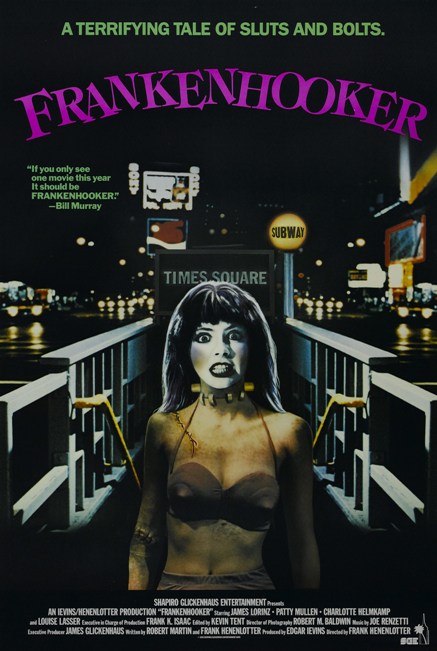
specifically, Horror Fest V will take place at The Cranpire's Apartment on Friday, October 29th, and Liz and Randy's House on Saturday, October 30th. This is the poster:


This year's Horror Fest Includes:

Friday's Films:

Pieces

The House on Sorority Row


Happy Birthday to Me


The Living Dead at the Manchester Morgue


Street Trash

City of the Living Dead


Saturday's Films:

Weasels Rip My Flesh

Curse of the Undead

Point of Terror

Kingdom of the Spiders

Frankenhooker

The House of the Devil

And on Halloween, as a part of Liz and Randy's Halloween Party, the following films will be playing in a special "Horror Fest"room:


The Evil Dead

Night of the Living Dead

Tales from the Crypt

The Exorcist

and our only returning film...

Trick 'r Treat

Festivities will begin Friday night, October 29th, at 7 p.m. Saturday Night at 7 p.m., and Sunday Night at 8:30 p.m..

For details on how to get to The Cranpire's Apartment or Liz and Randy's House, please contact the Cap'n via comments.

Special Announcement: There will be NO Wild Irish Rose, Tequiza, or Bud Light with Clamato on the premises. You're Welcome.

Thursday, October 21, 2010

Blogorium Review: From Beyond the Grave

"Now Cap'n," you say, "are you really going to keep telling me the From Beyond the Grave is a good movie when we all know that it's too tame, too comical, too scattershot, and worst of all, not scary?"

And I will continue to say "Yes, I am."

Do I admit that your description of From Beyond the Grave, the Amicus Production's 1973 horror anthology, is reasonably to very accurate? Sure, I'll cop to that. The film is rated PG, keeps most of its violence off-screen, the "Elemental" story is far goofier than I might have led on, the stories aren't all consistently great, and yes, it's not creepy in the way that Tales from the Crypt is. On the other hand, may I refer you to my review of The House That Dripped Blood from this time last year.

These are all elements inherent to most anthology films: not just anthology films from the era (and specifically, most Amicus productions), but of the subgenre in general. I point you in the direction of Creepshow, The Twilight Zone: The Movie, Trick 'r Treat, Tales from the Darkside, or Dr. Terror's House of Horrors. You'll find that with some consistency, every criticism lobbed at From Beyond the Grave is fair in each case.

What I love about anthology films is that not every story works, that the tone varies from graphic to goofy, and that sometimes the parts don't add up to the whole. And yet, I come back to them over and over again. It's the cinematic equivalent of a short story digest; if you don't like what's in front of you, the next one isn't far away, so just relax.

From Beyond the Grave is a lot like The House That Dripped Blood, save for a less successful consistency in tone, but the cast is game to make the stories that shouldn't work palatable, and the ones that do carry the weight for everything else.

Like that old review, let's do a breakdown of segments, all held together by a frame story featuring Peter Cushing as the Proprietor of Temptations Limited, an antique shop that sells innocuous seeming items with supernatural repercussions.

1. The Gatecrasher - David Warner plays an antique collector who swindles Cushing out of a mirror, only to discover that it hosts a particularly hungry ghost with a grave deal for his new partner in crime.

2. An Act of Kindness - Ian Bannen plays a ho-hum middle manager looking for more excitement in his life, and finds it when he steals a medal from Temptations, Ltd. and befriends Jim Underwood (Donald Pleasance), a street beggar. When he discovers that Underwood's daughter Emily (Angela Pleasance) dabbles in a bit of witchcraft, he gets more than he bargained for.

3. The Elemental - Ian Carmichael is a well-to-do businessman that switches the price tag on one of Cushing's snuffboxes, only to be warned by a clairvoyant Madame Orloff (Margaret Leighton) that he's picked up an "elemental," an invisible creature attracted to the pleasures of the flesh, on his shoulder. He ignores her, only to see the elemental's effects firsthand when it attacks his wife (Nyree Dawn Porter). Can Madame Orloff successfully cast the creature out of their country home?

4. The Door - Ian Ogilvy buys an ominous looking door from Temptations, Ltd., only to discover that when he shuts and reopens it, his storage cabinet becomes an entrance to a massive blue room, one that may house a man who used the occult to draw victims into his "trap."

It's fair to note that the moral of From Beyond the Grave is "don't rip off Temptations, Limited," as the only character who isn't killed as a result of his visit to the shop lives because he paid in full for his door. Every other person who swindles the Proprietor ends up murdered, although not always in ways you might expect.

As a matter of fact, the second story, involving a stolen medal as a pretense for befriending an old soldier, doesn't head in the direction one would expect at all. Typically, in anthologies, the ironic twist is the plot du jour, and while "An Act of Kindness" does have a twist ending, it's not at all one you're going to see coming, even if you are paying attention.

The ending of "The Elemental" only falters because its grim tone follows the exaggerated Madame Orloff "casting out" sequence, which cannot be taken as anything but laughable. Had it been played like - and this is jumping forward quite a bit - a similar scene in Drag Me to Hell, there's a chance that the "twist" (which you can see coming a mile away) might be easier to accept.

Of the stories, "Gatecrashers" works the most, and benefits from the film's rather tame PG rating. Forced to keep most of the killings off-screen, director Kevin Connor settles on a slightly hallucinatory tone as David Warner sets about killing girls to "feed" the mirror spirit. That we don't see the first kill at all, and are only hinted to what actually happened later makes up for the unbelievable behavior on Warner's part in the middle of the story (would he really not change clothes, or wash the blood off of his hands?). The ending is suitably eerie, even if it's not hard to suss out where the story is heading.

From Beyond the Grave really suffers from the frame story, which never has the impact you hope it will. In part it's because "An Act of Kindness" and "The Elemental" really have nothing to do with what their respective protagonists take from Temptations, Ltd. The other factor (and it's a big one), is that Peter Cushing's kindly looking Proprietor has no sense of menace, of mischief, or really any presence at all until the film's coda, involving a thief that was casing the store all day. Cushing's make-up leaves him appearing older than he did four years later in Star Wars, and there's no real surprise to the "supernatural" - and undercooked - revelation about Temptations, Ltd. at the end of the film. By the time he addresses the audience directly (which isn't really new for Amicus), we're miles ahead of the "twist," so all that's left is the title card to end the film.

So, like most anthologies, From Beyond the Grave has the not-so-good, the pretty-good, and the entertaining-in-doses components. Sometimes it's a little silly, yes. It lacks a persistent tone of dread, unlike Tales from the Crypt or even The House That Dripped Blood, and it's not going to knock any gorehound's socks off. But taken on its own merits, I'd say From Beyond the Grave is as watchable as any anthology I've seen, and better than quite a few in the last twenty years or so.

Tuesday, October 19, 2010

From the Vaults: Frankenstein


editor's note: continuing with the past two weeks, here is another critical essay from Hollywood Horror and Beyond.


Film Report:

James Whale’s Frankenstein

Mary Shelley’s novel Frankenstein, it could be argued, has little in common with James Whale’s Frankenstein (and, indeed, this is James Whale, not Universal’s, picture). Granted, the core of the story remains the same: Frankenstein defies the laws of man and creates a “monster” designed from cadavers and given life through electricity, but the similarities end shortly thereafter. Shelley’s is a tale of science gone awry; Whale’s a veiled commentary on persecution.

James Whale was perhaps most famous for being a homosexual at a time when it was not considered wise to be open in such matters, and his films are infused with a perspective unlike that of many horror directors, and in time would come to be identified as “camp”. With subsequent pictures The Old Dark House and Bride of Frankenstein, Whale’s wicked sense of humor grew more refined, but Frankenstein is nevertheless infused with his unique outlook on the world.

After a prologue William Castle would be proud of, Frankenstein begins proper with two title cards. Whether the art on these cards was the conception of Whale or of Carl Lammele Jr., we are unsure, but they speak some volume of what is to come. The first such image, superimposed by the film’s title, is of an ominous half-face peering above a wall, eyes casting beams below, and hideous claws outstretched. Clearly, this is meant to set about unease in the 1931 audience’s mind, but the second image is less clear. As the cast, crew, and director are identified, a series of disembodied eyeballs rotate on the screen like some hypnotist’s wheel, and in the center, a bodiless head which resembles nothing so much as Nosferatu himself, with its bald head and elongated ears and chin. This image has nothing to do with the film to come, does it?

From the outset, Whale begins toying with his audience. The camera begins on a coffin, panning up and around to a series of grieving and pious villagers, and as it moves past them, to a statue depicting Death as the Grim Reaper. Then, behind an iron fence, the hideous face of Fritz (Dwight Frye), who cannot contain his enthusiasm and must be reined in by Henry Frankenstein (Colin Clive), who is only just visible behind Fritz. After the funeral ends and everyone leaves, Frankenstein and Fritz dig up the body frantically, and one subtle joke passes almost unseen: as Frankenstein hurls dirt with his shovel, he quite literally throws dirt into the face of Death.

As we follow Frankenstein and Fritz along their path of grave and gallows robbing, something seems off. Clearly, this is supposed to be outdoors, but by shooting these sequences in studio, Whale creates an “unnatural” sensation using the artificial as an exaggerated version of reality (he will continue to play on expressionistic influence as we move into Frankenstein’s refuge, with high ceilings and curiously angled stairways and walls).

A major point of contention in Whale’s adaptation is the inclusion of a sequence where Fritz is dispatched to find a suitable brain for Frankenstein’s creation, culminating in his break in of the village university. Immediately preceding this, Dr. Waldman (Edward Van Sloan) lectures his students on the danger of the “abnormal” brain, and explains that the specimen on display there belonged to a brutish, violent man. When Fritz accidentally destroys the “normal” brain specimen, he is forced to take the “abnormal” sample. Some point to this is a prime example of shifting the cause of the monster’s actions later in the film, but perhaps, knowing what we know about the director, there is an alternate reasoning behind the “abnormal” brain.

Running concurrently with this is a side plot involving Henry’s fiancée, Elizabeth (Mae Clark), and her increasing concern over Frankenstein’s “experiments”. She appeals to his friend Victor (John Boles) to contact Dr. Waldman and bring some sense to Henry, who she fears is increasingly becoming distant from her. When Elizabeth, Waldman, and Victor discover Frankenstein’s “secret”, their reaction is shock. Frankenstein has created a man from the cadavers of other men, and intends to bring his creation to life using the power of a heretofore unknown ray.

The monster himself, played with nuance by Boris Karloff, is conceived in a womb of electrical pulses and birthed in a flash of lightning, to the awe of Frankenstein’s spectators, who are unsure what to make of Henry’s obsession, a being he “created with [his] own hands”. Waldman urges Frankenstein to destroy his creation, viewing it to be an aberration of God and Science, a viewpoint which, with some subtle word shifts, could mean something entirely different. (The elder figure disapproves of his protégé’s choices, and urges him to recant.)

As Frankenstein welcomes his creation into the world, Victor and Elizabeth return to Baron Frankenstein’s home, concocting a story to distract the Baron (Fredric Kerr) from the truth about his son. Here, for the first time, Whale’s sense of humor comes out through Baron Frankenstein, who is nothing so much as a cantankerous old man with disdain for authority figures and being duped. He is convinced Elizabeth is disguising Henry’s infidelity under the guise of “scientific experiments”, and that there is “another woman”, who he will root out. In a sly twist, there is, of course, no other woman, but rather another man, whom Elizabeth and Victor are willing to lie about for the sake of Henry.

We are introduced to the monster in a dimly lit room, coming through the doorway backwards, and turning around to maximize the effect of his appearance to the audience (indeed, Whale cuts to his face with three successive close-ups). The monster, however, is little more than an oversized infant, unsure of his ability to walk erect and bent in angles that seem to accentuate the set. But the monster with the “abnormal” brain is not a brute initially; in fact, he seems confused and susceptible to directions like “sit down”, and only becomes physically active in response to the sadistic torture from Fritz, who delights in tormenting him with torches.

Eventually, through conditioning, the monster becomes hostile in defending himself, killing Fritz and attacking Henry before Waldman is able to sedate him. Not coincidentally, the struggle occurs immediately before Elizabeth and Victor arrive, with The Baron in tow. Waldman hides the monster, and Henry is taken back to the village with his fiancée.

If the first act of the film is an expressionistic world of high angles and long shadows, then the second is one of stark contrast, with well lit, formal interiors and natural location shooting of villagers and forests. Henry is seen rehabilitating with Elizabeth, who seems relieved to have the man she loves come back to her, and for his part, Frankenstein is happy to be in the care of a woman. A wedding is arranged hastily by Baron Frankenstein, who frequently references his desire for Henry to have “a son”, blissfully unaware of the “abnormal” son in the laboratory.

Waldman, ever the skeptic of Frankenstein’s experimentation with humans, dies trying to dissect the creature, and the monster, free for the first time, enters the world. We see the monster interact with nature, where his rigid stature begins to loosen, but he remains in stark contrast to the “natural” world, a being of vertical angles primal grunts. He ventures closer to the village, meeting the first (and last) true stranger shortly thereafter.

Universal demanded two key alterations to the film before release (numerous local censors made more drastic changes): one, that the line “I know what if feels like to be God” be removed, at it was considered blasphemous, and two, the shortening of a scene that considerably alters the monster’s storyline. The monster, upon meeting a young girl, is amazed and curious about this strange creature, who casts no judgment upon him. In fact, she wants to play with him, and casts flowers into a nearby lake. The monster also throws his flowers into the water, and squeals in delight as they float. But he runs out of flowers, and not capable of differentiating, throws the girl into the water, accidentally drowning her. He tries to help, but only makes things worse, and panicked, flees. At least, this is what Whale shot. Universal insisted the scenes of the monster throwing her into the water and trying to save her be removed, deeming it too horrific. As a result, prior versions of the film simply have Karloff reaching for the girl, followed by a scream, and then we next see her dead in her father’s arms. The alteration renders the monster more horrific; instead of accidentally killing her, the audience has no idea what he did prior to her death, and the mob revenge is more apropos. Because of the removal of two shots, the monster goes from misunderstood and confused to brutish and violent.

Of course, the third act of the film takes curious directions which support both possible interpretations, for the monster’s actions from this point on alternate wildly from scene to scene. Elizabeth is attacked by the monster while locked inside of her room, perhaps because she stands between Frankenstein and his creation, or is it because the monster has developed a predilection for killing females?

While Elizabeth survives, Henry is convinced he must destroy his creation, and joins the mob growing outside. Armed with torches (which, although they have no notion of this, is the only thing the monster fears) the mob splits up and searches the forest, marshes, and mountain trails. After taking considerable effort to show the audience both the forest and the marshes, Whale once again takes us into the realm of the “unnatural”, returning to his false exteriors for Frankenstein’s final encounter with his doppelganger, his automaton, where both men must meet their fate.

As Henry once again comes face to face with his “experiment”, his ability to scare the monster with fire is met with failure. He is unable to exert control over his creation, and the monster overpowers him, taking an unconscious Frankenstein to a nearby windmill, as the mob closes in.

The final sequence, taking place with the monster and Frankenstein in the windmill and the angry mob outside (using a heretofore unseen battering ram to breach the door - how curiously phallic) culminates with the monster rejecting Frankenstein and throwing him to the mob below. The villagers react by setting the windmill ablaze, taking Frankenstein back to the village to recuperate, and leaving the “deviant” monster to burn in his figurative funeral pyre. Surely this is reminiscent of the practice of burning witches, also considered to be unnatural and deviant, and with little stretch of the imagination could be applied to the persecution of homosexuals.

Whale’s film, which is finally available in its uncut form, uses the Frankenstein story as a springboard to address what is perceived as unnatural by people (the villagers) and frowned on by respectable people (Dr. Waldman), but is, in the end, something a person decides to do, regardless of how much “experimentation” he or she does. The Baron Frankenstein ends the film reiterating his desire for a grandson to the “House of Frankenstein”, and with Elizabeth and Henry together, perhaps all’s well that ends well. Of course, Whale would have the last laugh with Bride of Frankenstein, but that is a different matter altogether. Perhaps the monster is not some murderous brute, but rather a confused young man who has no conception of what he is here for; condemned as “abnormal”, and punished for being only what he was created to be.

Monday, October 18, 2010

Blogorium Review: House by the Cemetery

The House by the Cemetery is an exercise in futility: the film, made by Lucio Fulci (The Psychic, The New York Ripper) should be a gorehound's delight, with it's quasi-Lovecraftian connection (it forms the "Death" Trilogy with The Beyond and City of the Living Dead / Gates of Hell), brutal kills, and atmospheric setting (just north of Boston, Mass). Instead, the film is a disaster; an unnecessarily convoluted narrative that contradicts itself whenever possible, leaving plot points that go nowhere, characters that serve no purpose, and an ending that raises more "what?"s than anything else.

I don't know how much of this to blame on the fact that the DVD is dubbed and offered no alternate language / subtitle options (IMDB indicates it was filmed in Italian) but I doubt that many of the erratic plot jumps could be saved simply by Fulci's native tongue. From the opening sequence, which spatially misrepresents the Freudstein house, to the final scene and its fabricated Henry James quote, not a whole lot of The House by the Cemetery makes a lot of sense.

Following the strange death of his mentor, Dr. Peterson, Norman Boyle (Paolo Marco) moves his wife Lucy (Katherine MacColl) and son Bob (Giovanni Frezza) from New York to the small town of New Whitby, where Peterson murdered his mistress and hung himself. Staying in the "Freudstein" house - redubbed Oak Mansion by the real estate agent (Dagmar Lassander) - with Ann (Ania Perioni), Bob's babysitter, the Boyle's are beset with strange occurrences, mysterious indoor tombs, and a locked cellar that hides a terrible secret. Will Norman discover the secret of Dr. Freudstein before it's too late? Why did Peterson kill himself? Is Lucy really going insane, or is someone else in the house? And who is Bob's new friend Mae (Silvia Collatina), a girl only he can see who warns him of grave dangers?

Honestly, don't expect any of those questions to be answered. Well, not exactly. By the time anyone figures out what's going on at any point in the film, it's too late for them. Across the board, the plot of The House by the Cemetery makes no effort to address any of the many questions it raises, instead compounding on "twist" after another to the point that none of them mean anything at all. Every single character in the film exists to react to something that happens, and no one (including Dr. Freudstein) actually does anything to set events in place.

The criminal mistake that Fulci makes in The House by the Cemetery is to assume that just because the film is "inspired" by H.P. Lovecraft that he (and co-screenwriters Giorgio Mariuzzo and Dardano Sacchetti) frequently set up plot points that disappear mid-movie, or abruptly change characters in order to suit a "kill" scene. Norman is the subject of an entire subplot that goes nowhere: while following up on Dr. Peterson's research, more than one character mentions that Boyle has been to New Whitby before, has a daughter (not a son), and seem very surprised when he refutes their claims. Even Lucy asks him why it is he has a picture of the Freudstein house (which he makes dubious excuses about).

Ann, the babysitter, also seems to be involved in some conspiratorial pact with Norman, considering the frequency of close-up of Normans eyes, Ann's eyes, and sometimes Lucy, who has no idea what's going on. Ann, after all, goes out of her way to remove the board covering the cellar door, cleans up the blood after Freudstein kills the real estate agent, and seems to have a particular interest in Bob. That is, until she goes down into the cellar and is killed by Freudstein (decapitated, as per a vision Mae has with mannequins). Ann seems so surprised that Freudstein is down in the cellar that it totally undermines the suspicious behavior earlier.

Of course, almost everything is undone. To spoil a great deal for you (if such a thing is possible in a film that goes out of its way not to make sense), Norman doesn't have any connection to the Freudstein house that's ever mentioned, the couple in the beginning aren't Peterson and his mistress, and Mary Freudstein might be Dr. Freudstein and the monster we assumed was Dr. Freudstein is her son Jacob (at least, that is, if the ghost Mary and ghost Mae that take Bob away have anything to do with the quote Fulci made up and attributed to Henry James have anything to do with the story). We also never learn why the Boyles didn't leave the house after the "bat" incident (more on that below), even though they clearly stated they weren't staying.

The cheap and easy solution the trio of screenwriters thought they could get away with was a Lovecraft-esque series of revelations by Peterson that hinted at an increasing madness, leading him to suicide. Unfortunately, within the frame of a slasher narrative - with giallo-inspired murder set-pieces - creeping madness and dread become irrelevant. The two subgenres unfortunately fail to intersect: one demands a protagonist that encounters evil and goes insane, the other requires all characters but one to be killed and for the hero to kill the monster. The House by the Cemetery manages to do neither, instead settling more a muddled "ghost story" ending that just barely closes things out.

Does The House by the Cemetery have anything going for it? Well, as this is a Lucio Fulci film, the blood flows freely and the gore is at least worth some of your time*. While there's nothing as inventive or disturbing as Zombi 2, The New York Ripper, or Cat in the Brain, the Freudstein makeup is pretty cool, if entirely spoiled by the DVD cover. The kills alternate between simple giallo-esque stabbings (the real estate agent, the girl at the beginning) to full on exposed brains and heads decapitated slowly with a kitchen knife.

In particular, there's a sequence where the Boyle family goes into the basement for the first time and are attacked by a bat that starts unintentionally funny and grows increasingly violent, especially when Norman stabs the bat and it begins bleeding profusely, but doesn't die. Also of note: Mae's hallucination (vision?) of a mannequin that looks like Ann losing its head - complete with very real looking tendons and blood - adds a nightmarish quality early in the film. Alas, it promises more than The House by the Cemetery can deliver, so enjoy it while you can. The movie itself isn't really worth the time it takes to watch, especially when Fulci has so many better films to offer.


* How much of your time? Certainly not the 87 minutes it takes to watch the film, but I'm sure there's some "gore" compilation from the film on YouTube that'll save you wondering what you missed.