Tuesday, February 18, 2014
It's almost time for Nevermore!
Greetings, readers! It's been a little while, hasn't it? After a month straight of recapping 2013 and then a few reviews to follow that, the Cap'n took a little break to recharge the batteries and to focus on my other, regular job (it's nothing exciting and doesn't have anything to do with the Blogorium, which is why I don't mention it much). And then the Snowpocalypses happened and friends had kids and before you know it, I'm looking at two weeks of nothing new. But hopefully you had plenty to read in the meantime, and maybe now we've all had time to let news like Philip Seymour Hoffman's death to settle. It still sucks (it really sucks), but it is what it is.
I'd like to have some more reviews up for you soon, and I'll try to, but the past two weeks haven't been much more movie watching. The Cap'n did see The Bling Ring, and while I wrestled with whether I had anything to say about it, I'm landing on the side of "it didn't do much for me." I'm not convinced that Sofia Coppola really had any point to make about celebrity obsessed culture or that the movie accomplished much of anything at all. A gaggle of teenage miscreants break into the homes of people they idolize on superficial levels, steal their things, and attain a level of quasi-celebrity (the girl Emma Watson is based on had her own show on E!) and end up in jail. Well, some of them. And they betray each other because they're just as superficial... and that's the point. There's no insightful commentary or anything that really makes The Bling Ring stand out from the TV movie version that already existed, unless you count the fact that Coppola had access to Paris Hilton's house and also asked some of her friends to appear on camera, sometimes merely for seconds (seriously, how long is Kirsten Dunst on screen?). Maybe I'm missing something, but I sure didn't feel like I was while watching The Bling Ring.
Grand Piano, on the other hand, is much better, but I don't want to review that yet because I'm going to watch it again this weekend and will be covering it for the annual Nevermore Film Festival roundup. This will be my third year attending the festival of things dark and macabre in Durham, and it looks to be a fun one. Their "retro" feature is William Castle's The Tingler with Vincent Price (actual title, don't bother fact checking me on that one) with Castle's original "Tingler" gimmick. If you don't know what that is, either look it up or show up to The Carolina Theatre in Durham on Saturday night to find out. It's going to be a fun time and will make it the first time I've seen The Tingler as it was meant to be experienced.
I'll also be checking out Big Bad Wolves, Here Comes the Devil, The Shower, Open Grave (if I can fit in a showing), Last Days, Proxy, and the short film collections. In particular I enjoy the shorts because it takes me the rest of the year to find them online, and even then sometimes you just can't, meaning that Nevermore is the only time you'll see them. Some of my favorite bite-sized horror comes from the collections, and there's always a surprise or two that really works with an audience. On the features front, I'm looking forward to Here Comes the Devil and if I can squeeze it in, I'd really like to see The Returned, but right now it's not looking likely if I want to catch all four shorts compilations. Haunt is the same way, but with work as it is I can't make it there until Friday night, meaning that some of it's going to have to get left out. I'll see if I can get some of the other attendees to file reports on movies the Cap'n couldn't see.
If you live within driving distance of Durham, you really should go to Nevermore this weekend - the atmosphere is great, they have three screens running all day with all sorts of different varieties of horror, science fiction, thrillers, and just bizarre stuff. Tickets are pretty reasonable, and there's always something to walk around and see in between - vintage posters, movies for sale, memorabilia. The audiences are always great, which is a major plus when seeing something new or being able to watch a classic like Dawn of the Dead in a completely different way. John Dies at the End also played very well with a large audience, something that most people didn't get to see as a result of its limited release. The Tingler is going to be a lot of fun with a crowd, and for five bucks you really should make the trip out to see it. And at this point I sound like I'm shilling for the fest so I'll stop. The point is that I got my passes yesterday and the Cap'n is rather excited. It's the one fest I don't run myself that I try to make it to every year.
On the other side of that, there are a bunch of things I'd like to try doing beyond just reviewing movies, but I hate to set something up and then not get to it, so for now I'll leave it mysterious. I will say I've given some thought to revisiting movies that I reviewed a long time ago, both that I did and didn't like, if only because their original reviews are a) terrible, b) too short, c) both, or d) don't give a reader any real impression of the movie. I've gone back and read a few from years ago (particularly ones written in the middle of a Fest) that are too cursory and don't really seem fair to ask you to take at face value. So I might try to rectify that. The way I review films has changed a lot in the last ten years, and the Blogorium is more or less an archive of how that style evolved, but it means that old reviews really don't stand up, and there are a lot of movies in there I think deserve better consideration. Stay tuned on that one.
I'll see you cats and kittens this weekend for Nevermore!


Tuesday, February 4, 2014
Quick Review: Good Ol' Freda
At this point, you'd think there would be nothing about The Beatles that fans wouldn't know. Between the biographies, anthologies (musical and televised), fictionalized accounts (Backbeat), and the vast swath of websites devoted to the "Fab Four," all the ground has to have been covered, right? The Cap'n used to pore through books at the local library, soaking up details about the earliest days of the band, the transitional periods, the acrimonious break up, and solo careers, and while I don't pretend to know it all, I've certainly heard a lot of it over the years (and we're talking pre-internet for a lot of that). That considered, it's refreshing when a documentary like Good Ol' Freda pops up in the instant queue - it's a different side of the story of The Beatles, from someone who hasn't spoken about it in more than forty years.
To put some context at the opening, Good Ol' Freda begins with The Beatles' 1963 Christmas recording, where John, Paul, George, and Ringo give greetings to all of their fans. As they're moving through their "hello's" and Christmas wishes, George mentions their secretary, Freda Kelly, and the boys pipe in with "good ol' Freda!" - voila, we have our title. Kelly was Brian Epstein's secretary and the head of the Beatles fan club from before they were famous until the very end, and Ryan White and Jessica Lawson spend the lion's share of the film letting Freda tell her story of Beatlemania from the inside.
At 17, Freda Kelly was a typist in a secretarial pool, until one day her friends took her to the Cavern Club in Liverpool. She enjoyed the club so much she went back just about every day, and in 1962, that meant seeing quite a bit of The Beatles (John, Paul, George, and Pete Best at the time). The atmosphere was intimate enough that fans in the audience could request songs, although it was best not to send notes to John (Freda learned quickly that without his glasses, he couldn't read a thing onstage). Eventually, she started hanging out backstage with the bands and almost by accident became the fan club president of a band nobody knew - yet. In short order, that would change, and so too would her life...

Much of the well covered territory in Beatles lore is left out - conquering America, the psychedelic phase, the tension towards the end - because Freda didn't travel with the band much. In fact, when Epstein moves the base of operations from Liverpool to London, Kelly doesn't join them after her father objects. He never approved of The Beatles, and his health is such that she can't in good conscience leave, so rather than lose the heart and soul of the organization, Epstein gives her his old office and Kelly continues to run the fan club from Liverpool. Quite a step up from accidentally using her home address for the fan club in the early days. She's free to hire (and fire) helpers to maintain a massive operation (including the assistance of other Liverpool bands like the Merseybeats to help deliver mail every now and then), and does her level best not to disappoint the fans. After all, she's a fan, too.
Kelly is a fascinating figure in her own right, and scattered throughout Good Ol' Freda are brief interviews with her daughter that give us some idea why we've never heard this particular story before. There are other contemporaneous interviews, particularly with Tony Barrow (former Beatles press officer), mentioning that while most people related to the band decided to "cash in" at some point, Freda has been curiously silent about her life at the center of Beatlemania, a life she walked away from after the birth of her second child. Her decision to put that part of her life aside - in some instances, to literally pack it up in the attic, where we see hear going through some of the impressive memorabilia she didn't give away - was a personal one, and the reason for telling it now is one I'll let you discover in the documentary. One gets the impression that Kelly is happy to have told it now, so she doesn't have to again.
She's a great storyteller, and White and Lawson bridge her interviews with plenty of rare footage and photography, along with something that must be hard to get making a documentary on the outside of the band: Beatles songs. While Paul isn't in the film (and Ringo pops up at the very end), I suspect their longstanding affinity for Freda Kelly helped in approving the rights to use the band's songs in the film, which is rare outside of Apple produced films. It's necessary and would be strange for Good Ol' Freda not to have, but I sense that the surviving members still think fondly of "good ol' Freda" and are happy to see her tell her story. I think most Beatles fans will be happy to hear it too; it's rare to hear a perspective on the band you haven't heard, and even if you're caught up with archival interviews with her, seeing Freda Kelly tell the stories is something fab indeed. While I haven't seen it yet, I imagine Good Ol' Freda would make a good double feature companion with 20 Feet from Stardom, so maybe I'll check that out next...
Saturday, February 1, 2014
Blogorium Review: You're Next
Festival screenings are a funny thing: movies can really build or destroy their reputation based on playing at a festival, and sometimes it happens for reasons beyond the creators' control. For example, while I really do like Don Coscarelli's John Dies at the End and I think it does the best possible job it can adapting the book with the budget he had and the time constraints (and there's a lot that didn't make the adaptation), I think it benefited immensely from playing after Dawn of the Dead with audiences at the Nevermore Film Festival last year. I was there, and most of the people who came for Dawn of the Dead (and it was packed) stuck around for John Dies at the End, which played shortly thereafter, and they were already pumped having just seen what is arguably the best of Romero's "Dead" films (it's not my favorite, but I won't argue it's the best constructed). As a result, what is already a very good movie went through the roof because people were excited in the first place.
I didn't see You're Next in 2011, because I wasn't in Toronto, Austin, San Francisco, Sydney, Los Angeles, or any of the other cities it played it. But apparently audiences went gaga for it. I probably read about it and then, as time went on, forgot about You're Next. Like The Cabin in the Woods, there was a sizable gap between the completed product and release. In the case of You're Next, it finally came out last August, and just recently came out on DVD and Blu-Ray, which is how I saw it. And you know what? It is pretty damn good.
Crispian (AJ Bowen) is going to visit his parents - Paul (Rob Moran) and Aubrey (Barbara Crampton) - at their fixer-upper house in the woods for a family reunion. He's bringing along Erin (Sharni Vinson), his girlfriend, to meet his siblings: Felix (Nicholas Tucci), Drake (Joe Swanberg), and Aimee (Amy Seimetz), as well as their respective SO's Zee (Wendy Glenn), Kelly (Sarah Myers), and Tariq (Ti West). What none of them know is that three killers just murdered Paul and Aubrey's only neighbors (Larry Fessenden and Kate Lyn Sheil) and are preparing for a little family reunion home invasion. Then again, what the killers don't know is that Erin may be more than they can handle, much to the surprise of everyone else...

(Also seeing Barbara Crampton (Re-Animator, From Beyond) again is a bonus, who came out of semi-retirement to be in the film, although I honestly didn't recognize her until I saw her name in the credits)
Coming in, I'd seen the quotes that You're Next was "ground breaking" and that it would change the rules of horror movies, which to be honest is the kind of festival-related hyperbole that increases expectations for a movie beyond where they need to be. You're Next is a really good horror movie, and probably the best domestic "home invasion" entry I've seen in the last decade (at least), but it doesn't reinvent the wheel, gang. It's okay for a movie to just do its job very well. Director Adam Wingard (V/H/S 2) and writer Simon Barrett (The ABCs of Death) made the kind of straight ahead horror movie that audiences will eat up: great kills, some clever laughs, fun characters, and actual suspense. The Final Girl has a novel back story that explains why she knows so much about fighting back (she grew up on a survivalist camp in the Outback), and the "twist" may not be novel (it's taken from the playbook of 60% of all thrillers) but it plays out well. You're Next doesn't need to be described as game changing, because it plays the existing game and does a damn fine job of it.
You're Next also (apparently) falls into a category I'd never heard of before: "mumblegore." To be honest, I wasn't aware such a distinction was necessary, but the internet does love to create hybrid subgenres, and it was only a matter of time before "mumblecore" horror films had their own category. Other than Baghead, I'm not really certain what else qualifies as "mumblegore," because You're Next is most certainly too well scripted and too tightly directed to be considered a largely improvised, boring piece of shit. Oh, I'm sorry. I'm letting my bias slip through, but I really don't like mumblecore movies. Unless the way they've been made has changed drastically since I endured Funny Ha Ha, You're Next has one scene that even resembles "mumblecore" - the dinner table conversation right before the first attack.
In the extras on the disc, Wingard and Barrett mention that they wanted each conversation to be distinct from each other and that there were many, many takes to get it just where Wingard wanted it to build to, but even in that I sense a greater sense of control than "just let them act and we'll shoot it." There's still a sense of control in the editing that I don't associate with movies by the Duplass brothers or other directors of that ilk. To be honest with you, I haven't seen A Horrible Way to Die or Pop Skull (Wingard's other horror movies), so maybe that's why You're Next gets lumped in, but I don't agree with that any more than the ridiculous notion that Ti West also falls into that category.
Maybe that happened because West (The House of the Devil), Swanberg (Drinking Buddies), and Barrett are in You're Next, and (SPOILER) have some of the most memorable death scenes. Wingard does mention in the cast commentary that he wrote many of the parts for his friends (including Seimetz, who could only film in fits and spurts because she was in Upstream Color), which I suppose is something that gets lumped into the "mumblecore" playbook, but You're Next doesn't feel improvised. Once the movie really gets rolling, it's clear that Wingard and Barrett have a plan for every scene and how things are going to play out, which is the antithesis of "mumblecore." So is "mumblegore" a real thing? I don't know, but I'm going to go ahead and declare that if it is, You're Next shouldn't be part of that subgenre. It's a straight-ahead home invasion movie with some slasher influences, and what it does, it does very well.
You're Next is the kind of movie I would have liked to have seen with a crowd. I'm strongly considering breaking the rule of what plays at Summer Fest so I don't have to wait until Horror Fest in October to show everybody the movie. I would have loved to have seen it at Nevermore, because it plays right into what the crowds there love, but that was not to be. The good news is that You're Next is finally out there, and while it doesn't rewrite horror (and I don't think it was even trying to), it's a hell of a fun movie to watch. Check it out.
Wednesday, January 29, 2014
Cap'n Howdy's Best of 2013: her
This is it. I spent a long time going back and forth between The Wolf of Wall Street and her, between Martin Scorsese and Spike Jonze, and for a while there even Inside Llewyn Davis was in the mix, but when it comes down to it, my this was my favorite movie of 2013. It's as heartfelt, as thoughtful, as expertly crafted as movies come, and if we have to wait as long as we do for Spike Jonze movies (4 in 14 years!), then I'm okay with that. her is enough to chew on for a while, and I'm really looking forward to the conversations that are going to come out of it with my friends.
For example, one of my very good friends is a Philip K. Dick scholar, and he's been looking forward to this movie for a while now. The implications of someone creating and maintaining a relationship with an artificial intelligence is right up his field of philosophical inquiry, and it's going to be an interesting discussion the next time we sit down after he sees her. (For those curious, the last time we talked about a movie was a lengthy debate over the meaning of Upstream Color, much of which influenced my review, but also drove the rest of the room crazy because they hadn't seen it). But I'm getting away from the point, which is the movie. Let's get back to her (and that's how it appears on screen, so I'm going to defy my spell check and keep it lower case).

And if you only know what you've seen from the trailer, there's a reasonable chance you might assumed it's going to be a comedy or some sort of dystopian horror story about an obsessive computer who loves a real person (think about that Treehouse of Horror where Pierce Brosnan's AI house falls in love with Marge), but that doesn't give Spike Jonze the credit he deserves. On paper, Spike Jonze movies sound like dumb gimmicks (you can crawl into John Malkovich's head! a writer and his identical twin brother struggle to adapt a book about orchids!) but he takes them seriously and brings a level of depth you might not expect, particularly from a Hollywood system that likes the easy option. This is the first time Jonze wrote the screenplay himself, and there's something intensely personal about it, something touching about the sentiment behind the synopsis.
One of the first things you realize while watching her is that this is a near-future science fiction film, but not one that feels improbable. Everything is an extension of where we already are - the phones are a little smaller and have one earbud and can read you your email and respond to voice commands. Theodore works for a company called Beautiful Handwritten Letters .com, where employees are hired to craft personalized communication from one person to another, often for years at a time. Even his video game, which is projected into the room, doesn't feel too far off from some X-Box prototypes. Jonze sets the film in Los Angeles but shot parts of it in Shanghai to give the architecture a slightly more futuristic feel. It never feels like "this is the future!" but it's clear that her is a few years off, yet never unrelatable.
I don't know why I was worried, but having just seen Scarlett Johansson in Don Jon, I started to worry that her might be headed in a similar direction, plot-wise, early into Samantha's relationship with Theodore. "She" talks him into going on a blind date (Olivia Wilde) and things seem to be going well but Theodore gets weird after dinner and things collapse. Theodore has been friends with Amy (Amy Adams) for a long time, and it's pretty clear that things aren't working out so well between Amy and Charles (Matt Letscher), and for half a second I was worried that this might be headed into more conventional territory, but Jonze avoids the easy "out." Amy and Theodore tried dating a long time ago, he explains to Samantha, but they could tell it just didn't work out. They have a much more platonic relationship, one as very good friends who feel comfortable talking to each other about things like dating an OS (which turns out not to be so uncommon in this world), but there's not a sense of a developing love triangle.
There are opportunities for her to be broader and sillier, like the scene where Samantha brings over a surrogate (Portia Doubleday) because she can't be physically present with Theodore. Isabella, the surrogate, has been following their relationship from a distance and wants to be a part of it, but it's just too much for Theodore, and the result is painfully awkward and funny in a sad way. Isabella is genuinely devastated that he rejects her, and like the earlier "sex" scene between Samantha and Theodore, there's a level of intimacy that overcomes any inherent silliness of the premise. her could easily be a much dumber movie, and it's a testament to the care of Jonze and of the performances of Phoenix, Johansson (who replaced the on-set voice of Samantha Morton), and even Adams. They're all pitch perfect. Speaking of which, I won't say who else is in the movie, but pay attention to some of the other voices your hear (early in the film when Theodore is on the phone and then later in the cabin).
Where it gets interesting in the latter part of the film involves the heavier science fiction and philosophical underpinnings of a relationship between artificial intelligence and a human. Samantha and Theodore are both capable of doing things the other can't, and as they begin to grow, unusual complications develop, several that I hadn't anticipated. It should have been obvious, in a way, considering how Jonze sets up society (mostly through showing, but never telling): Amy works for a game company that has a "mom" simulator as it's newest product, and it's established early on that an OS can communicate with other OS's, so the disconnect on both sides is apparent pretty quickly.
Without spoiling too much, there are ups and downs, not limited to Catherine's reaction to Theodore's relationship, Samantha's increased capacity for knowledge, and a certain inevitability to growing apart. It's handled in such a down to earth, sincere way that nothing ever feels contrived or less than organic (odd, considering the very premise is in its nature partly inorganic), and the ending of the film is sweetly downbeat. Or sadly uplifting. Hard to say. What do they use on the Internet these days? It hits you in all the "feels." Yeah, that's the ticket. I know a few people who didn't connect with Theodore and Amy and Samantha, so there's a possibility that her won't click with you, but it sure did with me. It sticks around with you and makes you think about the film and the implications of the story and a whole host of other scintillating concepts that are hinted at but never spelled out. It's funny, and sometimes sad, but genuine. And that, when it comes down to it, is what makes a great movie. I think 2014 is going to have a difficult time topping that.
Cap'n Howdy's Best of 2013: The Wolf of Wall Street
The Wolf of Wall Street is a study in excess, told in a masterful fashion, and a damn funny one at that, which continues to be misinterpreted, and that's a shame. I started my "Best of 2013" with American Hustle, a movie that I thoroughly enjoyed while I was watching it as both a movie about con artists but also as David O. Russell's homage to Casino and Goodfellas. And then I saw The Wolf of Wall Street, and remembered what a Martin Scorsese movie looks like when Martin Scorsese is directing, and not somebody doing a very good imitation.
The difference is night and day: American Hustle strains under the weight of trying to be like the master, where Scorsese makes it seem effortless. There are dozens of examples I could use, but let's take one from the very beginning of the film, where Jordan Belfort (Leonard DiCaprio)'s Lamborghini is tearing through traffic, and has Belfort is telling us about how rich he is, he quickly points out that the car was white and not red, and as it switches lanes, bam!, color change. Scorsese transitions the color on motion, timed perfectly with the narration, and continues as though nothing happened.
For those who aren't caught up on the story (or surrounding controversy that's going to rule the film out of any serious Oscar contention), The Wolf of Wall Street is based on the true story of Jordan Belfort, a stock broker turned penny stock dealer who scammed people out of their hard earned wages and lived a life of excess, beyond even the standards you'd think. He flaunted his illegality, fought the FBI and lost, and then turned on all of his friends to avoid serious jail time. Now he does motivational speaking engagements, and also wrote the book this film is based on. The real Jordan Belfort has a cameo in the film, introducing DiCaprio as Belfort near the end.

While this is undoubtedly Leonardo DiCaprio's show, the film is packed with well known actors in smaller roles that make a big impression. Continuing his streak of great appearances since 2012, Matthew McConaughey sweeps in at the beginning of the film, makes a big splash in a few scenes as Mark Hanna, the broker who hires Belfort and turns him from an idealist into a shark, and then disappears. There's a good reason his scene with DiCaprio in a restaurant has been compared to Alec Baldwin's scene in Glengarry Glenn Ross, because he makes that kind of impression and sets the stage for the film to come. Spike Jonze (her) has a similarly tiny role as Dwayne, the man who introduces Jordan to penny stocks, and Jon Favreau appears as Belfort's legal counsel. Rob Reiner is very funny as Jordan's father and has a few great scenes with Jonah Hill. Jon Bernthal, once of The Walking Dead, makes a good impression as one of Jordan's dealers, and Shea Whigham has a small but hilarious part as Belfort's boat captain.
Jean Dujardin (The Artist) is a Swiss banker who agrees to hide Jordan's money in a scene where they communicate without speaking to one another. Absolutely Fabulous' Joanna Lumley is the aunt of Jordan's wife, Naomi (Margot Robbie), and private investigator Bo Dietl appears as himself, offering Jordan advice with FBI Agent Patrick Denham (Kyle Chandler). And that's just scratching the surface - there's a cameo from Fran Liebowitz, who Scorsese recently made a documentary about, and I'm sure I missed a few others along the way. Almost everybody is playing broad, but the ostentatious style of the source material merits it - this is a life where people have so much money they don't know how to spend it.
I suppose you could say that, ironically, The Wolf of Wall Street is excessive in every way except its length, which might sound surprising considering that it's a few seconds shy of three hours. It never feels like three hours, although you're probably going to be a little overwhelmed by the rampant profanity, drug use, and gratuitous nudity, even considering who directed the film. From naked marching bands to the differences in prostitute quality to a scene involving Quaaludes that rivals the best physical comedy you can think of, The Wolf of Wall Street pushes Belfort's indulgences well beyond what a normal person would consider "reasonable" or even "excessive." When a movie opens with tossing a "little person" and a conversation where he's referred to as "it," you know for certain: Hugo this ain't.
It's a glimpse into a world you'll never live in, and while it was cool to visit, I wouldn't want to stay there, and that certainly seems to be the point. And that's why I reject the consistent argument that The Wolf of Wall Street glorifies Jordan Belfort's behavior or makes it out to be something that up and coming brokers would want to emulate. Only an idiot looking to ruin their life very quickly would try to do anything that happens in this film. I don't suspect anybody is going to emulate Belfort's idiotic attempt to bribe Agent Denham, get called out on it, and then decide to kick the Feds off of his yacht, and if they do, they're not going to get sweetheart deals like he did.
Don't misunderstand me: I'm not excusing what the actual Jordan Belfort did, but The Wolf of Wall Street doesn't glorify him in any way. Scorsese lets you see the world of the super rich, of the scum that floats to the top and lives a lifestyle that might be cool for a day or two (nice boats, lots of money and drugs, lots of sex and acting life a buffoon) but sticks around long enough to show you that you really wouldn't want to keep going. Even the Quaaludes scene, which proves beyond the shadow of a doubt that Leonardo DiCaprio can handle physical comedy in a way nobody ever considered, has a sobering dark side when Scorsese cuts away to Belfort's young daughter watching her father. This is not a lifestyle that's admirable or worth emulating - it's fun to watch, and make no mistake that The Wolf of Wall Street is first and foremost a comedy, but it's unsustainable, even in the narrative of the picture.
I'm also a little confused about the reaction to this because people are behaving as though this isn't something Martin Scorsese does regularly. Many of his most well renowned pictures are centered around seriously flawed protagonists, and most of the very best ones are based on real people who were still alive when he made them. Henry Hill no doubt benefited from Goodfellas, and Jake LaMotta didn't exactly hurt from Raging Bull. "Ace" Rothstein was based on Frank Rosenthal, who was still alive when Casino was released. Were they any more "glorified" than Jordan Belfort in their respective films? Or are they also presented as characters with serious issues, people who we relate to but wouldn't want to be in any more than a "wish fulfillment" capacity? I don't want to be Jordan Belfort any more than I would want to be Henry Hill, but I enjoyed seeing their stories told by a great filmmaker. If I want to object to the glorification of horrible people, I would again point you in the direction of Pain & Gain, a movie that simultaneously laughs at and glorifies (by casting Mark Wahlberg, Anthony Mackie, and Dwayne Johnson) kidnappers and murderers.
In the end, it all boils down to whether The Wolf of Wall Street is a movie worth watching, and it's an easy "yes." It's funny, fast paced, excessive (does Jonah Hill play Donnie Azoff too broadly? I don't know, maybe?) but it never feels long. There's a playfulness in Scorsese's direction that keeps things moving, and DiCaprio hasn't been this good in a long time. I didn't see The Great Gatsby but I'll go out on a limb and say that this is the better "rich asshole" picture of 2013. Even with Shutter Island in consideration, The Wolf of Wall Street is far and away their best collaboration, and I think that once the controversy dies down people might be more comfortable with the film as a part of the larger body of Scorsese's work. There's something to be said for a great American filmmaker working at the top of his game, making movies well into his 70s that are as good as anything out there. No offense to David O. Russell, because I did like American Hustle a lot when I saw it - it's just that you picked the wrong year to tug on Superman's cape.
Tuesday, January 28, 2014
Cap'n Howdy's Best of 2013: Before Midnight
When Richard Linklater is on, I can sit in front of the screen with a big old dumb smile on my face. The Cap'n has had a somewhat scattered relationship with the Austin, Texas auteur's filmography: there are movies of his I absolutely go nuts for (A Scanner Darkly), and ones I grow to appreciate with every passing year (Dazed and Confused), but there are also the ones that I just cannot stand (Slacker, Waking Life), ponderous exercises on philosophy that you'd hear in a haze of bong smoke in freshman dormitories (not that I'd know anything about that, obviously). When I say "cannot stand," I mean that I've tried to watch Waking Life and Slacker again and I usually turn them off, because the only thing I think following one interminable monologue after another is "so what?" It's somebody's cup of tea, but not mine.
There are also the movies he makes where I can't quite wrap my head around the fact that Richard Linklater made that, like The Newton Boys, School of Rock, Fast Food Nation, or Bad News Bears. I guess it's kind of a "one for them, one for me" situation that I often equate with Steven Soderbergh, but reconciling that the guy who made Tape or who spend twelve years making a movie (Boyhood, coming out later in 2014) also made a movie about kids rocking out with Jack Black boggles the mind sometimes.

Before Midnight, set (and made) nine years after Sunset and eighteen years after Sunrise, doesn't wait long to answer that question, or to present the ramifications of Jesse's decision. He's dropping his son Hank (Seamus Davey-Fitzpatrick) off at the airport in Greece. After a summer vacation, it's time for Hank to go back home to his mother, Jesse's ex-wife, in Chicago, while Jesse, Celine, and their twin girls Ella and Nina (Jennifer and Charlotte Prior) enjoy a few more days in Messinia. They've been staying at the home of Patrick (Walter Lassally), a writer and friend of Jesse's, and some of his friends, for good conversation, but lingering and unresolved issues about Hank, Celine's career, and the vacation itself bubble up as the day wears on.
What's so fascinating about revisiting these characters after nearly twenty years is the sense of immediate familiarity with them, of knowing their history and being able to jump right back into their lives without needing to be reintroduced. I'm not sure how Before Midnight would play for someone who hadn't seen Before Sunrise and Before Sunset, but I have to imagine much of the appeal to the film is being able to come back to their relationship further along in time. And Linklater, Delpy, and Hawke make a very interesting decision with the third film: instead of taking a snapshot of the two of them connecting or reconnecting, Before Midnight is about the reality of them staying together and being in a long term relationship. We aren't seeing them together for the first time or navigating crossing paths again, but instead seeing them living their lives together after nine years. It's a different experience, but wholly rewarding.
The film is broken into what amounts to six scenes, six conversations, each building towards the last thirty minutes, where resentment and unspoken demands boil over in a hotel room. We see the foundation of the argument building in the car ride from the airport, at Patrick's house, during the walk to the hotel, and in the lobby, and the way that Jesse and Celine use their history against one another. It's a slow build, where slights go ignored first, but are later held for use to really hurt someone's feelings, to dispute the idea that someone is "winning" this fight. It never feels artificial, never scripted: their conversation flows like two people talking, picking up on half finished thoughts and running with them throughout the film, holding on to them for later.
And in the background, we as an audience can feel their history, can relate to it, because we've been there with them, even if it wasn't the entire time. Jesse and Celine lived on in our imaginations, so when we pick up with them in their 40s, we bring along everything we hope they did or saw since the last time we saw them. It's a unique opportunity for Linklater to explore a relationship onscreen over time, where the audience fills in the ellipses. It wouldn't work if Before Midnight didn't have something compelling to add, and it does, but it's nevertheless impressive that a fictional relationship continues to have such resonance.
Hawke and Delpy slip back into the roles effortlessly. Yes, they're both older, and life has changed in many ways since Paris of 2004, but who they are is still there. Things are just more complicated, and they've had nearly a decade of being together, of being parents, of navigating a divorce and custody and trans-continental families to contend with, and there are strains. They might be growing apart, and it's scary. All of this comes out organically through their conversations, often presented in long takes with just Delpy and Hawke on camera. The hotel scene could be a one act play, and a potent one at that. The coda, following the argument, is ambiguous in a way that surpasses either of the first two films. Depending on how you choose to read it, it could be sad but hopeful or be the last light in the face of resignation. To credit the three of them (who co-wrote the screenplay), it's up to us to decide.
Whether we meet Jesse and Celine again in 2022 or not, I'm grateful to have been able to take this journey with them, and for Linklater, Delpy, and Hawke taking what could have been a one-off about romance in Vienna and crafting into a lasting portrait of relationships, ups and downs. Before Midnight is easily the best of the three, and that's saying something when it follows Before Sunset. If you've already seen the first two, this is an absolute no-brainer: watch it now. Before Midnight is an exquisite feast of storytelling. If you haven't seen any of them, do yourself a favor and get caught up: it's worth your while and then some. And, if you don't mind being bored to tears at animated theories on life, the universe, and everything, I suppose you can see Linklater's theoretical tease (between Sunrise and Sunset) at the Jesse and Celine to come in Waking Life. That's probably a chapter you can just skip to, so you might want to do that. Seriously. But to end it on an up note, I'm very excited about Boyhood - Linklater, Hawke, and Patricia Arquette have been filming on and off for the last twelve years to tell the story of a family as their son (Ellar Coltrane) grows from kindergarten to high school. Very interesting stuff...
Monday, January 27, 2014
Cap'n Howdy's Best of 2013: 12 Years a Slave
Unless he's got a light-hearted comedy lined up next, I don't think anybody is ever going to accuse Steve McQueen of making easy movies to watch. That is not to say that Hunger, Shame, and now 12 Years a Slave are not also excellent movies, but you should prepare yourself in every instance for an emotionally draining experience. McQueen makes, stark, unflinching, visceral cinema - films that are as rewarding as they are difficult to endure, and 12 Years a Slave might take the cake. In Hunger, McQueen gave audiences a front and center view of an IRA hunger strike; in Shame, he dropped us in on the meaningless existence of a sex addict. In 12 Years a Slave, he returns to the realm of "based on a true story," and adapts the story of Solomon Northrup, a free man falsely imprisoned and forced into slavery.
Northrup (Chiwetel Ejiofor) lives in upstate New York with his wife and family as a free man. His violin and fiddle skills draw the attention of Brown (Scoot McNairy) and Hamilton (Taran Killam), who work for a carnival and offer Solomon a hefty payday to join them in Washington, D.C. to perform with them. While in D.C., they get Northrup drunk and sell him to a slave trader, who then sends him on a riverboat to New Orleans. Solomon is sold to the ironically named Freeman (Paul Giamatti), a slave dealer whose mercy "extends only to the end of a coin," and who renames Northrup "Platt." Thus begins his odyssey of life as a slave, in a world where no one cares Solomon was (or is) a free man, and where dignity is often punished.

When Ford finally returns and cuts Solomon down, he's less relieved to have saved his life and more frustrated at what "Platt" has done. Now he has no choice but to sell him in order to prevent Tibeats from bringing a lynch mob to his home, and the only man that would take a renegade slave is the loathsome Edwin Epps (Michael Fassbinder). Like Ford, Epps considers himself to be a man of God, who quotes the Bible to justify his right to own and to hold dominion over his property. He beats his slaves, demeans them, and takes a special interest in Patsey (Lupita Nyong'o), much to the disgust of his wife (Sarah Paulson). Patsey becomes a pawn in their increasingly harsh war of words, and Platt discovers that life under the vindictive Tibeats was nothing compared to what Epps is willing to subject his property to daily.
There is no respite, no moment of calm in 12 Years a Slave that is not followed by something more horrible than the last. Solomon finds no one he can trust, including a shamed worked named Armsby (Garret Dillahunt) who takes Platt's earnings from a sugar plantation owner (Bryan Batt) and promptly tells Epps. When it appears he might be free from Epps and in the hands of the more moderate Judge Turner (Batt), who also appreciates his violin skills, Northrup is pulled back into the mind games and brutality of the Epps farm, and for nothing greater than a bar of soap is forced to do something unthinkable to Patsey, in what is arguably the most difficult scene to watch in 12 Years a Slave. By the end, we feel a sense of relief, but not of joy so much as of emotional exhaustion, as Mr. Moon (Tony Bentley) finds him in the cotton fields and takes him home, while Epps curses them for stealing his "property." Even the final title cards rob us of any actual satisfaction of having endured this plight, based on the actual experiences of Solomon Northrup: the last card tells us that no one knows the details of where, when, or how Solomon died, only that his legal case against Brown and
Hamilton was unsuccessful because he was forbidden to testify in Washington, D.C.
I suggested in last year's review of Django Unchained that perhaps the film's popularity had something to do with a "white guilt revenge fantasy" on the part of Quentin Tarantino, and I'm still not sure that isn't the case. 12 Years a Slave is a stark contrast from the perspective of a British filmmaker, with a a cast whose leads are primarily non-American. Much had been made leading up to the release of the film about whether that contributed to the frank portrayal of slavery, without many of the contrivances one would expect, but I would chiefly attribute that to John Ridley's screenplay and McQueen's direction. If you are in the least bit familiar with Hunger or Shame, you should know going in what to expect of his depiction of slavery in the South.
The cast is uniformly impressive, even though half of them play the most disgusting examples of humanity you'll see on screen. Chiwetel Ejiofor is on screen most of 12 Years a Slave, and his quiet desperation to cling on to Solomon's dignity, to not give up or cave in, is something to marvel at. When he finally cracks, the scene is heartbreaking, but he pushes forward. Cumberbatch has moments of a spine as Ford: he calls out Freeman's callous decision to split up a family but goes no further to stop it, but his role in the film is minimal. Dano specializes in playing petty, weasel-y scumbags, and he's so good at it that you hate Tibeats the moment you see him.
Much of 12 Years a Slave is a three person drama between Ejiofor, Fassbender, and Nyong'o, with Paulson on the wings, waiting to interject in critical scenes. Fassbender is a study of horrors, a righteous, libidinous mess of a man, who bellows and beats and emotionally manipulates as is his wont. He's a study in contrast from his quiet desperation in Hunger and his charming but hollow Lothario in Shame. As Patsey Nyong'o is asked to shoulder much of the suffering in the mid-sections of 12 Years a Slave, and does so admirably without resorting to overacting. She plays it right down the middle, afraid to say too much but with enough boldness from Mistress Shaw (Alfre Woodard) to end up where she does over a bar of soap. Her last scene with Solomon mirrors an earlier scene where "Platt" watches a man he befriended leave Freeman with his "rightful" owners, and we as an audience shudder to think what lies in her future with Epps.
If there's a false note in the entire film, or at least one that stands out among the other excellent performances, it's the presence of producer Brad Pitt as Bass, the Canadian carpenter who agrees to deliver Solomon's letter to his family and the authorities in New York. It's not that Pitt does anything wrong, to speak of, but his presence draws attention away from the story. With Legends of the Fall hair and an Amish beard, Pitt's Canadian has a strangely Southern drawl and represents the only character in the film opposed to slavery. While Samuel Bass was a real person and he did, in fact, help Solomon Northrup deliver his letter to Saratoga Springs, the sudden appearance of Brad Pitt late in the film does disrupt the verisimilitude McQueen works so hard to establish.
Beyond that, I have no qualms about saying that 12 Years a Slave is a powerful film. Difficult to watch? Absolutely. There's an intense effort to avoid any sentimentalization of Solomon's plight, to eschew any of the uplifting beats an audience would need to feel comfortable watching this story, and the pervasive despair is palpable. I disagree with Armond White's dismissal of 12 Years a Slave as "torture porn" (a position that ended with the long time contrarian reviewer being expelled from the New York Film Critics Circle earlier this month), in large part because there is no relish to be taken in the violence of this film. This is slightly closer to a reality often washed over, or as close as any Hollywood version of slavery could be. It's a reminder of where we've been, and like Hunger, where we are now. Sometimes, it needs to be difficult to face that, and sometimes that difficulty is what makes it necessary for us to do so. 12 Years a Slave comes highly recommended, but you should come in knowing that it won't be a pleasant two hours, and that's a good thing.
Friday, January 24, 2014
Cap'n Howdy's Best of 2013: Inside Llewyn Davis
Dave Van Ronk (1936-2002) was a particularly influential figure in the New York folk music scene during the early 1960s, to the point he was nicknamed "The Mayor of MacDougal Street." Among other clubs for music and poetry on MacDougal Street was the Gaslight Cafe, and Van Ronk's fourth album went by the title "Inside Dave Van Ronk." After reading Elijah Wald's The Mayor of MacDougal Street, Joel and Ethan Coen decided to make their follow-up to True Grit a true-ish story about the folk music scene in the very early 60s.
Inside Llewyn Davis opens and closes in 1961 at the Gaslight Cafe, where Llewyn Davis (Oscar Isaac) is performing, possibly for the last time. Increasingly frustrated by musicians around him finding success with insipid lyrics and trite gimmicks, Davis has been abandoned by his agent and told he isn't commercial enough by the most influential folk club in Chicago. His previous musical life as a duo ended abruptly, but everyone wants to talk about his old partner. He has nowhere to live, doesn't have enough money, and is stuck with a cat he doesn't want. Oh, and some guy just beat him up in the alleyway behind the club.

Instead of a story of "has been's," Inside Llewyn Davis is a story of a "never was," punctuated with the presence of a legend in the making, but more on that in a little bit. Llewyn moans and groans about how horrible many of the other songs are, but he doesn't write his own material (like Jim), he just performs songs "you might have heard before." After all, they "were never new and they never get old, and it's folk music." As ridiculous as many of the songs in the film seem to Llewyn (and, by proxy, the audience), at least one of them, "500 Miles" was a hit for Peter, Paul and Mary. A novelty song that Davis records with Jim and Al Cody (Adam Driver) about Kennedy and the space program could net him royalties, but afraid to tell Mel (Jerry Grayson), his agent, that he took a "for hire" gig, he takes a quick payout and signs away any future earnings. But at least his sister Joy (Jeanine Seralles) thinks he's a famous musician.
Audiences have been lukewarm to Inside Llewyn Davis, perhaps because the titular character is so unlikeable, so pessimistic. To be fair, most of the characters in the film are hard to warm to, either because they're horrible people or because Llewyn hates them for seemingly arbitrary reasons. Troy Nelson seems to be a nice guy, but Davis regards him with nothing but disdain. When Llewyn takes a job riding to Chicago with washed up jazz musician Roland Turner (John Goodman), he's continually insulted for not playing "real" music and finds no help in the monosyllabic Johnny Five (Garrett Hedlund), Turner's driver. Even the cat wants to get away - Davis is initially stuck with him when he escapes the apartment of Mitch and Lillian Gorfein (Ethan Phillips and Robin Bartlett), but Llewyn is insistent of keeping the cat around, even when he realizes he brought the wrong one back to the Gorfeins.
It is true that Inside Llewyn Davis is a tricky movie to like, even by the Coen brothers standards, but after I finished it (and enjoyed it), days later I found it stuck with me. I kept thinking about the film, and I needed to watch it again. Like Barton Fink, it makes an immediate impression, but also grows on you. There's a sadness in the hopelessness of Llewyn's story, but beneath that I sense a desire to make something, to do something with your life, even if things clearly aren't working out. Llewyn's stubbornness to do it on his terms up until nearly the end of the film that counterbalances the jaded and cynical characters. But don't expect even a sliver of hope as Inside Llewyn Davis comes to a close: you won't find it. Strange for a movie based on someone considered by most to be jovial and beloved.
Which brings us back to the first paragraph: Inside Llewyn Davis is "based on" (or even "inspired by") Dave Van Ronk in the same way that O Brother, Where Art Thou is "based on" The Odyssey: it's more of a springboard to tell their own story than an account of the influential and beloved Mayor of MacDougal Street. There are a few actual connections: most of the songs Oscar Isaac performs are ones you'll find on Dave Van Ronk albums; Jim and Jean were an actual duo, and they aren't the only actual people to make it into this fictionalized version of the folk scene. Inside Llewyn Davis closes with perhaps the most potent juxtaposition between our "never was" protagonist and arguably the most famous figure to emerge from the New York folk scene. Blink and you'll miss the silhouette of the singer who follows Llewyn, but once they start playing, you'll know exactly who it is. The song, playing over a scene we were presented without context at the opening of the film, is a potent coda for Inside Llewyn Davis.
What helps, I think, to ease the bleakness of the story is T-Bone Burnett's choices in music, performed almost entirely by the actor on camera singing. Isaac sings all of Llewyn's songs, and while we only see his partner Mike Timlin on a record sleeve, he's joined by Marcus Mumford for "Dink's Song (Fare Thee Well)" an upbeat tune that eases the on-screen frustration of our protagonist. Fans of folk music are going to find plenty of lesser known songs to recognize (even "Please Mr. Kennedy" is an actual song) while audiences who don't know the scene so well might simply assumed they were invented for the film. The music serves a similar effect as in O Brother to move the narrative along and to punctuate important moments.
I don't know if Inside Llewyn Davis is going to stick with the rest of you the way it did with me. It is true that I am a fan of the Coen brothers, and it won't take too much digging on this site to find a series of essays on their films. Where does this fit into their body of work? Into their (increasingly downplayed or outright denied) auteur canon? Well, there is a continued theme of "true" art being crushed by commerce, or feeling de-legitimized and surrounded by mediocrity that's evident in Barton Fink. John Goodman returns for the first time since O Brother, Where Art Thou, and it has a similarly begotten upon protagonist as A Serious Man. There's even a shot of windshield wipers in rain that immediately brought Blood Simple to mind, as strange as that might sound.
This is not the affable Coen brothers that audiences tend to embrace, and there's little of the quirky charm found in Fargo, but if you liked The Man Who Wasn't There or A Serious Man or Barton Fink, I think you'll enjoy Inside Llewyn Davis. A darker Coen brothers movie is still something working paying attention to, but be prepared to work a little bit. They won't make it easy on you, and in this film in particular, nothing comes easy. But the soundtrack helps. And the cat acting - I know they hated working with cats, but how they got some of those shots is mighty impressive. Cat acting... that seems like a good place to leave this review on. Now if you'll excuse me, I'm going to listen to "Dink's Song" again...
Thursday, January 23, 2014
Cap'n Howdy's Best of 2013: Stoker
For a long time this year, Stoker was the strongest contender for my favorite movie of 2013. It's a testament to the movies to come that anything could unseat it, and while I don't think you'd argue with what's to come, that shouldn't in any way diminish what Chan-wook Park (Park Chan-wook?) accomplished in his first English language feature. I still marvel at his ability to misdirect repeatedly, to such a degree that I was never quite certain where Stoker was going. The Cap'n watches a lot of movies, and I have a bad habit of figuring out where things are going well before they get there, so when not one but two movies this year had me guessing right up to the very end (Upstream Color was the other film - it's no coincidence I mentioned Park in yesterday's review), it was a very good year indeed.
India Stoker (Mia Wasikowska) is a bit reserved, to put it mildly; she prefers solitude, to be outside, and doesn't have much tolerance for her peers or her mother, Evelyn (Nicole Kidman). The only person she really liked was her father, Richard (Dermot Mulroney), but he died very recently in a car accident, just before her eighteenth birthday. And yet, as was his tradition, Richard hid a present for her outside, but instead of a pair of shoes (as is normally the tradition), India finds a key inside. That's not the only surprise - after the funeral, she discovers Richard has a brother, Charlie (Matthew Goode), who is quite insistent on moving in and even more intent on befriending his niece. India doesn't trust Charlie, but is strangely drawn to him, and Evelyn takes to his presence immediately. But Richard's estranged brother comes with his own baggage, and somehow anyone who wants to talk to them about Charlie disappears mysteriously. What is he really after?

From the set up (and most of that is on the back of the box), I wouldn't blame you for feeling pretty confident knowing where Stoker is headed, but as is the case with almost all of Park's films, the synopsis is just a springboard to dive further into the psyches of the characters. Remember that Park's previous film, Thirst, can be boiled down to "a Catholic Priest struggles with his faith when he becomes a vampire," which in no way prepares you for the wickedly funny and often dark places he takes you. And then there's the Vengeance Trilogy - Sympathy for Mr. Vengeance, Oldboy, and Lady Vengeance - all of which are more than the moniker would suggest. Fixed genres are not something that Park feels beholden to, much to all of our benefit(s). And yet, there's an inherent fear when a foreign director of such cult acclaim decides to transition to an English language film. The lingering memory of a Hard Target or a Mimic sticks with us. Maybe it's the language barrier, or maybe interference from the studio, but the shift almost always seems to be a bumpy one.
So to my pleasant surprise, Stoker suffers from none of that. The screenplay, but Wentworth Miller (yeah, the guy from Prison Break) is well developed and takes left turns when you least expect them (let's just say that India figures out very quickly what Uncle Charlie's "secret" is, or one of them at least) and fits well into Park's propensity for the tragic. It's tricky to categorize Stoker: it's not exactly a thriller, nor is it really a drama. There are elements of horror, but Stoker is not a horror movie, much in the way that Thirst isn't really a horror movie either. Somehow, Park strikes a perfect tonal balance that keeps you off-guard, uncertain of what's going to happen next, and why.
In some ways, Stoker reminds me of a Henri-Georges Clouzot film, although for the life of me I couldn't point out specifically why. Perhaps it's the tone, or the precision with which Park controls the camera (which always seems to be moving) to shift what you think you're seeing. While on the surface, Stoker appears to be a thriller that falls into the "mysterious relative who murders" trope, the film is really more of an exploration of India's budding sexuality, sometimes subtlety but at times rather bluntly (there are a few visual metaphors that couldn't possibly be taken to mean anything else). How the theme and narrative intertwine, and more importantly, how they play out, is the key to Stoker's success.
Park also makes the most out his three leads, all of whom I hadn't thought much about in a while. After Watchmen, I'd mostly forgotten about Matthew Goode, and didn't realize that the limitations of playing Ozymandias didn't give me a fair representation of what he could do as an actor. Mia Wasikowska was a nice supporting part of Lawless, but I guess I still mostly associate her with Tim Burton's forgettable Alice in Wonderland. I'm not certain I can remember a Nicole Kidman movie I wanted to watch since Birth (to be fair, I haven't seen Rabbit Hole), and so I was coming in with (unfairly) middling impressions of the cast. Not to worry, as it turned out.
Stoker is, without a doubt, Mia Wasikowska's film, from the first moment to the last, and India Stoker is a study in layers. There's so much we don't know about her that is slowly, deliberately revealed, that explains why she is at the beginning of the film. Some of it comes through flashbacks, but most of it Park reveals through dialogue and, later, action. The boys at high school are more than a little fixated on India, but like Mandy Lane in another genre twister, there's more than they bargained for behind the surface. The question is how does she react to what Charlie already seems to know? In what may be the first major turning point of Stoker, Park deliberately misleads you into thinking you're watching one sort of scene, only to reveal that it's nearly the opposite (I know it seems coy to keep dancing around spoilers, but you really should find out for yourself).
There's more to Charlie than meets the eye, even if you think you have him figured out. That it takes nearly three quarters into the movie to find out what the key opens, where Charlie's been, and the deeply unsettling reason why is a testament to the deliberate nature of Miller's script and Park's direction. The final flashback that follows is haunting and quite unexpected, but informs what's to come for India and Evelyn, and the choices they'll have to make with respect to their visitor. The ending is satisfying, and inevitable, but still manages to catch you off guard, despite the fact that you've already seen part of it at the beginning of the film, a testament to how refreshingly off-guard Park can catch you.
I'm still mightily impressed with Stoker and feel that from here on out any of the films mentioned are interchangeable as "favorite" of 2013. It really depends on what day it is, what I'm thinking about, and what mood I'm in. If you're in the mood for a slightly off-kilter film that doesn't need to fit into on particular category, or you're a Chan-wook Park fan that was on the fence, don't even hesitate to pick up Stoker. Go in not knowing much, and hopefully you'll have as much fun as I did watching the layers peel away.
(interesting tidbit: Harmony Korine has a very small role as India's art teacher in the film, which is what led me to watch Spring Breakers shortly after I finished Stoker).
Wednesday, January 22, 2014
Cap'n Howdy's Best of 2013: Upstream Color
I'm not sure that I could tell you what Upstream Color is about. Then again, I'm not sure that writer / director / co-star Shane Carruth necessarily wants me to be able to, or that there even is one clear reading to take away from the film. The first line of dialogue, spoken a few moments into the film is "keep trying until you find one," which might be the only hint for audiences searching to untangle the narrative and find what's beneath. It's up to you to decide what Upstream Color means to you, and that is as much or as little as there is.
That's not meant to diminish Upstream Color, which is, in many ways, as dense as Carruth's debut, Primer - still one of the best and carefully thought out time travel movies you're likely to see. It's a movie that sticks with you, that digs into your subconscious, that beckons you to return and watch it again, to pick up pieces you missed the first or second or third time, and to keep trying. What you take away from Upstream Color might shift based on what you see that you didn't before, or the way you respond to a line of dialogue or an image. I've even considered not explaining what happens in the film - even in a rudimentary fashion - because part of the thrill of watching it for the first time is putting together the pieces as you go along, unsure of how they fit together.
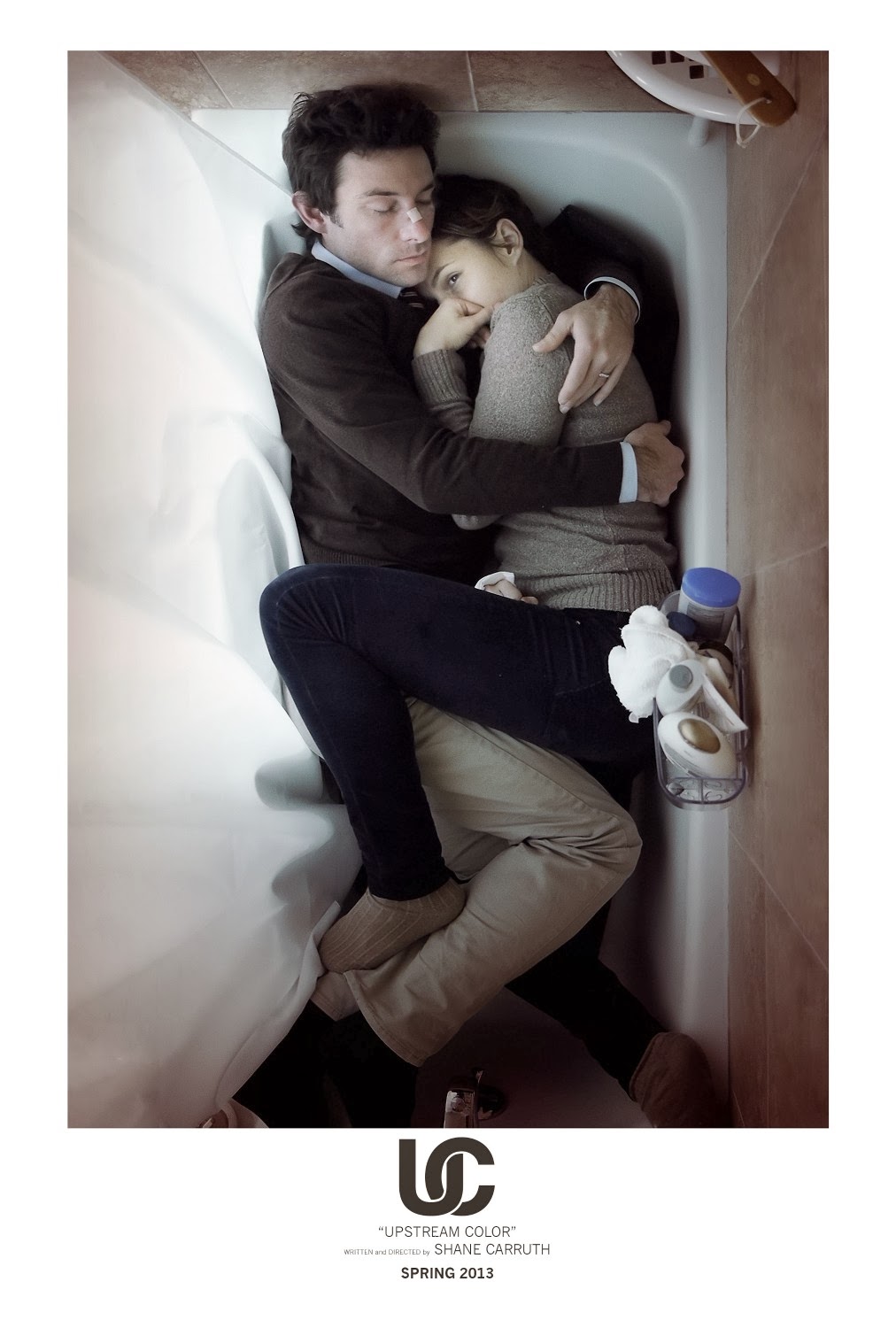
For the dealer (Thiago Martins) - identified as "Thief" in the credits - that's not enough to make a living on, so every now and then he doses someone with an undiluted version: the entire grub. For our purposes, this victim is Kris (Amy Seimetz). The effects leave her highly susceptible to suggestion, and the Thief uses this to his advantage, asking her to take out loans and give him the money. But being easily suggested isn't the only issue with this drug. There are... side effects. Before he can abandon Kris to her own devices, he takes her to The Sampler (Andrew Sensenig), for reasons better left to be discovered. Later, Kris meets Jeff (Carruth), another lost soul trying to cope with a loss in his past, one that may or may not be related to the Thief and The Sampler...
That's as much as I'm comfortable telling you about Upstream Color, and that's actually telling you a lot. I've described the first thirty minutes of the movie, which is concerned mostly with the methodical operation the Thief runs to brainwash Kris and take her money. Where the drug comes from, how it affects you after it runs its course, and what The Sampler does other than create music from sounds he makes in nature, I leave up to you to discover. It's worth warning you that people with a sensitivity towards animals might have trouble with a few scenes in Upstream Color, so much so that even though it isn't real, it's quite haunting. You should know that going in, and that in many ways it's directly linked to what the title of the film means.
Is Upstream Color meant to be put together? That, I suspect, is up to the viewers drawn to it. If you've seen Primer, you know Carruth's approach to narrative is unorthodox - he operates in a non-linear fashion, even when not making a movie about time travel. Upstream Color makes sudden lurches forward, and sometimes backwards, without necessarily acknowledging the shift in time. Conversations begin in one place and end in another. Memory becomes scrambled and loses its subjective quality (this is most certainly a running theme of the second half of the film). One could argue that we're simply being presented disparate moments that aren't intended to be put together, which is not to dismiss the potency of what we're seeing - only that finding the underlying theme might not be the point. Upstream Color might simply be experiential storytelling, if you choose to watch it that way. For those who love to seek out riddles, to answer ellipses, there's plenty of that to dig into as well.
Upstream Color makes an explicit connection to Thoreau's Walden, and it's continuously referenced throughout the film (it may be the only consistent through-line in the movie), although I cannot say with certainty its significance when you find out why it's important near the end of the film. There is something to be said for the longing of capturing a specific moment in time that haunts the characters in Upstream Color, and part of the film close to the end reminded me a bit of Chan-wook Park's Lady Vengeance, although the significance of the moment for the characters in each film is very different. I do feel, for the moment, that a sense of loss (of memory, feelings, and time) binds together the Thief's victims, and they are inexplicably drawn together. Some of the symbolism involving The Sampler and who and how he watches I'm still working on, but I have a friend who is quite enthusiastic to discuss this at greater length. If you choose to follow Carruth down the (very enticing) rabbit hole, you too will want to join us. We'll keep trying until we find a really good one.
Tuesday, January 21, 2014
Cap'n Howdy's Best of 2013: The World's End
I mentioned somewhere in the "middle" recap that This is the End was probably the funniest comedy I'd seen in 2013, but The World's End is the smartest. By a mile. The final chapter in Edgar Wright and Simon Pegg's loosely connected "Cornetto Trilogy" may not be as consistently hilarious as Shaun of the Dead or as audaciously violent as Hot Fuzz - which is not to say it isn't still frequent with the belly laughs and contains some serious carnage - but it's easily the best thought out of the three, the most thought provoking in its themes, and the most heart felt in its relationships. If, for some reason, you haven't made The World's End a "blind buy" on DVD and Blu-Ray (I know you didn't see it theatrically, because the numbers bear that out), do it right now. I'm going to spoil the ever loving hell out of The World's End, and I'd rather you see it without knowing where the movie is going.
...
.......
..........
.............
.....................
..........................
I'm Warning You! SPOILERS AHEAD!!!
...................
............
.......
...
Back? Wasn't that great? Yes, it was. If you just went ahead and skipped to the next paragraph, shame on you. I told you to watch it and you didn't, and now you're just going to have to see it knowing everything. But because you cheated, you'll be able to watch The World's End armed with some of the cleverly hidden easter eggs and thematic set-ups and payoffs that come from seeing it more than once. And you'll be seeing it more than once, cheater.

There are many place I could start with The World's End, but let's deal with the science fiction element that makes it part of the "Cornetto Trilogy" (Zombie movie, Cop Movie, Science Fiction Movie). I had the good fortune of seeing The World's End with a friend of mine who didn't know anything beyond the Golden Mile premise, so when the film takes a turn while Gary's in the bathroom, it caught him completely off guard. And that turn? Well, it's robots.
Robots. Yep, getting that right out there, even though the replicants (?) don't like being called "robots," and the aliens behind the machines replacing humans in Newton Haven have (arguably) the most peaceful take-over planned in all of science fiction film. But it's not to be, of course, because humanity has a right to want not to be civilized in the galactic picture. In that way, one could argue that The World's End is a middle finger from mankind to the end of The Day the Earth Stood Still, with roughly the consequences that Klaatu promised as a result. It is, in essence, the pawns rebelling against a benevolent world-creator (well, mostly benevolent - all of the characters replaced by robots are fertilizer, which seems a little harsh) to the point that the creator (literally) says "Oh, fuck it."
What's so very impressive about The World's End is how well structured Wright and Pegg's screenplay is. Like Shaun of the Dead, they lay out the entire story in the prologue, and pack in a dozen other small details that are referenced so quickly you wouldn't be faulted for missing them the first time around. On top of that, not only do all of the names and signs of the bar hint at what's going to happen inside (and have corresponding numbers to the phases of the Golden Mile hidden somewhere), they also reference, in varying ways, the twelve steps of recovery that we don't exactly know Gary is going through until near the end of the film. The last one isn't really covered in the "Signs and Omens" extras on the disc, which will help you if you don't have time to watch The World's End three more times this weekend, but came from another friend of mine who was in a similar situation to Gary.
And, oh yeah, it's very funny. Put aside the densely layered script, the folding back on itself, the metaphysical subtext of humanity in the universe, and you still have a laugh out loud comedy. I love that Frost and Pegg switched character types for The World's End: Frost the one who has it together and doesn't trust Pegg, the perpetual loser who pushes his likability to the very limits over and over again. If the "Three Musketeers" scene in the trailer made you chuckle, wait until you see how they alter the phrase "rob Peter to pay Paul" and the shit-eating grin that Gary closes the scene with.
However, it's not Pegg or Frost, or even Freeman who walks away the VIP - it's Paddy Considine. Admittedly, I'd seen less of him than Freeman, Marsdan, Pegg, Frost, and even Rosamund Pike, but he has some of the best lines, many of the best reactions, and ends up with the most to do in the story. The World's End is centrally about the fractured relationship between Gary and Andy, and the event that drove them apart, but Steven's longtime crush on Sam is the heart of the movie. I keeps Andy and Gary alive in the end, and Steven is the final vote that saves humanity (or dooms them, depending on your reading of things).
That, in turn, brings us to the ending, which turns The World's End from science fiction film to my second favorite sub-genre (behind anthologies): Post-Apocalyptic Cinema. This seems to be a point of contention for some people, because it's such an abrupt left turn for the movie, but thematically it fits perfectly with what everybody in the story wants. Gary gets the gang back, Andy's with his family, Steven and Sam are together, Robot Oliver is basically the same (with a Wilson-esque head), and Robot Peter is pretty much where he started. Yes, humanity is without technology, and communication across long distances is almost impossible (until Kevin Costner comes to the rescue, we can assume), but they seem happy. Humanity continues, on their own terms.
I'd like to mention that while I wasn't impressed with the characters in Scott Pilgrim vs. the World, the staging and filming of fight choreography that Wright honed in making that film pay off in spades during The World's End. The fight scenes (and there are a few) are dynamic, with fluid camera work that manages to shift from one character to the next without ever losing a sense of geography in the (basically identical) pubs. The poor robots and their blue blood (?) are torn asunder, bashed, smashed, cracked, and beaten to pieces repeatedly, and Wright covers it all in a way that might not have been possible had he not made Scott Pilgrim. So bully for him.
Even though we're neck deep in spoiler territory, I'm not going to tell our cheaters about the surprise characters in the film. I will say that in keeping with the tradition started in Hot Fuzz, there's another James Bond in the film, but I won't say who, nor will I tell you where the other cast members from earlier "Cornetto" entries appear, although most of them do. The World's End, of the three films, benefits the most from re-watching, and is an easy call to put in when you have friends over. Like Shaun of the Dead and Hot Fuzz, it didn't light the box office up, which is a shame, but since I gave Scott Pilgrim fans so much grief for saying the same thing, I won't lament it. Let's hope it has a long life on home video, just as its predecessors have. King Gary would want it that way.
Saturday, January 18, 2014
Cap'n Howdy's Best of 2013: Blue Jasmine
Woody Allen has been making a movie every year for a while now, and while consistency has never been his strong suit, that's always something to look forward to. Sometimes he makes great ones (Midnight in Paris, Match Point), sometimes he makes popular ones (Scoop, Vicky Cristina Barcelona), sometimes just okay ones (From Paris with Love), and sometimes you get the rotten egg (You Will Meet a Tall Dark Stranger). Of course, every now and then he makes the one only I like (Whatever Works), but I'm happy to say that Blue Jasmine is one of the really good ones. It might even be one of the great ones, in large part because of Cate Blanchett, playing a woman in the middle of a mental breakdown with serious denial issues.
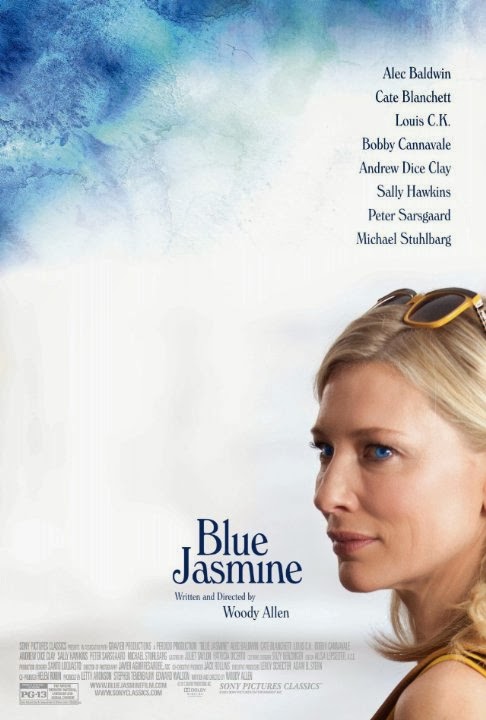
Oh, by the way, Jasmine isn't her name - it's Jeanette, but she changed it because she liked the color. Like much of her life, Jasmine deludes herself into believing it's actually her name and that her mother gave it to her, but she also has some serious mental stability issues. Throughout the film, as Allen jumps backwards and forwards in time to fill in the gaps of how their lives collapsed, he'll often cut back to Jasmine repeating dialogue from the flashback to herself, out loud. People nearby often don't know how to react, and the woman sitting next to Jasmine on the plane to San Francisco gets more than anybody ever wanted to hear just for asking "were you talking to me?"
Augie is still in the picture, and the reason his marriage with Ginger broke up is the same reason he doesn't trust Jasmine moving in with her: Hal tricked Augie into giving him lottery winnings to invest, largely upon Jasmine's insistence, and they lost everything. Ginger might have also seen Hal with another woman, but she can't be sure and won't tell her, even when Augie says he would. Ginger seems happier with Chili, but Jasmine is more disgusted with him than she was with Augie, and works to split them up. Uncertain of what she's supposed to do (other than drink to keep the depression, anxiety, and trauma at bay), Jasmine takes a job as a receptionist for dentist Dr. Flicker (Michael Stuhlbarg) so she can pay to take computer classes in order to be able to become an interior decorator on an online course. Meanwhile, she insists she was oblivious to Hal's illegalities, even as the flashbacks continue to fill in the pieces.
Things begin to look up when Jasmine drags Ginger to a party and they each meet new men: Ginger meets Al (Louis C.K.), a nice guy who sets up stereo equipment, and Jasmine meets Dwight (Peter Sarsgaard), a diplomat with expensive tastes and political ambitions. But, as seems to be the case with the sisters, not everybody is being entirely honest at the beginning of these budding relationships, although it might surprise you who isn't and why. Everybody seems nice (well, except Jasmine) and everybody means well, but it's not always so easy to just be honest with themselves or each other.
If I'm making Blue Jasmine out to sound terribly serious, I don't mean to. It's actually a very funny movie, if tinged with a dark undertone. Much of the humor comes from the oblivious, deluded Jasmine, who struggles to maintain her superiority over Ginger and everyone else early in the film, and the flashbacks which make it abundantly clear how open Hal is about the fact that he's ripping people off (there are a number of scenes where he's scheming with his lawyers to keep things appearing to be above board). Blanchett and Hawkins are an excellent study in contrast: the former a complex, nuanced performance in maintaining a facade while falling to pieces mentally, and the latter a woman disrupted, torn between the life she enjoys and wanting to please someone she looks up to.
Added to that is a surprisingly sweet turn from Andrew Dice Clay, as the sincere but beleaguered Augie, who wants to do right by Ginger but can't stand what Jasmine and Hal did. Louis C.K. is only briefly in the movie, but plays a less sardonic verison of his character from Louie. Bobby Cannavale's Chili is, even during violent outbursts, a man madly in love with Ginger that doesn't understand why Jasmine can't just let them be happy. I was also quite taken with Sarsgaard, who plays a mostly materialistic character until one scene late in the film where his reaction to Blanchett will remind Allen fans of the best kinds of Woody blow ups. Alec Baldwin is stuck with the sleazy part, and he does it well, but his purpose in the flashbacks is largely to get us to the last revelation, the one that really put Jasmine where she is mentally.
If Midnight in Paris was too whimsical for you, I think Blue Jasmine might be the best mix of sweet and sour Woody Allen we've had in a while. You'll laugh, and marvel at Blanchett's performance, which is at times mesmerizing, and by the end be impressed at the sleight of hand. It's been a while since I saw an Allen film that surprised me at the very end, and credit where it's due for structuring the film in such a way that even I wasn't quite sure where it was headed - other than "not well." Blue Jasmine comes highly recommended, for casual viewers but also for dedicated Woody Allen fans. You never know what's coming next, but at least there's another candidate to join the great ones in the meantime.
Subscribe to:
Posts (Atom)