Friday, June 19, 2015
Blogorium Review: Jurassic World
Jurassic World is a pretty good movie and a great example of corporate filmmaking at its best. That is to say that it reflects the kind of movie that fulfills all quadrants, offends nobody, and coasts along on enough charm that it does not bore or annoy audiences. Just don't think to hard about it, and you'll be just fine. It's weird, because I feel strange saying that I thought it was enjoyable. I've watched the Screen Junkies debate and I watched Red Letter Media's Half in the Bag review, and to be perfectly honest, I can't mount a defense of any of the problems raised about Jurassic World. The characters are barely one note, the contrivances and narrative conveniences are at time embarrassing, and yeah, there are plot holes you could drive a truck through. I'm not even going to try to defend the movie from the type of criticisms I'd normally hold it accountable for. I can't. By the same token, I've tried to talk myself out of the fact that I did enjoy it, and it's not sticking.
Let's get the elephant out of the room right away: I don't view Jurassic Park with rose colored glasses. I feel like that's important to point out, because I didn't watch Jurassic World through the lens of nostalgia. I think Jurassic Park has some fun moments, mostly the suspenseful ones, but have always felt like most of the characters are broadly drawn cartoons who dress in such a way that you can easily tell their toys apart. I'm the weird person who still kinda likes the mostly terrible The Lost World, even though I just watched it again, and yeah, it's still pretty bad. The "Spielberg does Godzilla" part still makes me laugh, because it's such a stupid, audacious way to close out that movie. But I didn't really care about seeing Jurassic World. I wasn't interested at all, and when I did see it, my thought process was "what the hell, I just watched The Lost World yesterday, and it can't be worse than Jurassic Park III." And it's not. Unlike just about every review, I'm not going to say that Jurassic World is better than the sequels but not as good as Jurassic Park, because I don't hold the first one in the same standard as most people. Bear that in mind as we move forward, because your mileage may vary.
For starters, I guess I do like the premise: Ingen finally got its shit together and John Hammond found somebody to reopen the park. His name is Simon Masrani (Irrfan Khan), and he's immediately not like the usual sleazy businessmen you've seen in the other Jurassic movies. He's one of those carefree billionaires who is managing the money and taking care of Hammond's vision, but mostly just wants to show off that he's almost finished his helicopter lessons. He leaves the actual running of the redubbed "Jurassic World" to Claire (Bryce Dallas Howard), who is a numbers, spreadsheet type that thinks of the dinosaurs as "assets" and is concerned about the bottom line and appeasing investors. In other words, the character we're probably not going to like but since she's a main character, she'll eventually see the error of her ways, right? Eh... maybe not so much. Back to that later. Claire is supposed to be hanging out with her sister (Judy Greer)'s kids, but she doesn't have time and foists precocious Gray (Ty Simpkins) and moody teen Zach (Nick Robinson) on her assistant Zara (Katie McGrath). They have VIP passes, so they can go anywhere which is a good way for us to see the park. It beats seeing the control room, which is where comic relief audience nostalgia surrogate Lowery (Jake Johnson) works. (He bought a Jurassic Park t-shirt on Ebay and has dinosaur toys on his work station).
Anyway, nobody cares about the characters, because there's a new dinosaur. Like, a new, genetically modified dinosaur that never existed, and as dumb as Indominus Rex ends up being a lot of the time, but reason for her existence is actually a pretty sound one. In the universe of Jurassic World, the park reopened two years after Jurassic Park (well, actually they completely rebuilt it, as we find out) and it's been a tourist attraction with a cruise ship that takes people to Isla Nublar every day since then. Claire is explaining to investors from Verizon (no, really) that after twenty years, the allure of dinosaurs has started fading, and they want something new. Audiences want something they've never seen, something scary, so Dr. Wu (JP alum BD Wong) cooked up the I-Rex, a mystery hybrid that has super powers. We'll also come back to the convenient super powers later. The reasoning behind creating the new dinosaur plays like a commentary on moviegoers today. I mean, the novelty of seeing dinosaurs in a movie has pretty much worn off, so lets make them bigger stronger faster scarier. More CGI. More mayhem. Jurassic World the movie is the proof that Claire the character isn't wrong: people went in droves to see it.
Indominus has been raised in her paddock, alone ever since she ate her sibling, and Masrani wants Claire to have ex-military consultant Owen Grady (Chris Pratt) to check it for security before the consider opening it to the public. Claire doesn't like that because of course they went on a date when he started working there and of course it didn't work out because she's into designing itineraries and he's into the Matt Foley school of living life. But he's Chris Pratt so we mostly like him and he's capable and manly and cracks jokes, etc. He cares about the dinosaurs and has raised a pack of Velociraptors from birth and is their alpha. Just in case we don't get that, their names are Echo, Delta, Charlie, and, uh, Blue. I guess maybe they thought audiences might not understand why a raptor was named "Bravo" or maybe the network said they couldn't use it, so it has blue markings instead.
The raptor subplot is actually a lot less stupid than the trailer made it look, because Owen just barely keeps them in check for most of the movie. It's established early on that they accept him as the alpha, but only to a degree. They listen to him, but he still has to roll under the closing gate to get out of their pen when he saves some idiot who falls in. They know he's not like them, but he's their alpha, so it's a tenuous balance. You've seen the part in the trailer with the motorcycle, but that happens because he's following them as they follow the scent of the I-Rex, and that happens as a matter of last resort. Mostly thanks to subplot we didn't need in this movie character Hoskins (Adventures in Babysitting's Vincent D'Onofrio). His "lets militarize dinosaurs" contractor guy feels like a leftover plot thread from the abandoned John Sayles draft of Jurassic Park 4 with the human / dinosaur hybrid Dirty Dozen*.
But anyway all of these characters have to converge so of course the kids are out in a gyrosphere rolling around when the I-Rex gets loose and Claire has to evacuate most of the park while the Asset Containment Unit gets slaughtered. See, the I-Rex can mask her thermal signature if she wants to, so she tricks them into thinking she's not in her cage and Owen can see how dangerous she is when she eats a fat slob red shirt (seriously, this dude has a tie that's not on straight, a barely tucked in shirt, and a safety hat that's tiled at an angle: he's clearly getting eaten from the moment we see him). I-Rex goes on a murder spree, killing everything, in a once again reasonably explained way. Owen correctly points out that having been raised in captivity with no contact at all, Indominus Rex has never encountered other dinosaurs (or anything) before, and doesn't know its place in the food chain. And they really don't want her to find out.
Anyway, dumb kids somehow go "off road" and Claire and Owen have to find them. Hoskins takes over the control room, and everything goes straight to hell. This leads to the disaster part of the movie, where people die horrible, horrible deaths. Like, I was surprised how horrible in some instances. There's one character whose death is wildly disproportionate to their behavior in the movie, unless being inattentive means you should be pecked apart by Pterodactyls and then swallowed alive by the Mosasaurus, the Sea World-like attraction. I mean, the dude who grabs his margaritas while running doesn't even get it that bad. He might not die at all, and there's no way he ordered both of those drinks for himself, if he ordered them in the first place. There are people who totally deserve to have their arms bitten off or to be dino-stomped or Pterodactyl impaled**, but there's dome disproportionate brutality going on. Maybe director Colin Trevorrow had a bad vendetta with somebody or just hates Mary Poppins or something.
Well, now's as good a time as any to transition into the "why people think this movie sucks and I can't even argue with them" part of the review. I'm going to start with two pieces of dialogue from the dumb kids who are only in Jurassic World because the movies are ostensibly aimed at kids (and not their 30-something parents who saw Jurassic Park twenty years ago). I'm going to slightly modify what they say to point out what incredible plot conveniences they introduce, but if you're SPOILER averse, you might as well skip ahead to the last paragraph.
"Hey, do you still have those matches neither of us ever mentioned at any point before now even though we just got away from the I-Rex by jumping into water?"
"Do you remember that time we fixed up Grampa's car which would totally mean we can repair this Jeep we found in the old Visitor's Center from Jurassic Park and then drive back?"
Putting aside the fact that any theme park that offered a "gyrosphere" attraction without a guide should have a way to bring said gyrosphere back when the park is unexpectedly closed, those two lines are indicative us just how lazy the writing in Jurassic World is. They both happen within five minutes of each other, and I think they were hoping we'd be too caught up in fact that "hey, it's the old Visitors Center! I remember Jurassic Park! Omg!" to really think carefully about how contrived those plot points are. Almost as contrived as Indominus Rex, who is white (except when she's not), can mask her thermal signature (once), pulls out her own tracking device, and is part Raptor. How do we find out she's part Raptor? Someone in the movie has to say it. In fact, here's what Owen says:
"No wonder they didn't tell us what's she's made of: she's part Raptor..."
This happens at the end of the motorcycle scene, when the Raptors find I-Rex and, even though she's never seen a Velociraptor before, she begins communicating with them. Guess there's a new Alpha. Oh wait, that's also something Owen says. The Raptors of course turn on Owen and Hoskins men and kill them, and then go all the way back to their paddock to chase Claire and the stupid kids who are sitting in a truck that the boys for no apparent reason won't close the back doors of. It's one of the many, "wait, what?" moments that Jurassic World hopes you won't ask questions about, like "where did the other helicopter pilot go if Masrani and the helicopter are still on the island?" or "wait, wasn't the Mosasaurus attraction further away from the main park area?" or "would you really stop to comfort a dying dinosaur when there's nothing you can do to help at all and you're searching for two children that may or may not be in mortal danger?" Yes, the last question is the closest scene Claire has to a humanizing moment, and it may be the only dinosaur in the entire movie that isn't CGI, but if you give it a moment's scrutiny, why does it need to happen?
And yet, I didn't really mind while watching it. Yes, in retrospect, the film compounds so many lazy, convenient, or "we hope you're not paying attention to this" moments that you probably won't even remember the loose plot thread they leave for the next Jurassic sequel (hint: BD Wong). Does it really matter what happened to Lowery? Eh, I didn't even think about him in the last scene. In truth, most people are only going to remember the final battle, and to Jurassic World's credit, it takes the humans out of the equation and goes for full on dino fight. And it's a pretty good fight with a great (if implausible) conclusion. You'll be excited, you won't care about product placement - I mean, have you been to a theme park? Is the Jimmy Fallon scene really that out of place? - and if you loved Jurassic Park, you might even cheer when T-Rex makes her grand return by crashing through a Spinosaur skeleton. Take that, Jurassic Park III. You never forget that everybody hates you. I'm sure there's tons of press material where producers and the director and four writers talk about making the fans happy, and that lip service is expected, but this movie was created by committee. And to be honest, for what it is, it's better than it has any right to be. I cannot pretend that it's a well constructed, well thought out film, but Jurassic World gives you what you came for. If you're the nostalgic type, there's a chance you might like it even more than I did. It's not really the best or the worst, which I know the internet hates, but that's how it is sometimes. Every now and then you get a mostly happy middle, and for reasons I can't quite fathom, Jurassic World was entertaining, in spite of itself.
* I am not making that up.
** Although, if we're picking nits, one was done in The Lost World and the other was the original ending of the film before Spielberg took T-Rex to San Diego.
Thursday, June 18, 2015
Retro Review: Jurassic Park III
Jurassic Park III is the one that Steven Spielberg didn't direct, the one that has a dream sequence with a talking Velociraptor that says Alan Grant (Sam Neill)'s name on an airplane. I mean, that really ought to cover it, right? It's the one that's universally recognized as terrible and that director Joe Johnston (Captain America: The First Rocketeer) somehow managed to bounce back from. William H. Macy and Tea Leoni are in it, somehow they talked Laura Dern into shooting a cameo but Jeff Goldblum said, "nah, there's a line and I'm not crossing it again." I guess that Cats and Dogs money was too good to pass up. But enough about Jeff Goldbum - people will debate until the end of time about whether The Lost World really sucks or just kind of sucks - Alan Grant is back you guys! I choose to believe that this is the work of Sutter Cane, but obviously I have no evidence to support that because Cane hasn't given me any.
Anyway, so I saw Jurassic Park III in the theatre because that was back when I'd go see anything and maybe we didn't know it was going to suck. Or we hoped it wouldn't. Or maybe we did know and we went to see it anyway because, hell, we'd already seen Jeepers Creepers. It was a long time ago. We watched the terrible movie where the Raptors have quills because dinosaur research had continued to advance and now they're closer to birds than lizards to yeah, multi-colored quills. Some dumb kid with rich parents got lost on Isla The Other One from The Lost World (I would like to point out that in The Lost World you can also see this island chain includes Isla Muerte. I'd love to see the dinosaurs on that one) and Alan Grant has to find him. Even though he's never been to that Island. I guess Vince Vaughn isn't considered trustworthy enough to find a kid. Probably a good call.
So we left the stupid movie and went to a friend of a friend's house, which is never my idea of a good time, especially when the friend who brought you there (and is driving) goes in one of the back rooms to get high and you're watching South Park with some dude who is half conscious and mostly paying attention to his turtle aquarium behind the couch. Good times. If that doesn't already sound sketchy enough to you guys, the people who lived in this apartment would later steal a bunch of stuff from some girl, get confronted about it, and decide to just leave it all on the runway of the airport for them to find. True story. But eventually my friend comes back out and he's going to drive me home which is what I wanted to do, and he grabs two beers "for the road." This is my only option of getting home and we're well before the days of cell phones here.
Well, as luck would have it, while driving back there's a police checkpoint and he's already opened one of the beers to drink while on the road (in his defense, he's a very functional alcoholic) and can't turn around. So, uh, we're going to have to deal with this prickly situation. In his infinite (read: under 21) wisdom, he opens the other beer and proceeds to pour both of them onto the floorboard of the driver's side, hoping that they won't notice. Take a guess how that well that worked. We are both ordered to get out of the car and to submit to a breathalyzer, which is fine with me because I haven't been drinking and I'm not going to jail. On the other hand, they continue to ask him "Sir, have you been drinking?" and he answers "No."
Taking the breathalyzer out: "Sir, are you sure you haven't been drinking?"
Him: "I have not"
Handing him the breathalyzer: "Are you certain that you were not drinking tonight?"
Him: "No"
He's blowing into the breathalyzer: "One last time, have you been drinking tonight?"
BEEP!
Him: "Well, maybe one beer."
And they put him in handcuffs and take him off to jail. Me? I'm sober and without a ride home, so I get to walk with the officer back to his truck so she can take a look around and see if there's anything else they should know about. The entire cabin reeks of cheap beer and I'm getting a headache just standing there. She finds his back pack filled with issues of High Times and says "this is promising" and to this day I don't know how she didn't find his bowl or why she didn't check the ash tray, which is exactly where what he normally smoked was tucked away. I mean, you are a cop, right? Well, I'm not going to be too rude, because she very apologetically explained that I would have to take his truck home because they couldn't spare an officer to drive me to my parents house (that'll be important in a minute). She have me her badge number and name in case someone pulled me over and noticed the pungent odor of beer everywhere, and off I went.
I was living with my parents, who were asleep, so I had to sneak into their room to get the cordless phone out. That way they wouldn't wake up when he called me from the drunk tank to come pick him up, as he did at about 2 in the morning. I took my car (much better idea) and navigated through downtown - which I didn't know very well - and found him outside of the jail, giving a homeless guy the last five dollars he had. Then he smoked a cigarette and I took him back to his truck, which he drove home without incident. He lost his license for a year and there was probation or something else and now he has a PhD and four masters and is an expert on bats. So I guess it worked out. One time we shared a motel room during a wedding and there was a bat outside. He brought it in, but because he was drunk, he dropped it and the bat went under the bed. He laughed and said "that's what you get when you party with me!" and then went to sleep.
Where was I...?
Wednesday, June 3, 2015
Blogorium Review: Ex Machina
There's really only one way that Ex Machina can end, and it does. It would hardly be fair to hold that against a film that poses so many intriguing questions about mankind and our relationship towards (if not, eventually, with) machines. For ninety or so minutes, we watch a Turing Test play out, for reasons that aren't entirely clear, with parameters that aren't well defined, and based on agendas we can't necessarily predict. And yet, despite the "all is not what it seems" atmosphere which is as pervasive throughout the film as it is in the trailer, writer / director Alex Garland (The Beach, 28 Days Later) manages to address concerns as the narrative unfolds without betraying the audience. After all, there's only one way it can end, but how it gets there is best part.
Ex Machina is ostensibly the story of Caleb (Domhnall Gleeson, Frank), a code writer for Blue Book, the largest search engine in the world. He wins a company raffle - of sorts - and is sent to spend a week at the estate of Blue Book's creator, Nathan (Oscar Isaac, Inside Llewyn Davis), for purposes undefined. There are clues in the opening scene that something else is going on, some subtle, some less so - although we don't know why until later. Nathan, who lives in the midst of a fortified compound in the midst of mountainside land (as the helicopter pilot explains when Caleb asks when they'll be at Nathan's property, "we've been flying over it for the last two hours!"), is very strict about who he allows to visit. Custom made ID badges are required, and they don't always grant access to rooms. Nathan himself, a coding prodigy who built Blue Book as a teenager, lives in isolation, exercising and drinking in equal measure. To say the least, Caleb is intimidated. This man is his boss, trying to talk to him like a friend, but under specific parameters. Parameters he's not always willing to divulge.
But Caleb isn't really there to hang out with his boss for a week. No, Nathan's invited him for a very specific purpose, one that explains the need for no windows and a self-sustaining generator. And no cell phone service (can't leave that one out). Nathan's been working on an advanced artificial intelligence, and he's chosen Caleb to be the man to administer a Turing test. Can Caleb determine whether Ava (Alicia Vikander) passes for human or not? Nathan's already decided to bypass some of the original rules Alan Turing designed for the test: he's confident that if Caleb couldn't see Ava, he'd be convinced, so instead Caleb has to interact, to see. Ava has a human face, human hands, and fee, but is otherwise clearly a machine. So the question becomes, can Caleb, knowing he's talking to a machine, discern the presence of intelligence and be convinced that Ava is more than artifice?
In writing the last paragraph, I caught myself trying to write the word "she" when referring to Ava, which is a nagging pet peeve I have, even for myself. The concept of trying to anthropomorphize, to gender identify, something which is explicitly identified as non-human is still difficult to shake. Pay attention to how many people refer to Apple's SIRI as a "her": because a woman recorded the audible responses that SIRI provides, we give it a gender. But SIRI is not a human being, and neither is Ava, which became the first philosophical point of contention I thought I would have with Ex Machina. Why sexualize Ava if all Nathan wants to do is prove its intelligence is genuine? Ava has a woman's face and hands, contoured plastic breasts and buttocks, so even if the arms and torso are transparent, even if the top of the head is, too, Caleb's eyes are going to be drawn to some degree to the fact that Nathan made a specific decision to gender-ize Ava.
As it turns out, just as I was beginning to really think about the conscious decision to give Ava a gender, Garland chose to address it by having Caleb come right out and ask Nathan about it. The film is broken up into "sessions" between Caleb and Ava, punctuated by conversations with Nathan or sequences where Caleb learns more about the house. It's not far into the movie - maybe the second or third session - before the conversation comes up, and like many things which appear to be adhering to "audience expectation" tropes, there's a method to the madness. In fact, as Garland slowly reveals, there are several: Nathan has a specific reason for making Ava look like a young woman, one tied to the nature of the testing. But there are other reasons as well, although I'm not going to SPOIL much about Ex Machina. Suffice to say that many of the plot points I thought were or would be problematic turned out to be better thought out than your average screenplay.
Ava is, indeed, quite impressive, and Caleb finds himself conflicted. On the one hand, he understands his role as the skeptic - he has to evaluate Ava from all possible angles, including whether Nathan's programming is responsible for its "flirtatious" behavior. By the same token, maybe Nathan is right that Caleb is "the first man Ava has seen" other than him. Nathan's a little looser when it comes to talking about Ava, and sometimes says "her," but I'm trying to refrain from that. They don't just talk about Ava, and it's very clear that Nathan has a secret agenda. He's also condescending and dismissive, except when he's not. There's something Caleb just can't trust about the parameters of this "test," which is confirmed when the power cuts out during a session with Ava. Ava warns Caleb that he shouldn't trust anything that Nathan says or does, which sets off the second half of Ex Machina. But which one of them is more trustworthy: the creation or the creator?
Unfortunately, Caleb's only other point of communication is with Kyoko (Sonoya Mizuno) - Nathan's housekeeper / cook / assistant, who can't speak, read, or understand English. Nathan prefers it that way, as it allows him to "talk about trade secrets" without fear of any leaks. Astute readers are already working out her role in the story, but since Kyoko appears so early in the film and there are so few characters, it would be unfair to leave her out. While attempting to negotiate his living space, or the fact that the television in his room only shows CCTV footage of Ava, Caleb continues his sessions, becoming more smitten with Ava's apparently genuine expressions of intelligence. Ava draws, turns lines of questions around on Caleb, and begins to blur the line between machine and human. In the last instance, literally: Ava puts on a dress, stockings, and a wig (left in a closet, one might assume, purposefully), which obscures much of the artificiality. The results on Caleb are somewhat predictable, although by that point he's far more concerned with Ava's status as "captive" in Nathan's home.
Although I said there was only one way that Ex Machina could end, I'm not going to address it in this review. In fact, what has been covered leaves out a number of plot points, because there's a great benefit to not knowing much more than what you see in the trailer. That might even give away a bit too much, although the "what" of what happens is more interesting when the pieces of "why" it happens come together. It goes without saying that Caleb is also being tested, Nathan is being far less than straightforward, and that Ava is taking advantage of that. Or are all three of them manipulating the others, and themselves? There are a number of interesting Biblical allusions in the film, as well as nods to Frankenstein, The Allegory of the Cave, Star Trek, Blade Runner, and Oppenheimer's famous "now I am become Death" quote. There are also some smaller references to Wittgenstein, Close Encounters or the Third Kind, and Hoffmann's The Sandman.
With such a small cast, it's hard to really say any one of the three leads stands out, although much of the credit goes to Alicia Vikander, who has to appear to be human without being human. Considering that most of her on-screen performance is a visual effect, Vikander manages to sell her role in /as the effect. The reasoning behind how Ava is capable of reproducing human expressions has its own interesting plot device, but Vikander's slow evolution on camera as Ava is most impressive. It's hard to tell who is the cat and who the mouse, as Gleeson slowly moves from star-struck rube to man in crisis to his own sense of (possibly misguided) agency. Isaac appears to have the more one-note role, playing Nathan mostly through intimidation - physically, mentally, and emotionally - but there are a few moments in the last act that shed light on him. Some for the better, some for the worse, but I feel like his last conversation with Caleb is a better glimpse into who Nathan really is than the diabolical puppeteer we've been taking him for. It all depends on whose side you take during Ex Machina - and don't worry, the title is quite appropriate - to how you react to the inevitability of its conclusion. Like I said, there's only one way it can end once the pieces are in place. Discovering how it gets to that point, however, is what makes the film worth your while.
Labels:
Alex Garland,
Bad Ideas,
Gratudity,
Mad Scientists,
Reviews,
Robots,
Science Fiction,
trickery
Friday, May 29, 2015
Blogorium Review: Mad Max - Fury Road
(editor's note: please forgive the relative lateness of this review - the Cap'n insisted on seeing the film a second time before turning this in.)
Eh. It was okay, I guess. You know, nothing special.
Nah, I'm just pulling your chain. This is the internet, where everything either rules or sucks, and there's no level of hyperbole big enough to attach to something, but even I can't argue with the fact that Fury Road is the goods. For a little while there, at the beginning, I thought I maybe had, though: it's not for very long, but right after Max (Tom Hardy) crashes his Interceptor and gets captured, your fearless Cap'n was worried he might have overhyped himself for this movie. Something about the persistent flashback, um, flashes (that might not actually be what we think they are, but more on that later) and the strangely under-cranked action as Max tries to escape the Citadel just felt... off. Like, something wasn't working. Also, it felt less like under-cranked camerawork and more like someone set the video to play at 1.5 speed but kept the audio the same. Since we're in a digital projection world, I did worry that maybe that could actually have happened.
But then that went away and George Miller settled down and suddenly it was a Mad Max movie, and it just got better and better. And by that I also mean more bugnuts crazy until you thought it couldn't anymore and then there's the guy strapped to the wall of amplifiers on a truck who plays an electric guitar that also shoots fire while six dudes play massive drums behind him. All so you know that doom is coming. Also, his name is The Doof Warrior. That's not even the craziest character name in the film, which includes the likes of Immortan Joe, Imperator Furiosa, Rictus Erectus, The Splendid Angharad, The People Eater, and Cheedo the Fragile. All of a sudden, Max Rockatansky, The Humungus, and Aunty Entity don't seem so outlandish.
In the Retro Review for Mad Max Beyond Thunderdome, I singled out how much I liked the "world building" aspect of the film, specifically Barter Town. Miller ups the ante a bit in Fury Road by giving us three hubs of post-apocalyptic civilization (even if we only see one): Gas Town, The Bullet Farm, and The Citadel. We only spend any time in The Citadel, run by warmonger Immortan Joe (Hugh Keays-Byrne), but we meet The People Eater (John Howard) and The Bullet Farmer (Richard Carter), who run things. No Master or Blaster here. They don't seem particularly happy to be dragged into a "domestic squabble" when Joe's lieutenant Furiosa (Charlize Theron) smuggles his wives out of The Citadel inside of her "War Rig" - a fully loaded tanker truck designed for offense and defense. Joe doesn't take kindly to Furiosa stealing his "property," and takes great exception to The Splendid Angharad (Rose Huntington-Whiteley) writing "We are not Things" inside the vault he keeps them in. His "brides" are for breeding, just like his Warboys are for fighting, and the milk maidens are for, uh, milk.
Joe is a diseased ridden old man covered in cancerous tumors, but underneath his painted muscle shell and hidden behind his post-apocalyptic Darth Vader breathing apparatus, he's managed to brainwash the huddled masses of The Citadel into thinking he's a god. He gives them water when he feels like it, has a shrine of removable steering wheels, makes grandiose speeches and promises the equally "half life" diseased Warboys that their sacrifices will lead them to the gates of Valhalla. And they believe it. The Warboys and War Pups worship this guy, and in his defense it's not like Joe just sends out his minions to get Furiosa and the brides back. He packs into his "cars stacked on top of each other" monstrosity and leads the pack, aforementioned Doof Warrior along for the ride. Also in the convoy is a rebuilt V-8 Interceptor, freshly pilfered from The Citadel's newly acquired "blood bag": Max Rockatansky.
I'm sure you've noticed that we got a ways into the synopsis before Max figures into the story, but that's because, like in Thunderdome, he's dragged into another power struggle that he had no part in to begin with. We just spend a little more time with the players in this particular story than we did in Thunderdome or The Road Warrior. It's not Max's fight, and this time he really doesn't want to be involved, but since he's literally strapped to the front of Warboy Nux (Nicolas Hoult)'s car, feeding him "high octane road warrior universal donor" blood, Max has no choice. He's chained to Nux, and Nux is a hard core fanatic of Immortan Joe willing to die at least three times to stop Furiosa. And Max is stuck to this idiot, to the point that he literally has to carry him around after they miraculously survive an electrical storm Furiosa drives through to lose the convoy.
When Max finally catches up to the actual protagonists, there's a funny moment where Miller plays with the concept of the "male gaze" in introducing the "brides": Immortan Joe keeps women who look like supermodels and has them all in similarly scantily clad white... well, I guess cloth would be the right description. It's not really clothes. Max sees Splendid drinking, to the point where she's soaking wet, but it becomes clear very quickly that his (and the camera's) gaze is directed at the water, not the post-apocalyptic wet-shirt contest on display. And then there's a fight, because Max decides to hold them at gunpoint. The ladies have been using a bolt cutter to remove chastity belts that give the term "vagina dentate" a new meaning, and after a drink, he wants to lose some Nux dead weight. Furiosa, robot arm detached, doesn't take kindly to this, and a smarter than usual struggle involving Max, Furiosa, the brides, Nux, and the chain ensues. But Max isn't interested in killing anybody. He just wants out - this isn't his fight, but he'll take your War Rig, thanks.
Some folks have complained that Max is more of a supporting character in Fury Road, and that it's unfair to have his name in the title since Furiosa is more or less the protagonist of the film. However, the story isn't that much different than the way The Road Warrior or Beyond Thunderdome are structured: Max travels the wasteland, runs into trouble, and reluctantly helps a group of survivors before taking off again on his own (SPOILER for The Road Warrior and Beyond Thunderdome). The difference between those films and Fury Road is that we spend most of the expository period with Max, whereas in this one there's a lengthy period of time where he has little or no agency. Max is a prisoner all the way up until he wrestles the pistol away from Furiosa, and when her "kill switch" shuts down the War Rig, he's essentially at her mercy. Max doesn't so much agree to help them as he does go along for the ride, eventually deciding to do the right thing when they pass through the canyons.
(MILD SPOILERS FROM HERE ON OUT: There's an interesting, if underdeveloped parallel between Joe's obsession with his "property" and Max's continued protestation about the Warboys stealing what's belongs to him. He repeatedly shouts to the driver of his Interceptor that it's "mine," and the first thing he does after he's freed from Nux is take his jacket back. There's not really any kind of thematic resolution to being fixated on "things" for Max - the Interceptor is destroyed, but he keeps his jacket, and he's mostly replaced his stuff by the time he kills the Bullet Farmer)
What follows is a mostly non-stop chase in one direction, and then a chase back, after the "Green Place" Furiosa promised the brides no longer exists. It's actually impressive to consider that a film with this much uninterrupted action has enough of a plot that I'm leaving out everything that happens after the "wetlands"
I'm going to address and sidestep the "is this a reboot / is this a prequel" argument by saying that if Furiosa hasn't seen the Vuvalini in "7,000 days" - roughly twenty years and that Max was still a cop before the world collapsed, then maybe Fury Road is both. And by that I mean that since Miller (Happy Feet) has been working on this Mad Max film since 2003 (when it almost happened) that Furiosa could have been kidnapped post-apocalypse and taken to The Citadel while, let's say, The Road Warrior was happening. You could argue that a Mel Gibson-aged Max would have made sense in that timeline, while a Tom Hardy Max seems, um, a little young. And not just because he's three years younger than Theron. But since we have the math we have in Fury Road and it at the very least directly acknowledges Mad Max, let's just agree that none of them have to be sequels and are all stories set in the Wasteland. Chronology dodge activated.
That said, it was nice to have tiny, unobtrusive nods to the other Mad Max movies (and Peter Weir's The Cars That Ate Paris), ones that you might not have noticed. The music box one of the "wives" is playing with. The shot of Toecutter's eyes when Max is dreaming in the rig. My favorite is the Thunderdome reference, when Max is collecting weapons from Furiosa and completely misses the knife hidden in something else. They don't draw attention to themselves, but they're there. Miller's idea of "fan service" is to remind you of what world you're in without saying "hey, everybody, remember The Road Warrior, that movie was really cool!" Like everything else, it's about the economy of storytelling: showing, not telling. We learn a lot about the Citadel and the various factions in Fury Road without exposition dumps.
Take, for example, the moment that actually launches Fury Road: Furiosa's sudden turn left on the road to Gas Town. In most movies where someone working for a big bad guy decides to betray them, the people accompanying the "traitor" try to stop them, much to their detriment. What happens instead in Fury Road is an insight into the mentality of the War Boys. Without being told that they obey their power structure without question, we understand that they wouldn't dare question Furiosa when she says they're taking a "detour," even though she provides them with no explanation whatsoever. They fight for her and protect her, and end up dying to defend her mission without even knowing what she's trying to do.
It's the same unquestioning loyalty Nux has for Immortan Joe for the first half of the film, and even though we don't know much about Furiosa or Joe, we know that no matter what they decide, the War Boys support them. Nux is functionally our gateway into the mindset of Warboys, who are so naïve and sheltered that he doesn't even know what a tree is. The brides, in contrast, seem to have a better understanding of Immortan Joe's propaganda, but some of them (Cheedo in particular) believe he's capable of forgiveness in the same way they are. They stop Furiosa from killing Nux and convince her (and Max) to let him help, and their mercy contributes to the success of their plan. They also contrast well with the Vuvalini, the tribe of warriors Furiosa comes from. There's a conversation between The Dag (Abbey Lee) and the Keeper of the Seeds (Melissa Jaffer) where the former expresses surprise at the latter's boast she's killed everyone she met in the wasteland. "I thought you'd be above all that," she muses.
While I remain partial to The Humungus and admire the ambiguous threat that is Aunty, Immortan Joe is quickly rising on the list of "Mad Max villains." He's arguably just a combination of Humungus and Wez into one character, with a much better power structure, but Keays-Byrne conveys a sense of entitled insanity using only his eyes most of the film. He doesn't ever actually do anything other than drive, but the aggregate effect of his influence over the brides and the Warboys is palpable throughout the film. It raises the question of how someone so charismatic and control oriented would allow Furiosa to meet with the Rock Riders in the first place. He trusts her, and it's clear she's been in the Citadel since a very young age, but it seems unlikely that he authorizes trips anywhere other than Gas Town or the Bullet Farm. I'd also like to mention former WWE Smackdown Superstar Nathan Jones as Rictus Erectus, Immortan Joes' healthiest son (when you see Corpus Colossus, that will make more sense), who has a fantastic moment of pride when he announces that he had a baby brother, who was "perfect in every way!" He's surprisingly touching as the "heavy" of this film.
I'll get to Tom Hardy in a moment, but there's no point in discussing the actors in Fury Road without taking some time to appreciate what Charlize Theron does as Furiosa. She emerges early in the film as fully formed, even though she has arguably less back story than even Max. We know Max - we've seen him before - but Furiosa effortlessly takes the stage and keeps the stakes high. Theron balances a steely determination with eyes that reflect doubt at every turn. She's not making a mistake in what she's doing, but is how she's doing it going to work? Can she really trust Max or Nux, or are they just going to hinder her? We know very little about her relationship with Immortan Joe - he obviously trusts his Imperator, to a fault, but if she's been in the Citadel since a very young age, in what capacity? Was Furiosa a bride before she lost her arm? How did she lose it? What about the skeleton stencil on the War Rig? Is that some kind of reference? There's a lot to wonder about them, all of which comes to a head when she growls "remember me" near the end of the film. What she's seeking "redemption" for isn't always clear, but we want her to find it, and so does Max.
Oddly enough, Tom Hardy left less of an impression on me the first time I saw Fury Road. It wasn't until the second viewing that I really paid attention to Max, knowing where Furiosa's story was heading. Hardy has a strange balancing act, not quite sounding like Mel Gibson (or even Australian, at times), but still playing a character we know. I'm not going to lie that sometimes his pronunciation choices sounds just a little like Bane, but it was less distracting the second time. He's more chatty when tied to the front of Nux's car than I would have expected, but it's drowned out by the noise surrounding him. He's less chatty in the rest of the film, speaking more frequently through action (although the best moment in the movie happens off-screen). Hardy seems a little hampered by a character development I'll mention in a bit, but overall he assumes the role of Max well. It would have been interesting to see Gibson playing this part, but I think it might have radically changed the way audiences react to Max's fight with Furiosa.
Even after seeing the film for a second time, the feeling I came out with was still one of admiration. It's rare to see an action film that's so carefully constructed, so clearly thought out. These days I'll be happy for one that unobtrusively relies on quick edits or CG heavy sequences (Furious 7, I'm looking at you), but to see a film with action that's easy to follow and is still dynamic is really impressive. Georg Miller conveys his information visually, more so in Fury Road than in any of the other Mad Max films. He expands on the concept of post-apocalyptic "world building," but never lets it detract from the story. Everything you learn about the world surrounding the Citadel comes from seeing it and how the characters react. Something as simple as the people in stilts wandering through a radioactive swamp is evocative of a world we may never explore again. All of the tribes in the film are fully realized, even if we only get brief glimpses of them. It really is something to behold.
The one exception to this is an out of place reliance on Max's hallucinations / dreams about the people he couldn't save. I don't necessarily mind explaining to an audience thirty years later why the character is "mad," but the haunted quality is sometimes distracting from the immediacy of Fury Road. If I'm going to pick nits here, this is a recurrent them in Fury Road almost exclusively - Max never addresses things like this in The Road Warrior or Beyond Thunderdome. He doesn't say much of anything about his life "before" in either film, but I suppose if we're operating on the premise that there's no real chronology here, I can live with it. It keeps him alive at least once and is (mostly) resolved before he gets back to the Citadel, but even after the second viewing it sticks out to me. If the series continues - and announcements aside, there's no guarantee of that - I wouldn't miss dropping this version of "Mad" Max.
Of course, it's nice that Mad Max: Fury Road is technically a reboot that's content to be self contained. In an age where every movie needs to have an opening for a trilogy or a spin-off, I find it refreshing that as much as I like Furiosa, we've probably seen as much of her as we'll ever seen. Knowing Miller's penchant for Mad Max continuity, it's very unlikely that a major character - even one as memorable as hers - will appear again. There's plenty of Wasteland to explore, more towns and world building, and while it doesn't feel like audiences I saw the film with really embraced Fury Road (half empty auditoriums will give you that impression), maybe there's a chance for one more down the line. If not, there are now three great Mad Max movies, and Thunderdome, which I think is still mostly pretty good. I can't complain about that. Hell, I might go see it on the big screen one more time - if you're going to see it (and you should), you owe it to yourself to see it as large as possible.
Thursday, May 14, 2015
Retro Review: Mad Max Beyond Thunderdome
So there's some kind of Mad Max movie coming out this weekend, but I heard it sucks so there's no point in talking about that, right? Why waste time talking about some dumb reboot when we can discuss the true highlight of George Miller's post-apocalyptic saga, the only one to have earned its own dedicated Mystery Science Theater 3000 joke? Of course, I'm talking about Mad Max Beyond Thunderdome, and all joking aside, I do actually like it. I know that Thunderdome is the "black sheep" of the Mad Max movies, if only because most people have only seen Mad Max 2 (The Road Warrior) and / or forget that Mad Max 1 (Mad Max) is nothing like its sequels, vehicular mayhem aside. That's okay, because they're kind of right to think that Thunderdome is not as good as The Road Warrior, but that doesn't mean it doesn't have its charms. As long as those charms don't involve the term "Captain Walker".
There's significantly less vehicular mayhem on display for most of Beyond Thunderdome, starting with the fact that Max (Mel Gibson) is riding on a camel-drawn truck, which he quickly loses to Jedediah (Bruce Spence), who is not the gyro-copter pilot from The Road Warrior* but is another pilot who has a son (Adam Cockburn). We don't even know it's Max right away, but I mean, who else is the movie going to start with? Max has scraggly, long hair, and one of his eyes is a different color after the crash Wez (Vernon Miller) caused in the last movie, but it's still him. He's understandably not pleased that someone knocked him off of his vehicle and took it, so he follows the trail of detritus to Barter Town. If you meet somebody who will admit to liking Thunderdome (as I do), this section of the film is probably their favorite part. It is for me, but that's because I'm a sucker for world-building in post-apocalyptic cinema, and Barter Town is a great example of how humanity reforms itself after collapse.
Max has to enter with the rabble, because who is he? Nobody. No one in Barter Town cares that he used to be a cop or that he saved a whole community and smuggled out their gasoline from Lord Humungus (Kjell Nilsson) that one time. Those stories don't get passed around until the Feral Kid (Emil Minty) grows up, anyway. To Barter Town, he's just some dude who walked in, just like everybody else. He doesn't have anything worth trading with The Collector (Frank Thring) at the gate, so he has to be a little more, shall we say, persuasive, but you still have to turn in your weapons or get lost. You can keep the flyswatter, I guess. The pilot has to be here somewhere, so Max has one hour to find him. Instead, he meets Aunty (Tina Turner)**, and her goons.
Aunty likes Max's moxie, and when he dispatches some goons with the knife hidden inside his flyswatter, she's even more impressed. Like Max, Aunty was someone else before, and she senses that he's resilient, and adaptable. Mostly that he's dangerous, which is good, because Aunty has a problem. She likes to think she runs Barter Town, but there's a bit of a power struggle. See, in order to keep the power running, she needs the generator to keep running, and only Master (Angelo Rositto) knows how to keep the pig shit / methane production going underground. Master's a diminutive fellow, but that's why he has Blaster (Paul Larsson) as his muscle. As long as Master Blaster is a unit, Aunty doesn't really run Barter Town. Master runs Barter Town, and if he feels he's being slighted, he cuts the power off to prove it.
The way that Master and Blaster are introduced leans heavily on presenting them as antagonists, even though there's clearly something about Aunty that's not to be trusted. Max goes down to Underworld, where Master runs everything, in order to learn more about Blaster. If he can defeat him in combat, everything the pilot stole will be returned to him, plus methane. Of course, once he's down there, it becomes clear who has his truck: Master. Max rigged it to explode, so any attempts to repair it have been thwarted. Master draws a hard line with Max, but in the process reveals Blaster has a weakness: high pitched sounds, including a penny whistle that Max has been carrying around. Max takes Aunty's offer and we're off to Thunderdome. Two men enter. One man leaves.
It goes without saying that the Thunderdome portion is the best part of the movie, not only because it's an inventive, exciting action sequence, but also because it has some of the best examples of world-building in the film. Aunty keeps the citizens and criminals of Barter Town in line by giving them gladiatorial-like combat, provided in a dome they can hang onto. She also gives them easy to remember catchphrases to keep them invested: "Two men enter. One man leaves." "You break the deal, you spin the wheel." Nobody watching Max fighting Blaster seems to know or care about the stakes, and it's not necessarily clear that anyone cares who really runs Barter Town. There's a fight in Thunderdome, and Blaster is the reigning champ. There is, of course, another twist, one that we find out at the same time Max does, that almost immediately reverses our sympathies towards the otherwise loathsome Master. Aunty gets what she wants, even when Max "breaks the deal," and he has to "spin the wheel". Luckily for Max, he lands on "Gulag". It may not be so lucky for us.
So Aunty ships off Max, on the back of a horse with a paper mache mask, into the desert, thus exiting the "Barter Town" section of the film. Unfortunately, it ushers in the "Never, Neverland" portion of Beyond Thunderdome, which feels like it belongs in a different movie. Mostly because it does: the original concept, prior to being appropriated into a Mad Max film, was about a group of children left alone in the post-apocalypse, who form their own Peter Pan-esque society. It turns out that when you drop Max into the equation, that doesn't harmonize as well as one might think. I'm not opposed to juxtaposing the hardened Max Rockatansky with innocent children, many of whom seem to have completely forgotten about the plane crash they survived (and almost everything else), but the mid-section of Beyond Thunderdome grinds whatever narrative progress there was to a halt. Okay, the children think he's "Captain Walker," the pilot of the plane they crashed in who left to get help. Only he's not, and they figure that out, but decide they can still find the "Tomorrow-Morrow Land" Captain Walker promised them, so he reluctantly follows them back into the desert. I wonder where they'll end up?
In the defense of Mad Max Beyond Thunderdome, things do pick up when they decide to rescue Master and escape using the locomotive he lives in, with the help of Jebediah and son. The chase scene is largely what Miller directed (George Ogilvie handled the rest of the movie), and it's reminiscent of some of the better moments in Mad Max and The Road Warrior, even if the comically un-killable Ironbar (Angry Anderson) eats up much of the screen time. The ending is surprisingly reminiscent of The Road Warrior, substituting Savannah (Helen Buday) for the Feral Child, as Max once again becomes a story of a budding society. Epilogue aside, I do appreciate the last scene between Max and Aunty, when she and her gang have him dead to rights, having once again separated from the others in an act of sacrifice. There's no reason she shouldn't kill him, having functionally ruined Barter Town and costing her Master, but she just laughs and lets Max go. There's the grudging respect between two survivors we saw early in the film, and after everything goes to hell, what's the point in killing him? We don't need another hero. He's alone in the desert, and she's going back to Barter Town. Let the chips fall where they may.
To be honest with you, despite being a studio mandated "American" presence for this Mad Max sequel, I really like Tina Turner as Aunty. There's a lot about this movie that seems kind of like a watered down version of Mad Max, but Turner seems really invested in playing this ridiculous character with her ridiculous haircut. She's an equal onscreen with the not quite Lethal Weapon-level famous Gibson (one could argue that Tina Turner was a bigger star than Mel Gibson in 1985), and even though he destroys everything she built, something tells me that Aunty will be all right. She'll set up shop again, re-open Thunderdome, and Barter Town will be back. Meanwhile, Max will roam the wasteland, hopefully not running into more kids. I guess maybe the brides of Immortan Joe or Toecutter or whatever he's calling himself. Max will get his Interceptor back and somehow be younger or something. You know, reboot crap.
I mean, if we're being honest here, there's no way that Mad Max Beyond Thunderdome isn't a better movie than Mad Max: Fury Road. Even with the stupid kids. No chance I could eat crow or something like that. Happy 30th, Thunderdome. You might not be everybody's favorite Mad Max movie - or anybody's - but you're good enough for me.
* Or maybe it is. It depends on what story you hear or what person is citing George Miller at what point. A similar problem exists when you try to figure out whether Mad Max: Fury Road is a reboot or whether it fits somewhere between The Road Warrior and Thunderdome, or after Thunderdome, because over the last five years, Miller has vacillated a bit about that. Although the current position is that it's a reboot. A terrible, no good, nobody likes it, reboot.
** I know the credits say "Aunty Entity," but I challenge you to find me any point in the movie where someone says the word "Entity" in relation to her. Hell, Max only says his name one, and that's to Master.
Monday, May 4, 2015
Blogorium Review: Lost River
Now it might just be the Cap'n against the critical community here, but I'm going to go out on a limb and say that Lost River is getting pummeled less because of what's in the movie than because of who made it. That's not to say that Lost River isn't a mess - and at times a hot mess at that - but it's a far cry from the disaster you'd think it would be reading the Rotten Tomatoes reviews*. It's somewhere between the two: a stylistic, albeit sloppy exercise in mood over narrative, with a very good cast that keep things from falling apart. Most of the time, anyway. If you choose to buy into the "urban fairytale" perspective, some of the logical ellipses are less problematic. As a directorial debut, Lost River isn't a disaster for internet meme Ryan Gosling, but there are some areas he could work on before (or if?) he makes another film.
Before I jump into the movie, let's juxtapose Lost River with another actor-turned-director debut from not long ago, Joseph Gordon-Levitt's Don Jon. I mentioned the "internet meme" adjective(?) before Gosling's name because by and large, that's how people think of him. He's an actor who was making fairly bland romantic comedies or dramas and was considered harmless enough that there are hundreds of "hey girl" memes out there devoted to his inoffensiveness. Hell, I made a few of them, based on the juxtaposition between his "romantic" phase vs. the newer, indie-er fare. The transition from The Notebook to Only God Forgives seems to rankle some folks, and I guess that's how we ended up here. It's funny, because Gordon-Levitt is considered more "likable" - for whatever that's worth - or is more favorable, so when he made Don Jon, it received mostly positive marks. Kind of a "wow, good for him" vibe.
And don't get me wrong, I like Don Jon, both as a movie and as a directorial debut. It gets a lot of mileage out of Gordon-Levitt's charisma, and that helps smooth over the fact that the flashy beginning fades away into a wholly conventional conclusion. Gosling isn't on camera in Lost River, but a few people he worked with before are, specifically from his "serious" phase: Christina Hendricks (Drive), and Ben Mendelsohn and Eva Mendes (The Place Beyond the Pines). Also along for the ride are Ian De Caestecker (Filth), Saoirse Ronan (The Grand Budapest Hotel), Matt Smith (Doctor Who), and Barbara Steele (Black Sunday), although her role amounts to little more than a glorified cameo, as she's mostly catatonic during the film.
In the town of Lost River, everything is falling apart. Literally. Buildings that aren't being demolished are crumbling, abandoned, as residents pack up and move out. Billy (Hendricks) lives in her grandmother's old house with Bones (De Caestecker) and Franky (Landyn Stewart). Bones has been stealing copper from abandoned buildings in order to sell it to fix his car, but he won't leave without his mother and little brother. Billy won't leave, even though she's three months behind on the mortgage and the bank marks the house for demolition. Stealing copper has put Bones on the bad side of Bully (Smith), a vicious thug who claims to "own" any abandoned territory in Lost River. Bully's violent predilections threaten to affect both Bones and Rat (Ronan), a neighbor who lives with her Grandma (Steele), who only watches videos of her wedding from decades ago. Rat and Bones discuss the origins of the town's name after Bones discovers streetlights leading away from Bully's hideout into the water. The old town was flooded in the 1960s, and Rat believes that Lost River is cursed. In order to set things right, Bones takes a particularly unusual reading of "kill the dragon" literally and heads underwater, even as Bully closes in on him.
I've seen quite a few reviews compare Lost River to David Lynch (often unfavorably), which is odd to me, because it seems like another example of "tie something to David Lynch because it's 'weird'". If you really want to throw lofty comparisons out there, the beginning of Lost River is reminiscent of The Tree of Life, both in Gosling's focus on the children, but also his choice of camera angles. In reality, I'm much more inclined to say that if Lost River resembles any other films, stylistically, it would be fair to say that Gosling picked up a lot from Nicolas Winding Refn and Derek Cianfrance, who he's been working with recently. There's a heavy does of Only God Forgives' fluorescent lighting clashing with the natural ambience of The Place Beyond the Pines, somewhat uncomfortably, to be honest. It's hard to tell what the geography of Lost River is, because Gosling filmed in Detroit (it's fairly evident when you watch the film, especially if you've seen Only Lovers Left Alive or It Follows), but where Billy's house is in relation to the city or how far Bully's hideout (an old zoo) is from Rat's house is really unclear. You have to take a car or a taxi to get from where they live to downtown, but Bones can walk unfettered between apartment complexes and the woods where the river is.
The most "Lynch-ian" element would be, I suppose, the "club" that Dave (Mendelsohn) operates in Lost River. He's taken over as the manager on foreclosures at the bank, and whenever he moves into a town, Dave sets up a club catering to fans of Grand Guignol enthusiasts, where women entertain the audience before being brutally murdered. That's how Billy meets Cat (Mendes), the star attraction of Dave's show. She's friendly, blasé about the bloodletting (it's all for show, anyway), and at Dave's behest, offers Billy a job to help pay that mortgage off. She also shows Billy the "downstairs" section, which involve private rooms and some sort of device the girls can "lock" themselves into while clients... do something. It's the most abstract element of an already abstract narrative, and other than bringing Dave and Billy's relationship to its logical conclusion, serves little purpose other than to be menacing and slightly weird. Far more interesting are the girls routines, particularly Billy's. I'm not sure if the acts are meant to be some kind of magical realism or simply artifice, but I seriously doubt she could put together hers in three days. It's grotesque, but a highlight of the film.
Matt Smith is easily the other high point of Lost River; as Bully, he's a true threat to anyone and everyone he comes into contact with. Long before we see what he likes to do with his scissors (and, believe me, if Billy's act doesn't scare away the squeamish, what he does to his sidekick Mouth certainly will), we know to fear him. Bones drops all of the copper he's found the moment he sees Bully waiting outside of the school he's been pillaging. If you only know Smith at the Eleventh Doctor, you're in for a real surprise. He's terrifying without having to say a word, using his lanky frame to impose, his face twisted, capable of snapping at a moment's notice. Even when he's being nice (as he seems to be while driving Rat home), there's a palpable tension. This man is Evil, and you should not upset him.
Likewise, but to a lesser degree, people who only know Hendricks as Joan from Mad Men or De Caestecker as Fitz in Agents of S.H.I.E.L.D. will be pleasantly surprised to see them in different sorts of parts. Although, I'd hesitate to say there's much in the way of "characters" to speak of: the fact that many of them don't have names should be an indicator of just how closely Gosling hews to the "fairy tale" aspect of Lost River. Bones and Rat are more or less thinly sketched out collections of "traits," and Bully is, strictly speaking, just the monster. Dave has a bit more nuance, only because there's so much we don't know about him during the film. Unfortunately, while nobody really has a character arc to speak of, Dave gets the most build up for a quickly glossed over moment of dramatic irony (tied to the fact that he continually mentions being deaf in one ear).
Only the legendary Barbara Steele feels wasted, spending most of the film sitting in a chair, a funeral veil covering her face. She only has a moment or two with Ronan onscreen, when the tape stops playing and Rat finds her cowering in the room, unsure of what to do with herself. Other than being a sort of jumping off point for exposition - how Rat would know what she knows about Lost River - Steele serves little purpose in the film, and it's debatable that just having her there at all is more important than not having that character. Billy is underdeveloped, which wouldn't matter as much if the middle of Lost River didn't shift so heavily in her direction. Gosling seems to be unclear whose story the film is: Billy's or Bones', so he alternates, haphazardly, between the two, without ever really bringing them together at the end.
The issues with who (or what) Lost River is about are indicative of the overall sloppy nature of Gosling's writing and direction. As a mood piece, the film is certainly worth seeing. As a film, it falls short of the mark and is often too confused about where it was aiming for in the first place. But as I stressed at the outset of the review, it's nowhere near the disaster that critics claim it is. It's appeal is limited, yes, but there's enough to appreciate about what Gosling was trying to do that I can think of a few people I know who might enjoy it. I've heard the phrase "overindulgent" lobbied at Lost River, and while I don't necessarily agree with it, there is an at times deliberately obtuse way in which Gosling presents information.
His visual metaphors are obvious, but their purpose is often times unclear, or at best poorly conveyed. There's a continued through line of juxtaposing fire and water, which seems to relate to his uncomfortable shoehorning of "slaying the dragon" into the narrative. It's introduction into the film is more problematic than how Bones finally "lifts" the curse on the town, and I give Gosling credit for finding an arresting image on which to close out the film. On the other hand, the resolution of Dave and Bully as alternate antagonists feels rushed, as though an afterthought. Bully, in particular, exits the film in such an anticlimactic manner that you might miss what's actually happening to him - the shot preceding his last moment is a perfect example of the "fire / water" theme, but it's barely onscreen long enough for it to resonate. There's also a questionable issue of geography (again).
And yet, despite all of this, I kind of liked Lost River. I would certainly be interested in seeing what Gosling the director does next, although Gosling the writer could use some fine tuning. Many of the films problems are less on what's on screen than in the translation from what they were supposed to mean. If anything. To suggest the film might be "Lynchian" in the sense that what's on screen was never meant to refer to something specific, or to defy conventional explanation might be fair. But by the same token, Gosling is utilizing well worn themes and archetypes in ways that conform to traditional fairy tale structures. It's a combination that could work, but doesn't necessarily in this case. That said, there are many striking moments and visuals in Lost River, enough to keep adventurous viewers engaged between scenes of leaden exposition. If nothing else, it's a real showcase for Matt Smith, who makes the strongest impression with a character we barely know. His feral performance kept me invested for most of the film. Lost River, while not an unmitigated disaster, is a curio: a rough draft, a sketch of a mood piece, that maybe needed more refining. That's not what we got, and your mileage may vary about whether it's worth seeing, but don't (necessarily) believe the hype. A noble failure might still be a failure, but it's not a train wreck just because the director is easy to ridicule.
* I realize that this shouldn't be used as the sole barometer of the quality of a film, but the site does give you a good idea of what a wide swath of critics think about a movie.
Friday, April 24, 2015
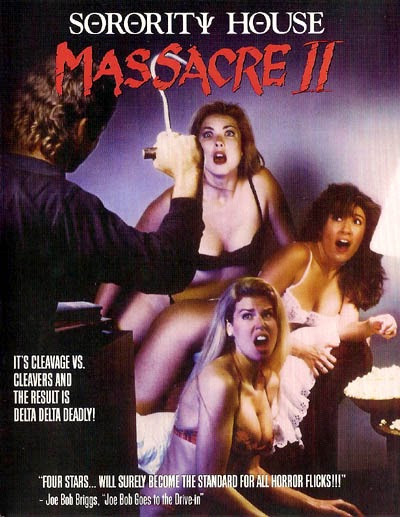
Cranpire Movie(s): Sorority House Massacre and Sorority House Massacre II
Welcome back to Cranpire Movies! It's been a little while since I visited this feature of the Blogorium, so maybe a quick refresher is in order. There are bad movies I like to watch, but many more of them that I just can't (or won't) find time to sit through. When that happens, I'll hand then off to my friend Cranpire, who will watch just about anything I won't. He's fond of Syfy Channel Original movies, and not just the new ones - thanks to Bruce Campbell's presence in Terminal Invasion, Alien Apocalypse, and The Man with the Screaming Brain, Cranpire was on board early with their quickly manufactured schlock. Every now and then, the Cap'n ends up watching something (usually accidentally) that would normally fall into Cranpire's wheelhouse, and when that happens, they are reviewed accordingly.
Today we're going to take a lot at the Sorority House Massacre series, specifically the first two. The third film - Hard to Die - is technically a sequel in that it has much of the same cast and uses the exact same back story, but it's also a Die Hard knock-off instead of a slasher flick, so I'll mention it in passing or when relevant. It's also worth noting that other than possibly using the same exterior, there's no continuity whatsoever between Sorority House Massacre and Sorority House Massacre II, although the second films does tie itself to a completely different slasher series. But more on that when we get to the sequel in name only.
For a Roger Corman produced, late-era slasher cheapie, Sorority House Massacre is kind of... classy? It's a relative term, I realize, but considering where it came from and what the marketing sells the film as, there's a comparably nuanced story buried inside of slashing and T&A. Yes, it's borrowing (heavily) from A Nightmare on Elm Street during the dream sequences, but the imagery is also suggestive of Dario Argento in a way you wouldn't expect. If you somehow end up seeing the films in the wrong order, you'd be shocked at how much better Sorority House Massacre is than its "sequel". While Carol Frank didn't quite make a "Feminist Slasher" on the same scale as Amy Jones and Rita Mae Brown's Slumber Party Massacre, it's definitely a less voyeuristic approach to the subgenre than I had expected.
Actually, it's debatable that Sorority House Massacre is even a slasher film at all, because the dream / psychic connection between the Final Girl and the Killer (shades of Halloween II) means we almost immediately meet our antagonist. Most of the film is about putting together how they're connected, what he's after, and what it has to do with the sorority house their paths collide in. By necessity, I'm going to SPOIL this, but it's hardly that since the audience is miles ahead of the characters for most of Sorority House Massacre. Beth (Angela O'Neill) is a withdrawn college student staying over at a friend's sorority house during Spring Break. Most of the girls are gone, including their sorority "mother," but when Beth arrives, she begins having nightmares about the house, of tables covered with blood and butchered mannequins. Her dreams begin to affect her waking life, and simultaneously Bobby (John C. Russell), an inmate in a mental institution, becomes more active, eventually escaping. He's looking for Laura, the only member of his family he didn't kill during a bloody massacre, and wouldn't you know it that Beth just happens to be her middle name...
Sorority House Massacre is not an especially violent or even gratuitous movie. Sure, there's nudity, but not in copious amounts (mostly taking place while Beth's friends (Wendy Martel, Pamela Ross, and Nicole Rio) try on the "rich" girl's clothes after she leaves, and during a Teepee make-out later in the movie), and most of the film's 77 minute running time is devoted to cutting between Beth's hallucinations / memories and Bobby coming "home". He kills just about everyone he runs into quickly, particularly the unfortunate boyfriends (Joe Nassi, Marcus Vaughter, and Vinnie Bilancio) of the main characters. What keeps Bobby interesting is that when he sees the women, it switches to his POV, where he imagines them as his sisters. He calls them not by their names, but by who he sees them as, almost as though he was killing them all over again. The disconnect between imagination and reality in the film actually makes the deaths that much more brutal.
Of the two films, the first Sorority House Massacre is probably less deserving of being a "Cranpire Movie": it's a lower-to-mid-tier slasher film, but is surprisingly atmospheric for a low budget horror film. While it borrows from better movies, Frank at least manages to make the "lifts" seem interesting, and the characters are at least developed enough that you care when they die. Horror hounds looking for a quick and bloody fix should probably go elsewhere, as this is (surprisingly) reserved considering where it came from, but I might have a film that's right up your alley in the next paragraph...
If Sorority House Massacre has some degree of class in the way it's presented, Sorority House Massacre II has all of the exploitation elements, and almost nothing else. Directed by Chopping Mall's Jim Wynorski, it offers gratuitous nudity, spurts of blood, leering perverts, dumb jokes, pointless subplot(s), and 60-ish minutes of nubile young ladies running around in their nighties, sometimes soaking wet. That said, as schlock goes, it's pretty entertaining, provided you're watching it in the right frame of mind. The opening should be a dead giveaway that it's not to be taken seriously, with an aggressive synthesizer soundtrack and pseudonyms in the credits like "Produced by Shelley Stoker" or introducing an actor as being the same person as his character.
The jokey tone is heightened after we're introduced to the new sorority sisters moving into a house that may or may not be the same one from the first film (if it's not, the exterior is pretty close, but the interior looks nothing like it - just a generic "house" set). In short order, we meet Linda (Robyn Harris), Jessica (Samurai Cop's Melissa Moore), Kimberly (Stacy Zhivago), Suzanne (Michelle Verran), and Janey (Dana Bentley), who are staying at their new house overnight until the power and phone utility men come over the next morning. They got the house cheap because it was the site of a series of murders five years ago, which kind of creeps out the girls, but they have tequila, so it's okay. They also meet their creepy neighbor from across the street, Orville Ketcham (himself) who, in addition to keeping the key to their basement in his underwear, was present during the original massacre. Just not the Sorority House Massacre.
For reasons unknown to me, instead of using the fact that there's already a Sorority House Massacre and it's kinda the same house and roughly five years later, Wynorski opts to use the back story from a completely different movie in both Sorority House Massacre II and Hard to Die. Even though the house looks nothing alike, all of the flashbacks to "Old Man Hocksteder" who went crazy and killed his family is footage from Slumber Party Massacre, another Corman produced slasher movie that has its own sequels. And it's a lengthy flashback to many of the "kill" scenes from Slumber Party Massacre, which uses a totally different murder weapon than the hook in Sorority House Massacre II. Why? Your guess is as good as mine, but it adds another layer of intertextuality, albeit a very silly one.
The girls, having taken cold showers and slipped into something more comfortable, go down into the basement and find a Ouija board, so they have a little séance - as you do - which ends in a spooky way. And by "spooky" I mean "basically what happens in Night of the Demons but much cheaper". Maybe it's the framing, but it's easy to spot the boom mike in many scenes, most notably in the living room near the beginning. It's also a shockingly well lit house for only having candles and a few portable lamps. Maybe it's the lightning that helps, although that looks an awful lot like the same stock animation I saw in Hillbillys in a Haunted House...
Anyway, so the girls try to get some sleep, but they have arguments about sleeping with a guy someone else is "going with," and somehow Jessica's 40-something boyfriend Eddie (Mike Elliott) never comes up again. Sorority House Massacre (mostly) waits until the boys come over to start a-murderin', but Sorority House Massacre II is ladies night through and through. Other than persistent cutaways to Ketcham looking menacing / loathsome, the bulk of the film is just gals in lingerie bouncing around the house, running into oddly placed bear traps (in the attic!) or getting murdered by a hook (despite the presence of a chainsaw in the basement). Interestingly, the drill that "Hocksteder" used to kill all of his victims in the "flashback" is nowhere to be found in the film.
To keep the "appropriating Slumber Party Massacre as a prequel to this film," Sorority House Massacre II has a subplot involving to cops (played by Jürgen Baum and Karen Chorak) who are slowly investigating a phone call that came from the "old Hocksteder place" - which, for the record, is the house with no phone service. They don't want to drive through a roadblock (or something) because of the rain, so instead they head to a strip club. If you're asking "why?" the answer is more breasts on camera while the action slows down back at the house, but the plot excuse is that one of the survivors of the original massacre is now stripping to work through her trauma. Candy (Bridget Carney) has her own routine, followed by a sit down with the cops while another stripper does her show (all on camera, of course), and suggests that maybe Ketcham shouldn't have been ruled out as a suspect. While this should surprise nobody, Bridget Carney wasn't in Slumber Party Massacre, nor was there a character named "Candy." But hey, more boobs, am I right fellas?
As it's really not clear where this movie should be going, Wynorski throws in a "possession" angle to justify the Ouija board, and while I won't tell you who ends up with Hocksteder's ghost at the wheel, I will give the director enough credit to make sure they're always where the killer would be or at least separated from the group. There's a lot of "let's split up" that you'd expect from really bad slasher movies, but in this instance it does serve as pretty good misdirection, at least until there aren't enough ladies left to rule out anybody else. Despite continually trying to imply that Ketcham is dangerous, it's pretty clear he's just a weirdo red herring, and despite being stabbed, choked with a chain, drowned in a toilet, and being shot by the police, he's still somehow alive at the end of the movie, not to mention the one who kills the, uh, Final Girl. It must have been all the raw meat he was eating earlier...
While I can easily say that Sorority House Massacre is pretty good "for what it is," it's difficult to say the same for Sorority House Massacre II. It is exactly the lurid, dumb, gratuitous slasher movie you think you're getting based on the cover. So it has that going for it. If you want cheap thrills, you'll mostly get them without groaning too much. Gone is any hint of artfulness, replaced with a workman-like approach of showing the goods and getting out. The comedy isn't that funny (trust me, I'm not sure if we're really supposed to laugh at the "Arab" stereotypes at the strip club, or just marvel at how dated they are), the gore is mostly limited to blood splattering on the wall (and one bathtub scene lifted from Slumber Party Massacre 2 - oh, did I not mention that there are more than one Slumber Party Massacre films?).
I guess the only thing that Wynorski really delivers on is the nudity, which I suspect Cranpire will agree is at least a selling point. They are attractive young women, and have no problem disrobing and taking cold showers for no reason, or standing directly underneath a porch dripping water in white nighties. Good for them? While Hard to Die is more of an "action comedy," it does have most of the same cast, including Orville Ketcham, playing the same kind of unkillable exposition machine he does in this one. Oh, and yes, the same flashbacks to a different movie. Well, the same different movie, because Hocksteder was a busy driller killer. As Cranpire Movies go, these are arguably better than his normal fare, but what is that really saying? I can easily recommend Sorority House Massacre and Sorority House Massacre II over the likes of Sharknado 2: The Second One and, uh, Sharknado 3: Oh Hell No, but they aren't going enhance your life or anything. Or maybe they will. Who knows, it might win you trivia one night, just by knowing what other series this one flashes back to. And if I'm being honest, the Sorority House Massacre movies are better than Slumber Party Massacre 2 and 3, so there's that. If you're the sort of person who hears the phrase "Cranpire Movie" and is excited, you're probably Cranpire, but if not, prepare for a fun double feature.
Tuesday, April 14, 2015
Bad Movie Night Recap
The time has once again come for Bad Movie Night: my shameless celebration of the movies that just aren't quite good enough, but also aren't so terrible they become unwatchable. It's a fine line, and sometimes it's just the right goofy element that pushes it over. Sometimes it's just who you watch it with, and the Cap'n has a fairly loyal crew of masochists willing to descend on Blogorium Headquarters every year. Even though I subjected them to Things last year, they came back. What that says about their cinematic fortitude is up to you, but I'm proud to call them my friends. This year, I opted to give them a less agonizing experience, but not without some serious brain bending. Let's take a look at what you (hopefully) missed out on:
We started with Devil Girl from Mars, based on the hit London stage play (or, that's what I'd like to believe), and it shows. Despite the fact that a Martian spaceship lands outside of a remote Scottish Inn, most of the motley crew of patrons are concerned with their own stupid problems, leaving time for Naya, the titular character, to enter and exit through the same door, repeatedly. At least it's nice to know that Martians also call their planet Mars. They - well, she - arrived on Earth with her new prototype spaceship, which has organic metal and runs on an engine that creates nuclear reactions that explode inward, creating perpetual motion. Their science is vastly superior to ours, but in the great war of the sexes, all men were wiped out and they need some breeding stock, if you catch my drift. Perhaps if she'd landed in America, rather than Scotland, this would have been an easier task, because the citizens of the United Kingdom are more interested in cockamamie plans to shoot or electrocute her, to no avail.
Brave newspaper columnist Mike Conner (or Carter, depending on who's saying his name) has the scoop of a lifetime, but would rather his on a fashion model hiding out in the inn. Thankfully his indeterminate accent doesn't bother her, and she even falls in love with him in the two hours between when they meet and when he agrees to join the Devil Girl on her ship. That, of course, is a ruse for him to try to steal the remote control for Johnny, a robot who "looks very similar to you Earth people," in that he looks nothing like humans but instead a guy in a robot costume. Naya has a ray gun that's effective on everything but glasses, constructs an invisible wall that the only scientist in the group somehow runs into headlong, and loves to open the same doors over and over and make sweeping pronouncements about how stupid we humans are. There are other characters, because we clearly care about an escaped adulterer who murdered his wife or some dumb kid, but the innkeeper's husband's name is Jamie Jameson, which is amusing. Also, they sit down to eat dinner at 10 o'clock at night. If only Mike and the Professor had taken the turn to "Loch Something" (actual line), they might have missed this unfortunately duller than it sounds movie.
Speaking of dull, I hadn't seen Disney's knock-off of Star Wars, The Black Hole, in close to 25 years, so I didn't remember what a bore it was. Fortunately, I also didn't remember a lot of other things about it, like the fact that a 90 minute film had an overture and that all of the music - by James Bond composer John Barry - sounded just like any other Bond music. I did remember the robot with the Texas accent, and that Event Horizon lifted quite a bit from this terrible, terrible movie. When it's not ripping off Star Wars, it's borrowing liberally from the released-the-same year Star Trek: The Motion Picture, and Forbidden Planet, and Battlestar Galactica, and pretty much any other vaguely popular science fiction film they could think of. To be perfectly honest with you, we lost interest about fifteen minutes in, started talking about the new music on Star Wars and about The Hobbit, and eventually made some jokes about Ernest Borgnine's libido and the movie Alligator, while pausing to note just how badly one could steal from George Lucas. I might have even said something kind about The Phantom Menace, which might be a first for the Cap'n.
High School Confidential! eased us out of the "boring" zone of bad movies - hey, I try, but sometimes things just don't land with the crowd - by being entirely too interested in being "hip" and "with it". That works wonders in its favor, because the ridiculous overuse of slang, coupled with what seems to be not even veiled suggestions about incest between Tony (Russ Tamblyn) and his aunt Gwen (Mamie Van Doren). In Tony's defense, it's mostly one way, and given there's a twist, I guess it's possible that they maybe aren't related, but why would he refer to her as his aunt behind closed doors? There are a number of questionable "bait and switch"-es in High School Confidential!, a movie about Tony moving in to town and taking over the high school drug trade in the course of two or three days. He's tough talking and backs it up, and pops his collar, even when it's on a sweater. Why? Because he's hip, daddy-o.
There are so many ways to address how hard the writers are trying to sound "cool" and failing miserably: the hip version of Columbus that J. I. Coleridge (John Drew Barrymore) "lays" on his class, or the awful (even for Beat Poetry) performance at a "Jazz Club" the kids all go to. Or the notion that marijuana is a gateway drug to heroin, and nothing else. Tony, a "7th year" high school student, immediately starts hitting on his teacher and also moves in on Coleridge's girl, who turns out to be a junkie. The drug kingpins in town are played by Charles Chaplin, Jr. and Jackie Coogan. Yes, Uncle Fester forces Tony to shoot up to prove he's not a narc. But wait, he is! (SPOILER) Tony is really Mike, who works with the cops, and there's a big shootout at the jazz club when a deal goes bad. Fortunately, the leader of The Rangers - played by Michael Landon - is there to help out, even though they're the rival gang to Tony's Wheelers and Dealers. Also, Jerry Lee Lewis begins and ends the film playing the title song, in what appears to be the same shot.
High School Confidential! picked up the pace a bit, and after a musical interlude, it was time to dive right into Raw Force. It's an almost perfect storm of kung-fu zombie cannibalism interspersed with gratuitous nudity and hokey special effects. And yet, some people were grumbling, perhaps because I oversold the "cannibal monks who raise kung-fu zombies" part of the movie. Yes, most of Raw Force's 86 minutes is devoted to a Kung-Fu cruise to "Warrior Island," where disgraced martial artists are buried. It's also where Hitler sells prostitutes in exchange for jade. Is his name Hitler in the movie? I honestly don't remember, but if he looks like Hitler and talks like Hitler, we're going to go with "that guy is Hitler". The cannibal monks eat the girls because it gives them power to raise the dead, which they use (eventually) for the final showdown.
In the meantime, there's a lot of showing off of kung-fu skills, coupled with late 70s / early 80s clothes, music, and nudity aboard the cruise ship. Almost everyone on the boat - from the cook to the bartender - seem to know how to fight, and are therefore well equipped to handle Hitler's lackeys. You see, despite the fact that Warrior Island is the home of an illicit human trafficking ring, it's also the subject of its own tourism guide. Because, why wouldn't it? When the cruise ship catches on fire (or, rather, has fire overlaid over the image), some of the passengers escape, and the rest are presumably killed. We never hear from them again, so let's just assume they died. What's important is that the life raft lands on Warrior Island and the monks raise the dead. There's lots of chop sockey, some decapitations, some dynamite, and piranhas. How are there piranhas in salt water, in the ocean? My guess is they couldn't find any stock footage of sharks. So Hitler gets munched on by piranhas (SPOILER).
Rather than launching into the "Luc Besson Presents an Affront to Science" double feature as promised, I gave them the option of getting the Trappening out of the way, which they decided was best. What they didn't know was that this year's mystery feature wasn't just a Bad Movie - it was a Great Bad Movie. By no stretch of the imagination could one call Commando a "good" movie, but I'll be damned if it isn't one of the most fun films to throw conventional cinema out the window. Continuity errors? Check. Bad one liners? Yessir. Gratuitous nudity? Well, it has absolutely nothing to do with the fight scene, so yep. The mall from Chopping Mall? Sure is! Arnold Schwarzenegger killing an entire army, single-handedly? You know it.
To get Alyssa Milano back, Arnold will plow his way through David Patrick Kelly (John Wick), Bill Duke (Predator), Dan Hedaya (Alien Resurrection), and finally The Road Warrior's Vernon Wells (Weird Science) for the mother of all bad puns. Oh, and his name is John Matrix, because Rambo is a pansy. I firmly believe that Commando is what everybody thinks all action movies from the 80s are like (that, and First Blood Part II), and why they hold the admittedly average Expendables series to an impossible standard. Matrix is introduced hauling a log down to a cabin (on his shoulder), and then eats ice cream and feeds a deer with his daughter. Because he's tough, but sensitive. Until you steal his daughter, and then he just kills you. Rae Dawn Chong's Cindy isn't even developed enough to have Stockholm Syndrome when she assumes the role of "new mom" at the end, having been kidnapped by Matrix less than twelve hours before. Commando is all killer and no filler, but I asked attendees to give it the same scrutiny as any of our other howlers, which is exactly the point at which you realize the many logic gaps and inherent flaws that make it technically "Bad." Now that everybody was in a great frame of mind, it was time to throw common sense out the door and let Luc Besson insult our basic intelligence...
I've been hosting official fests for nearly a decade now, and in all that time I have never heard the phrase "wait... what?" as many times as I did during Luc Besson's Lucy. Perhaps the mini-review in the "Worst Of" recap didn't quite convey just how painfully cavalier Lucy is with the concept of "science," but the reactions were hilarious. During the film, at least one large bottle of Kraken was consumed, and descriptions of what they'd seen ranged from "an atrocity" to "amazing." A friend of mine whose dissertation is on Philip K. Dick insists that it's not science fiction at all, but rather a brilliant example of "slipstream," a newer iteration of magical realism. The entire room erupted with laughter when Lucy (Scarlett Johansson) explained that she could "feel her brain" in what's supposed to be heartfelt scene over the phone with her mother. The comical, video-game-esque use of brain percentage "unlocked" was also a source of enjoyment, but nothing stood out quite as much as figuring out how long it took for Johansson to "say this horseshit with a straight face." One viewer worried that she could no longer take Morgan Freeman's Through the Wormhole seriously after seeing him in Lucy. I freely admit that Lucy is a bad movie, but it's a very entertaining one, and it was somewhat validating to see the baffled reactions as they tried to take Besson's affront to science seriously.
That said, I made a critical mistake in putting Lockout after Lucy, because by comparison, the former is just a "run of the mill bad science fiction film". It's true that after you've heard Scarlett Johansson explain what it's like to feel your bones growing, or to become the monolith from 2001, a high speed unicycle chase just doesn't have the same impact. Even my favorite line of awful science, "the gravity should keep you floating" just can't compete with Besson's double-down on Insane Clown Posse-like disdain for science. Lockout is still a bad movie, and it's insistence on identifying everyone and every location on screen (repeatedly, in the case of the latter) is amusing, but it just wasn't the same head-scratcher that it was in 2012. On the other hand, the outcries of mental anguish reconciling what Lucy was saying vs. what they knew to be true was more than worth it.
By the end of Lockout, just about everybody was ready to go, but a few stragglers felt like they had one more Bad Movie in them. Despite the fact that it meant Cap'n's Choice - I hadn't planned on anything past Lockout - they were willing to suffer through another one. Being that it was late, or comparatively late (we can't do movies until sunrise anymore), I opted to go short and show Cranpire a "Cranpire Movie": Sorority House Massacre II. As I'll be writing about that and the first Sorority House Massacre soon (and possibly Hard to Die), I won't go too into detail about it, but he enjoyed it. There's barely a plot, and most of the first half of the movie is devoted to showing as much gratuitous nudity as possible, followed by another 30 minutes or so of women running around a house in their nighties and going out in the rain for no good reason. Jim Wynorski (Chopping Mall) even takes a pointless side-trip to a strip club to shoehorn in more nudity under the specious logic that one of the characters from a flashback is now dancing topless. Classy stuff.
For the immediate future, I think I've hit my quota of schlock (although that doesn't rule out watching Furious 7). There's enough time to reload the queue in time for Summer Fest, where I think 80s cheesefests Without Warning and Deadly Eyes are going to be a hit. Thanks to everybody who made it, and to the folks at home who didn't, you now have a roadmap for your own Bad Movie Night. Just have alcohol and a good support system of friends nearby. And whatever you do, don't watch Things.
Subscribe to:
Posts (Atom)