Saturday, October 26, 2013

Shocktober Revisited: Documentaries - UnConventional

I've decided that it's best to keep this review short; otherwise, I'm going to feel like the Cap'n is kicking a dog when it's down. See, UnConventional may be the most unflattering document of any event I've seen on DVD.

Somewhere on the cover artwork, there's a statement along the lines of "Like Trekkies for Horror Fans", which I guess is technically true if you watched Trekkies the same way I did: as a collection of increasingly goofy people that make that one super-dork you know look cool by comparison. Which is what that movie is. Trekkies is a freak show disguised as a documentary about fandom, as is Ringers: The Lord of the Fans or whatever its called. You watch because you can't help but guffaw at these poor people, but you feel awful afterwards.

UnConventional is like that, but not entirely because of the subject matter. The film attempts to be about the 13th Annual Chiller Theater Convention in East Brunswick, New Jersey. Chiller Theater is, if you've read my review of American Scary, hosted by Zacherely the Cool Ghoul, one (if not) the first Horror Hosts on television.


While Zacherely appears in UnConventional periodically, the documentary focuses primarily on one person you've heard of, one you might kinda recognize the name of, and somebody the Cap'n had to look up to figure out what she'd been in. They are (in order): Gunnar "Leatherface" Hansen, 42nd Street Pete, and Tiffany Shepis.

This is not to say that there weren't many more recognizable names at the Chiller Theater Convention. Appearing briefly on camera are Sid Haig, Bill Moseley, Linda Blair, David Carradine, Kane Hodder, Michael Jai White, Linda Blair, Cybill Danning, and Tom Savini. If you take the credits' word for it, apparently Bruce Campbell, Clint Howard, and Elvira, among others who don't appear on camera for one reason or the other.

Instead, we spend the lion's share of our time with Tiffany Shepis, who I had to look up on IMDB, and found was in Abominable and a number of Troma movies, plus LOTS of movies I've never heard of. Considering how much narration by 42nd Street Pete (who also appears in the film and, as far as I can tell, is responsible for this) and fan interaction revolves around how hot Shepis is, I'm gathering she's the sex appeal for the documentary. Mostly she drinks, complains about fans, and later in the film appears in various states of undress.

This all seems somehow tame compared to the lesser billed "star", Bob Gonzo. The producer, writer, director, and pimp employer of "Gonzo's Gorgeous Girls", Gonzo makes movies that would barely classify as "horror." Think of Fred Olen Ray crossed with the film Snuff and you have some idea. Bob Gonzo has a table at the convention to sell his sexploitation films (of which he's also the star) and to let attendees oogle his girls, who also show up. Sleazy doesn't begin to cover it.

Only Gunnar Hansen comes off looking good, mostly because he's such a genuinely likable guy in UnConventional. He's not really that attached to being Leatherface, but appreciates the fans and stays for the three day convention in order to make them happy. He doesn't get involved in the drunken parties that make up the Chiller Theater after-hours portion(s) of the doc, and is happy to sit down and talk about The Texas Chain Saw Massacre and horror fandom during the movie.

In fact, I gather that the Chiller Theater Convention is actually a reasonably cool place to be. I don't know, because UnConventional is a documentary which seems to point the camera in all the least interesting directions - like 42nd Street Pete pretending to vomit in a trash can or the world's lamest Horror Auction - for 90 minutes.

It also doesn't help that the documentary feels so low rent. At times it feels more like a collection of home movies than an actual film, and none of it seems all that intriguing to people not directly involved in the convention. The Cap'n will admit that he turned UnConventional off a few times out of boredom, particularly when they seem to run out of things to do and send Shepis down to the laundry room of the hotel in a skimpy dress.

See? This is just getting mean. I don't know any of the people involved in UnConventional, and I don't have any reason to believe they'd ever read a review of their documentary from 2004, but I feel bad beating up on them. They were doing the best they could, and I guess they thought all of this footage was pretty cool. The problem is that it makes them look silly, the fans look idiotic, and the convention look cheap and uninteresting. All of that may not be the case, but UnConventional doesn't leave me with any other verdict.

Friday, October 25, 2013

Shocktober Revisited: Documentaries - American Scary and The 50 Worst Movies Ever Made

Well, one documentary and a "list" movie, American Scary and The 50 Worst Movies Ever Made, both thanks to Netflix streaming video.

---

American Scary is easily the better of the two: it deals specifically with the cultural trend of "Horror Movie Hosts" which caught on regionally in the 50s and 60s. For those not familiar with the movement or have just heard of Elvira by reputation, in the early days of television the networks were starved for content to fill out their schedules. The film studios began leasing out their back catalogs (particularly horror) to the stations, and local stations would punctuate the films with a gag-spouting "host" who alleviated the tension for kids watching at home. As the "Horror Movie Host" spread, it ended up at all hours of the day and grew popular with local audiences.

The documentary covers the birth of the "Host", takes a regional journey through hosts in Chicago, Cleveland, Philadelphia, and Trenton. Many of the surviving Hosts are on hand to tell their stories, including Roland / Zacherley, Vampira, Ghoularid, Count Gore D. Vol, Crematoria Mortem, Son of the Ghoul, and Penny Dreadful. Elvira doesn't appear in the interviews but he impact is mentioned on a national level.

Along for the ride to share memories of the Hosts are Neil Gaiman, Curtis "Booger" Armstrong, Joe Bob Briggs, Bob Burns, author James Morrow, Chris Gore of Film Threat, Joel Hodgson of MST3k, Tim Conway, Leonard Maltin, Patricia Tallman (the evil witch in Army of Darkness), John Kassir (the Crypt-Keeper), Len Wein and Phil Tippett.

I found the discussion of MST3k's role in carrying on the "host" tradition (albeit in different ways) an interesting take on the show's impact. If you look at Mystery Science Theater 3000 in that light, it does bridge the gap between the corporatization of network television (which effectively ended "Horror Hosts") and the rise of Public Access "Horror Hosts". It's strange that while Joe Bob Briggs appears, no mention is made of Monster Vision. USA Up All Night also fails to register even though it did similar work.

Still, this is quality stuff, and you'll get a lot of footage from people you may have only read about. Check it out.

---


The 50 Worst Movies Ever Made is less a documentary and more of a quick hit kind of list. The "movie" itself is 60 minutes long, so you can do the math. Generally you spend barely more than a minute with each film (the runtime includes credits and "graphics" devoted to a booing audience) so it's more of an overview than anything.

All things considered, I did pick up a few ideas for future Bad Movie Nights, and I buffered out the "trailer gallery" for this weekend (available here). I can't really argue with the list too much (other than possibly Spider Baby, which I like), but here are the 50 Worst Movies Ever Made:

50. Glen or Glenda?
49. Mesa of Lost Women
48. Troll
47. Teenage Zombies
46. The Fat Spy
45. Voodoo Woman
44. Ishtar
43. Frankenstein Conquers the World
42. The Creeping Terror
41. Santa Claus Conquers the Martians
40. Howard the Duck
39. They Saved Hitler's Brain
38. Black Belt Jones
37. Greetings!
36. The Great Alligator
35. Hillbillys in a Haunted House
34. TNT Jackson
33. Robot Monster
32. The Incredible Melting Man
31. Firebird 2015 A.D.
30. Dracula Vs. Frankenstein
29. Bride of the Monster
28. Smokey and the Bandit Part 3
27. Xanadu
26. Leonard Part 6
25. The Wild Women of Wongo
24. Bela Lugosi Meets a Brooklyn Gorilla
23. The Ape
22. Galaxy of Terror
21. The Robot vs the Aztec Mummy
20. Snow White (German Version)
19. Creature from the Haunted Sea
18. The Swinging Cheerleaders
17. Trial of Billy Jack
16. Killers from Space
15. Spider Baby
14. Trog
13. The Three Stooges in Orbit
12. The Crippled Masters
11. Sorceress
10. The Crawling Hand
9. Bloodsucking Freaks
8. J.D.'s Revenge
7. Frankenstein Meets the Space Monster
6. Killer Shrews
5. Great White
4. Plan 9 from Outer Space
3. The Thing with Two Heads
2. Eegah!
1. The Incredibly Strange Creatures Who Stopped Living and Became Mixed Up Zombies


Honestly this "movie" has next to no value unless you want a quick overview of some bad movies with next to no insight and clips of bad acting and cheap monsters. All Monsters Attack is better for that, as are the 42nd Street Forever discs. This is a "Watch Once" at best, but I'd advise skipping it altogether.

Thursday, October 24, 2013

Shocktober Revisited: Documentaries - Going to PIeces; The Rise and Fall of the Slasher FIlm


 Going to Pieces: The Rise and Fall of the Slasher Film is a pretty good documentary, if a little light on content. Truthfully, it's a pretty good overview of the genre (with the exception of never mentioning Black Christmas and only showing clips of it during a montage of kills), but you could make much longer pieces about any number of sub-sections they spend time on. Sure, there are plenty of lengthy docs about the Friday the 13th series and at least three really good Halloween documentaries, and more Tom Savini featurettes than you can shake a stick at. Still, there's some interesting stuff tucked into the middle section of the movie, including the first acknowledgment of Splatter University's existence I've seen. Some lesser discussed slasher and post-slasher movies get their due; movies like The Prowler, Sleepaway Camp, He Knows You're Alone, and April Fool's Day. Even something as shitty as Return to Horror High gets a quick mention.

As noted above, many devotees to the genre are going to wonder why certain movies don't get as much attention (Alice, Sweet Alice, Black Christmas, and a deeper investigation of Suspiria's influence) and the transitional music is a little distracting, even if it is by Harry Manfredini (he of the ch-ch-ch kill-kill-kill). There's sort of a lull between A Nightmare on Elm Street and Scream, but the movie is so front heavy you might not notice.

There's also the curious style of interviewing people: the director really must have wanted something different, because some interviewees are constantly walking or being circled by the camera (the editor of Fangoria and Greg Nicotero stand out) and the camera is sometimes uncomfortably close to people like Tom Savini and Robert Shaye of New Line. Still, the line up of people interviewed is pretty impressive. Of particular note are Felissa Rose (the original Angela from Sleepaway Camp) and Fred Walton, who defends April Fool's Day and its twist ending, insisting that Paramount decided to market the film as a slasher movie. Oh, and kudos to Going to Pieces covering the feminist angle on Slumber Party Massacre during the "Critic Bashing" section.

You may not have the same problem that I did with this, but the movie itself would not play from the dvd menu. In fact, nothing would; I had to press stop and then play again to get the film itself to play. None of the special features would play either, which bummed me out because there was a bonus interview with Bob Clark, director of Black Christmas (and, incidentally, A Christmas Story) which leads me to believe there was some coverage of Black Christmas cut from the film. Bummer.

At 88 minutes, Going to Pieces is possibly too short, but if you're a fan of slasher movies or want to give somebody a good primer on the genre, it's certainly worth watching. Some of the stories won't be new, but the inclusion of lesser known entries and the people who made them more than cover for old anecdotes. If you can get the dvd to play, it comes Recommended.

Now bring on the follow-ups!

Wednesday, October 23, 2013

Shocktober Revisited: The Descent Part 2

Folks, I have good news and bad news. Let's get the bad news out of the way first.

By definition, The Descent: Part 2 is an unnecessary sequel. There is no reason for the film to exist, because the story is predicated on an assumption that director Neil Marshall's original ending to The Descent didn't happen. For you to even buy into The Descent: Part 2, viewers need to go with the truncated "American" ending, where Sarah (Shauna MacDonald) does escape and drives off for that last minute jump scare. The movie tries to play off her escape from the caves in a different way, but it still undermines the original ending, where it's clear she's bonkers and never leaving. But let's say we buy into that for the sake of watching this film - which is not directed or written by Marshall - and simply move forward.

So two days after the cast of The Descent go missing, a police search is underway with media coverage. It turns out that Juno (Natalie Mendoza) is the daughter of a Senator, so there's a pressing urge to find her. When Sheriff Vaines (Gavin O'Herlihy) finds out Sarah made it out and is in a nearby hospital, he drags her - along with his deputy Ellen Rios (Krysten Cummings), a spelunking instructor (Douglas Hodge) and his assistants/students (Joshua Dallas and Anna Skellern) - back into the cave system to find Juno and the other girls. Vaines assumes that Sarah killed Juno on account of all of the blood on her clothes and her semi-catatonic state.

The biggest problems I have with The Descent: Part 2 are in the opening. There's a big hurry to get back into the caves, so Vaines brings Sarah back out to the Appalachians hours after she's taken to the hospital. In fact, there's a pretty good reason to believe she's still sedated considering how choppy the narrative is up front. The other serious issue is Vaines' insistence that instead of re-directing the search in light of this discovery, he instead keeps it hush-hush and brings along an ill-equipped search team. Two police officers with no experience underground (one of whom appears to be the department's psychiatrist), a trauma victim, two students, and only one person who seems to know what he's doing. It doesn't make any sense.

But there is good news. Once the six of them get into the caves again, things get better. While the sense of claustrophobia isn't quite as pervasive as it was in The Descent, when things get tight later in the film, it does finally get unnerving. The unmemorable characters are dispensed with quickly by the Crawlers, and there is a reasonably good sense of tension in the second half of the film, particularly after (SPOILER) Juno turns out to be alive. (one minor point of contention - the opening is pretty clear that they've only been missing two days, one of which is theoretically the day in which the first film takes place, so it's a little odd that Juno goes quite as "feral" as she does when Vaines catches up with her).

Once the teams are split up and Sarah snaps of her "Barbara in Night of the Living Dead" state, it's actually a pretty good movie. Director Jon Harris finds interesting ways to keep the caves fresh, and has the good sense not to mess with what works. The Crawlers aren't really any different than they were in the first film, and that's probably for the best. It's harder to scare viewers when all the really good reveals were used in the first film, but Part 2 finds other ways to keep things moving.

The big one, I have to say, is that the gore in this film is a) all practical, and b) really gross. It's not often that you can have one really good disgusting gore moment, but Part 2 has several. A handful of them build off of deaths from the first film, but there's one moment in particular that I both give the writers and director credit for and found alternately pretty tasteless.

I imagine that most of you remember the "blood pool" scene in The Descent, so you're expecting something like that to happen in the second film. And it does. But it's not blood this time. In fact, it isn't really clear what Sarah and Rios are swimming in until a Crawler wanders over to the edge of the pool, turns around, and shits. Yes, they've been fighting in the toilet. Gross. As stupid as it sounds, the way it's revealed is more revolting than stupid, but it should give you some idea of where Part 2 is willing to go.

The acting is kinda all over the map, but Shauna MacDonald and Natalie Mendoza are still good, and when they finally cross paths again there's a nice moment of grudging respect that either one of them survived. Krysten Cummings emerges from Part 2 as the most memorable character, which is all the better considering a much better surprise ending in this film. I'm not going to spoil it, because I honestly didn't see what ends up happening coming ahead of time. That also bumps the movie into "better than I expected" territory.

Overall, while it's nowhere in the same ball park as The Descent, I have to say that Part 2 is a reasonably fun horror movie, and much better than I was expecting it to be. I thought I'd be getting into another s. Darko "so you won't have to", but this is worth checking out. Since it's going direct to DVD, I don't need to recommend you wait to rent it, because that's really your option. It's quite watchable after a bumpy beginning, and despite the fact that there is no reason for it to exist, The Descent: Part 2 is one of the better unnecessary sequels I've seen.

Tuesday, October 22, 2013

Shocktober Revisited: The House That Dripped Blood

Since it is October, and since Cap'n Howdy's Blogorium could be described as "horror themed" in its layout, I guess I should make with the reviewing horror movies that won't be a part of our annual celebration in two weeks. Fortunately for you, dear readers, I have a shelf full of horror flicks waiting to be discussed. We'll start this semi-regular column with 1971's The House that Dripped Blood.

I've made no secret of my love for anthology films, specifically those coming from Amicus Productions, so it was a surprise to me to discover that I'd never gotten around to watching The House that Dripped Blood. It turns out that House is a pretty good addition to their collection of supernaturally based horror films. The cast is great, the direction is atmospheric, and most of the stories work in context.

Like most anthology films, you get four stories with a bit of a wrap-around, and House that Dripped Blood covers most of your horror bases: Spectral Killers, Vampires, Witchcraft, and evil museums / shops of mystery. The stories, by Robert Bloch (author of Psycho) are:

1. A writer (Denholm Elliot) and his wife move into the house in question so he can finish his macabre masterpiece. When his creation, a mad strangler named Dominick, starts to appear in and around the house, he's convinced his grip on reality is slipping.

2. A recently retired businessman (Peter Cushing) moves into the house, and while wandering the nearby town, finds a wax museum of horrors. He becomes obsessed with a figure of Salome that reminds him of a long lost love, and when a visiting friend goes missing, the terrible secret of the museum comes to light.

3. A not-retired businessman (Christopher Lee) and his daughter (Chloe Franks) come to the house to get away from the city. When a tutor (Nyree Dawn Porter) begins to connect with the distant and sheltered child, her true nature comes to light, with terrible consequences.

4. An actor and horror-buff (Jon "The Third Doctor" Pertwee) and his co-star (Ingrid Pitt) rent out the house while he's filming Curse of the Bloodsucker. Convinced that his cape looks too cheap, he visits the mysterious Theo Von Hartmann's shop and buys an authentic vampire cape. Maybe a little too authentic, as he discovers when he puts it on.

The wrap-around story involves a detective (John Bennett) investigating the disappearance of Pertwee's character. The owner of the house, Mr. Stoker (John Bryans) shares the mysterious history of the tenants. When Inspector Holloway finally goes to the house, he finds much more than he expected in the basement...

I think the third and fourth stories were my favorite. Admittedly, the Jon Pertwee story gets quite silly in the middle (especially when he puts the cape on after midnight and reacts hammily to his fangs and... flying), but it is salvaged by Holloway's visit, one that ties up the film nicely.

The first story, about the writer and his mad killer, suffers from a rushed ending, one that relies on you paying attention to a last second development based on a character you just met. The set up is wonderful, and most of the lingering architectural shots and creepy ornaments does soften the weak ending.

Despite the really trippy dream imagery in the second story, the ending just doesn't make sense. Something happens to the wax figure that, if what the owner says is true, would render it impossible to be fixed in time for the last shot. The final image, on the other hand, is a pretty good one.

Despite the fact that the film (rated PG) is virtually bloodless, there's plenty of atmosphere and suggested horrors to raise a bit of a chill. This is more evident in the witchcraft story with Christopher Lee, which relies entirely on suggestion for its gruesome finale. The House that Dripped Blood isn't as gory as Tales from the Crypt or From Beyond the Grave, and it might come off as a little tame compared to what was to come. However, taken with the much earlier Dr. Terror's House of Horrors, I think House fits the Amicus m.o.

Finally. the title is a little misleading, because while the film is about four tenants who died (separately) in the same house, at least two of the stories really have nothing to do with house as evil. They attempt to tie everything together with Stoker directly addressing the audience (something that seemed strangely familiar, although I'm convinced I've never seen this before), but if you're willing to put the misnomer of the title aside, it's a fun little spookshow you could probably scare children with - and not scar them permanently.

Monday, October 21, 2013

Shocktober Revisited: Slaughter of the Vampires

Previously on Cap'n Howdy's Blogorium:

I started but haven't finished watching Slaughter of the Vampires, which is a nice slice of Italian Cleavesploitation (no nudity, but lots of nubile young ladies in very tight bodices for no reason whatsoever) and I guess a vampire. I mean, there is one, but I'm not far enough in to see what his plan is, other than finding a new vampire bride (the old one was left behind and staked by angry villagers).

The film is dubbed but it's not such a bad thing. I don't honestly know how watchable it would be with subtitles, and horror is the universal language, y'know? Besides, I'm pretty sure that the vampire is a German gentleman and perhaps this was a multilingual shoot, like those Spaghetti Westerns.

For some reason, this movie was released stateside as Curse of the Blood Ghouls, which is admittedly a better title, but it doesn't set you up for any vampire slaughter. I like it when the movie promises you something and then kinda delivers on it in the first three minutes. Hopefully there's more slaughtering to come.

Here's the trailer, which looks much worse than the dvd picture does. Kudos to Dark Sky Films for cleaning this up, I suppose.

We now return to our regularly scheduled programming:

I'll give Slaughter of the Vampires this: it's a more appropriate title than Curse of the Blood Ghouls, but just barely. Technically speaking, three vampires are killed, so it earns the plural quotient, and at least one of them is stabbed pretty viciously, so I'll count that as "slaughter". Otherwise, there's not much about the trailer or the title of the film that would be considered "accurate".

Most of Slaughter of the Vampires is about talking. And waiting. And talking about waiting. There's some momentum at the beginning, when the Vampire (he has no actual name, just Vampire, but is played by Dieter Eppler) and his first vampire bride (not sure who) are running like crazy from angry villagers. After he escapes and she doesn't, Count... uh, Vampire rides like crazy in a carriage to a castle. It's not really clear how he knows about the castle or if he lived there, but he moves into the cellar.

The castle belongs to Wolfgang (Walter Brandi) and Louise (Graziella Granata) and assorted servants. The Count takes a liking to Louise and decides to make her his new vampire bride. Very. Slowly. So slowly that Wolfgang has lots of time to talk about it with the servants and a Doctor and then to travel out of town to visit Dr. Nietzsche (Luigi Batzella). They talk some more and eventually get around to hunting down Louise, Count Vampire, and Louise's inexplicably vamped out servant maiden (also don't know the name. IMDB is a little vague).

As I said before, the movie is 79 minutes long. During that time I fell asleep three or four times, woke up, and rewound the dvd only to discover I'd missed nothing. Typically, it was a shot of Wolfgang 0r Dr. Nietzsche waiting for something to happen, followed by a shot of the vampire or Louise with "dramatic" music, except that they were also waiting. There's a lot of waiting for a movie where almost nothing happens.

I will say two things kept my attention, and neither one of them were the abundant cleavesploitation of Louise (who spends 80% of the movie in a low cut nightgown):

1. Count Vampire's main theme is played on a Theremin, which has the exact opposite effect they were intending (rather than mysterious and creepy, it's pretty silly).

2. The dubbing is done the same way many Japanese films are dubbed, so you get lots of overexplained sentences in order to match the mouths of characters. For example, Wolfgang says "Here comes the Doctor who was a good friend of mine in school. He will help you out he is a good Doctor. He does not bother you, does he little girl, you are not afraid of Doctors."

For a movie with a gratuitous bath scene (I mean, there is absolutely no reason for the bath, unless you really need to argue re-introducing a character late in the film) which is less suggestive than Louise's nightgown, Slaughter of the Vampires is pretty lackluster. I should have known better than to rewind after nodding off, because I probably stretched the running time into actual 90 minute territory as a result, and this movie doesn't deserve it.

Sunday, October 20, 2013

Horror Fest VIII (Day Three): The Wolf Man, Frankenstein Meets the Wolf Man, and John Dies at the End


 "Even a man who is pure of heart
     and says his prayers by night
         may become a wolf when the wolfsbane blooms
            and the autumn moon is bright"

 That's the poem uttered three times in the first twenty minutes of The Wolf Man, so that audiences won't forget that the movie they came to see (The Wolf Man) is about a man who becomes a wolf. The man in question is Lawrence Talbot (Lon Chaney, Jr.) although you wouldn't know that from the opening credits, which bill Chaney as "The Wolf Man." I must imagine that when The Wolf Man ran on television during the 1950s and 60s that its opening looked familiar to children: title cards introducing the characters play over a brief clip of them from some point in the film, a template of sorts for most TV sitcoms and many dramas.

 Back to the poem for a moment, because the one takeaway I had from watching The Wolf Man this time is that Lawrence Talbot isn't really a man who is "pure of heart" at all. In fact, he's kind of sleazy: not only does he use his father's telescope to spy on Gwen Conliffe (Evelyn Ankers), but he then uses that information while in her father's pawn shop to put the moves on her. He gives her some business about being psychic, but even when he eventually comes clean about how he knew about her earrings, it's still in an unrepentantly smarmy fashion. It's no wonder that she doesn't want to go with him to the gypsy camp and brings along her friend Jenny (Fay Helm).

 It's a good thing that Talbot buys a cane with a silver wolf's head, because the gypsy woman Maleva (Maria Ouspenskaya) is hiding a secret: her son, Bela (Bela Lugosi) is a Dracula... no, wait. That's not right. He's also a wolf man, and while reading Jenny's fortune, Bela realizes she's his next victim. He sends Jenny away, but she can't run fast enough and he attacks her in wolf form (more like German Shepherd form, but you get the idea) and Talbot is injured while killing said wolf with his cane.

 I'm being a little unkind to The Wolf Man, one of the Universal Classic Monster movies that I was always the fondest of, and I do feel bad about that. I had always remembered Lawrence Talbot as something of a tragic figure, something that continued as long as Chaney reprises the role in various quasi-sequels (House of Frankenstein, Abbot and Costello Meet Frankenstein), but it's hard to feel too sympathetic about a guy who clearly doesn't care that Gwen already has a boyfriend and who behaves in such an underhanded way when he meets her. Perhaps it's supposed to be charming, but when he reveals that he has a telescope and she says "from now on I'll be sure to draw the curtains" and he tells her not to, that's just creepy.

 Talbot is more sympathetic in Frankenstein Meets the Wolf Man, to be sure; after having been killed by his father (Claude Rains, the Invisible Man himself), Lawrence is placed in the family mausoleum, where he at least has peace (as promised by Maleva upon his death). That is, until the two graverobbers show up and break in, looking for jewels. They open Lawrence's coffin and move some of the wolfsbane so they can take his ring (but not before saying the poem for people who might not remember) but seeing as it is a full moon, after all, it's hard to keep a dead werewolf down...

 Revived and apparently immortal, Talbot is found in Cardiff and taken to a nearby hospital with head trauma (the cane wound that killed him) and he's patched up by Dr. Mannering (Patric Knowles) while the authorities try to figure out who their mystery man is. Lawrence Talbot has been dead for four years, so the man in the hospital can't possibly be who he claims he is. And the following night a police officer is murdered by a wolf, something that Talbot seems to know about.

 In The Wolf Man, Sir John Talbot and the authorities regard Lawrence's claims of being "dangerous" as an illness of the mind, but Dr. Mannering seems much more willing to accept his "affliction," although there's quite a while between when they are together in the story. Lawrence leaves the hospital (and Wales) to track down Maleva and find a way to die. He has no interest in being cured, only in no longer living - which is fair, considering that he was dead.

 Frankenstein Meets the Wolf Man opens the scope of the first film considerably, and by necessity. Maleva is not only somewhere in Europe, but she's also nowhere near where the two of them need to be in order to help Lawrence. Maleva has heard of a man, named Frankenstein, who might be able to help Talbot, so they travel to Vasaria, the (fictional) home nation of the Frankenstein family, only to find that Ludwig Frankenstein is dead and that the burnt down castle has been abandoned.

 The person I was watching Frankenstein Meets The Wolf Man with had not seen Ghost of Frankenstein, which caused a bit of a conundrum here, because until Baroness Elsa Frankenstein (Illona Massey) mentions that the experiments killed her father AND her grandfather, it's not stated in the film which Frankenstein is dead when Talbot arrives. As this is a sequel to both The Wolf Man and Ghost of Frankenstein, it's a good idea to be caught up on both series. (They do play it a bit fast and loose with chronology, though: in The Wolf Man you can clearly see cars driving around town, but by Frankenstein Meets The Wolf Man either there are no cars in Eastern Europe and Cardiff or Lawrence was dead for four years and traveled backwards in time. By the same token they have a hydroelectric dam in Vasaria - they mention that it powers the equipment in the castle - so it's anybody's guess)

 At any rate, Talbot finds Frankenstein's monster (Bela Lugosi) frozen in ice and thaws him / it out in the hopes of finding some way to end his existence, and ultimately decides to contact the only surviving Frankenstein (Massey) to see if she can help him. The Baroness is not a scientist and wants nothing to do with the family, but during the Vasarian equivalent of Oktoberfest, Dr. Mannering finds Talbot and the merry band settle in at the castle to see if energy can be drained from Talbot and the monster, finally killing both of them.

 The villagers are, understandably, weary of any activity involving a Frankenstein. They have good reason to be, as Mannering can't help but try to bring the monster back to full strength. Lucky for him (and us), they choose to experiment during a full moon. Well, that's a little fuzzy. I'm not sure if it's a full moon or if the experiment causes Talbot to turn into the Wolf Man (which Chaney is again billed as), but what's important is that the monster smackdown ensues to close out the film. How the Baroness and Dr. Mannering (and, I'm hoping, Maleva) manage to escape the exploding dam above the castle is a manner of movie convenience, but the two monsters presumably perish in the ensuing flood - as would everyone in the village below.

 Interesting tidbit time: Bela Lugosi and Patric Knowles appear in both The Wolf Man and Frankenstein Meets the Wolf Man, albeit playing different roles each time. Ilona Massey, who plays Elsa Frankenstein, replaces Evelyn Ankers, who played Elsa in Ghost of Frankenstein, because it might be a little weird for the woman who played Gwen Conliffe to also be Baroness Frankenstein. All of the monster (Lugosi)'s dialogue was cut from Frankenstein Meets the Wolf Man, which makes it tricky to understand why it walks arms outstretched. The reason? In Ghost of Frankenstein, the monster is blind as a result of receiving Ygor (Lugosi again)'s brain. Vasaria, is, by the way, a post-World War II replacement for Germany, where the original Frankenstein was set, created by writer Curt Siodmak.

---

 Finally we come to John Dies at the End, the best possible adaptation of David Wong's novel that Don Coscarelli could make with the budget he had. That's not a knock on the movie, because I can't imagine it would be easy to faithfully adapt that book considering how many crazy, outlandish, and disgusting moments are on nearly every page. Without the money to clear the many songs mentioned in the book, or to include Fred Durst, or to even be able to include the section in Vegas (it should happen instead of going straight to the mall, for those who have only seen the movie), let alone what happens AFTER David and John come back from the dimension Korrok originates from, it's impressive how close to the book John Dies at the End is. The first hour or so picks up all of the major beats with only a few omissions (where David works, Amy's brother, and some of the names of characters in the film).

 As much as I want to resist the temptation to compare the book to the movie, it tends to happen without trying. So many people I know read John Dies at the End (how can you not when someone describes it as "GrossBusters"?) and while I'm glad that the movie works for audiences who haven't read it, I have no idea how it would play if I didn't know where the story was going. It's a collection of some of the stranger moments you'll ever see onscreen. I am impressed that Coscarelli turned what is an episodic structure in the book and made it more streamlined (mostly by dropping some of the detours) even if the ending is... abrupt.

 I would imagine even if you hadn't read the book, the sudden leap from "things from another dimension that invade people and cause them to explode" to "welcome to the dimension of Korrok" must be a little jarring, even in a film where a guy's mustache flies off and attacks our hero. The last section of the film happens so quickly and is so packed with exposition that I'm kind of impressed it works at all. The coda during the credits eases things a bit, and the resolution to Arnie's frame story is surprisingly bittersweet for a movie so ready to shrug off the bizarre with "what's next?"

 And yes, it still plays well the third time. I suspect it will the fourth, fifth, and so on, to boot. John Dies at the End may not be the level of "cult" film of Coscarelli's Phantasm series or as beloved as Bubba Ho-Tep, but I suspect that it will grow an audience for a long time on home video. It's just a shame that Coscarelli killed one major character, making a This Book is Full of Spiders adaptation very, very difficult, if not out right impossible. Then again, if they ran out of money for the spiders scene in John Dies at the End and had to animate it, there's probably no chance you could make This Book is Full of Spiders into a movie (the scope is considerably larger). But read both books, if you haven't. It isn't going to hurt the movie one bit.

 Horror Fest VIII has come to a close, and I'll tell you it's been a good year for the Cap'n and Fests. Bad Movie Night was a blast, Summer Fest 5 had some great moments, and Horror Fest VIII may be my favorite to date, rivaling only III and V. I'm looking forward to next year - I hope you are too.

Horror Fest VIII (Day Two): The Haunting and The Woman in Black


 I have a piece of advice for any character in a Nightmare on Elm Street sequel (remakequel?): if you really need to stay up, like not fall asleep at all, just watch The Haunting and The Woman in Black back to back. Do it alone in the middle of the night and you'll be too terrified to close your eyes, let alone fall asleep. Freddy will just be twiddling his thumbs, waiting impatiently while you seek every shadow for the terrible ghosts waiting to murder you.

  Nancy had the right idea trying to watch The Evil Dead, but there's something to be said for an atmospheric haunted house movie. Many contenders are out there, and horror fans have their favorites, but for me, Robert Wise's The Haunting edges out The Innocents and The Uninvited. The only one that comes close for the Cap'n is Lady in White, and that has everything to do with the fact that it terrified me as a child. But The Haunting is, for me, the haunted house movie to go to and it's all about atmosphere.

 You never see a ghost in The Haunting, and, in fact, the only "effect" on camera is the pulsing door between Nell (Julie Harris), Theo (Claire Bloom), and whatever might be on the other side. Wise relies entirely on sound and the cast does the rest of the work, with Harris handling the brunt of the scares. It's a fair argument as to whether Hill House is actually haunted or if Nell's tenuous grip on reality is feeding off of the creepy vibe. She's not helped in any way by the distant Dr. Markway (Richard Johnson), the emotionally manipulative Theodora, or the pragmatic but otherwise "audience surrogate" Luke (Russ Tamblyn). Is she losing it or do the spirits haunting Hill House really have it in for the most vulnerable member of this research team?

 The Haunting is a brilliant exercise in audience manipulation, slipping you into Nell's mindset without the benefit of snapping you back to reality. The response from other members seems unwarranted, but we're predisposed to her perspective, so of course something is trying to get her. Only on the other side of the credits is the ambiguity more clear - are they really under attack or feeding off of each other's anticipation for something to happen? Did something really move or were we not paying attention to the background carefully? The imagination is really quite a powerful tool to scare, and you won't find many better of building tension merely by suggestion until things literally go careening off of the road.

 The Woman in Black is less subtle, and designed with more "jump" scares - although nowhere near the level you'd find in a Paranormal Activity or Haunting in Connecticut - as well as making it pretty clear there IS a ghost and that she has the power to directly impact the world of the living. That said, the second theatrical release from the newly branded Hammer Films (the first was Let Me In) has enough atmosphere to carry it past the mandatory "scares" modern audiences seemingly require.

 I've already reviewed The Woman in Black here at the Blogorium, and I selected it specifically because it does make you fear the darkness in your own home. Where the Cap'n lives, there's an upstairs "loft" section that overlooks the living room, and I won't pretend I haven't glanced up there while writing this. It's late and there's nobody else here but... you never know.

  While I'm pretty sure I mentioned this last time (forgive me, it's late... or early, I guess), but I do appreciate that director James Watkins takes a slow approach with the ghost. Instead of lots of "jump" scares, there are long scenes wherein Arthur (Daniel Radcliffe) is sleeping or distracted while in Eel House and the "woman in black" appears and creeps up on him. We can see her, but he can't, and the tension is palpable. It's so much easier to have "nothing, nothing nothing, LOUD NOISE," but until late in the film Watkins resists doing that much with the titular specter. It's much appreciated, and to be honest, that set up / pay-off isn't going to work as well after Sam Raimi took modern horror directors to school with "jump" scares in Drag Me to Hell.

 I'm still not gaga about the very end (what happens to Arthur is appropriate and narrative-ly inevitable), but that last shot is... I don't know. Yes, it's one last jolt to the audience and it does its job, but there's something about letting Arthur wander off into the mist that's in keeping with the slightly ethereal, fairy tale tone of the film. I know that Hammer is planning on a sequel, set (I believe) in the 1940s, which could be interesting. I'd be curious to see what direction they head in. I've been told the original version of The Woman in Black (the TV movie, but also the novel) is much creepier, but for the moment I'm having a hard enough time wanting to close my eyes. She might be up there...

 Oh well, I must give in to sleep, so maybe it wouldn't work out for the children of Elm Street. At least I know I have to be up in a few hours for the last three films of Horror Fest VIII, so chances of waking up are pretty high. I hope... 

 Up Next: The Wolf Man and Frankenstein Meets The Wolf Man, and then... John Dies at the End!

Horror Fest VIII (Day Two): Curse of Chucky and Trick 'r Treat


  After an episode of Tales from the Crypt ("Beauty Rest," for those curious) and waiting for some attendees to run to get some food, it was time for the double feature "main event," the unveiling of Curse of Chucky for audiences who barely knew it existed and the return of Trick 'r Treat for the first time since Horror Fest IV: The Final Chapter! As I expected, neither disappointed, but other than Demons, Horror Fest VIII has (to this point) been quite the success.

 Like All the Boys Love Mandy Lane, attentive readers are no doubt aware that I already reviewed Curse of Chucky to kick off Shocktober. Unfortunately for those of you reading this, I don't have much to add to that review (feel free to click on that link, I'll be here when you get back), but as it's been a few weeks since the beginning of the month, I'm comfortable spoiling a little bit of the movie and describing how it plays with a larger crowd.

 As the Cap'n suspected, Curse of Chucky works very well with fans and relative newbies to the Child's Play series alike. Some long time fans came in with trepidation, but Don Mancini's willingness to play with expectations goes a long way towards easing any doubts about Curse's "direct to video" stigma. The misdirect about who the nanny was "shtupping," about how Nica's family fits into the Charles Lee Ray back story (and how that retcons into Child's Play), and the kills in particular were big hits, but the cameos that close out the film really sealed the deal. Aside from having to explain why Jennifer Tilly appeared as Tiffany (again, if you haven't seen the ending of Seed of Chucky in a while, you might want to jog your memory), that was the most welcome of the two.

 It was a little trickier with the post-credits Alex Vincent reprising Andy Barclay, mostly because you don't immediately recognize him (for obvious reasons). They do a pretty good job of catching you up quickly, but the interaction between Chucky and Andy is so brief and the final cut so abrupt that I almost with Mancini had left it out. Yes, it helps set up an inevitable Child's Play 7 or Chucky 4 or however you like to keep track of them, but the actual, post-Jennifer Tilly ending with the "hide the soul" and grandma is a more effective way to close out the film. It also leaves you with the question about whether Chucky did transfer his soul or not, because there's no way that little girl would know who Andy was.

 But I'm picking nits, here, folks; Curse of Chucky is not only a better movie than any of us thought we'd get, but probably up there in the Child's Play series overall.

---

 While several people had to split after Curse of Chucky (it was getting late and we're getting old and boring, what can I say?), I had the distinct pleasure of watching Trick 'r Treat with one person who had seen the film and one person who hadn't. The nice thing is that both of them still saw the movie a new way.

 Looking back at my Horror Fest IV coverage, I noticed something: the recaps were a LOT shorter. Take a look at this and see if you can come away with much of anything about Trick 'r Treat of substance. I couldn't, and I wrote it. And that was four years ago, when I had the stamina to watch all of those movies and get reviews together before going to bed (oops... *SPOILER*). Well, it's been four years and the Cap'n is nothing if not long winded these days, so let's give you a more "proper" look at Michael Dougherty's excellent addition to the Horror Anthology pantheon.

 I still contend it's better not to know all of the twists and turns of Trick 'r Treat going in, because the construction of the anthology is such that it rewards the uninitiated. Watching it a second, third, or fourth time, even when you know how the chronology works (SPOILER: the movie isn't told sequentially, and the overlapping stories aren't always intercut to reflect that), you're going to catch things in the background that give you some idea of where the beginning of the movie fits in with the school bus story, the Principal's story, Mr. Kreeg's story, and the girls' night out story.

 The trickiest editing is actually right after the prologue, where two stories (not going to spoil which ones) cut back and forth when a major character overlaps between the two and they seem to take place hours apart. In fact, I'm only a little fuzzy about how early in the story Principal Wilkins' story is supposed to take place (it has to happen before the prologue and during Kreeg's fight with Sam), but it also has to take place well before the pumpkin collectors take Rhonda (Samm Todd) to the quarry. Why? Because there's a direct spoiler to the "twist" in the Laurie (Anna Paquin) / "vampire" story - while they're in the elevator going into the quarry, Rhonda identifies the howling well before we cut back to Sheep's Grove (as is evidenced by the fact that Sam made it back from the quarry and is watching the girls party). It makes sense in a fashion, but Wilkins (Dylan Baker) and his son (Connor Christopher Levins) must have taken care of Charlie well before the news report about the Halloween parade downtown.

 Every time I watch Trick 'r Treat (and I try to every year near Halloween), I pick up on some other detail in Dougherty's insanely planned narrative. It's quite a draw to revisit the film, even if it weren't already a fun, suspenseful, and at times downright creepy experience to begin with. Some day, I'd love to see this in a theatre with a really big audience; I bet it plays like gangbusters.

 One final note that came up during a post-movie discussion: both of the guys who stayed late to watch Trick 'r Treat have kids, so we ended up talking about what a shame it is that parts are so violent / disturbing, because the movie does a great job of explaining why Halloween / Samhain is important culturally, but also why there are "rules." There may be no better demonstration of why you should always check your candy than the beginning of the Principal Wilkins story, why we decorate our yards and dress up, or why respecting the dead is important. They're packaged in a supernaturally charged fashion that is, almost without fail, exceptional, but underneath everything is a celebration of why Halloween continues to be such an instrumental holiday, and why October is the best month of the year for a lot of people, the Cap'n included.

 Up Next: Why am I still awake? Oh, right, because Day Two closed out with The Haunting and The Woman in Black! I may never get to sleep...

Saturday, October 19, 2013

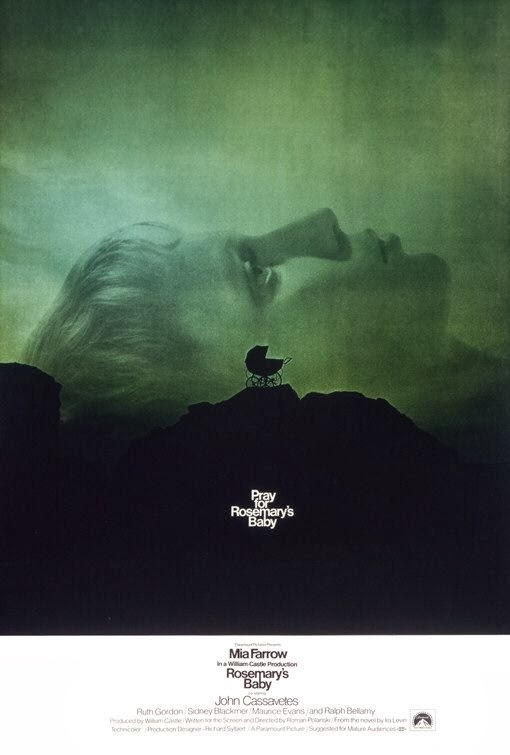
Horror Fest VIII (Day Two): Rosemary's Baby

Rosemary’s Baby may be based on the novel by Ira Levin (Son of Rosemary) and be produced by William Castle (The Tingler) directed by Roman Polanski (I can only imagine what’s going to happen now that I’ve mentioned his name again on this blog), but it’s really the story of a book. And not just any book, because while Rosemary Woodhouse (Mia Farrow) has a lot of books, including the conspicuously placed copy of Yes, I Can: The Story of Sammy Davis Jr.*, the most important one appears about an hour into the film.
Of course, I speak of All of Them Witches.
 Oh sure, the title is an anagram (although not the one Rosemary figures out – for the record, you can make “Hell a Cometh Swift from the title), but for whatever reason, it became the running joke of the rest of the movie. There was a lengthy discussion about follow-up books like Some More of Them Witches, The Rest of Them Witches, That Should Cover Every Last One of Them Witches This Time, and the legally obligated retraction book Not All of Them Was Witches After All, and many a chuckle was had.
  
I realize that it’s probably disrespectful to Rosemary’s Baby to talk about it this way when I’ve never properly written about the film here before, but sometimes when you’ve seen a movie enough times and you’re with a crowd of people who have as well, instead of focusing on the actual story you begin to fixate on silly details or make jokes. While I often try to give a film its proper perspective on the Blogorium, much of what constitutes a Horror Fest recap is trying to convey the atmosphere surrounding the screening as well.
 For the record, I was not the first person to make a tasteless John Lennon joke about the Dakota Building. I made the second, and it was in reference to an audience member being unhappy that nothing bad happens to Guy Woodhouse (John Cassavetes) at the end of the film. I responded that she needn’t worry, because “there’s a guy outside waiting for phonies.”
 There were many jokes and references to Cassavetes films (as actor and as director), to Planet of the Apes, Harold and Maude, Midnight Run, The Wolf Man, and to Frank Sinatra, Robert Evans, William Castle, and any number of other ridiculous observations, like what was playing at Radio City Music Hall with Fred MacMurray (our theory – Walt Disney’s The Shaggy Dog: The Musical, or Son of Flubber: The Musical).
 (This is a total side note, but since I mentioned John Carpenter’s references in Prince of Darkness, it’s worth pointing out that at the beginning of In the Mouth of Madness,  John Glover’s character’s name is Dr. Saperstein, a slight variation on the name of Ralph Bellamy’s character in Rosemary’s Baby.)
 All joking aside (and it’s really the big point at the fest where the audience participation took over, which the Cap’n fully endorses as long as you can still enjoy the movie), Rosemary’s Baby is a great horror movie. It’s so well constructed and so limited to one character’s perspective that even though you know what’s happening to Rosemary and you desperately want her to get away from the Castevets and the conspiracy in The Bramford, you understand why she’s confused and can’t leave. The world is set against poor Rosemary from the outset, in arguably more insidious ways than even Suzy Bannion faces in Suspiria (it turns out witches, Satan, and issues with pregnancy emerged as the consistent themes this Horror Fest).
 Her husband is distant and verbally abusive, especially after he gets close with Roman and Minnie Castevet (Ruth Gordon and Sidney Blackmer), her doctor recommends doing nothing when she feels pain during pregnancy, and then her old doctor (Charles Grodin), hands her over to the enemy when she comes to him for help. Her only real ally in the film, Hutch (Maurice Evans), is the victim of witchcraft – as is Guy’s original agent – and the first friend she makes in The Bramford plunges to her death not long after they meet. All the while, Polanski keeps us tightly locked in on Rosemary (although not quite as uncomfortably framed as Catherine Deneuve in Repulsion) as we slowly move towards June of 1966, when her baby is due. I shouldn’t need to spell that out for you, and it’s not as blatantly stated in the film, but if you do the math from when conception happened to when the baby should be due, it only makes sense.
 The use of dream sequences and somewhat ambiguous dream logic (another recurring motif this fest) helps disorient the audience early in the film, so that even forty five years later, it’s not abundantly clear what Rosemary is imagining and what we’re actually seeing when plans are set in motion. The ending still gets me, despite the presence of one of the worst Asian stereotypes since Mickey Rooney’s unfortunate appearance in Breakfast at Tiffany’s. “What have you done to his eyes, you maniacs!” and, eventually, “You’re rocking him too hard.” It’s unsettling, but inevitable.
 If we jest during Rosemary’s Baby, it’s only because we like it so. Also, All of Them Witches would want it that way. Hail Satan!
Up Next: Curse of Chucky and Trick ‘r Treat!
* Now, it’s entirely up to you whether Yes, I Can is there because of the Rat Pack connection or just as another subtle hint about the Satanism to come.  In the interest of full disclosure, we leaned towards the former.

Horror Fest VIII (Day Two): Prince of Darkness


 It’s been almost a decade since I last watched Prince of Darkness. In fact, the last time I did was followed by the first time I saw Visiting Hours, which turned out not to be such a good idea for Visiting Hours. I suppose I should watch the latter again now, because Prince of Darkness is pretty good but nowhere near as great as I remembered it being.

  For those of you who follow John Carpenter to any degree (or just read the end of the last recap), you are probably already aware that Prince of Darkness is the second part of what he calls the “Apocalypse Trilogy.” If you’re just a casual fan of his movies, you’ve probably heard of the other two films – The Thing (has not played at a Fest… yet) and In the Mouth of Madness (Horror Fest III) – all of which deal with the end of the world in some capacity. At the risk of spoiling both films, let’s just say they don’t end well for the protagonists. Prince of Darkness has the, shall we say, “happy” ending of the three, if you can call it that.
 Thematically, The Thing, Prince of Darkness, and In the Mouth of Madness deal with different aspects of the human experience: in The Thing, it’s the inability to trust one another, and with In the Mouth of Madness, it’s about notions of reality. Prince of Darkness is about the uneasy space between science and religion, and Carpenter poses some intriguing questions but doesn’t always get around to addressing them.
 Writing under the pseudonym Martin Quatermass (the first of several references to the British science fiction film series), Carpenter ties together quantum physics with religious prophecy and makes a somewhat uneasy mix, largely because of the uneven nature of the film. Donald Pleasance plays a priest invited to see a dying colleague, who passes holding a metal box. Inside the box is a key that unlocks the basement of the Godard Church, where the “Order of Sleep” has been keeping something ancient and almost certainly evil in a large glass container. Convinced that this green liquid is a physical manifestation of the “prince of darkness,” he contacts Professor Howard Birack (Victor Wong) to investigate its origins.
 Birack teaches quantum theory at Kneale University, and brings along his PhD students (including cast members Jameson Parker, Lisa Blount, and Dennis Dun) to help him study the cylinder.  (It’s worth pointing out that while Parker’s Brian Marsh says something to the effect of getting his “doctorate” in physics, there’s also a scene where Birack says “now I know none of you have your degree in this” which puts a puzzling  conundrum about how old these students are supposed to be). At the church, they set up equipment and meet a number of other scientists, including chemists and microbiologists led by Caler (Jessie Lawrence Ferguson) and Dr. Paul Leahy (Peter Jason), as well as a theologian (Ann Yen), there to help translate a book resting near the green liquid. Of concern to almost everyone inside is an ominous – and growing – contingent of the homeless outside of the church, including Alice Cooper (billed as “Street Schizo”).
 Undoubtedly there’s some creepy imagery (nature also seems to respond to the presence in the basement, so there’s a lot of creepy crawly business and one great scene involving beetles) and admittedly some novel combination of religion and science (one of the many discoveries in the book are a set of equations that go beyond what any of Birack’s students recognize). The hook comes halfway into the film, when a collective “dream” sets in: we later discover that it’s a transmission from the future (1999!) sent to warn people in the present that they have to stop the coming of Satan and the release of the “Anti-God.” It seems to change slightly every time we see it, but would be served better had it not been introduced so late into the narrative.
 The problem with Prince of Darkness is that there are so many good ideas swirling around that it’s disappointing when most of them go undeveloped. Blame it on a cast that keeps growing in the first thirty or forty five minutes, to the point that we’re continually being introduced to people and just barely aware of what purpose they serve, other than to (SPOILER) be possessed. The grand “plan” to release the “Anti-God” isn’t really clear until nearly the end of the movie and is resolved so quickly that it barely has any impact. Moreover, it’s meant to be a “tragic” ending for Marsh, but Jameson Parker has more of an impact for his rockin’ (if uneven) mustache than his chemistry with Lisa Blount’s Catherine. It’s also puzzling that the most obnoxious character ever – Dennis Dun’s Walter – makes it all the way through the movie when his “type” is usually marked for death from the first inappropriate comment.
 I don’t actually mind that Walter lives – it’s a good bit of misdirection for Carpenter – but the why of who is and isn’t possessed is unclear and the seemingly endless discussions between Pleasance and Wong about their respective fields don’t add any insight to either position. Prince of Darkness has some good ideas knocking around, but Carpenter (as he would later admit) doesn’t quite know what he wants to say about them. The end result is a very good premise that’s diluted in the execution, giving the film a somewhat earned cult status among John Carpenter fans. It’s certainly worth watching, but for my money the weakest entry in the “Apocalypse Trilogy.”
 Up Next: Speaking of Satan, how about Rosemary’s Baby?

Horror Fest VIII (Day Two): All the Boys Love Mandy Lane and A Nightmare on Elm Street


 As some of you have already noticed, I re-posted a review of All the Boys Love Mandy Lane earlier this month, with more contemporaneous thoughts about the film (as much as two years’ worth of reflection allows, at any rate), so I don’t have much more to add. It’s strange how the intervening years (Jonathan Levine made the film before the smartphone was a regular presence in the life of teenagers) make Mandy Lane more “quaint” than it would be otherwise: the choice in music and many choices in editing resemble any of the CW-style “modern” slasher film, but the lack of always connected, social networking makes for strange bedfellows.

 It’s a modern horror movie that isn’t quite modern enough, and not enough of a “throwback” (as loathe as I am to use that term) to feel different. I understand why people aren’t responding to it now, but I’m curious how it would fare in the height of remake-mania seven years ago. I apologize again for not spoiling the end of the movie – this is the third time I’ve brought up All the Boys Love Mandy Lane without directly addressing the ending of the film. To be honest, it’s why I like the movie, and why I think people interested in Final Girls as a horror trope would find it worthwhile. If this gives you any hint to how it ends, Mandy Lane would have beaten Scream 4’s “twist” to the punch by five years, and only been behind High Tension by a year. It’s a newer, if under-examined, development in Final Girl theory.
---
Along similar lines, I feel like I’ve written about A Nightmare on Elm Street so many times that I’m not sure what to say about it. I appreciate how grimy Freddy Krueger is in the film, how disgusting and creepy without relying on puns or horror showmanship. Robert Englund is clearly relishing the opportunity to make Freddy (really, it’s more “Fred” in the first film) as sadistic as possible. The more I watch A Nightmare on Elm Street, the more I notice that, frankly, surprise me that I didn’t remember from the last time. To wit:

The “dream logic” of the first film is much more, let’s say “practical” than in the subsequent films. It’s more like actual dreams are than what people might associate with the series (although Dream Warriors did push it in a direction that was almost impossible to come back from). The craziest “nightmare” moment early in the film is a goat in Tina (Amanda Wyss)’s dream that opens the film, and after that it’s largely limited to things Freddy can do: the (terrible) extended arm effect, cutting off his fingers, pulling off his face, etc. When Nancy (Heather Langenkamp) starts experimenting with her dreams, we see simple things, like the door into her basement leading to the boiler room at the high school. It’s more of an Inception level of “dream logic” than what people assume when they think of the series. They resemble dreams we’ve had, where one place becomes another but it seems to make sense in the dream.
 This is not to say there isn’t some nightmarish imagery in Nancy’s dreams – while it’s hard to forget Tina in the body bag while Nancy sleeps at school, I’d totally forgotten about the second time she appears later in the film. Nancy is dreaming and Glen (Johnny Depp) is supposed to be watching her (more on this in a moment), and in the dream Tina appears again, her feet covered with worms writhing around on the pavement. It’s an effectively unsettling image, as much so as the trail of blood Nancy follows in the hallways of school.
 Now, speaking of Glen, it’s worth pointing out that Wes Craven does something in A Nightmare on Elm Street that would subsequently be picked apart and reconfigured for the sequels (and, apropos to this discussion, a Simpsons Treehouse of Horror segment) that I completely forgot was in the film. Nancy is at home, watching The Evil Dead, and nodding off when Glen climbs in through the window. She asks him to sit next to her while she’s dreaming and wake her up if she starts struggling, which he agrees to do.
 Nancy then enters the “dream world” and is walking down Elm Street, when she turns and asks Glen if he’s still watching her. Inside the dream, Glen appears from behind a tree with to let her know that he is, and then disappears again. With the other films, and also The Simpsons in mind, this is an odd moment, because Nancy is dreaming, not talking out loud, and if Glen is in her dream, there’s a good chance he’s not awake. Now it turns out he isn’t, but they aren’t sharing the dream, so either Nancy imagined Glen reassuring her in the dream or he really was responding to her from the “real” world. I bring up The Simpsons because when Lisa appears in Bart’s dream, that’s how Bart knows she isn’t awake to save him. It’s not something that harms the film – as I mentioned before, I forgot it even happened – but upon reflection, it’s an odd moment.
I also picked up some dumb details that I’d never seen before, like the poster of a cat wearing a Hawaiian t-shirt and riding a trolley in San Francisco in Dr. King (Charles Fleischer)’s office. While he’s monitoring Nancy, you can’t miss it behind him on the wall.
It’s not difficult to spot the palm trees in the background of A Nightmare on Elm Street (like in John Carpenter’s Halloween, Craven is doubling California for the Midwest – Springwood is supposed to be in Ohio and Haddonfield in Illinois), but for some reason I’d never focused on how prominently a palm tree appears in one scene. When Nancy and Glen are on the bridge having a conversation about homemade weapons and giving dreams power, there’s a rather large palm tree right in the middle of the frame. I guess I’d been focused enough on the story that I willingly blocked it out, but it’s really hard to miss.
The last one is just an odd tidbit I picked up, one that only has any relevance if you’ve listened to the Wes Craven / Heather Langenkamp commentary before: during the bathtub scene, Langenkamp and Craven point out that the girl pulled into the tub and trying to escape is a body double. No, fanboys, that’s not a nude Heather Langenkamp you’re seeing. On the other hand, when Nancy is pretending to sleep so her mother will leave her alone, she does get up and change shirts, exposing her bare back to the camera in a shot that is Langenkamp. I suppose it’s a “neither here nor there” addition to the conversation, but I did know because of the commentary that she avoided any nudity in the film, so it was a scene I didn’t remember being in the film (technically it’s not nudity, but it’s a shot that implies it and doesn’t necessarily add anything to the plot).
 Up Next: John Carpenter’s Prince of Darkness, the middle chapter of his “Apocalypse Trilogy.”

Horror Fest VIII (Day One): Demons and Suspiria


 Lamberto Bava’s Demons is a movie with a great premise… and that’s about it. I will grant you that the gore and makeup effects are nice, but after a spell even those become tiresome, in large part because there’s so little happening in the film that even the demons are boring after a while. For a film that isn’t even ninety minutes, Demons feels padded and overlong, and it’s a shame.
  Quickly, I’d like to dispel an erroneous assumption on the part of attendees at Horror Fest VIII: Dario Argento did not direct Demons; he wrote it and has a “Presented By” title card at the beginning of the film. Now it’s not inconceivable that one would leap to that conclusion, as a) the titles were in Italian (even though I chose the English dub) and b) if you don’t know Italian horror cinema very well, you could make the mistake that if Dario Argento is involved at all, he was a strong influence, but no, it’s a Lamberto Bava film. Bava was Argento’s assistant director on Inferno and Tenebre, but he’s probably better known as a director in his own right (A Blade in the Dark), or for being the son of the legendary Mario Bava.
  At any rate, Argento and Bava co-wrote Demons with Dardano Sacchetti and Franco Ferrini, and it’s hard to imagine that it took four people to write a movie where so little happens. The film is based around a mysterious “Man in Black” (Michele Saovi, director of Cemetery Man and The Church, also known as Demons 3) handing out golden tickets to the Metropol theatre. The tickets are for a very special screening, and we meet a handful of people in the lobby, including a student (Natasha Hovey), a blind man (Alex Serra), and a pimp (Bobby Rhodes). Okay, I’m making an assumption on that last one, and IMDB’s synopsis doesn’t exactly match my reading of it, but it’s not hard to leap to that conclusion when he brings to girlfriends to the movie.
 The plot of the movie within a movie is that four college students are looking for the grave of Nostradamus, and they find one that seems to match, but in the coffin they find a strange mask and a book (which, of course, they read from). If you put the mask on, something sharp cuts into your face and you become a demon, which is interesting because one of the pimp’s girlfriends put on a similar mask in the lobby and has a similar cut on her face…
 As the move plays out, more people are infected and become demons, and as the audience desperately tries to escape, they discover the doors are a façade – the front of the building is now simply concrete, and they’re trapped inside. If anyone is injured by a demon, they become a demon, so they barricade themselves on the balcony and try in vain to find a way out. And that’s pretty much when Demons ceases to be interesting in any way, shape, or form. There’s only so much “bait and switch” Bava can employ when people pair up and split off from the main group, and it’s always the “which one is going to be the demon?” variety. The survivors eventually break through the wall of the balcony and cut off the projector and find an adjacent building, but even that goes nowhere as the building is abandoned and the only room they bother going into is walled off.
 To demonstrate just how disjointed (and front loaded) the plot of Demons is, Bava introduces four totally unrelated punks in the middle of the film, tooling around town and doing coke out of a Coke can (okay, I will admit that’s clever). If you’re under the impression that they’ll be saving the survivors in any way, don’t hold your breath – their purpose in the story is to enter the theatre, but only because one of the demons needs to get out in order for the ending to make any sense.
 Aside from a ridiculous scene involving a motorbike, a samurai sword, and a helicopter crashing through the theatre’s ceiling – all of which happen without any sense of causality – nothing happens in the second half of Demons. People wander around, they die. There’s no sense of tension at all, and the apocalyptic ending is just an excuse for another “bait and switch” to end the film on after the credits finish rolling. Characters abruptly change personalities – the usherette, for example, when introduced appears to be in on what’s happening (or about to happen), but as soon as the demons run amok she transforms into another terrified patron, seemingly without reason.  I understand that people really like Demons, and I remembered enjoying it when I was younger, but the film is too threadbare to really invest in. Sometimes gore just isn’t enough, and the atmosphere only goes so far.
---
  Are you ready for the fun part of this recap? I just slammed Demons for its slight narrative and I’m about to do the exact opposite for Dario Argento’s Suspiria. To be fair, Suspiria has a “through-line” story to go along with strong atmospherics, stylish color schemes, and at times disturbing gore, but the main difference is that while Demons peters out as soon as the plot should be kicking into high gear, Suspiria builds to a literally explosive conclusion. I’m also more willing to accept Suspiria’s dream logic structure over Demons nightmarish buildup, but perhaps it’s just a matter of personal preference.

I’ve also seen Suspiria more often than Demons, and have come to have a certain affinity for its story construction. We know as much as Suzy Bannion (Jessica Harper) does when she arrives at a ballet academy in Germany, with an added benefit of a brutal murder for a former student and her friend (this is an Argento film, after all). Information is revealed slowly, punctuated by strange events and even stranger behavior (maggots in the ceiling, suspicious activity by the staff, people leaving and then being murdered), mostly without clear reasons. Anyone who tries to find out too much about the staff, particularly Ms. Tanner (Alida Valli) and Madame Blanc (Joan Bennett) end up dead, under mysterious circumstances. At least, to the students: as the audience, we’re privy to what happens to the pianist and Suzy’s friend Sara (Stefania Casini), although the how is often unclear.
Am I spoiling anything by telling you that Madam Blanc and Ms. Tanner are familiars for the witch Helena Markos? If so, I guess *SPOILER*, but I can’t imagine anybody reading a Horror Fest recap this far hasn’t heard of or seen Suspiria, the first of Argento’s “Three Mothers” trilogy (followed by Inferno and, much later, Mother of Tears). I’ve been meaning to show it at a Horror Fest for years, but it always gets bumped at the last minute by something or would fall victim to exhaustion from participants. To be honest, the dreamlike logic of the film was even more effective for me this time because towards the end of the film (specifically around the dubbed Udo Kier scene), I was drifting in and out of consciousness myself. It’s how I always intended Suspiria to play at one of these festivals – late at night, when the mind is prone to wander, leaving you unsure whether what you saw really happened in the film or your imagination.
 I wouldn’t recommend anyone watch Suspiria this way for the first time, but the film lends itself well to a relaxed mind, one that wants to remain invested but is also hovering between lucid and sleepy. Never fear, because just when you think you’ll drift off, the memorably creepy score by Goblin rattles you awake. It was an excellent way to close out the first night of Horror Fest, but there’s a lot more fun to go tomorrow…

 Up Next: All the Boys Love Mandy Lane and A Nightmare on Elm Street!