Saturday, October 16, 2010

Blogorium Review: Satan's Little Helper

Today's review is not going to be terribly long, in part because Satan's Little Helper is a terribly boring movie. It really isn't sure what kind of movie it should be: a scary, violent, sex-infused, Satan-apropos film, a critique of Christianity (which it does so ham-handedly that I doubt it to be accidental), or a family-friendly horror film - a sort-of Gooby, but with the Devil instead of an oversized pederast Teddy Bear.


Very Scary!

Satan's Little Helper was a DVD cover I'd seen many times in Used and Mark Down bins, but something I never considered watching until Professor Murder insisted we queue up on Netflix's "Watch It Now" - a service I have to thank for so many bad ideas (*ahem* Monsturd). He loved it, but let's remember that the Professor takes great pride in enjoying movies even the Cap'n thinks twice about.

As it is, I doubt many of you will go hunting down Satan's Little Helper (even on your Instant Queue), I've decided to include photos in this review, just to give you an idea how schizophrenic of a film it is. That, and some things just need to be seen to be believed.

Jenna Whooly (Katheryn Winnick) is a student returning to Bell Island to spend Halloween with her mother Merrill (Amanda Plummer) and little brother Dougie (Alexander Brickel). She brings along a fellow student, Alex Martin (Stephen Graham), who has family in the area, and may be a potential love interest. But to be honest, the movie is about Dougie, who loves his video game "Satan's Little Helper." Dressed as the devil, Dougie wants nothing more than to be an actual minion of Satan, which works out nicely when the dark lord happens to be tooling around Bell Island, killing people (off camera) and posing them as Halloween displays. Dougie brings Satan home, and uh... well, chicanery ensues, followed by some eventual peril, and then some other things happen. Will Dougie learn the error of his ways? Will Alex and Jenna hook up? Is Merrill drunk or is that just how Amanda Plummer acts these days? What does Satan look like under that mask? Where can I get a copy of that video game?


Wait... where was I? Oh, right: the mask. The one thing Satan's Little Helper has going for it is the refusal to actually show Satan. He's always wearing a costume that covers his face (and often, hands) which put me somewhat at ease after first seeing the cheap rubber mask we're introduced to him in. To put it in perspective, here's Dougie's costume:


And here's Satan when we meet him:


That's what Satan looks like for most of the movie, and until Jenna tries to take off Satan's mask - assuming he's Alex wearing a costume - it's not really clear what we're supposed to make of this stiff-armed, totally silent goofball. And when I say goofball, I mean that yes, he kills people (again, none that we see for the first half of the film), but mostly he does things like steal prescription drugs, flip off people with those over-sized blue gloves, examine wine bottles:

1666: a very good year...

And in what may, arguably, be the most memorable scene in the film, sniffs Merrill's panties:

Classy, Satan.

I mentioned Gooby earlier because there's a very similar scene in Satan's Little Helper where the boy and his mythical friend go shopping in a grocery store:


Followed by the strangest reference to Death Race 2000 you're ever likely to see, involving Satan running people down in a shopping cart while Dougie announces the amount of points each pedestrian is worth. (Picture not available because I couldn't find one that did it justice)

Later, when Dougie realizes that Satan is, well, evil, he prays to God to save him (here's where the awkward and ham-handed religious part comes in) and who shows up at his door?

Save me, Jeebus!

But it's not really who you think it is, which prompts the strangest line in the film: "Jesus is Satan!" There's a really funky critique of Christianity going on in this film, where Jesus is immediately equated to God, but Satan is masquerading as Jesus, so what are we saying here? Oh well, it doesn't matter, because Satan starts using his costumes to trick our imbecilic protagonists into killing each other while he trades out costumes.

The family is so stupid that it completely undermines what could be a bleak ending. When NO OTHER characters are around and you've established that the "Satan" you stabbed repeatedly in the Jesus costume is Alex, why would you trust a police office WEARING A MASK that rings your doorbell. Why would you invite him inside? Especially when he does this:


Again, I'm at a loss here. Satan's Little Helper is just a mess of a movie. There's a party scene where, for some reason, everyone is listening to Bob Dylan. Merrill encourages her daughter to dress up like a slutty Renaissance Fair attendee, the previously nonexistent father to Jenna and Dougie shows up only to be disemboweled, and a character is introduced for the express purpose to sneaking in some gratudity halfway into the film. Nothing works, and the only thing I can say for Satan's Little Helper is that I didn't pay any more than the monthly Netflix fee to watch it.

Thursday, October 14, 2010

Blogorium Review: Sisters

Sisters, a film that arguably is the first time the signature "style" of Brian De Palma is on display, is also a precursor to his "homages" to Alfred Hitchcock*, like Dressed to Kill and Body Double, cobbling from a number of the "Master of Suspense"'s films.

Danielle Blanchon (Margot Kidder) was born half of Siamese twins, with her sister Dominique. After being separated, Danielle pursued a career in modeling and acting, appearing on game shows like "The Peeping Tom Show" (which opens the film in a curiously race-baiting manner, both for the contestants and the audience). When Phillip Woode (Lisle Wilson) avoids the temptation of watching a "blind" woman undress, he wins a dinner for two to the even less politically incorrect "African Room" and invites Danielle (the "blind" woman) to come along (Danielle wins a set of knives). Aside from an awkward run-in with her ex-husband, Emil Breton (Bill Finley), the date goes swimmingly, and he accompanies her home to Staten Island.

After a night of heavy petting, Phillip overhears Danielle and Dominique having and argument and accidentally knocks her medication into the sink. Phillip runs out to find the twins a birthday cake, and comes back only to be (SPOILER, I guess) stabbed in the groin by Dominique, and then viciously sliced up before scrawling "HELP" on the window in full view of investigative journalist Grace Collier (Jennifer Salt). Collier becomes obsessed first with proving the murder happened, then on uncovering the "true" story of the Blanchon twins, enlisting the help of private detective Joseph Larch (Charles Durning). What is Breton's actual relationship to Danielle and Dominique? Why aren't the police interested in the murder? And what is really going on at the institute that the Blanchon twins grew up in?

I don't feel bad about ruining the death of Phillip Woode because if you've seen Dressed to Kill, you have some idea how the first thirty minutes of Sisters is going to play out. Hell, if you've seen Psycho, you know how both of them are going to play out, but sticking strictly to De Palma films, Dressed to Kill is likely better known than Sisters, which plays out like a grindhouse-friendly warm up for his more direct Psycho homage.

But it isn't just Psycho that gets the nod in Sisters: there's also Rope, Rear Window, Frenzy, and a strange running gag akin to The Trouble with Harry involving Woode's final resting place - and the film's MacGuffin - a fold out couch-bed. The last shot, in fact, echoes the futility of the MacGuffin, as Joseph Larch (the Sam Loomis /Lisa Fremont stand-in) sits perched on a telephone poll, spying on an abandoned couch in a comparably abandoned Canadian train station, never to be claimed.

If it feels like I'm spoiling a lot of Sisters, really I'm not; I deliberately left out the film's "twist," which shouldn't be difficult to figure out given De Palma's penchant for Hitchcock plot turns, and I'll dance around the hallucinatory third act, which takes place in the institution and intentionally echoes Freaks or The Cabinet of Doctor Caligari in its dream sequences. It's placement in the film is rather jarring, considering the great technical lengths De Palma goes to earlier in the film (including not one, but two intricate split screen sequences), and nearly derails the picture. It kicks the Freudian overtones into overdrive and drastically switches gears from an exercise in intertextuality into an overcomplicated bundle of psycho-mumbo-jumbo before returning to a by-the-numbers murder mystery.

Which is not to say that critics with a psychoanalytical bent won't have a field day with Sisters (as they do with virtually all of De Palma's films): the almost literal "castration" of both male leads (and a more figurative form for Larch and Arthur McLennen [Barnard Hughes**], the reporter who broke the twin story) is consistent throughout the film. Dominique seems to be triggered by arousal and her weapons are always phallic (a kitchen knife, a scalpel), and Collier's general disdain for men (and her overburdening mother) eventually point her towards a safe, if unsatisfying, end.

Sisters is a bit sloppy around the edges, lacking in much of the precision evident in later Brian De Palma films, but it has a scrappy quality to it that keeps the film watchable when it teeters on incomprehensibility. It doesn't hurt that Kidder is very good as Danielle and Dominique, and Salt carries most of the film as the truth obsessed Collier. Wilson, Finley, and Durning are also believable in mostly thankless roles, and when De Palma is on, the film crackles with suspense. It's easy to see in Sisters the traces of his later, superior films, as well as his interest in incorporating Hitchcockian themes and images early on. As a horror film - which I suppose is technically why it's included this month - you could do worse, although Sisters is probably going to appeal to cinephiles more than casual viewers.

*edit* In my haste to put this up, I forgot about the Cranpire's favorite character, who will be referred to only as "The Midnight Gardener," who so inexplicably a plot device that I must assume he's a direct reference to another film. Kudos to you if you identify it in the comments!

* The debate rages on whether these are homages or rip-offs, and I don't really want to get into it here. For plenty of starting points, I refer you to Google.
** If the name doesn't ring a bell, Hughes' voice should automatically ring a bell, particularly if you remember Dumont in Tron or Grandpa in The Lost Boys.

Tuesday, October 12, 2010

From the Vaults: Shadow of the Vampire

editor's note: like last week's entry, this is a critical essay written in 2006 for a class on horror cinema.

Film Report:

E. Elias Mehrige’s Shadow of the Vampire

In Shadow of the Vampire, E. Elias Mehrige attempts to put a Twilight Zone-like spin on F.W. Murnau’s Nosferatu by pre-supposing that instead of hiring an actor to portray Count Orlock, Murnau, obsessed with “realism” in his films, instead found an actual vampire.

After a credit sequence which juxtaposes images of what appear to be medieval knights and demons (and perhaps a representation of the fall of Lucifer) with the canned lighting popular in theatres during the early era of cinema (see King Kong’s opening credits, for example), Mehrige makes a hard cut to an extreme close up of an eye, followed by the lens of the camera, while Murnau (John Malkovich) gives direction to Greta Schroder (Catherine McCormack), in the first of many in camera recreations of actual scenes from Nosferatu. (Mehrige is careful in these recreations not to replicate exact camera angles for a reason we will see shortly)

The title cards necessary in most silent films are also replicated here, but instead of narrating dialogue, Mehrige and writer Steven Katz utilize them as a means to get historical exposition out of the way, much of which is factual, in opposition to much of what he dramatizes on the screen. Murnau’s obsession with delivering the realistic in the fantastical takes his crew out of the Berlin film studios and to Czechoslovakia, via a train named Charon (of note because in Greek mythology, Charon is the boatman responsible for ushering the dead across the river Styx to the afterlife.)

Murnau’s producer, Albin Grau (Udo Kier), has no idea why the trek is of such necessity, nor does he comprehend the secrecy shrouding Max Schrek (Willem Dafoe), an “actor” alleged to have studied with Stanislavsky and be very devoted to Method acting, but Grau trusts Murnau’s vision, and has only minor questions surrounding the conditions of making Nosferatu, their unauthorized adaptation of Bram Stoker’s Dracula.

We are also introduced to Gustav von Wangenheim (Eddie Izzard), the actor playing Hutter in Nosferatu, the screenwriter Henrik Galeen (Aden Gillet), and Wolfgang “Wolf” Muller (Ronan Vibert), who takes a curious turn for the worse during the first night spent in Czechoslovakia, mirroring plot points from Nosferatu.

Katz takes care to mirror certain elements from Nosferatu in Shadow of the Vampire, giving an imagined sense of plot points we are not seeing being filmed, but existing to drive the story forward in a different way as we, like Hutter, prepare to meet Count Orlock. Much like Shadow of the Vampire itself, characters in the film struggle with exactly what kind of film they’re making. The self-reflexive nature of the script pushes the audience itself to question the kind of film they’re watching. Is this a horror movie? A historical recreation? Perhaps a film designed to replicate the early era of film, not unlike The Bad and the Beautiful?

However, as the film moves towards the “twist”, so to speak, certain alterations come into full effect. In the original film, day for night is clearly employed as a practical means to convey the Count’s introduction. But in Shadow of the Vampire, the scenes are portrayed as actually being filmed at night; a necessity in maintaining the premise of the film, but from this point on we’re clearly working in an alternate reality. Key scenes begin to deviate from the original film as a means to remind us that we’re not watching the making of Nosferatu, but rather the imagined version of the filming.

Shadow of the Vampire also changes our fundamental perspective of Ellen Hutter, by portraying Greta Schroder as less innocent and pure as her character in Nosferatu is suggested to be. In fact, Schroder is an open morphine user, and behaves not unlike the “vamp” of the twenties social scene. Speaking of which, it is apropos to note the presence of Udo Kier, who himself played Dracula in Blood for Dracula (also known as Andy Warhol’s Dracula), and a vampire elder in Blade. A standby in horror cinema, Kier’s involvement in this film is another element of self-reflexiveness, as is Cary Elwes’s, who plays Wolf’s replacement photographer. Elwes appeared in Francis Ford Coppola’s version of Dracula only seven years prior to Shadow of the Vampire.

Of course, Murnau himself is not simply a misunderstood genius devoted to accuracy (at the protestations of his crew over casting local villagers, he reminds them “They do not need to act. They need to be.”), but as a man driven beyond his capabilities to create film history, to the point that he too succumbs to morphine and fear of his star.

Speaking of which, let us take a moment to discuss “Max Schrek”, or Count Orlock himself. Willem Dafoe takes the images from Nosferatu and amplifies the animalistic appearance to distinguish him from the humans that surround him. Orlock literally sniffs his prey out, hissing and clicking his nails together to create unease. At the same time, Orlock has existed so long as a vampire he no longer has any memory of what humanity was like, and accordingly alternates between an unnerving beast and an almost child-like innocence, uncertain of how to “act” on camera, or how to deal with the object of his desire (Greta). Because of thise, Orlock is frequently the cause of Vampire’s biggest laughs, again, changing the film into something of an extremely black comedy, an element rarely noted when discussing the film.

Orlock’s most potent moment comes when he explains his interpretation of Stoker’s Dracula, from a perspective only one vampire could note of another; his loneliness. The strain of immortality is too much for Orlock, who at one point quotes Tennyson’s 'Tithonus', based on the Greek myth of a man who is immortal but continues to age. Orlock’s interests become baser as time drags on. Note how Shadow of the Vampire augments the sexual tension in the scene where he drains Greta, as Orlock openly gropes her breast while feeding. The film also suggests that Orlock’s power over Greta in its final scene is not a construction of the film, but the shadow grasping her heart is a literal demonstration of his power over her.

As filming continues, Orlock’s disinterest in the film, coupled with his sporadic desire to feed on crew members strains his tenuous relationship with Murnau, who cannot risk losing his star. He caves in to Orlock’s demand that the boat scene will not take place on water, and that Murnau will fly him to the island for their final location. As their tension escalates, Murnau becomes less and less reasonable; eventually lapsing into drug induced stupor, although whether the strains of the film or Orlock are the cause, it is unclear. Shadow of the Vampire also uses Orlock as a means to comment on film, both jokingly (“I don’t think we need the writer anymore.”) and poetically (Orlock watches the sun rise for the first time in centuries with the aid of a film projector.)

Of course, as Murnau and Orlock become more of a threat to the production, Albin and Wagner (Elwes) must reign in the mounting disaster, ultimately discovering Schrek’s true nature and deciding without the aid of Murnau that the vampire must die. The hiring of an actual vampire is a shock to them, but the promise of their leading lady to Orlock is too far for Murnau to go. The final scenes must go as planned, but the death of Orlock will not be that of movie trickery.

The greatest alterations to actual footage from Nosferatu come in the final scenes. Prior to this, Mehrige alternates between original footage and slightly different angles on recognizable scenes, but he makes two key changes to the “death” scene of Count Orlock. The first and most important alteration is the removal of Orlock’s reflection in the mirror as he approaches Greta. In Nosferatu, Orlock’s reflection is clearly visible in the mirror, perhaps a sign of Murnau’s disinterest in vampire lore or in overloading this scene with trickery (interestingly, given the lavish effects in his production of Faust, this line of thought is strange and out of character for him). In Shadow of the Vampire, in order to prevent the alternate universe most fully, Orlock casts no reflection, and alerts Greta to his true nature and possible intentions. In order to maintain her state of pre-feeding hypnotic trance, Murnau gives her morphine, but is he also considering the effect it will have on her blood when Orlock feeds? Is Murnau aware of the plan to kill Orlock, or has he planned it all along?

Therein lays the second change between the original and this supposed history: the means by which Orlock comes to die. Again, in Nosferatu, it is implied the sunlight comes through the window, and in a double exposed frame, Orlock is “wiped” out of existence. However, since we know Max Schrek is in fact a real person, and not a vampire, the technical nature of the effect makes sense. In order to kill Orlock in Murnau and Katz’s version, we are to believe Wagner and Albin designed the pulley system to open as Orlock awoke from his post-feeding (and possibly post-morphine induced) slumber, but they are the fools. Orlock is on to their plan, and prevents the door from opening mechanically, subsequently killing them both. Curiously, Murnau films the entire assault with cold detachment, asking the dying Albin to return a prop to its key location before he dies. Orlock, outraged at this ruse, turns his attentions to Murnau, who remains aloof, giving direction as though Orlock’s advances were nothing more than an actor unsure of his place onscreen. Then, as he did so early in the film, Mehrige cuts to Murnau’s eye, and to the camera lens, as the final trick is pulled on Orlock. Villagers outside open the door, and as the sunlight pours in, Murnau gives Orlock his final direction.

The final juxtaposition between art and film lies in Murnau’s final monologue, an echo of his earlier speech about the power of film to elevate art to a higher level on a permanent basis. As the paintings dissolved against canned lighting, so does Orlock against the sun, an image captured as the literal dissolving of an overexposed frame of film, finishing Nosferatu on film and in mortality. As is appropriate for this imagined version of film history, Shadow of the Vampire ends with Murnau’s pronouncement, “I think we have it.”

So what kind of film is it? Is Shadow of the Vampire a horror movie? Is it, as suggested, a black comedy? It’s certainly about a period of time in film history, but in an alternate reality where vampires are very much real and not the product of literature or art or film, so it can’t strictly be considered a historical piece. What is Shadow of the Vampire, and what does it say about reinterpreting film history in the vein of fiction? Is it so curious to consider that the largely unknown German actor who played Nosferatu could be recast as the literal figure of horror? And what does it say about our knowledge of the early years of cinema that this could be considered a viable alternate universe. This is why Shadow of the Vampire exists viably as more than a footnote in the history of Nosferatu, and what makes it so difficult to classify is also what makes it relevant.

Monday, October 11, 2010

Shocktober News and Notes

All right, gang: the Cap'n is back from a wedding and ready to talk some horror. Being that I'm a little slow on the uptake (or that the Cap'n posted ahead of time last week in case the trip from Santa Fe ran long), both stories come from the first weekend of October. At any rate, I'm hoping one will prove to be discussion-worthy and the other will prompt somebody to get back to me with a reaction.

---

It's no secret that I was no fan of Adam Green's Hatchet. Many people swear by its "Old School American Horror" tag line, and honestly I don't understand why (aside from some good gore effects, there's nothing remotely interesting about Hatchet, and certainly nothing "old school" if you want to split hairs), but it doesn't mean the Cap'n was any less surprised at the sudden removal of Hatchet II from theatres last weekend.

If you hadn't been following the Hatchet II saga, the film was released in theatres unrated, which is a major coup considering that the MPAA dictates just about everything that can and can't open theatrically. AMC theatres felt strongly about Hatchet II and made a deal with Anchor Bay to release it without a rating, and there was much rejoicing online. Honestly, while I had no plans to see Hatchet II, it was cool to hear about a movie opening without excessive editing or prolonged fighting*. In an age when "unrated" cuts are available in every medium except theatrically, it sounded like a nice precedent.

And then AMC pulled Hatchet II from domestic distribution, and then Canadian theatres, some of which had never screened the film. When I went back out into the ether of the internet to follow up on the "why," it appears the mystery still remains. An early press release from AMC suggested that low box office performance had something to do with the pull, although Green suggested on his Twitter page that his sources indicated otherwise. Either way, he's not able to discuss what happened, so speculation runs rampant.

Whatever happened, Hatchet II will eventually (probably sooner than later) arrive on DVD and Blu-Ray and make a killing - no pun intended - from both fans who wanted to see it and from people who heard about the controversy and want to see what all the fuss is about. So Hatchet II is going to be okay in the long run, and I'm sure that Hatchet III won't be ruled out forever. On the other hand, this doesn't bode well for major chains bucking the MPAA stranglehold and releasing films anyway, so we're stuck with watered down PG-13 horror films, the new "acceptable" rating for the genre, since R rated films cut down on first weekend business (which is now the barometer of all films and therefore the only thing worth marketing towards).

In short, if studios feel that no demand exists for "unrated," or even strongly rated content, they will continue to water down films in order to get the largest slice of the pie possible. Distributors will continue to kowtow to the MPAA as long as they dictate what is and isn't "permissible" for audiences, and films like Hatchet II will be less likely to ever play on the "big screen" before inevitable home release.

---

My second point is more of a query, directed at anyone reading this who watched Let Me In: I am not convinced that I want to see the film, as reviews seem to be evenly split between "a worthy remake" and "basically the same film" as Let the Right One In. The problem I find is that both use the same criteria as their supporting evidence (minor changes to the plot, tonal shifts, and similarities in major set pieces), so I'm at a loss as to whether it's worth checking out or not.

I do very much enjoy Let the Right One In (as you may have noticed, since it cracked my "Top Ten Horror Movies" list), and remain dubious about Let Me In on principle. That being said, I'm not opposed to checking it out if enough people think it's worth the trip. Good horror is often hard to come by, but I'm on the fence about horror I know I've already seen - just not in English. If some of the casual readers out there wouldn't mind filling the Cap'n in, it would be much appreciated.

---

Join me tomorrow for another trip to the Vaults, followed by more horrible horrors in Wednesday's Video Daily Double. Then, depending on the week ahead, I'll either have a new review up for you Thursday or a new edition of Five Movies devoted to newer horror films worth checking out.


* For the record, the MPAA gave Hatchet II an NC-17, which means that most theatre chains won't play the film and papers generally refuse to advertise it, thusly killing any chance of release outside of home video.

Friday, October 8, 2010

Top Ten Horror Movies

You got lucky, Blogorium readers: the Cap'n was thinking of taking the night off, what with a wedding to attend tomorrow, but a social network-related message from an old co-worker prompted your fearless leader to spend far more time than should be necessary to put together a list.

His message, in its entirety, read "top ten horror films..."

So you try that. Try to do it quickly. Maybe you can, maybe you can't. Do you go for the easy answers? The best known favorites? Do you throw in something that you love but you know others aren't as familiar with? Is that why he asked the Cap'n in the first place? Am I supposed to go unorthodox?

After mulling it over, I put in the first two without hesitation. Here's the entire list (which is technically twelve movies, so sue me):


The Haunting
(1963)
The Evil Dead
Let the Right One In
Re-Animator / From Beyond
The Wicker Man (1978)
Night of the Living Dead
In the Mouth of Madness
Hellbound: Hellraiser II
Friday the 13th: The Final Chapter
From Beyond the Grave / Tales from the Crypt


Notice I left out the entirety of the Universal "Classic Horror" films, in part because as much as I love Frankenstein, The Wolf Man, The Mummy, The Invisible Man, The Creature from the Black Lagoon, and Dracula, I feel like everybody's seen them at one point or another in their life. The same cannot always be said of The Evil Dead and Night of the Living Dead, which are recognized more for having popular sequels than are seen.

I left off A Nightmare on Elm Street... well, I'm not sure why. Most of you (I'd imagine all of you reading this) have seen the first Nightmare over and over again, and maybe I just wanted to branch out a little bit. Even rabid fans of Re-Animator haven't necessarily seen From Beyond, which is as good if not better. I remain an ardent supporter of John Carpenter's In the Mouth of Madness, in part because it's construction replicates the experience of reading H.P. Lovecraft in a way most direct Lovecraft adaptations don't.

As sequels go, Hellbound and The Final Chapter are on par with the original film and in many ways both more successful. From Beyond the Grave and Tales from the Crypt are two of my favorite anthology films, a sub-genre in horror that doesn't get enough love from my perspective.

Oh, and The Haunting and The Wicker Man just creep me out. Put them on late at night, in the dark, right before bed. Good luck sleeping.

One thing I'd like to point out is until the very last second Terrovision was in the "top ten" list, and then I replaced it with Let the Right One In, which is a hard - but fair - substitution. Slashers films didn't get much of a showing there, and neither did "true story" movies like Henry: Portrait of a Serial Killer or The Texas Chainsaw Massacre. Horror comedies went largely unrepresented, but what can you do? I had ten spots to fill and no more.

As I challenged him, so too do I challenge you to provide me with your top ten horror films. Would you include Near Dark? Return of the Living Dead? Black Christmas? Ginger Snaps? An American Werewolf in London? The Fall of the House of Usher? Suspiria? The Hills have Eyes? The Horror of Dracula? Nosferatu? The Exorcist? Martin? The Thing? Phantasm? [REC]? Cat People?

You have ten slots to fill. You can push it to twelve, but they'd better be closely linked, and no more. Good luck.

Thursday, October 7, 2010

Blogorium Review: Mad Ron's Prevues from Hell

Sometimes, it pays to follow your gut. When I read a review of Mad Ron's Prevues from Hell, a review that said at best the trailer compilation was a "rental," I filed the title away in my head until I saw the DVD at Hastings. The Cap'n is something of a trailer freak, and I love a good compilation - I own all of the 42nd Street Forever discs, All Monsters Attack, and am trying to get ahold of Stephen Romano's Shock Festival set - so despite the fact that Mad Ron's Prevues from Hell was clearly duped from a 1987 VHS copy, Professor Murder and I sat down for 83 minutes of preview mayhem.

Mad Ron's Prevues from Hell isn't just a trailer compilation; director Jim Monaco places the clips in between a sort-of "frame story," involving a movie theatre invaded by the living dead. Mad Ron, the projectionist, threads trailers for the ghastly, the exploitative, and the extremely violent while we're "entertained" by Nick (Nick Pawlow) and his zombie dummy Happy. Happy tells... well, I'd be lying if I called them "jokes," but that's what the tape-turned-DVD wants you to regard them as. When Nick and Happy aren't cracking wise, the "film" (I'm using that very loosely) cuts away to zombies getting into hi jinks like pouring blood on popcorn, eating guts, and pulling eyeballs out.

I suppose it's worth noting (because the back of the DVD does) that the effects were done by Jordu Schell, who later went on to work on Avatar, and the gore is pretty good. The tape itself feels like a "let's put on a show" production from locals who wanted to play the living dead while trailers string the story together. They aren't always horror, but you're in for a pretty good selection of full frame, fuzzy, beat up ads for films like Three on a Meathook, Torso, House of Exorcism, The Wizard of Gore, Flesh Feast, Children Shouldn't Play with Dead Things, Fangs of the Living Dead, Black Christmas (advertised as Silent Night, Evil Night), Sisters, and Mad Doctor of Blood Island.

Towards the end, the trailers wander off into exploitation territory, with movies like Africa Addio (identified here as Africa Blood and Guts), Ilsa, She-Wolf of the SS, and some 3-D porno which is presented partially in 3-D (in case you have glasses handy). Does it run a little long? Maybe. Are the Nick and Happy segments kinda tedious? Oh, you bet. Does the anti-piracy warning at the end serve any purpose other than one more gore effect? Not really.

Despite the very low budget-ed nature of Mad Ron's Prevues from Hell, the myriad of detracting factors working against it, and the fact that it's clearly just a video cassette plopped onto a DVD, I'm highly considering showing the disc at Horror Fest during pre-festivities. It's just entertaining enough that audiences in the right frame of mind could get a kick out of the old school vibe.

Blogorium Review: House of 1000 Corpses (revisited)

After becoming the victim of a "trappening*" by Professor Murder and the Cranpire, I find myself in the unique (unfortunate?) position of being able to re-review Rob Zombie's feature debut, House of 1000 Corpses, and it since falls somewhere within the category of "horror," it seems appropriate to include the film in our Shocktober celebration.

Briefly, a little history between the Cap'n and House of 1000 Corpses: I worked as a projectionist for a movie theatre way back when Universal studios was still planning on releasing Mr. Zombie's first film, and as a White Zombie fan, I was pretty excited. He promised "raw" and "unrelenting" horror with a guarantee of "1000 corpses**!," so when the teaser trailer came out, I did pull aside an extra copy for another fan. Then, as many of you might be aware, Universal dropped House of 1000 Corpses, touting that it was "too hardcore" or something to that effect in 2000.

Eventually (circa 2003), Lion's Gate picked up House of 1000 Corpses and released in theatres, and I saw it a few days before my 24th birthday. I hated it. The film was garish, obnoxious, tried too hard to be shocking and "hardcore," and was ultimately a lackluster mish-mash of bad acting, tedious over-editing, and cheap stunt casting. The memory that sticks with me was a passing joke by one of the people I saw it with about Dr. Satan needing to fight "Doctor Jesus," which sent another friend into fits of hysterical laughter.

Over the ensuing seven years, I've tried to watch House of 1000 Corpses again, gathering that I must have "missed" something, considering its loyal supporters and advocates. Considering that I really enjoyed The Devil's Rejects (which features the same characters), disliked Halloween, but liked Halloween II, I made concerted efforts to give House of 1000 Corpses another go-round. Without fail, I make it as far as Baby (Sheri Moon-Zombie)'s lip-synch routine before I'm so bored that I hit the "Stop" button. That is, until Sunday night.

So... how is the rest of House of 1000 Corpses? Pretty much exactly the way I remember it: actors who can do better (and clearly did, considering The Devil's Rejects) shouting, mugging, and generally making asses of themselves for 89 minutes. In between, there are long, pointless scenes, intercutting of wholly irrelevant footage from other films or characters unrelated to the story, and lots of acts which one is apparently supposed to find "wrong" or "taboo." Unfortunately, the film has all the subtlety of an anvil to the forehead, so tedium replaces sensory overload in short order.

I suppose I could talk about the cast, which features Rainn Wilson (The Office), Chris Hardwick (Attack of the Show), Erin Daniels (The L Word), Jennifer Jostyn (The Brothers McMullen), Walton Goggins (Predators), and a host of genre veterans: Karen Black, Bill Moseley, Tom Towles, Irwin Keyes, Harrison Young, and Sid Haig. The truth is, that there isn't a single character to take any interest in; not the kids, not the Firefly family (which includes Moseley, Black, Moon-Zombie, Matthew McGrory, Robert Mukes, and Dennis Fimple), or the victims-to-be that populate the rest of the cast.

I could mention the myriad of references to other films (or, in many cases, direct lifts from The Texas Chainsaw Massacre, House by the Cemetery, or Spider Baby), or even the fact that all of the members of the Firefly clan borrow their names from Marx Brothers characters was kinda-clever until Zombie made the reference explicit in The Devil's Rejects. I even thought about the crane shot that takes forever (and remains unintentionally hilarious, despite the fact that I can't quite suss out what it's a reference to), but instead I'll point out one telling detail that should give viewers unfamiliar with the film all the information they need.

At one point, Denise Willis (Erin Daniels) uses a phone booth to call her father (Harrison Young), and there are a few "missing" signs littering the inside of the booth. The missing children one isn't really an issue, but the "Missing Cat Head" really sent the Cap'n into fits of giggles. It's so stupid, so incongruous, and so indicative of the pervasive "oh man, that's messed up!" that I could no longer take the film remotely seriously. It reminded me of the one clever visual gag in the film (a box of Agatha Crispies cereal), and nothing else. Had the film been included on one of Zombie's video DVD compilations, this chicanery might be more forgivable, but House of 1000 Corpses was released theatrically and people were expected to pay to see this film alone.

If House of 1000 Corpses was intended only to undermine the sleazy, grindhouse-esque era of The Texas Chainsaw Massacre and Eaten Alive, I could maybe give the film a pass, but having listened to Zombie's commentary track, it's not. House of 1000 Corpses is meant to be sensory overloading shock, a film that'd Zombie would rather have Universal drop than sacrifice any of his "original vision." On those merits, I contend that the film fails miserably, and worse still, is simply too dull to recommend watching.

Watch The Devil's Rejects, which does actually manage to do what Corpses cannot, or watch Halloween and Halloween II. The first may be an interesting failure and the second a widely reviled sequel (by almost everyone but me), but at least you won't feel like your time was wasted.


* "Trappening," a term coined by Professor Murder, is when someone tricks you into coming over, only to discover they've put on a horrible movie that you have to watch. They considered this totally fair because I've put them (and most of you) through many a "Trappening" before...
** This is debatable, since I still argue most of Dr. Satan's lair is skeletons, and that the hallway that Denise runs down is deliberately suggested to be larger than it is without actually showing said "corpses." Even if there are 1000 corpses, they certainly aren't in the Firefly house.

Tuesday, October 5, 2010

From the Vaults: The Exorcist


editor's note: the following was - I think - partially written for a class on horror films, and potentially reshaped halfway through to be included in the old blog as a quasi-retrospective on the Exorcist series. I'm going to check it against the old essay and include both versions. Warning, they represent the Cap'n in a very early stage, and probably aren't up to what you've come to expect from the Blogorium.


Film Report:

William Friedkin’s The Exorcist

Evil is a palpable presence. This is clear from the opening moments of The Exorcist, even if we are not yet aware of its intentions. A dig in northern Iraq brings Father Merrin (Max Von Sydow) into direct contact with evil, in this case the demon Pazazu. Pazazu’s visage is buried in the earth and displayed prominently as a statue, but his power permeates Merrin’s world. Clocks stop, beasts rage, and ominous signs point to the arrival of evil incarnate. But not in Iraq; this evil will manifest itself much closer to home.

In Georgetown, Chris MacNeil (Ellen Burstyn) lives with her daughter Regan (Linda Blair), her assistant Sharon (Kitty Winn), and assorted servants. The MacNeils are displaced people in a world coming apart; Chris is divorced and living in the Washington D.C. area while her home is being rebuilt in Los Angeles. She’s also in the midst of shooting a film about student riots, another sign of the times. The world is in upheaval, and Chris’s world will undergo a further change soon, beginning with sounds in her attic.

Regan is a normal girl; she likes horses, art, and loves her mother. But all this moving disrupts her social world, and at the cups of puberty, Regan is all alone. Chris pays little attention to Regan’s imaginary friend Captain Howdy, but soon her strange behavior becomes too much to ignore. Although it may be no surprise that Regan knows how to curse (her mother frequently utters profanity), when she urinates on the floor during a dinner party and complains of her bed shaking, Chris realizes something is amiss. Little do Regan and Chris know of the journey into the abject that lies before them.

Chris is not the only person in Georgetown suffering a crisis of conscience. When we meet Father Damien Karras (Jason Miller); he is dealing with the crippling blow of his ailing mother’s death after being committed to a psychiatric facility. Damien is himself a psychiatrist, and his faith is waning from the shifts he and his mother faced; her death is but another test he is incapable of dealing with. Meanwhile, his church is shocked when a statue of the Virgin Mary is defiled with a phallus and overly phallic breasts, reminiscent of Pazazu.

Regan’s condition continues to worsen, and her behavior continually breaches what could be considered abject: she vomits bile, curses, mutilates herself, and violently masturbates using a cross. She is sexually uninhibited in her language, either by her own virtue or that of a demon who claims to possess her. Whether it is Regan or this demon speaking, her actions are beyond that of the abilities of doctors and psychiatrists. Their horrendous tests amount to no reasonable answer for her condition, and when Chris’s director / love interest is murdered (possibly by Regan), they attempt one last option; hypnosis. Even while under hypnotic suggestion, Regan is openly hostile towards men and attempts to castrate the psychiatrist. As a last ditch effort to avoid committing Regan to an institution, one doctor recommends the possibility of an exorcism.

Chris turns to Father Karras for assistance, but he is at first unconvinced that Regan is actually possessed. The demon inside of Regan claims to know Damien’s mother, and reacts to tap water as though it were Holy Water. However, when she begins speaking in languages which Regan does not know, and one Karras discovers to be backwards English, he suspects this may in fact be possession. Damien does not believe the demon’s claims that it is the Devil himself, but the demon speaks fearfully of a priest called Merrin. Regan appears to plea for help from inside her own body, now wracked and cut from self mutilation and filthy from vomit. The church agrees to allow the exorcism, on the condition that Merrin oversees it.

For Chris, Regan, Father Karras, and Father Merrin, the final act of The Exorcist is a journey into the abject itself. Karras and Merrin are instruments designed to restore the natural order, and Regan / Pazazu / Captain Howdy is the abject, which must be faced and rejected in order to do so. Their ritual, an exorcism, will not be easy. Regan hurls profanity, telling Karras “Your mother sucks cocks in hell!” and implying the two priests are homosexuals, challenging order. Merrin remains unfazed by her display of language and her attempts to distract him by spewing bile, but Karras cannot ignore her, and Merrin casts him out of the ritual. When Damien returns, he discovers that evil prevails; Merrin is dead, and Regan, unbound from her bed, sits laughing. In a fit of rage, Damien attacks the girl, begging the demon to enter him, and as it does, he casts himself out her bedroom window, plunging down the same stairwell that killed Chris’s lover. The ritual is complete; order is restored.

Finally, with her daughter returned to her and the natural order back in balance, Chris and Regan leave Georgetown, presumably to Los Angeles. Regan has no memory of what happened, and Chris will perhaps no longer utter profanity or take the Lord’s name in vain, but the cost of facing the abject will sit heavy on them both. The Exorcist warns us that evil is everywhere, and we cannot simply ignore it. Only by facing evil can we hope to understand or even defeat it.

---

The Exorcist

William Peter Blatty and William Friedkin knew that had something on their hands when adapting Blatty's book, The Exorcist, but perhaps no clue of the impact it would have on horror to come.

The Exorcist, regardless of what came before or since, is rightly considered a benchmark of horror because it deals with demonic possession in a sober and disturbing light. While Rosemary's Baby came first, The Exorcist is from beginning to end an exercise in mounting terror, the inability to a mother to help her daughter in the face of evil.

The Exorcist works because it shies away from explaining too much, instead only disproving every other possibility for what ails Regan MacNeil (Linda Blair). The problem isn't brain damage: there is no lesion. The problem isn't psychiatric: Regan will not respond to conventional therapy, or even hypnosis. As the outer world spirals out of control, so too does Chris MacNeil's (Ellen Burstyn) world, her daughter, on the cusp of puberty, becomes the very definition of the abject.

This evil is not unprecedented, however. Father Lankaster Merrin (Max Von Sydow) senses the presence of the demon Pazazu while digging in Northern Iraq, although he will travel a great distance to come face to face with it.

Because much of The Exorcist is about people and how they deal with the world, Regan's transformation is that much more terrifying. Father Damien Karras (Jason Miller) losing his mother becomes a tool for the demon inside of Regan to torture him. Father Merrin's heart condition is a weapon with which it can wage war on him. And Regan takes special care to corrupt her relationship with her mother, leaving no choice to but choose exorcism.

The Exorcist spawned three sequels (well, two, if you want to get technical about it) and a refurbished "Version You've Never Seen" in 2000, which is more of a writer's cut, since it reinserted a number of sequences Blatty felt were important, including a jarringly happy ending and the quite disturbing "spider walk" sequence. While Exorcist II: The Heretic is considered one of the most ill conceived sequels of all time, The Exorcist III: Legion at least attempts to re-establish the series, even if Blatty's results are less than desirable.

Then there is the matter of The Exorcist's prequel, or should I say prequels. At this point it is public knowledge that Paul Schrader (writer of Taxi Driver and Raging Bull) shot a prequel to The Exorcist called Dominion, which producers Morgan Creek felt wasn't scary enough. So Schrader was fired, the film tucked away and go to Hack Director Renny Harlin (Deep Blue Sea) was hired to re-shoot 90% of the film and release it as The Exorcist: The Beginning.

Among Harlin's many changes are ill conceived fight sequences, a shoddy sandstorm, the wholesale replacement of characters, and a ridiculous showdown between the Devil and Father Merrin (Stellan Skarsgard) inside an ancient church in Africa. No, really.

So it would stand to reason that Schrader's more sober take on the prequel is the superior version. Well, yes and no. It's true, Dominion is better than Exorcist: The Beginning, but it doesn't keep it from being too sober and too laconic for its own good. The final confrontation between Merrin and the Devil is still undercooked, and the movie takes a little too long getting anywhere before puttering out after two hours.

The good news is that The Exorcist is still potent, although it depends greatly on your own personal feelings. Some people find the movie deeply disturbing; others find it unintentionally hilarious (the Version You've Never Seen does little to dissuade this with a subplot involving ritalin, which is now so common as to be considered a joke) but The Exorcist is still worth watching, even thirty three years later.

Monday, October 4, 2010

The Cap'n Presents: Have Your Own Horror Fest!

Greetings, Blogorium readers! Welcome of Shocktober, the Cap'n's own personal favorite time of the year. As you noticed on Friday, Horror Fest V: The Revenge of Cap'n Howdy is scheduled for the end of the month, but let's say you can't make it to that, or, perhaps you'd like to spend the entire month celebrating all things horror like I do.

Well, because the Cap'n is such a swell fella, I've put together a list of "themed" mini-marathons you can have in the comfort of your own living room. Choose any or all of the following, kick back, and get ready for a dose of old favorites, new frights, and a few films you never knew existed...

Fear of Family:

Alien

Eraserhead

It’s Alive

The Brood

The Stepfather

Village of the Damned

The Bad Seed


Sibling Rivalries:

Basket Case

Sisters


The Devil Will See You Now:

Rosemary’s Baby

The Exorcist

The Omen

To the Devil, A Daughter


We’re Smarter Than You Are (Deconstructionist Horror):

Scream

Funny Games

Return of the Living Dead

Hostel Part II

Seed of Chucky


Road Trips to Hell:

The Texas Chainsaw Massacre

The Hills Have Eyes

Wolf Creek

The Hitcher


From Horror to Comedy in Just One Sequel:

Evil Dead 2: Dead by Dawn

The Texas Chainsaw Massacre Part 2

Sleepaway Camp 2: Unhappy Campers


Faces of Schlock:

The Wizard of Gore

Little Shop of Horrors

The Giant Claw

The Stuff


Video Nasties:

Faces of Death

The Evil Dead

The Beyond

The Last House on the Left


Slashers (The Classics):

Black Christmas

Halloween

Friday the 13th

My Bloody Valentine

Maniac


Slashers (The Lesser Knowns):

The Burning

Madman

Silent Scream

Maniac Cop

The New York Ripper


Anthology Rama-Rama:

Dr. Terror’s House of Horrors

From Beyond the Grave

Tales from the Crypt


One By One, We Will Take You:

Invasion of the Body Snatchers

Pontypool

The Signal

In the Mouth of Madness

Prince of Darkness

The Crazies


Not for the Faint of Heart:

Baby Blood

The Human Centipede

Dead Alive

Cat in the Brain


Now, this is by no means a "complete" list, and there are many more categories you could try on your own (like "Animals Gone Wild," "From Across the Pond," "French Fright," "Zombie Mania," or "Bad Dreams"), but I'm hoping that as you seek out these films, and as you broaden the horror palette, new titles will appear and before you know it Horror Fest is happening to you all month long!

Saturday, October 2, 2010

Blogorium Review: Pontypool

For some reason, since 28 Days Later, it's been fashionable to identify movies about infected masses as "zombie" films, even if the infected maniacs aren't actually dead. As long as they move in herds, lack specific individual identity, and every now and then might engage in cannibalism, it means they must be zombies, so the argument goes. I tend to stick to the "living dead" argument, particularly in cases like 28 Days Later and today's film, Pontypool.

While Pontypool might not actually classify as a "zombie" movie (and since the DVD cover boasts "one of the 25 best zombie movies ever," I feel like that's how it's being characterized), it is a well made, tense horror film reminiscent of The Crazies, Prince of Darkness, and The Signal. And from where the Cap'n is sitting, that's a pretty good pedigree to remind one of.

Pontypool is a small town in Ontario where former shock jock turned local radio news host Grant Mazzy (Stephen McHattie) finds himself. Snowed in, bored, and broadcasting out of a church basement, Mazzy has only producer Sydney Brier (Lisa Houle) and tech assistant Laurel-Ann Drummond (Georgina Reilly) to keep him company (and on task), with the occasional call-in from Ken Loney (Rick Roberts), the "eye in the sky" at CLSY, the "Beacon." During a blizzard, Grant, Mazzy, and Laurel-Ann find themselves inundated with phone calls about strange activity in town, tied in some way to Dr. Mendez (Hrank Alianak). When it becomes clear that the virus spreading outside is attached to the English language, Mazzy desperately tries to find a cure while fending off the infected masses.

Director Bruce McDonald and writer Tony Burgess (who adapted Pontypool from his own novel) make a wise decision early on, one that likely benefited a low budget: once Mazzy arrives at CLSY, the film never leaves the radio station. Most of the contact with the outside world in the first half of the film is limited to phone calls from eyewitnesses, police, and one oddly placed call from a BBC affiliate that provides otherwise unavailable exposition. Even in the second half of the film, when Dr. Mendez arrives - followed by a crowd of infected townspeople - McDonald keeps the scope limited to two or three people per scene.

Pontypool manages to create a sense of claustrophobia with a relatively large setting (the church, which is only identified as such once, is somewhere between the size of the radio station in The Texas Chainsaw Massacre Part 2 and the cathedral in Prince of Darkness). The camera is rarely static early in the film, keeping dialogue heavy scenes from losing momentum, and McDonald often chooses tight closeups or composition that favors a crowded mise-en-scene.

Beyond the technical aspects, Burgess' script presents a novel solution to "where did the disease come from" question, and slowly doles out information organically, as the characters process what's happening around them. The concept of a disease that spreads through language - specifically through one infected word, one that varies from person to person, and only takes hold when they understand the word - feels fresh enough that if it's been done before (and one could argue that The Signal certainly inches in that direction, as would Stephen King's Cell), the film doesn't suffer for it. In fact, it's Pontypool's greatest strength, as it takes John Carpenter's In the Mouth of Madness to its logical conclusion - language as a virus - and makes the most of plot device and setting.

The film plays with an insistence that only English is infected, although it's not explored as much as one would expect. On the other hand, Pontypool is so successful in slowly depicting a world collapsing outside the "Beacon" that I was willing to overlook less developed aspects of the story. McHattie, Houle, and Reilly have to carry the film mostly through reactions, but they sell the growing chaos so well that you don't mind never seeing the outside world. The cast is largely people I didn't recognize (save for a cameo by ubiquitous character actor Boyd Banks, who appeared in Land of the Dead and The Fountain), and it adds to the story's ability to draw you in without attachment.

Stick around during the credits, both for continued radio broadcasts that tie up the story, and for a truly odd coda, the less spoiled the better for you. Pontypool comes highly recommended for horror fans, and even if the cannibalistic infected aren't technically "zombies," it's certainly a fine film in its own right.

Friday, October 1, 2010

Shocktober: Official Horror Fest Announcement

Greetings, readers. As many of you know, October is my favorite month for movies, and the Cap'n tries to stack the deck with horror movies that I haven't seen or that I think you should hear about. There's also something else that happens every October, and that's:

HORROR FEST

Now, a number of regular readers have been asking me for details about Horror Fest V (originally sub-titled "A New Beginning," per the Friday the 13th series). Originally, I had planned to hold it in Santa Fe, where I'm currently located, but there's been a slight change of plans. This Halloween weekend, Horror Fest V will take place in....

GREENSBORO

where the Cap'n will be returning in the next week or so. I won't bore you with the details, because Horror Fest is front and center here in the Blogorium, and boy howdy do I have a killer lineup this year. Also, I have a new sub-title:


This year's Horror Fest Includes:

Weasels Rip My Flesh

Curse of the Undead

Point of Terror

Kingdom of the Spiders

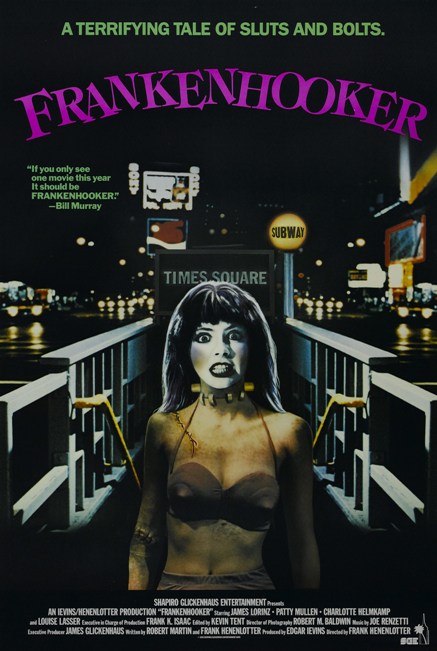
Frankenhooker

Pieces

The House of the Devil

Street Trash

City of the Living Dead

The New York Ripper

The House on Sorority Row

It's Alive

The Evil Dead

Happy Birthday to Me

Let the Right One In

Night of the Living Dead

Tales from the Crypt

The Living Dead at the Manchester Morgue

The Exorcist

and our only returning film...

Trick 'r Treat

Festivities will begin Thursday, October 28th, at 7 p.m. and will continue until Sunday, October 31st. Due to budgetary limitations, this year's Horror Fest will be a BYOB affair*, and snacks may be limited.

The location is contingent on where the Cap'n ends up moving in Greensboro, so stay tuned for details. I hope to see as many of you as possible for Horror Fest's return to G-Vegas!

* The upside is that there will be NO Wild Irish Rose, Tequiza, or Bud Light with Clamato on the premises.